PART 3 — WHEN THEIR PERFECT LIFE BEGAN TO FALL APART
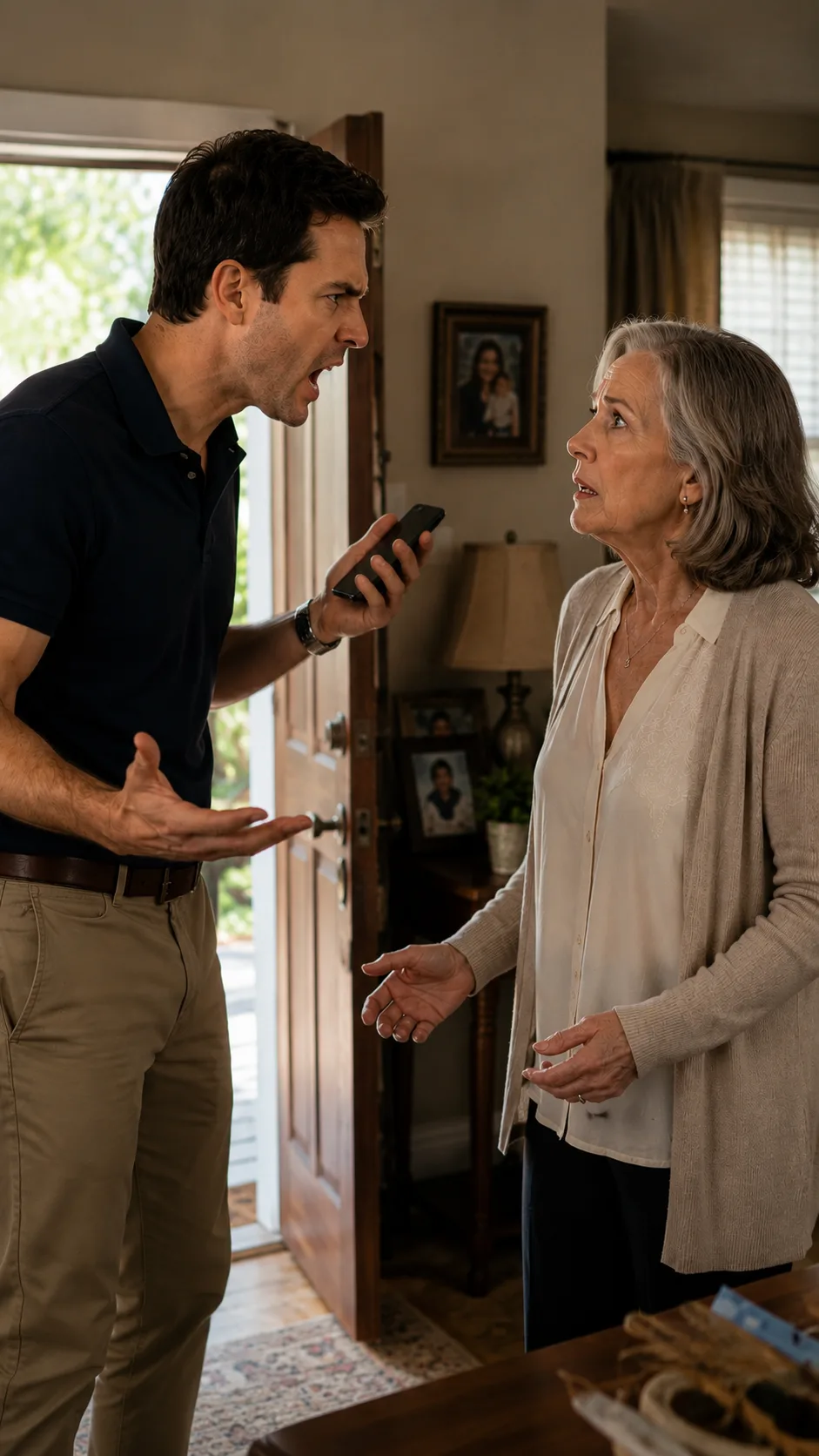
He stared at me like I was a stranger.
Chapter 3
He stared at me like I was a stranger.
“You’ve changed.”
“Maybe I’ve just stopped pretending I haven’t noticed how you’ve changed.”
He grabbed the folder, his hands shaking slightly, and walked to the door. He paused with his hand on the knob, turned back to look at me.
“What do you want me to say, Mom?”
“I don’t want you to say anything. I want you to think. Really think about who you’ve become and whether that’s someone your father would recognize.”
He left without another word. The door closed softly behind him and I stood in my quiet living room listening to his car start and pull away. My tea had gone cold. I picked up the mug anyway and took a sip.
It tasted like clarity.
My phone started buzzing before Evan’s car had even left the neighborhood. I glanced at the screen and saw Anita’s name flashing repeatedly, text after text, each notification overlapping the
last in a digital tantrum. I set the phone face-down on the kitchen counter and went to finish making my sandwich.
Turkey, lettuce, a thin slice of tomato from my garden. Simple. Satisfying. Real.
The buzzing continued. I took my plate to the table, poured a glass of water, and sat down to eat. Outside the window, a cardinal landed on my bird feeder, its red feathers brilliant against the green leaves. I watched it eat, unbothered by the chaos unfolding in my ignored messages.
When I finally picked up the phone an hour later, there were seventeen texts waiting.
“What have you done?”“Evan is devastated.”“You’ve ruined everything.”“This is beyond selfish.”“We trusted you.”“You’re destroying our family.”“How could you do this to your own son?”“We’ll never forgive you.”“Don’t expect to see Lily anymore.”“You’ve shown your true colors.”
I read through them all once, feeling nothing but a distant sort of sadness.
Not for myself. For the woman who’d written them, so desperate to maintain a façade that she’d attack the person funding it.
I didn’t respond. Not to a single message. Instead, I deleted the thread, blocked the number, and set my phone back down. The silence that followed felt like clean air after a storm.
Within days, I learned through my neighbor, Mrs. Chen, that the family gossip had started. Apparently, Anita had been calling relatives, painting a picture of me as vindictive and cruel. An old woman who’d lost her mind. A bitter mother jealous of her son’s success. Someone who couldn’t let go of control.
Mrs. Chen told me this while we shared tea on her porch one afternoon, her weathered face creased with concern.
“Linda, people are saying terrible things. Don’t you want to defend yourself?”
“No,” I said simply. “The people who matter know who I
am. The ones who believe gossip without asking questions aren’t people I need in my life anyway.”
She patted my hand, understanding in her eyes.
“You’re stronger than you look.”
“I’m exactly as strong as I’ve always been. I just finally decided to use that strength for myself instead of people who don’t value it.”
That evening, I did something I hadn’t done in years. I went to the cabinet where Robert’s record collection still lived, pulled out his favorite Frank Sinatra album, and placed it on the old turntable we’d bought at a yard sale thirty years ago. The needle crackled as it found the groove, and then Sinatra’s voice filled my living room, smooth and timeless.
“Come fly with me…”
I sat in Robert’s old armchair, the one I’d kept even though the fabric was worn, and closed my eyes, letting the music wash over me. For the first time since he died, I didn’t cry listening to these songs. I just felt present here, alive in my own life instead of haunting the edges of someone else’s.
I thought about the difference between revenge and freedom. Revenge would have been calling Evan’s business partners, exposing his financial instability, actively trying to damage his reputation. Revenge would have been malicious, calculated to cause maximum pain.
But what I’d done wasn’t revenge. It was simply withdrawal. I’d stopped participating in my own erasure, stopped funding my own exclusion, stopped accepting scraps of affection from people who’d forgotten how to genuinely love.
There’s a difference between hurting someone and refusing to be hurt anymore.
Over the following weeks, I reconnected with old friends I’d neglected while trying to maintain my place in Evan’s busy life. Margaret, whom I’d met in a painting class years ago. Susan, my former coworker from the grocery store. Dorothy from church, who’d invited me to her book club at least a dozen times while I’d made excuses about family obligations.
We met for lunch at a small café downtown. Nothing fancy no Italian marble or boutique fixtures just good food, honest conversation, and laughter that came from actual joy rather than performance.
“You look different,” Margaret said, studying my face over her coffee cup. “Lighter, somehow.”
“I feel lighter,” I admitted. “Like I’ve been carrying something heavy for so long, I forgot what it felt like to stand up straight.”
“What changed?” Susan asked.
I thought about how to answer that.
“I remembered that loving people doesn’t mean letting them treat you like you don’t matter. And that sometimes the kindest thing you can do for someone is let them face their own consequences.”
Dorothy raised her glass of iced tea.
“To boundaries,” she said, “and to friends who remind us we deserve them.”
We clinked glasses and I felt something open in my chest space for new relationships, room for genuine connection, permission to exist fully instead of apologetically.
That afternoon, I came home and spent hours in my garden. I pulled weeds, planted new herbs in clay pots, arranged river stones around the base of my rose bushes. My hands were dirty, my back was sore, and I felt more myself than I had in years.
As the sun began to set, painting the sky in shades of orange and pink, I stood in my small backyard and looked at what I’d created. Nothing impressive by Anita’s standards. No designer landscaping or expensive features. Just a patch of earth tended with care, growing things that mattered because I’d chosen them.
I went inside, washed my hands, and made myself dinner just for me. Exactly what I wanted, eaten at my own pace in my own home. The phone sat silent on the counter, and I’d never felt less alone.
Three weeks passed. I settled into a rhythm I hadn’t known I was missing. Morning walks before the heat set in. Afternoons at the library, where I’d started volunteering in the children’s section, reading stories to wide-eyed toddlers. Evenings on my porch with a book or sometimes just the sound of crickets and distant traffic.
Peace, I learned, wasn’t the absence of problems. It was the presence of boundaries.
Then my phone rang on a Tuesday evening. Evan’s name appeared on the screen. I considered not answering, but something in me maybe the part that was still his mother beneath everything else made me pick up.
“Hello, Evan.”
His voice came through strained, thinner than I’d ever heard it.
“Mom, we need to talk.”
“I’m listening.”
“The bank won’t refinance us.”
The words came out rushed, desperate.
“We spent two weeks gathering documents, proving income, everything they asked for. They turned us down. Said our debt-to-income ratio is too high. Something about too many credit accounts and not enough liquid assets. They sent us a letter. We have thirty days to either pay the full loan amount or vacate the property. Mom, we can’t pay $400,000. We don’t have it. We can’t even come close.”
“I’m sorry to hear that.”
“You’re sorry?” His voice rose. “That’s all you have to say? You’re the one who did this. You pulled out. You started this.”
“I removed my name from a loan you should have been able to carry independently. That’s not the same as doing this to you, Evan. What’s happening now is simply the reality of your financial situation without my support.”
“We were managing fine before you pulled this stunt.”
“Were you? Or were you just ‘managing’ because I was there to catch you every time you fell?”
A pause. I could hear his breathing on the other end harsh and uneven.
“Anita is furious,” he said finally. “She wants to sue you.”
“For what? Removing my name from my own financial obligation? She’s welcome to try, but I suspect a lawyer will tell her she has no case.”
“Mom, please.” The anger cracked, revealing something raw underneath. “We’re going to lose everything. The house, our credit, our reputation. Do you know what this will do to us professionally? Anita’s parents are already asking questions. Her friends from the club are gossiping. This is humiliating.”
“Humiliating?” I repeated softly. “Like being called embarrassing by your daughter-in-law. Like being told you’re ‘not their circle.’ Like paying for a vacation you’re not allowed to attend.”
“I apologized for that.”
“No, Evan. You explained it. You justified it. You never actually apologized.”
Another pause. Longer this time.
When he spoke again, his voice had shifted to something more calculated a tone I recognized from his business calls I’d overheard.
“What if we sold some things? The furniture, Anita’s jewelry. We could come up with maybe $30,000. If you co-signed again, just temporarily, we could get approved for a smaller loan. Keep the house. Start over.”
“No.”
“Mom, I’m begging you.”
“And I’m saying no. Not because I want to see you suffer, but because you need to understand that actions have consequences. You can’t spend money you don’t have, exclude the people who support you, and expect everything to work out just because it’s inconvenient for it not to.”
“So you’re really going to let your own son lose his home.”
It wasn’t a question. It was an accusation wrapped in disbelief.
“I’m going to let a grown man face the results of his choices. There’s a difference.”
I heard a sound in the background. Anita’s voice sharp and demanding.
“Is she helping? What did she say?”
Evan’s voice became muffled as he covered the phone, but I could still make out fragments.
“She said, ‘No. I don’t know what else to do. Maybe your parents…’”
Then he was back, clearer now.
“Anita’s parents might be able to help us. They’re looking into it.”
“That’s good,” I said genuinely. “Family should help family. Maybe they’ll teach you what reasonable support looks like the kind that comes with respect instead of resentment.”
“You’ve changed.”
The words came out bitter, accusatory.
“The mom I knew would never have done this.”
I looked out my kitchen window at the garden I’d been tending, at the life I’d been rebuilding one quiet day at a time.
“You’re right,” I said. “I have changed. Or maybe I’ve just finally remembered who I am underneath all the years of trying to be what everyone else needed.”
“And who is that?”
“Someone who knows her worth. Someone who understands that love without respect isn’t really love at all. Someone your father would be proud of, even if you’re not.”
“That’s not fair.”
“Fairness,” I said quietly, “would have been you treating me like I mattered. What you’re experiencing now isn’t unfairness, Evan. It’s equity. You get back what you put in, and you stopped putting anything into our relationship a long time ago.”
The silence stretched between us like a chasm neither of us knew how to cross.
“I have to go,” he said finally. “We have a meeting with a real estate agent tomorrow to discuss listing options.”
“I hope it goes well.”
“Do you really? Or are you happy about this?”
“I’m not happy you’re struggling, Evan, but I’m not unhappy that you’re learning. There’s a difference between those things, too, even if you can’t see it yet.”
He hung up without saying goodbye. I set the phone down and returned to the book I’d been reading before he called a novel about a woman who’d traveled across the country alone at seventy, discovering herself in ways she’d never imagined possible.
The story felt like a mirror.
Outside, the evening stretched long and warm. Somewhere down the street, children were laughing. A dog barked once, then settled. Normal life, continuing its rhythm, while individual worlds shifted and reformed.
I turned the page and kept reading.
Six weeks later, I was at the grocery store when I saw the listing.
I’d been comparing prices on coffee brands something I’d started doing more carefully now that I was rebuilding my own savings when a familiar voice called my name.
“Linda, I thought that was you. How have you been?”
Janet Morrison, a real estate agent who’d helped me sell Robert’s truck years ago, was standing near the dairy section with her phone in hand. We exchanged pleasantries, the kind of surface conversation that happens in grocery store aisles. But then her expression shifted, became more careful.
“Listen, I saw a listing come through today. Your son’s house in Coral Springs. I recognized the address from when you mentioned helping them buy it. Are they upgrading?”
The word “upgrading” hung in the air between us, heavy with assumptions that no longer applied.
“Something like that,” I said softly. “They’re making a change.”
She nodded, understanding more than I’d said.
“Well, it’s a beautiful property. I’m sure it’ll move quickly, even in this market.”
After we parted ways, I stood in the coffee aisle for a long moment, staring at the bags without really seeing them. Then I made a decision.
That evening, I drove to Coral Springs. I told myself I wasn’t checking on them, wasn’t gloating or seeking validation. I just needed to see it one more time the house that had represented so much of what I’d wanted for my son. Success. Stability. A life better than the one Robert and I had struggled to build.
The drive took forty minutes. I remembered the first time Evan had brought me to see it three years ago, his voice bright with pride as he’d pointed out features I didn’t understand the value of. Brazilian hardwood. Smart home technology. A kitchen larger than my entire first apartment.
Now, as I pulled up across the street, the house looked different. Not the structure itself, which remained as impressive as ever, but something about it felt diminished, like a stage set after the play has ended.
The “For Sale” sign stood prominently in the front yard, professional and impersonal. The lawn, usually manicured to country-club perfection, showed signs of neglect. Grass slightly too long. Flower beds with browning edges. The kind of details that emerge when people stop caring about appearances because reality has become too pressing.
The pool visible through the side gate sat dark and still. No string lights glowing. No water feature bubbling. Just flat black water reflecting the evening sky like an empty promise.
I sat in my car as the sun began its descent, watching the house that had cost my son his humility. A couple walked by with a stroller, glancing at the “For Sale” sign with the casual interest of people who might be neighbors soon. Life moving on, as it always does, indifferent to the personal earthquakes happening inside these walls.
A light came on in what I knew was the master bedroom. A shadow moved across the window. I wondered if it was Evan or Anita and what they were thinking in that moment. Were they packing, fighting, mourning what they’d built on a foundation they couldn’t actually support?
I felt sadness then. Not regret, but genuine sorrow for the lessons learned the hard way. For the family that could have been if pride hadn’t gotten in the way. For the grandchild inside who would have to leave the only home she’d known because her parents had confused wealth with worth.
But underneath the sadness was something steadier, a quiet certainty that I’d done the right thing, even though it was hard. Especially because it was hard.
Robert used to tell me that the most important lessons were the ones that cost something to learn.
“Easy wisdom doesn’t stick, Linda,” he’d say. “It’s the expensive kind that changes us.”
Evan was learning expensive wisdom now.
Another car pulled into the driveway. A woman stepped out carrying a clipboard and wearing a blazer despite the heat the real estate agent, probably there for measurements or photographs. Professional efficiency, preparing to sell off the remnants of a life built beyond its means.
I started my car but didn’t pull away immediately. Instead, I looked at the house one final time, trying to find words for what I was feeling.
This wasn’t victory. I’d won nothing except the right to protect my own dignity. This wasn’t satisfaction. There was no joy in watching my son lose something, even something he’d pursued for the wrong reasons.
This was simply the natural end of an unsustainable situation. Gravity asserting itself after years of artificial elevation.
Sometimes, I thought, letting go is the kindest thing you can do. Not because you stop caring, but because you care enough to allow someone to fall and then learn to stand on their own.
I’d caught Evan so many times over the years every stumble, every mistake, every consequence I’d cushioned or erased. I’d thought I was being a good mother. Supportive. Loving. Always there. But maybe the most loving thing I could have done was let him feel the weight of his choices sooner, before the falls became this catastrophic, before he built a life so precarious that one removed safety net could topple everything.
As I drove away, watching the house shrink in my rearview mirror, I whispered something into the quiet of my car.
“I’m sorry it had to be this way… but I’m not sorry I finally chose myself.”
The words felt true. Painful and true at the same time, the way honest things often are.
I drove home slowly, taking streets I didn’t usually take, passing houses with lit windows and the warm glow of lives being lived without pretense. Modest homes with toys in yards and practical cars in driveways. The kind of neighborhood I’d raised Evan in, where people measured success by different standards.
When I pulled into my own driveway, my small house looked exactly like what it was. Simple. Honest. Paid for with money that had been earned and saved, not borrowed and spent.
I went inside, turned on the porch light, and made myself chamomile tea. Tomorrow, Lily had a school program I’d been invited to. Dorothy wanted to show me a new bakery downtown. The library needed help organizing the summer reading program.
Life, full and purposeful, waiting for me to live it without apology, without permission. Just mine.
Two weeks after the house was listed, I was washing dishes after dinner when I heard a soft knock at my door. Not the aggressive rapping Evan had delivered weeks before, but something tentative, almost apologetic.
I dried my hands and walked to the entrance, wondering who would visit at 7:30 on a Thursday evening. When I opened the door, my breath caught.
Lily stood on my porch, her small backpack slung over one shoulder, her face streaked with dried tears. She was ten years old but looked younger in that moment, vulnerable in a way that made my chest ache.
“Grandma,” she whispered. “Can I stay here tonight?”
I pulled her inside immediately, wrapping my arms around her thin frame. She was trembling slightly, her fingers clutching the straps of her backpack like a lifeline.
“Of course, sweetheart. Always.”
I stroked her hair, feeling her lean into me with the kind of relief that comes from finally reaching safety after being scared.
“What happened?”
“Mom and Dad are fighting again.” Her voice was muffled against my shoulder. “They’ve been fighting all week, but tonight was really bad. Dad said I could come stay with you. He drove me over, but he didn’t come in. He was crying.”
My heart broke and hardened simultaneously. Crying. Evan was crying, but he’d sent his daughter away rather than shield her from whatever chaos was unfolding between him and Anita.
“Well, you’re here now, and that’s what matters.”
I pulled back gently to look at her face.
“Have you eaten dinner?”
She shook her head.
“I wasn’t hungry earlier.”
“How about some grilled cheese and tomato soup? That used to be your daddy’s favorite when he was your age.”
A small smile flickered across her face.
“Really?”
“Really. He’d eat three sandwiches if I let him.”
I led her to the kitchen, settling her at the table while I pulled out bread and cheese. She watched me work, her backpack still on her shoulders like she wasn’t sure if she was allowed to fully stay.
“You can put that down, honey. Take your shoes off. Get comfortable.”
She slipped the backpack off slowly and set it beside the chair but kept it close. The gesture told me more than words could about how unstable her world had become.
While the sandwich grilled and the soup heated, I sat across from her, taking her small hands in mine.
“Do you want to talk about it?”
She looked down at our joined hands.
“They’re selling the house. I know. Mom says it’s your fault.”
Her eyes lifted to mine, confused and searching.
“She says you’re being mean to them. That you took away their money.”
I took a slow breath, choosing my words carefully. This child didn’t need adult problems dumped on her shoulders. She needed truth, but truth given with gentleness.
“Sometimes, Lily, grown-ups make choices that don’t work out the way they hoped. Your parents wanted a very big, expensive house. I helped them get it, but they needed to be able to keep it on their own. When they couldn’t, the house had to be sold. That’s not mean. That’s just how things work.”
“But Mom said you ruined everything. That you canceled our cruise to punish us. Did you?”
“Did you know I wasn’t invited on that cruise?”
Her forehead wrinkled.
“What do you mean?”
“Your parents decided they wanted it to be just the three of you. ‘Family time’ without Grandma. Since I wasn’t going, it didn’t make sense for me to pay for it. Does that seem fair to you paying for something you’re not allowed to be part of?”
She thought about this, her young mind working through the logic.
“No. That doesn’t seem fair.”
“Life isn’t always about being ‘mean’ or ‘nice,’ sweetheart. Sometimes it’s about what’s fair and what isn’t. What’s right and what isn’t. Your mom and dad are upset because things are changing, and change is hard. But that doesn’t mean you did anything wrong. And it doesn’t mean I did either.”
“Are you mad at Daddy?”
The question cut deeper than she knew. I stood to flip the sandwich, using the moment to collect my thoughts.
“No, honey, I’m not mad. I’m sad that he forgot some important things your grandpa tried to teach him. But being sad and being mad are different. I still love your daddy. I just can’t help him the way I used to anymore.”
“Why not?”
I brought the sandwich and soup to the table, setting them in front of her.
“Because sometimes the best way to help someone is to let them figure things out themselves, even when it’s hard to watch.”
She picked up the sandwich, taking a small bite.
“Mom says we might have to move to an apartment. That apartments are for poor people.”
The casual cruelty of that statement, repeated by a child who didn’t know better, stung more than any of Anita’s angry texts.
“Apartments aren’t for poor people, Lily. They’re for people. Your grandpa and I lived in an apartment when your daddy was born. Some of the happiest years of my life happened in that little place. It’s not about how big your home is. It’s about who’s in it and how they treat each other.”
She nodded slowly, her eyes tired.
“I miss how things used to be. When everyone was happy.”
“I know, baby. I miss that, too.”
We sat together while she finished eating, the kitchen warm and quiet around us. When she was done, I ran her a bath with bubble soap that had been under the sink since her last visit months ago. I found an old nightgown of mine that swallowed her small frame, and we laughed as she shuffled around in it like a tiny ghost.
I tucked her into the guest room bed the same one I’d prepared when she was born, the same one that had held so many hopes about family and connection.
“Grandma,” she said sleepily, “am I safe here?”
“Always, my love. Always.”
“Can I stay tomorrow, too? I don’t have school on Friday.”
“You can stay as long as you need.”
She smiled, her eyes already closing.
Click the blue “PART 4” below to read the final part:
Chapter complete
You have reached the end of this chapter.
Continue reading
A few more worlds to get lost in after this chapter.




