PART 2 — I STOPPED FUNDING MY OWN EXCLUSION
The phone buzzed one more time.
Chapter 2
The phone buzzed one more time.
I didn’t look at it.
That night, sleep didn’t come. I lay in bed, staring at the ceiling, my mind pulling me back through the years like pages turning in reverse. I thought about Robert, my husband, gone ten years now but still so present in the walls of this house, in the lessons he’d taught our son, in the values we tried to pass down like heirlooms.
Robert had been a mechanic, not the kind who owned the shop, but the kind who arrived at six in the morning and left after dark, his fingernails permanently rimmed with grease no amount of scrubbing could remove. He’d smelled like motor oil and honest work, and I’d loved him for it.
We didn’t have much back then. Our first apartment had paper-thin walls and a refrigerator that hummed so loudly we couldn’t hear the television, but we had each other and
we had dreams for our baby boy.
Evan was born in that tiny apartment. I remember Robert holding him for the first time, tears streaming down his weathered face, whispering promises about the life our son would have.
“Better than ours. Easier. Fuller. He won’t have to break his back like I do,” Robert had said, kissing Evan’s tiny forehead. “We’ll make sure of that.”
And we did. Every overtime shift Robert picked up, every birthday present I went without, every vacation we skipped, it all went into a jar labeled Evan’s future. We saved for years. When he got accepted into college, we were ready. Not completely, but enough.
Robert worked double shifts that entire freshman year, his hands shaking from exhaustion at the dinner table. I took a second job at the grocery store, stocking shelves at night while my feet screamed for rest. Evan never knew the
full extent of it. We made sure of that. We wanted him to focus on his studies, to chase opportunities without the weight of guilt holding him back.
He graduated with honors, got a job at a tech startup. Within five years, that startup exploded into something worth millions. My son became successful. Truly successful. And I was so proud I could barely contain it.
But somewhere between his first promotion and his first luxury car, something shifted. Phone calls became shorter. Visits became rarer. The boy who used to sit at this very kitchen table eating my meatloaf and telling me about his dreams slowly transformed into someone who checked his watch during conversations and talked about things I didn’t understand. Quarterly projections. Market disruptions. Investment portfolios.
Then he met Anita.
She was beautiful in that polished, practiced way that some women master. Perfect hair that never moved in
the wind. Clothes that looked expensive even when they were casual. A smile that seemed designed for photographs rather than genuine moments.
When Evan first brought her home for Sunday dinner, she’d complimented my pot roast with a tone that somehow made it sound inadequate.
“This is so homey,” she’d said, pushing the carrots around her plate. “Evan, you never told me your mother was such a traditional cook.”
I’d smiled and thanked her, not quite sure if I’d been insulted or praised.
Anita came from money. Real money. The kind that built wings on hospitals and had streets named after grandparents. She’d grown up with housekeepers and private schools, summers in Europe and winters in Aspen. Everything Evan and I had worked toward, she’d simply been born into.
I tried not to judge. Love finds us in unexpected places, and Evan seemed genuinely smitten.
At their wedding, which cost more than our first house, I watched my son dance with his bride under lights that probably cost more than Robert’s entire annual salary. Anita’s family filled one side of the venue, dressed in designer labels and discussing their second homes. Our side was smaller, simpler cousins in their Sunday best, friends from the old neighborhood, people who knew the value of a dollar because they’d had to count every one.
Evan had changed his last name placement on the wedding program. “Matthew Evans” instead of “Evan Matthews.” Anita’s suggestion, he’d explained. It sounded more sophisticated for business cards.
After they married, the distance grew faster. They bought a house in Coral Springs, five bedrooms for three people, a pool that looked like something from a resort magazine, furniture that seemed too perfect to actually sit on. I visited once, and Anita gave me a tour that felt more like a real estate showing than a welcoming.
“The kitchen is Italian marble,” she’d said, running her hand along the counter. “Custom imported, and these fixtures are from a boutique in Milan. We really wanted something that reflected our lifestyle.”
I’d nodded and smiled and pretended I understood why anyone needed a chandelier in their bathroom.
Evan started missing Sunday dinners. Too busy, too tired, too many networking events. Anita needed him at functions where appearance mattered, where the right conversations could lead to the right connections. I understood, or at least I told myself I did.
But standing in their gleaming kitchen that day, watching my son check his phone while his wife discussed thread counts, I realized something painful. Success hadn’t just changed Evan’s circumstances. It had changed his heart.
The boy who used to help his father change oil in our driveway now had people who did everything for him. The young man who’d cried when Robert died now rarely mentioned his father at all. The son I’d raised to value character over appearance had married someone who seemed to value only what could be seen and measured.
I drove home that evening feeling something I’d never felt before. Not quite sadness, not quite disappointment just a hollow recognition that the family I’d built was becoming something I no longer recognized, and I had no idea how to fix it.
The morning after that sleepless night, I made myself tea and sat at my kitchen table with my laptop. The house was quiet, too quiet. The kind of silence that forces you to hear your own thoughts, whether you want to or not.
I opened my online banking portal, something I’d been avoiding for weeks. Numbers appeared on the screen in neat columns, each one representing a choice I’d made, a trust I’d extended, a boundary I’d failed to set.
The cruise charge stared back at me. $22,417 charged to my credit card six weeks ago. I remembered that day clearly. Evan had called, excited about a last-minute deal on an upgraded suite. The deadline was midnight. Could I just put it on my card? They’d pay me back next month once Anita’s bonus came through.
Next month had come and gone. So had the month after that.
I scrolled further. My emergency credit card the one I’d given them during what Evan called a “temporary cash flow issue” last year. The agreement was simple: emergencies only medical bills, car repairs, actual needs.
Instead, I found charges at luxury hotels, a spa in South Beach, online boutiques with names I couldn’t pronounce, a wine bar in Fort Lauderdale, dinner at a steakhouse that apparently charged sixty dollars for a cut of meat. Multiple charges. Weekly. Sometimes daily.
My hand trembled slightly as I added up the total.
Over the past year, they’d spent $43,000 on my emergency card. Forty-three thousand dollars that Robert had earned, dollar by sweating dollar, that I’d saved penny by careful penny.
I sat back in my chair, the tea growing cold in my cup. This wasn’t about helping family through hard times. This was about funding a lifestyle I could never afford for myself, while they treated my accounts like an unlimited allowance.
I thought about the times Anita had mentioned being “stretched thin” financially. How she’d sighed about wanting to redecorate their already perfect living room but needing to be “responsible.” All while my card was paying for her weekly spa treatments and designer handbag purchases.
My phone dinged an email notification. I almost ignored it, but something made me look. The sender was Anita. The subject line read: house options. It was addressed to someone named Veronica, probably one of her country club friends. But at the bottom of the email chain, I saw my name. She’d accidentally included me in a forward.
My finger hovered over the delete button. Some instinct told me I didn’t want to read this. But a stronger instinct, the one that had been whispering warnings for months, made me scroll down.
The email was dated three weeks ago, before the cruise cancellation, before that devastating text message. Anita’s words appeared in crisp black text.
“Once the house is in Evan’s name alone, we can stop depending on her. It’s embarrassing having your mother involved in everything. She’s sweet, but she’s not our circle. Let’s just get through this cruise and then we can create some distance. I’m thinking of telling Evan we should spend the holidays with my family from now on. His mother still uses paper napkins at dinner parties. Paper napkins. I can’t.”
I read it once, then again, then a third time, each word landing like a small stone in my chest.
Not our circle.Paper napkins.Create some distance.
I thought about every Sunday dinner I’d hosted, carefully setting the table with my good dishes, the ones I’d received as a wedding gift forty years ago. I thought about the paper napkins I’d used because they were practical and I’d been raised not to waste money on things that got thrown away. I thought about how Anita had smiled at those dinners, complimented my cooking, hugged me goodbye at the door all while finding me embarrassing.
My eyes burned, but no tears came. I was beyond crying. This was something else entirely. A clarity so sharp it almost felt like relief.
They weren’t just taking my money. They were taking my dignity, my place in my own family, my son. And they’d been planning it strategically, coldly.
I closed the laptop and stood up, walking to the window. Outside, my small garden was blooming. Tomatoes I’d planted in spring. Roses that had been there since Robert and I first bought this house. Everything growing in its own time, in its own way, without pretense or apology.
I’d built this life with my hands, with love, with sacrifice. And somewhere along the way, I’d let people convince me that it wasn’t enough, that I wasn’t enough. The woman who used paper napkins. The mother who was too old, too boring, too beneath their circle to join a cruise she’d funded.
I stood there for a long time watching the morning light move across my garden. A hummingbird visited the feeder I’d hung last week. A neighbor walked by with her dog, waving when she saw me in the window. Normal life continuing while mine rearranged itself into something new.
Something clicked inside me then. Not anger, not even hurt anymore. Just a simple, profound understanding.
I walked back to the table, opened my laptop again, and looked at those numbers. The cruise. The credit card charges. The mortgage I’d co-signed three years ago when they couldn’t qualify on their own income. My name on everything. My money behind everything. My presence erased from everything.
I thought about Robert, about the values he’d died believing in family first. But he’d also taught me something else. Something I’d forgotten in my desperate attempt to stay connected to a son who’d already let me go.
“Respect yourself, Linda. If you don’t, nobody else will.”
I opened a new browser tab and typed in the cruise company’s customer service number. Then I whispered to myself, so quietly the words were barely sound.
“Enough.”
It was the smallest word I’d spoken in days, but it was the most honest.
I made fresh tea strong black tea, the way Robert used to drink it in the mornings before work. Something about the ritual of boiling water, steeping the leaves, pouring it into my favorite mug, steadied my hands.
The cruise company’s phone number was already pulled up on my screen. I dialed, took a sip of tea, and waited.
“Thank you for calling Paradise Cruise Lines. This is Jennifer speaking. How may I help you today?”
Her voice was cheerful, trained to handle vacation excitement and booking questions. I wondered briefly if she’d ever fielded a call like the one she was about to receive.
“Good morning, Jennifer. My name is Linda Matthews. I have a reservation for three passengers departing on the 18th of next month. Confirmation number is P7743521. I need to cancel all three tickets, please.”
There was a pause. I could hear typing in the background.
“I see your reservation here, Mrs. Matthews. Just to confirm, you want to cancel all three passengers. That includes yourself and two family members listed as Evan Matthews and Anita Matthews?”
“That’s correct. All three.”
More typing. Then a careful, professional tone.
“May I ask if there’s been an emergency? If it’s a medical issue, we might be able to offer a reschedule option instead of full cancellation.”
“No emergency,” I said calmly. “Just a change of plans.”
“I understand. I do need to inform you that there will be a cancellation fee. Because we’re within sixty days of departure, the fee will be approximately thirty percent of the total booking cost. That comes to about $6,700. The remaining balance will be refunded to your card within seven to ten business days.”
$6,700 gone. Just like that.
A month ago, that amount would have made me hesitate, would have made me call Evan first, try to work it out, find a compromise. But that was before I’d read Anita’s email, before I’d understood exactly how my family saw me.
“That’s acceptable,” I said. “Please proceed with the cancellation.”
“All right, Mrs. Matthews, I’m processing that now. You should receive a confirmation email within the hour. Is there anything else I can help you with today?”
“No, thank you. You’ve been very helpful.”
I hung up and took another sip of tea. My hand was steady. My breathing was even. I felt strangely lighter than I had in months.
The confirmation email arrived forty minutes later. Three tickets canceled. Refund pending. Future cruise credit available.
If I changed my mind.
I wouldn’t be changing my mind.
Next, I scrolled through my contacts until I found the number for my bank the mortgage department, specifically. This call would be more complicated, but I’d done my research the night before during those sleepless hours. I knew exactly what I needed to say.
“First National Bank Mortgage Services. This is David speaking.”
“Hello, David. My name is Linda Matthews. I’m a co-signer on a mortgage, account number 4782933. I need to request removal of my name from that loan.”
“Certainly, Mrs. Matthews. Let me pull up that account.”
A pause.
“I see you co-signed this mortgage three years ago for a property in Coral Springs. Current balance is approximately $420,000. Can I ask the reason for the removal request?”
“The primary borrowers are financially stable and no longer need my assistance.”
It was a lie, but a technical one. They should have been stable. Evan made good money. Anita worked part-time as a consultant. Together, their income looked impressive on paper. The problem was their spending habits, their belief that image mattered more than substance.
But that wasn’t my problem anymore.
“I see,” David said. “In order to remove a co-signer, the primary borrowers will need to refinance the loan independently. They’ll need to qualify based on their own income and credit. I can start that process. But I should mention that if they don’t qualify for refinancing, the bank may require the loan to be paid in full or call the note due within thirty days.”
“I understand completely.”
“All right, then. I’ll send the formal request through our system today. The primary borrowers will receive notification by mail within seventy-two hours. They’ll have thirty days to either refinance or make alternative arrangements.”
“Thank you, David.”
I hung up and set the phone down gently on the table. Outside my window, the world continued turning. A delivery truck rumbled past. Someone’s wind chimes sang in the breeze. Life moving forward in its ordinary way while I dismantled the financial scaffolding I’d built around my son’s life.
I wasn’t doing this out of spite. That’s what I kept telling myself. This wasn’t revenge in the traditional sense. I wasn’t trying to hurt them or teach them a lesson or make them suffer. I was simply stepping back, removing myself from places I was no longer welcome. Taking my name off things that had my signature but not my respect.
For years, I’d believed that love meant giving everything, sacrificing endlessly, being available always, never setting boundaries because boundaries felt like walls and walls felt like rejection. But maybe real love meant something different. Maybe it meant teaching people that actions have weight, that relationships require reciprocity, that you can’t build a family on the bones of someone who’s constantly being asked to disappear.
I finished my tea and rinsed the mug in the sink. Through the window above the basin, I could see my garden again. The tomatoes needed watering. The roses could use some deadheading. Simple tasks with visible results.
I decided to spend the afternoon outside. My hands in the soil, the sun on my face, doing work that mattered in ways I could see and measure. For the first time in longer than I could remember, I felt something close to peace. Not happiness exactly, not satisfaction just a quiet sense of alignment between who I was and what I was doing.
I wasn’t angry. I wasn’t sad. I was simply finally done.
And that felt like freedom.
Three days passed in surprising tranquility. I watered my garden, read a novel I’d been putting off for months, even called an old friend from my book club and made plans for lunch. The cancellation emails sat in my inbox like closed chapters, and I didn’t reread them. There was no need.
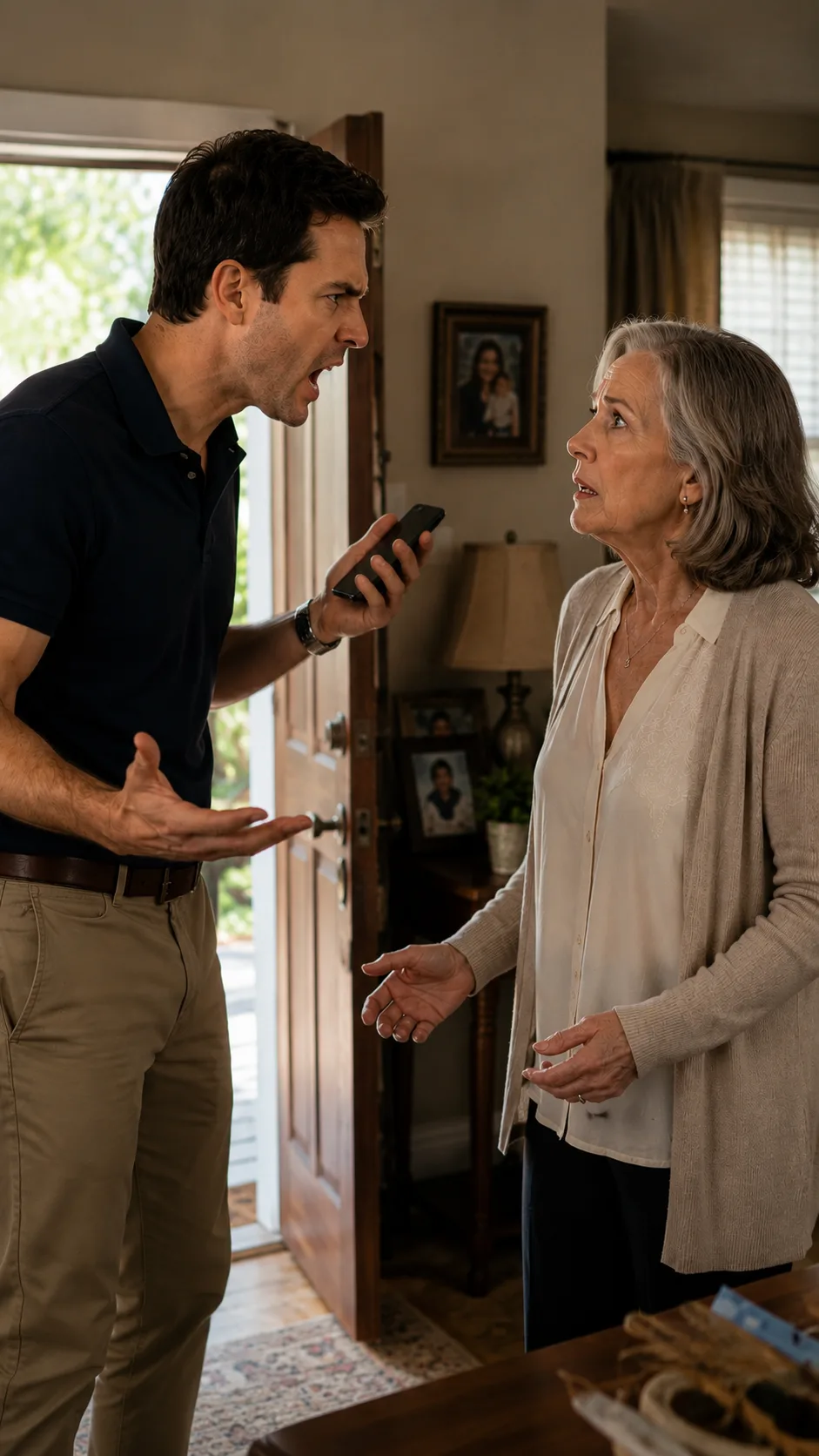
Then, on Thursday afternoon, I heard a car pull into my driveway with more speed than necessary. The engine cut off abruptly. A door slammed.
I was in the kitchen making a sandwich when the doorbell rang. Not a polite single press, but three rapid bursts that sounded like panic translated into sound. I wiped my hands on a dish towel, walked slowly to the door, and opened it.
Evan stood on my porch in his work clothes a pressed polo shirt and khakis that probably cost more than my entire week’s grocery budget. His face was flushed, his hair disheveled in a way that suggested he’d been running his hands through it repeatedly. His expensive watch caught the afternoon light as he held up his phone like evidence at a trial.
“Mom,” he said, his voice tight. “Did you cancel the cruise?”
“Hello, Evan. Would you like to come in?”
“Did you cancel it?”
I stepped aside, gesturing toward the living room.
“Let’s talk inside.”
He walked past me, his movements agitated, pacing near the couch rather than sitting. I closed the door gently and made my way to the kitchen.
“Would you like some tea?” I called over my shoulder.
“Mom, I don’t want tea. I want to know what’s going on. I got an email from Paradise Cruise Line saying our entire reservation was canceled. All three tickets. They refunded your card, but the prices have doubled now. The same cabin we booked is fourteen thousand more. What happened?”
I poured water into the kettle anyway and set it on the stove. Then I walked back to the living room, sat in my favorite armchair, and folded my hands in my lap.
“Yes,” I said simply. “I canceled the reservation.”
His mouth opened, closed, then opened again.
“Why would you do that? We’ve been planning this for months. Lily is so excited. I already took the time off work. Anita’s been shopping for weeks.”
“You sent me a text message,” I said calmly, “explaining that the cruise would be just for the three of you. ‘Quality family time,’ I believe you called it. Since I wasn’t included in that family time, it seemed logical to remove my financial contribution as well.”
He ran his hand through his hair again, a gesture I recognized from his childhood when he’d gotten caught doing something wrong and was searching for an explanation.
“Mom, that’s not what Anita meant. She just thought it might be easier. You know, you get tired on long trips. You don’t really enjoy the same things we do. She was trying to make it less stressful for everyone.”
I let the silence sit between us for a moment. The kettle began to whistle in the kitchen.
“I walk two miles every morning, Evan. I volunteer at the library twice a week. Last month, I helped Mrs. Chen next door move furniture. I’m not tired. I’m sixty-eight years old and in better health than some people half my age. Your wife isn’t confusing ‘tired’ with ‘old.’ She’s confusing ‘unwanted’ with ‘inconvenient.’”
His face reddened deeper.
“That’s not fair.”
“Isn’t it?”
I stood and walked to the kitchen, pouring hot water over a tea bag in my favorite mug.
“You’re welcome to one if you change your mind,” I called out.
“I don’t want tea.”
His voice rose, cracking slightly.
“I want to understand why you’re sabotaging our vacation. I’ve got an email saying everything’s canceled. The prices have gone up. We can’t afford to rebook at that rate, Mom. What are you doing?”
I walked back slowly, steam rising from my mug, and sat down again.
“I paid $22,000 for that cruise, Evan. Every penny came from my account. The suite you wanted. The excursions Anita insisted on. The dining packages. All of it. And then you told me I couldn’t come, so I removed my investment from an event I wasn’t invited to attend. That’s not sabotage. That’s common sense.”
“We were going to pay you back.”
“Were you?”
I took a sip of tea, watching him over the rim of my mug.
“The same way you’ve been paying back the $43,000 you’ve charged to my emergency card this past year?”
His expression shifted. Surprise, then defensiveness.
“That was for emergencies.”
“Was the wine bar in Fort Lauderdale an emergency? The spa treatments? The luxury hotels? I looked at the statements, Evan. Every charge. I know exactly what my money funded while you told me you were going through a ‘rough financial patch.’”
“We needed those things. Networking. Client dinners. Maintaining appearances for business. You don’t understand how my world works.”
“You’re right,” I said quietly. “I don’t understand a world where you lie to your mother about why you need money, spend it on luxuries, and then exclude her from something she paid for because she doesn’t fit your image.”
He stopped pacing and stood very still.
“This is about more than the cruise, isn’t it?”
“Yes.”
“Then what is it about?”
I set my mug down on the side table carefully.
“It’s about respect, Evan. It’s about recognizing that I’m not an ATM or a backup plan or someone you tolerate until you can afford to cut me out. It’s about the fact that I raised you better than this, and somewhere along the way, you forgot.”
“I haven’t forgotten anything.”
“Then why did Anita email her friend saying I’m not your circle? That having me involved in things is embarrassing. That you’re planning to create distance after this cruise.”
His face went pale.
“You read that?”
“She accidentally included me in the forward. I suppose she was too busy discussing my paper napkins to double-check the recipient list.”
He sat down then, heavily, on the couch. Put his head in his hands.
“Mom, I didn’t know she wrote that.”
“But you agreed with it, didn’t you? When she suggested I stay home. When she said I’d be tired or bored or whatever excuse she used. You agreed, because part of you believes it, too. That I don’t belong in your life anymore.”
“That’s not true.”
I reached beside my chair and picked up a manila folder I’d prepared that morning, slid it across the coffee table toward him.
“What’s this?” he asked.
“A notice from the bank about the mortgage I co-signed three years ago.”
He opened it slowly. His eyes scanned the page, then widened.
“You’re removing yourself as co-signer?”
“I am.”
“Mom, we can’t refinance. We already tried last year. We don’t qualify on our own income.”
“Then you’ll need to make some difficult decisions.”
He stood up abruptly.
“You’re going to let us lose the house?”
“I’m going to let you face the consequences of building a life you can’t actually afford. This is not revenge, Evan. This is consequence.”
His voice shook with something between anger and fear.
“This is revenge. That’s what it is.”
I stood too, meeting his eyes directly.
“No. Revenge would be wanting you to suffer. Consequence is simply stepping back and allowing your choices to teach you what I apparently couldn’t. I’m not your safety net anymore. I’m not your backup funding. I’m not the embarrassing mother you tolerate for holiday cards. I’m just a woman who finally remembered she deserves better.”
Click the blue “PART 3” below to read the next part:
Chapter complete
You have reached the end of this chapter.
Continue reading
A few more worlds to get lost in after this chapter.




