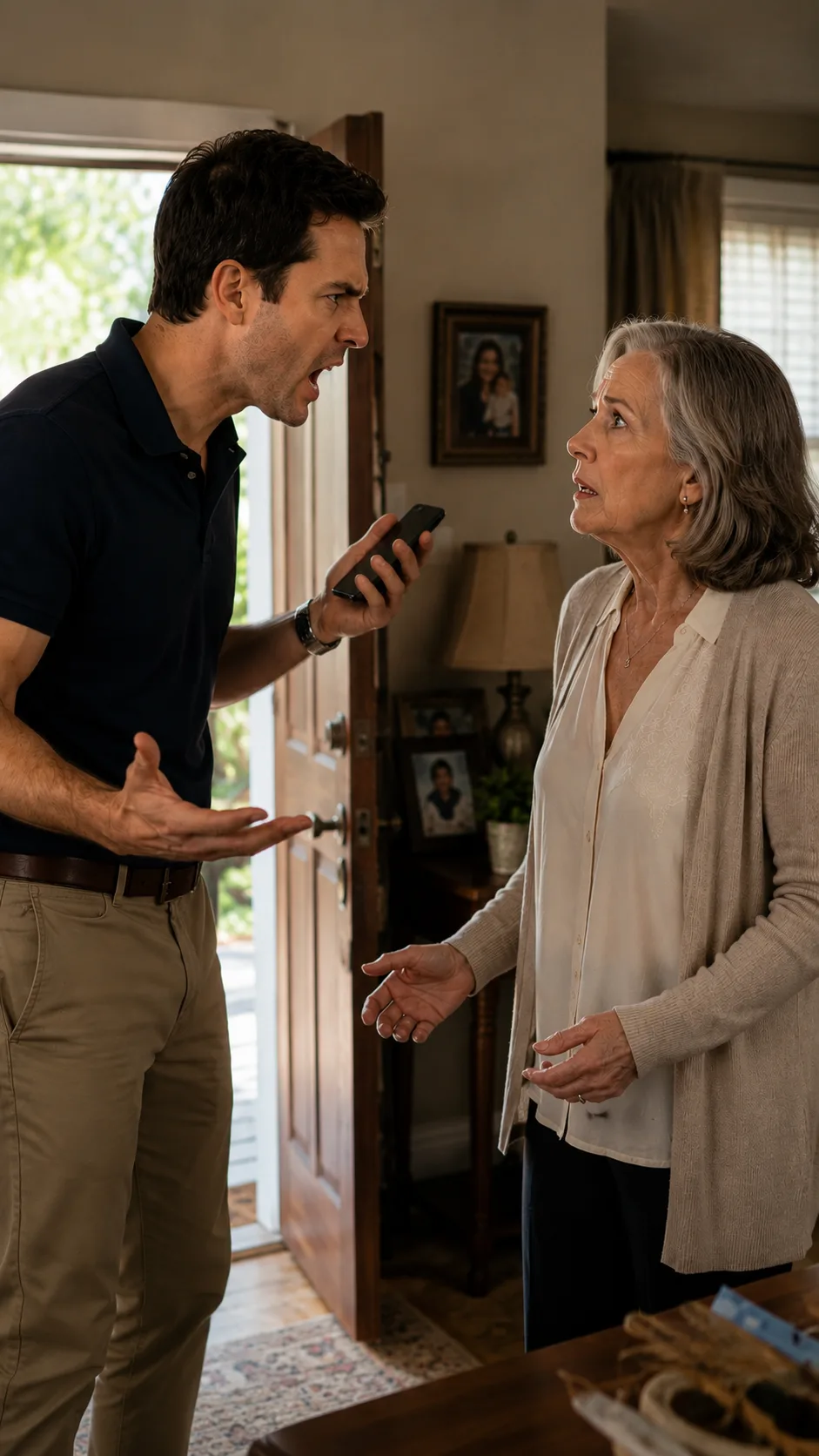
PART 4 — WHAT WAS LEFT AFTER EVERYTHING COLLAPSED
“Will you make pancakes in the morning?”
“How about we make muffins instead?
Chapter 4
“Will you make pancakes in the morning?”
“How about we make muffins instead?
You can help me mix them.”
“Okay,” she murmured. “Blueberry ones.”
“Whatever kind you want.”
She was asleep within minutes, her breathing deep and steady. I stood in the doorway watching her, this innocent caught in the middle of adult failures, and felt something fierce and protective surge through me.
Whatever happened between Evan and Anita, whatever consequences they faced, I would make sure Lily knew she had a safe harbor a place where she mattered more than appearances, where love didn’t come with conditions or price tags.
I closed her door softly and went to prepare the guest bathroom with fresh towels, an extra toothbrush, anything she might need.
The next morning, we stood side by side at the kitchen counter, flour dusting our hands and the air filled with the smell of baking blueberry muffins. She wore one of my old aprons tied twice around her waist, concentration
on her face as she carefully cracked eggs into the bowl.
“Not too hard,” I coached. “Gentle, like you’re being kind to them.”
She giggled when a piece of shell fell in, and I showed her how to fish it out with a spoon. We mixed and measured, getting more flour on ourselves than in the bowl, laughing when we realized we’d forgotten to preheat the oven.
For those hours, the world outside my kitchen didn’t exist. No failing marriages or foreclosed houses or families breaking apart. Just a grandmother and granddaughter making something sweet together, building a memory that would last longer than any mansion ever could.
When the muffins came out golden and perfect, we sat at the table and ate them warm, butter melting into the centers.
“These are the best muffins ever,” Lily declared, her earlier sadness replaced with simple joy.
“They are pretty good, aren’t
they?”
She looked at me with those wise young eyes.
“I’m glad Daddy let me come here.”
“Me too, sweetheart. Me too.”
Outside, life continued its complicated course. But in my small kitchen, with flour still dusting the counters and the sweet smell of baking lingering, everything felt exactly right.
Lily stayed that weekend, then the next. By the third weekend, it stopped feeling like visiting and started feeling like something more permanent, more necessary. Evan would drop her off Friday evenings with a duffel bag and a strained smile, picking her up Sunday afternoons with eyes that looked progressively more hollow.
We didn’t talk much during these exchanges. He’d ask if she’d been good. I’d assure him she had been. And he’d leave with a quiet “thank you” that sounded more like surrender than gratitude.
The house in Coral Springs sold faster than expected. I heard through Janet Morrison
that it went to a young family cash buyers who’d closed within three weeks. Evan and Anita moved into a rental apartment across town. Two bedrooms instead of five. Shared laundry instead of a private room. A parking lot instead of a pool.
I wondered how Anita was handling the downgrade, but I didn’t ask. Some questions have answers you already know.
By October, the cracks that had been forming became breaks. Evan called one evening while Lily was doing homework at my kitchen table.
“Mom. Anita left.”
His voice was flat, emotionless in the way people sound when they’ve cried so much there’s nothing left.
“She went to stay with her parents in Tampa. Says she needs space to figure things out.”
“I’m sorry, Evan.”
“She took most of the furniture. The apartment looks empty now, like nobody lives here.”
I wanted to say, That’s what happens when you build a life on appearances. That when the pretty things are gone, you’re left with whatever foundation you actually laid. But he sounded so broken that I just listened instead.
“Can Lily stay with you for a while?” he asked. “I’m working longer hours trying to cover the bills, and I don’t want her here alone all the time. The apartment complex isn’t… it’s not the neighborhood we had before.”
“Of course, she can stay. I’ll bring more of her things tomorrow. Her school supplies, some clothes.”
“Evan, take your time. Figure out what you need to figure out. She’s safe here.”
There was a long pause.
“Thank you, Mom. For this. For her.”
“She’s my granddaughter. This is what family does.”
“Is it?” The question came out bitter. “Because I’m not sure I’d know anymore.”
I wanted to argue, to defend, to point out all the ways he’d forgotten what family meant. But the brokenness in his voice stopped me. He was already drowning. I didn’t need to push his head underwater.
Lily moved into the guest room properly after that. We established routines: breakfast together before school, homework at the kitchen table while I prepared dinner, evening walks around the neighborhood, weekend projects, baking experiments, small adventures to the library or the park.
She never complained about the change, but sometimes I’d catch her staring out the window with a faraway look, and I knew she was thinking about the house with the pool, about when her parents were still together, about a version of normal that no longer existed.
“Are Mom and Dad getting divorced?” she asked one night while we washed dishes together.
I’d been expecting the question but hadn’t prepared an answer that felt honest without being hurtful.
“I think they might be, honey. Sometimes people realize they want different things, and staying together makes everyone unhappy.”
“Is it because of the house?”
“The house was part of it. But it was really about bigger things. About what matters and what doesn’t. About treating people with respect.”
She handed me a plate to dry.
“Mom used to be nicer before the big house.”
“Success changes people sometimes. Not always for the better.”
“Will Dad change back?”
I looked at her serious face this child trying to make sense of adult failures.
“I hope so, sweetheart. I really do.”
The divorce papers came in November. Anita filed in Tampa, citing irreconcilable differences. She wanted primary custody of Lily but agreed to generous visitation. When the court-appointed mediator asked about Lily’s current living situation, Evan mentioned that she’d been staying with me on weekends for months, that the arrangement had provided stability during a turbulent time.
The mediator noted this, suggested it might be in Lily’s best interest to maintain that stability.
By December, the custody arrangement was formalized. Lily would live primarily with Evan but spend every weekend and school break with me, a guardian arrangement that gave her roots while her parents figured out how to build separate lives.
Evan started visiting on Sunday evenings when he picked Lily up. At first, he’d stay only minutes, uncomfortable in the house he’d grown up in, surrounded by reminders of simpler times. But gradually, the visits stretched longer.
One Sunday in January, he sat at my kitchen table while Lily gathered her things upstairs. I made tea without asking if he wanted any, setting a cup in front of him the way I had when he was young and troubled by something at school.
He wrapped his hands around the mug.
“My company’s been struggling. We lost a major client in December. I might get laid off.”
“What will you do if that happens?”
“Look for something else, I guess. Maybe something that pays less but has better stability. I can’t afford another failure, Mom. Not with child support and rent and everything else.”
“Failure isn’t the worst thing that can happen, Evan. Refusing to learn from it is.”
He looked up at me then. Really looked like he was seeing me for the first time in years.
“You knew this would happen, didn’t you? When you pulled your name off the mortgage. When you canceled the cruise. You knew it would all fall apart.”
“I knew it couldn’t continue the way it was going. Whether it fell apart or transformed into something better was up to you.”
“And which do you think happened?”
I studied my son. This man who’d lost so much in pursuit of more. His expensive watch was gone sold months ago. His designer clothes replaced with sensible basics. The arrogance that had hardened his features had softened into something that looked almost like humility.
“I think you’re learning,” I said quietly. “And that’s a beginning.”
He nodded slowly, blinking back tears.
“I’m sorry, Mom. For all of it. For how I treated you. For forgetting what you and Dad taught me. For choosing Anita’s version of success over the values you raised me with.”
“I know you are.”
“Do you forgive me?”
I reached across the table, covering his hand with mine.
“I’ve already forgiven you, Evan. The question is whether you’ve forgiven yourself.”
Lily came downstairs then, backpack ready, and we ended the conversation. But something had shifted between us. Not healed completely, but acknowledged a first step toward repair.
As I watched them drive away Evan’s modest sedan, a far cry from the luxury car he’d once driven I realized something important. My purpose in all of this had never been punishment. It had been guidance. Teaching through withdrawal what years of enabling had failed to teach through presence.
Love sometimes means letting people fall and then being there when they’re ready to stand.
Spring arrived quietly, the way it does in this part of the country. One day the trees were bare and the next they were budding with new life. I’d been tending my garden when Evan’s car pulled into the driveway on a Wednesday afternoon. Unexpected and unannounced. He wasn’t scheduled to pick up Lily. She was at school, wouldn’t be home for another two hours.
I stood from where I’d been kneeling beside the tomato plants, brushing dirt from my gardening gloves. Evan got out of the car slowly, and I noticed immediately that something was different about him. Not just his clothes, which had grown progressively simpler over the months, but his entire bearing. The tension that had lived in his shoulders for years seemed diminished. He looked tired, but it was an honest tired rather than the exhausted fakery of someone maintaining an unsustainable pace.
“Mom,” he said as he approached. “Do you have time to talk?”
“Always.” I gestured toward the porch. “Let me wash my hands.”
We settled into the chairs I’d arranged there last summer two rockers that faced the street and the world beyond. I’d spent many evenings in these chairs, watching neighbors pass by, thinking about everything that had changed.
For a long moment, Evan just sat quietly, his hands clasped between his knees, staring at something I couldn’t see.
“I got a new job,” he finally said. “It’s not glamorous. Project manager for a small manufacturing company. The pay is half what I was making before, but it’s steady. Good benefits. Reasonable hours.”
“That sounds promising.”
“It’s in the industrial park off Route 27. You know… near where Dad used to work.”
The significance wasn’t lost on either of us. Full circle in a way neither of us could have predicted.
“I’ve been thinking a lot about him lately,” Evan continued. “About the things he used to say that I didn’t really listen to. I thought I understood them, but I was just hearing words. I wasn’t actually learning.”
“What made you start listening?”
He leaned back in the rocker, the wood creaking gently.
“Losing everything, I guess. When Anita left. When I couldn’t keep up the apartment rent. When I realized I’d have to move into something even smaller, I hit this moment where I was sitting on the floor of an empty living room, and I couldn’t remember the last time I’d actually been happy. Not performing happiness. Not buying happiness. Just feeling it.”
A breeze moved through the trees, carrying the scent of jasmine from Mrs. Chen’s yard.
“And I realized Dad was happy,” Evan said softly. “He came home every night smelling like motor oil. His back aching. His hands rough. But he was happy. He’d sit at the dinner table and talk about his day like it mattered, like changing someone’s oil or fixing their brakes was contributing something real to the world. I used to think that was small, that he’d settled for less than he deserved. And now… now I think maybe he understood something I didn’t. That meaning doesn’t come from how much you earn or how impressive your house is. It comes from knowing what you do matters. Even if it’s simple. Especially if it’s simple.”
I watched my son, this man who had traveled so far away from himself only to find his way back through loss.
“Your father believed the richest people were the ones with family to come home to,” I said quietly. “Do you remember him saying that?”
“I do now. I didn’t for a long time, but I do now.”
He turned to look at me directly.
“Mom, I need to apologize. Really apologize, not the half explanations I gave before. I need you to know I understand what I did.”
“I’m listening.”
“I let success make me arrogant. I started measuring my worth by what I owned instead of who I was. And worse, I let Anita convince me that you were somehow less than us because you didn’t live that lifestyle. I excluded you. I used you. I treated your love like it was an unlimited resource that would always be there no matter how badly I behaved.”
His voice cracked slightly.
“When you canceled that cruise, when you removed your name from the mortgage, I was furious. I thought you were being vindictive. But you were just protecting yourself from people who’d forgotten how to value you. And I was one of those people. The worst one, actually, because I should have known better.”
“Evan ”
“Please let me finish.”
He took a shaky breath.
“I thought money meant respect. I thought giving Anita everything would make her happy, make our marriage work, make me into someone important. But all it did was make me forget who I was. It made me forget that the boy who grew up in this house, who helped Dad change oil in the driveway, who ate your meatloaf every Sunday that boy had everything that mattered. And I traded him for a version of myself I didn’t even like.”
Tears were running down his face now, unchecked and unashamed.
“I can’t undo what I did. I can’t give you back the money or the time or the hurt. But I want you to know I see it now. I see how much you sacrificed, how much you gave, how little I appreciated. And I’m sorry. I’m so deeply sorry.”
I reached over and took his hand the way I had when he was small and scared of thunder.
“Thank you for saying that. For meaning it.”
“Can you forgive me?”
“I already have, honey. But forgiveness doesn’t erase consequences. It just means we can build something new on top of what was broken.”
He nodded, wiping his eyes with his free hand.
“I want to build that. I want Lily to grow up knowing what real family looks like. Not the performance version I was creating, but the genuine kind. The kind you and Dad showed me. Even though I forgot to pay attention.”
We sat together as the afternoon deepened, holding hands the way we hadn’t in years. Across the street, children played in a yard. A postal truck made its rounds. Life continuing its patient rhythm.
“Do you know what I think would make your father proud?” I asked softly.
“What?”
“Not that you’re working near where he worked though that’s meaningful. But that you’re finally honest about who you are and what matters. That’s what he wanted most. Authenticity, not achievement.”
Evan smiled. Sad, but genuine.
“I’m getting there. It’s humbling, starting over at my age. But it feels real in a way nothing has for years.”
“Real is good. Real lasts.”
“Do I get to come back?” His question was vulnerable, childlike. “Not to where we were before, because I don’t think we can go back. But to something. To being your son in a way that matters.”
I squeezed his hand.
“You never stopped being my son, Evan. You just forgot how to be part of a family. And families forgive. Families rebuild. Families give second chances to people who’ve genuinely changed.”
“I’m trying to change. Every day.”
“I know you are. And that’s enough.”
We rocked slowly in the spring air. Two people finding their way back to each other through honesty and time. It wasn’t perfect. It wasn’t fully healed. But it was a beginning.
And sometimes a beginning is all you need.
A year had passed since I’d canceled that Caribbean cruise. Twelve months of rebuilding, healing, and discovering that life could expand even as certain relationships contracted. The seasons had turned full cycle, and I’d turned with them stronger and clearer about who I was beneath all the years of accommodating others.
Lily was eleven now. Taller by three inches, wiser by immeasurable degrees. She’d adjusted to her new reality with the resilience children possess when the adults around them provide steady ground. She split her time between Evan’s modest apartment and my small house, thriving in both places now that the tension and pretense had dissolved.
Evan had kept his job at the manufacturing company. He’d been promoted to senior project manager a title that meant responsibility rather than prestige, substance rather than status. He dated occasionally, but nothing serious. Most importantly, he showed up for Lily’s school events, for Sunday dinners that had resumed, simpler and more genuine than before, for conversations that went beyond surface pleasantries into real connection.
We were rebuilding. Slowly. Honestly.
And then one evening in late spring, Lily and I were making dinner together when she said something that stopped me mid-stir.
“Grandma, do you think we could go on a trip together? Just us?”
I looked at her this child who’d weathered so much change with such grace.
“What kind of trip were you thinking?”
“Maybe somewhere with water. I’ve never seen the ocean. Not really. I mean, I’ve seen pictures, but not the actual ocean.”
Something shifted in my chest. A memory of that canceled cruise. Of turquoise water I’d dreamed about but never seen. Of a trip that had represented exclusion and hurt. Maybe it was time to reclaim that dream not the expensive, performative version Anita had planned, but something real. Something just for us.
“I think that’s a wonderful idea,” I said. “Let me look into it.”
I spent the next week researching options. Not luxury cruise lines with suites and exclusive dining packages, but something modest and meaningful. I found a four-day cruise departing from Port Canaveral. An older ship, smaller than the modern behemoths, with straightforward amenities and reasonable prices. The interior cabin cost a fraction of what I’d spent on that canceled reservation. No balcony. No special packages. Just passage across water, simple meals, and time together.
I booked it for July, during Lily’s summer break. When I told her, she threw her arms around me with such joy that I knew I’d made the right choice. We spent weeks planning what to pack, what to do, building anticipation in the way that matters most through shared excitement rather than expensive preparations.
Evan drove us to the port on a bright Thursday morning. He hugged Lily tight before she boarded, then turned to me.
“Thank you, Mom. For everything you do for her. For me.”
“We’re family,” I said simply. “This is what family does. Have fun, both of you. Take pictures.”
“We will.”
As Lily and I walked up the gangway, I glanced back once. Evan stood by his car, waving, a genuine smile on his face. Not the practiced expression he’d worn during his years of performance, but something real something Robert would have recognized.
Our cabin was small but clean. Two beds and a tiny bathroom that made us laugh at how compact everything was. Lily loved it immediately, claiming it felt like a cozy fort. We unpacked together, hanging our simple dresses and setting our toiletries on the narrow shelf.
That first evening, we stood on the open deck as the ship pulled away from port. The sun was setting, painting the sky in shades of coral and gold. Lily gripped the railing, her eyes wide as the land grew smaller and the ocean expanded around us.
“It’s so big,” she whispered. “I didn’t know it would be this big.”
“Pretty amazing, isn’t it?”
“Grandma, are you happy?”
The question caught me off guard. I looked down at her upturned face, so earnest and open.
“Yes, sweetheart. I really am.”
“Even with everything that happened? With Mom and Dad and the house?”
I thought about how to answer truthfully without burdening her with adult complexity.
“Sometimes the hardest things teach us the most important lessons. I learned that I’m stronger than I thought. That loving people doesn’t mean losing myself. That it’s okay to set boundaries even with family. Especially with family.”
“What’s a boundary?”
“It’s knowing where you end and other people begin. It’s saying, ‘I matter too,’ even when that’s scary.”
She nodded thoughtfully.
“Like when I told Mom I didn’t want to hear bad things about you anymore?”
My throat tightened.
“You did that?”
“Yeah. She was saying stuff on the phone to her friend, and I told her it made me sad. That you’re a good Grandma and I didn’t want to hear mean things.”
She looked up at me.
“Was that okay?”
I pulled her close, blinking back tears.
“That was very okay. That was you having a boundary.”
Over the next three days, we explored the ship together. We ate in the buffet, choosing whatever looked good without worrying about appearances or appropriateness. We watched a magic show in the theater, played trivia games with strangers, and spent hours by the pool reading books side by side.
We visited a port in the Bahamas, walking through markets where vendors sold handmade crafts and fresh fruit. Lily bought a shell necklace with her allowance money, declaring it the most beautiful thing she’d ever owned.
Everything was simple. Everything was real.
On our last night at sea, we returned to the deck after dinner. The ocean stretched endlessly in all directions, dark water reflecting the emerging stars. The ship moved steadily forward, its engines a gentle hum beneath our feet.
Lily leaned against the railing and I stood beside her, my arm around her shoulders.
“This was the best trip ever,” she said quietly.
“For me, too.”
“Better than the fancy cruise would have been?”
I thought about that question. About the suite I’d never slept in. The excursions I’d never taken. The exclusive dining I’d never experienced. All that money spent on something designed to impress rather than connect.
“So much better,” I said honestly. “Because this one is real. And you’re here with me.”
She tilted her head against my side.
“I’m glad you came, Grandma.”
Those words, so simple and sincere, meant more than she could possibly know. They echoed the moment a year ago when I’d been excluded from a trip I’d funded. When I’d felt erased and diminished. When I’d made the hardest choice to protect my own worth.
And here I was now, on the ocean I’d dreamed of seeing, with the person who mattered most. Having spent a fraction of the money but gained something infinitely more valuable peace, connection, joy without pretense.
The ship moved through calm water, cutting a path forward into darkness that felt more like possibility than fear. Behind us, the wake glowed faintly in the moonlight, evidence of where we’d been but not where we were going.
I thought about everything I’d lost and everything I’d gained. The relationships that had broken and the ones that had healed. The version of myself I’d surrendered and the woman I’d become.
For the first time in decades, I didn’t feel left behind. I felt free.
The wind lifted my hair, carrying the salt smell of endless ocean. Beside me, Lily hummed softly, content and secure. Above us, stars emerged in their ancient patterns, constant and reliable.
And I understood, finally, that this was what I’d been searching for all along. Not perfection. Not performance. Not approval from people who’d forgotten how to value what matters.
Just this this moment, this child, this vast honest sea, this life I’d reclaimed by finally choosing myself.
If this story touched your heart, if you’ve ever had to make the difficult choice to set boundaries with family, I want to hear from you. Drop a comment below sharing your thoughts. What would you have done in my situation? And don’t forget to like, share, and subscribe for more stories about finding strength in unexpected places. Your support means everything.
The ship sailed on through gentle waves, carrying us forward into a future I’d built with my own hands.
And it was enough. It was more than enough.
It was everything.
THE END.
Chapter complete
You have reached the end of this chapter.
Continue reading
A few more worlds to get lost in after this chapter.




