PART 3 — TWENTY MINUTES THAT CHANGED EVERYTHING
“You should call an estate attorney first thing tomorrow,” he said, like he was offering me advice on a stock pick.
Chapter 3
PART 3 — TWENTY MINUTES THAT CHANGED EVERYTHING
“You should call an estate attorney first thing tomorrow,” he said, like he was offering me advice on a stock pick.
“Before things get messy.”
Then he opened the door.
October air moved through the house, carrying the smell of cut grass and somebody’s distant bonfire.
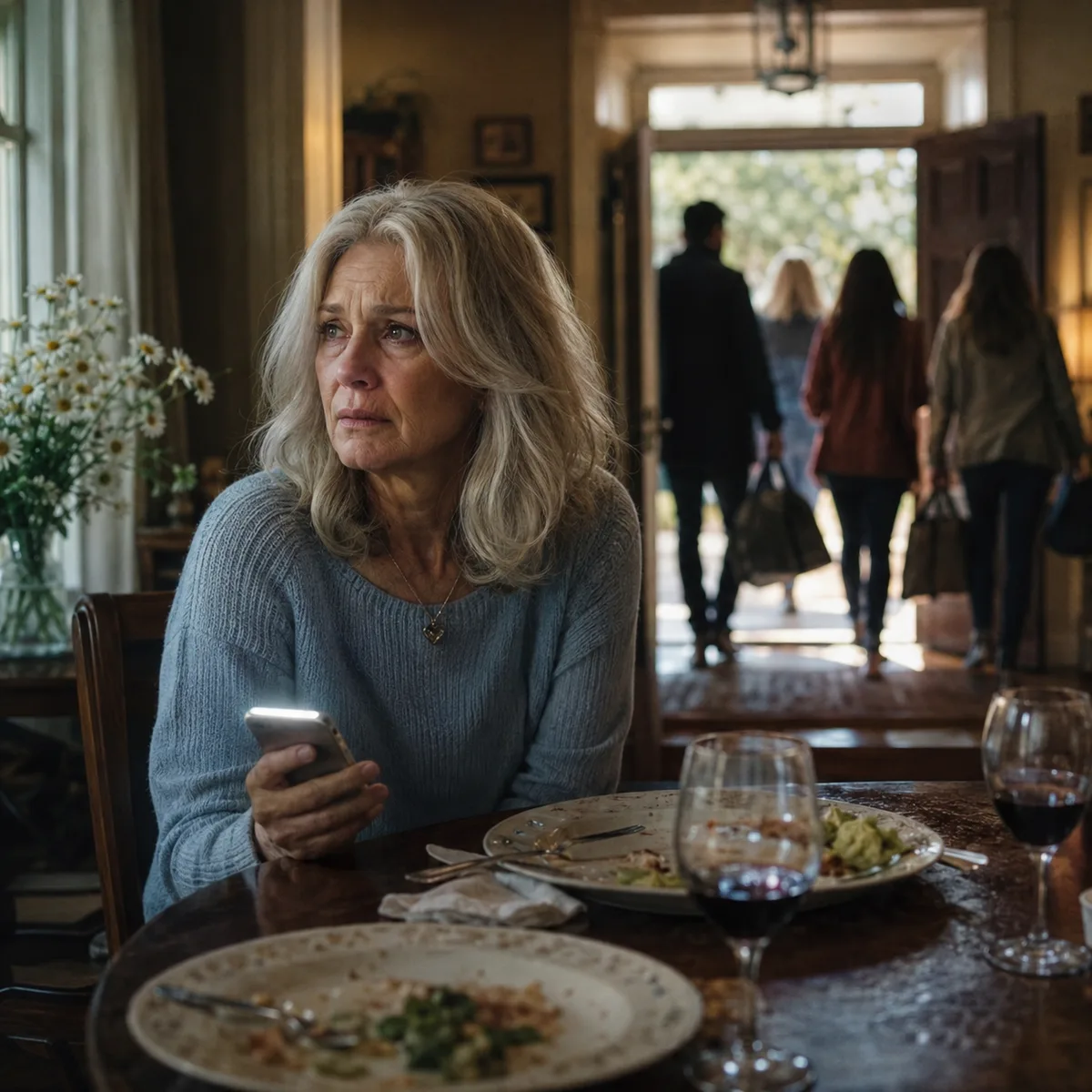
Tessa walked past me with her purse clutched tight against her side, not meeting my eyes.
Dashel paused for half a second at the threshold, opened his mouth like he might say something different than the others, then closed it again and walked out into the dark.
The door shut.
The house went silent in that particular way only an empty house can be silent.
Not peaceful.
Just empty.
I stood in my own front hallway with a good plate still on the table, the chicken going cold, three half-finished glasses of wine catching the porch light through the window.
20 minutes later, my phone rang.
Dr. Castellin’s name lit up the screen.
I almost didn’t answer. I almost let it go to voicemail because
I genuinely did not believe I had anything left in me that night to absorb more news.
But something made me pick up.
“Eleanor,” she said, and there was something different in her voice now, something that didn’t match the careful, measured tone she’d used in the exam room 4 days earlier. “I need you to sit down if you’re not already.”
I told her I was sitting.
I wasn’t.
But I sat down right there on the kitchen floor, my back against the cabinet, surrounded by the wreckage of a dinner nobody had finished.
“There was an error in your file,” she said. “A significant one. When I pulled your full pathology report this afternoon for our treatment planning meeting, I found that the original imaging had been cross-referenced with another patient’s biopsy results.”
“Your scans show a mass?”
“Yes. But the biopsy results we used to stage your
cancer as advanced, those weren’t yours, Eleanor. They belong to a different patient with a similar name.”
The room tilted slightly.
“I don’t understand.”
“Your actual biopsy results came back today,” she continued. “What you have is serious and it does require treatment, but it is early stage. Highly treatable. The prognosis is good, Eleanor. Genuinely good. I am so sorry this happened. I know what the last four days must have been like for you and your family, and I wanted you to know the truth the moment I confirmed it myself.”
I sat on that kitchen floor and I laughed, not because it was funny, but because in the space of 20 minutes, I had gone from believing I had months left to live to learning I likely had decades.
And in that same 20 minutes, I had also learned with absolute clarity exactly who my children were
when they believed there was nothing left in me worth staying for.
I didn’t call them that night.
I sat with the truth alone, the way I’d sat with the lie alone 4 days earlier, and I let myself feel every part of it, the relief, the grief, and underneath both of those, something harder and colder settling into place.
Two days later, something happened that I haven’t told many people.
I noticed my mother’s sapphire ring was missing from the jewelry box on my dresser, the one Tessa had walked past so many times during those four days.
I checked the doorbell camera footage out of nothing more than habit, the same way I checked whether I’d locked the back door twice before bed.
There, timestamped the morning after the dinner table conversation, was Tessa letting herself in with the spare key she still had from years ago, staying inside for 6 minutes, then leaving.
I never confronted her about it directly.
I simply had the locks changed the following week, and I quietly noted in the same private ledger where I had started keeping track of everything else that the ring was one more piece of evidence in a case I hadn’t realized I was building until it was already finished.
The next morning, I called my attorney, a sharp, no-nonsense woman named Priya Okapor, who had handled Thomas’s estate years before.
I told her everything.
The diagnosis. The correction. The dinner table conversation. The suitcases dragged down my staircase 20 minutes before the truth arrived.
“You don’t owe anyone an explanation for protecting yourself,” she told me. “Not even your own children.”
I sat in Priya’s office that following Thursday, the late afternoon light cutting long shadows across her desk, and walked her through every detail.
The dinner. The suitcases. The doorbell footage. The missing sapphire ring.
She took notes without judgment, the way good attorneys do, until I finally ran out of things to say.
“What do you actually want here, Eleanor?” she asked. “Not what you think you should want. What do you want?”
I sat with that question longer than I expected to.
“I want my future to belong to the people who showed up for it,” I finally said. “Not the people who showed up for what they thought was left of it.”
She nodded once, slid a legal pad across the desk, and said, “Then let’s build that.”
That same week, I told Margarite everything over coffee on her back porch. The misdiagnosis, the dinner table, the 20 minutes that had cracked something open in me that I doubted would ever fully close again.
“Are you angry?” she asked.
“Not the way I expected to be,” I said. “I thought I’d feel rage. Instead, I just feel clear, like I finally cleaned a window I didn’t know was dirty.”
“That’s worse than rage,” Margarite said, refilling my cup. “Rage burns out. Clarity just sits there, quiet, and rearranges everything around it.”
She was right, of course.
Over the following weeks, with treatment scheduled and my prognosis genuinely good, I did something I had been avoiding since Thomas passed.
My first infusion appointment fell on a gray Tuesday morning, the kind of overcast Savannah day where the moss on the oak trees looks almost silver.
I expected to go alone.
Instead, Hazel skipped her morning classes, sat beside me in the recliner chair for 4 hours, and read aloud from a battered paperback she’d brought from home, stopping every few pages to ask if I needed anything.
Water. A blanket. The volume turned down on the television bolted to the wall.
“You don’t have to do this every time,” I told her somewhere around hour two.
“I know,” she said, not looking up from the page. “I want to.”
That sentence stayed with me longer than almost anything else that year.
Two words said without performance, without anyone watching to make sure they landed correctly.
I want to.
Not because she needed something from me. Not because there was an estate attorney waiting in the wings. Because she actually wanted to be there.
Holden texted twice during treatment weeks, brief messages asking how things were progressing. The kind of texts you send to a coworker recovering from minor surgery.
Tessa sent a gift basket from an online wellness company, the card signed with a printed signature rather than her own handwriting.
Dashel called once for four minutes, mostly to ask whether my hospital bills were being handled efficiently by my insurance.
I noticed all of it.
I wrote none of it down with anger.
I simply noticed the way you notice weather patterns, the way you notice which direction the wind has decided to blow.
I finally wrote a real will.
Not the outdated, vague document I’d been putting off updating out of grief and exhaustion, but a clear, deliberate plan.
The house in Savannah, the one with the wraparound porch, goes to Hazel when she turns 25, held in trust until then.
My retirement accounts go to a scholarship fund I established in Thomas’s name for first-generation college students in our county, the kind of opportunity neither of us had growing up.
A modest fixed sum goes to each of my three children. Enough to acknowledge they are still my children. Not enough to reward what I watched happen at my own dinner table.
I didn’t do this out of spite.
I want to be clear about that, because spite burns hot and fades fast.
And this decision came from somewhere colder and steadier than that.
I did it because actions have a shape.
And the shape of what my children did in those final 20 minutes, before they could have known the truth was about to change, told me everything I needed to know about what they actually valued.
Hazel found out about the will months later.
Click the blue “PART 4” below to read the final part: 👉 PART 4 👈
Chapter complete
You have reached the end of this chapter.
Continue reading
A few more worlds to get lost in after this chapter.




