PART 2 — WHEN LOVE STARTED LOOKING LIKE MATH
She didn’t say a number of months.
Chapter 2
PART 2 — WHEN LOVE STARTED LOOKING LIKE MATH
She didn’t say a number of months.
She said we discussed treatment options, that some patients respond well, that nothing was decided yet.
But I have worked with numbers my entire adult life. And I know what it sounds like when someone is trying to soften the shape of something sharp.
I drove home with the windows down even though it was October and starting to cool, because I needed air moving across my face to feel like I hadn’t just stopped existing in the version of my life I’d planned for.
I parked in my driveway and sat there for 11 minutes before I could make myself go inside.
That evening, before I called my children, I called my neighbor and closest friend, Margarite Duboce, who had lived three doors down since before Hazel was born.
Margarite had buried a husband, too. And somewhere in the years since, we had developed the kind of friendship that
doesn’t require explanations, only honesty.
“Don’t call them tonight,” she said when I told her the news. “Sit with it first. Let it be yours before it belongs to anyone else.”
I didn’t listen.
I think some part of me wanted my children to carry this with me immediately, the way I had carried every fever and broken bone and heartbreak of theirs for 30 years without ever once asking them to wait their turn.
That evening, I called my children, all three of them.
Holden answered on the second ring.
“Mom, I’ll be there tomorrow morning. I love you. Don’t worry about anything.”
Tessa answered with her voice already cracking.
“I’m coming right now, Mom. I love you so much.”
Dashel was quieter, but just as immediate.
“I’m booking a flight tonight. I love you, Mom.”
Three nearly identical sentences.
At the time, I told myself that was just
what love sounds like in a family that’s used the same words for 30 years.
Children echo their parents.
I told myself that.
I should have noticed how fast they all reached for the word love, and how slowly they asked what I actually needed.
Holden arrived first the next morning, stepping out of his car in a sport coat like he’d come from a client meeting rather than a hospital update. He hugged me tightly at the door, but over my shoulder, I watched his eyes move past me into the hallway, toward the staircase, toward the antique writing desk that had belonged to Thomas’s mother.
“How bad is it really, Mom?” he asked, settling into the kitchen chair that used to be his father’s seat.
“Bad,” I said. “Stage four. They’re calling it advanced.”
He nodded slowly, the way you nod when you’re doing math in your head
and trying not to let your face show the answer.
Tessa arrived that afternoon with grocery bags full of bone broth, fresh ginger, and turmeric capsules from a wellness shop downtown. She moved through my kitchen with the practiced efficiency of someone performing care rather than feeling it, narrating each ingredient’s healing properties like she was hosting a segment on daytime television.
“You’re going to beat this, Mom,” she said, not once looking up from the cutting board. “We’re going to make sure you have everything you need.”
Dashel came that evening, hugging me a beat too long at the door, the way he used to hug me as a boy after a nightmare.
“Whatever you need,” he murmured into my shoulder. “I mean that.”
For four days, my house was full again in a way it hadn’t been in years. Holden made coffee every morning, black with one sugar, a detail he hadn’t remembered since college. Tessa cooked meals I barely touched, the kitchen constantly humming with chopping and simmering. Dashel sat beside me on the couch during old movies, refilling my water glass before I even noticed it was empty.
They called me Mom in voices soft enough to make me believe, for stretches of an hour at a time, that grief and love had finally taught them something.
But kindness that’s real doesn’t need that much choreography.
Real kindness shows up wrinkled and inconvenient. It burns the toast because it’s distracted by actually worrying about you.
What I was watching felt rehearsed, like a performance with stage directions only they could see.
By the third night, I noticed something that turned my stomach quietly, privately, in a way I didn’t share with any of them.
Holden’s eyes kept drifting toward the hallway closet where Thomas had kept our important documents. Tessa kept finding reasons to walk past my bedroom, glancing in at the jewelry box on my dresser.
Dashel, ever the numbers man, asked me twice in one evening with a casualness that felt anything but casual, whether I had everything organized in case things moved fast.
I didn’t accuse anyone of anything. I told myself I was being unfair. That fear makes families clumsy. That grief shows up sideways sometimes.
I wanted more than I wanted almost anything else in those four days to be wrong about my own children.
Hazel came by that same evening, straight from school, still in her uniform, backpack slung over one shoulder. She didn’t bring broth or wellness supplements or questions about paperwork.
She climbed onto the couch beside me, put her head on my shoulder, and asked me what my favorite flower was because she wanted to plant something for me in the spring.
“Daisies,” I told her. “Simple ones. Nothing fancy.”
“Okay,” she said. “I’m going to plant a whole row of them.”
She didn’t ask about the prognosis. She didn’t ask about the house or the accounts or what happened to things if the worst came true.
She asked about daisies.
And for the first time in 3 days, I let myself cry in front of someone without immediately apologizing for it.
On the fourth night, I made dinner myself for the first time since the diagnosis. Roasted chicken, the recipe Thomas used to request on his birthday.
I wanted one evening that felt like family instead of a hospital waiting room.
I set the table with the good plates, the ones we only used for holidays, and for a few minutes, listening to the three of them talk over each other about nothing important, I let myself believe we might actually get through this together.
Then Holden set down his fork.
“Mom,” he said in a tone I recognized from every difficult client conversation he’d ever described to me. “We should talk about the estate while you’re still able to make decisions clearly.”
The table went quiet in a way that had weight to it.
Tessa wiped her hands on a napkin even though they weren’t wet.
“We just want to make sure everything’s protected for you. So you don’t have to worry.”
Dashel stared into his glass.
“Do you even have a current will? Because if you don’t, things could get complicated fast.”
I sat with that question for a long moment, feeling something inside my chest go very still and very cold.
“I haven’t updated my will since your father passed,” I said quietly. “I’ve been meaning to. I just haven’t had the heart.”
The shift in the room was immediate, and it was the most honest moment any of them had shown me in 4 days.
Holden’s jaw tightened.
“You’re telling me we drove down here, took time off work, and you haven’t even handled the basics?”
Tessa’s soft voice vanished entirely.
“Mom, that’s incredibly irresponsible. Do you understand what could happen if something happens to you and there’s no clear plan?”
Dashel laughed once, short and humorless.
“I postponed three client meetings for this.”
I sat very still.
Somewhere in my chest, the part of me that had spent 30 years reading people across conference tables, spotting the difference between genuine worry and financial anxiety wearing worry’s clothes, finally finished doing the math it had been avoiding for 4 days.
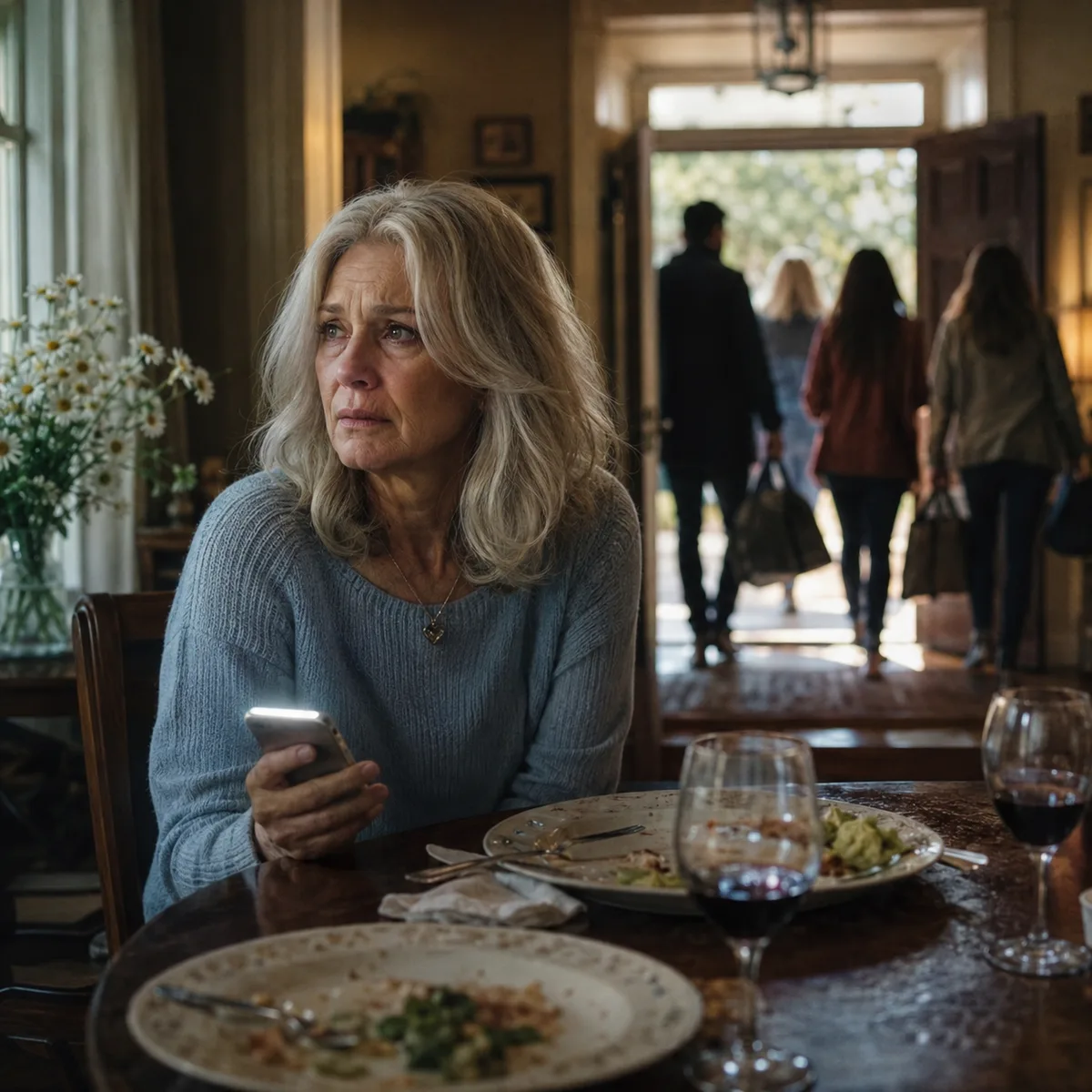
“We’re not wasting our time and energy on someone who can’t even get her paperwork together,” Tessa said, standing so fast her chair scraped against the floor. “I have a business to run, Mom. I can’t put my whole life on pause.”
Holden didn’t correct her. He nodded along, already reaching for his phone.
Dashel didn’t look at me at all.
They went upstairs together, and I sat at my own dinner table, listening to suitcase zippers and closet doors, and the particular rhythm of people who had clearly already decided sometime in the last 4 days exactly how this visit would end if I didn’t have answers that satisfied them.
Holden stopped in the front hallway, suitcase handle in hand, car keys already jingling in his other palm.
Click the blue “PART 3” below to read the next part: 👉 PART 3 👈
Chapter complete
You have reached the end of this chapter.
Continue reading
A few more worlds to get lost in after this chapter.




