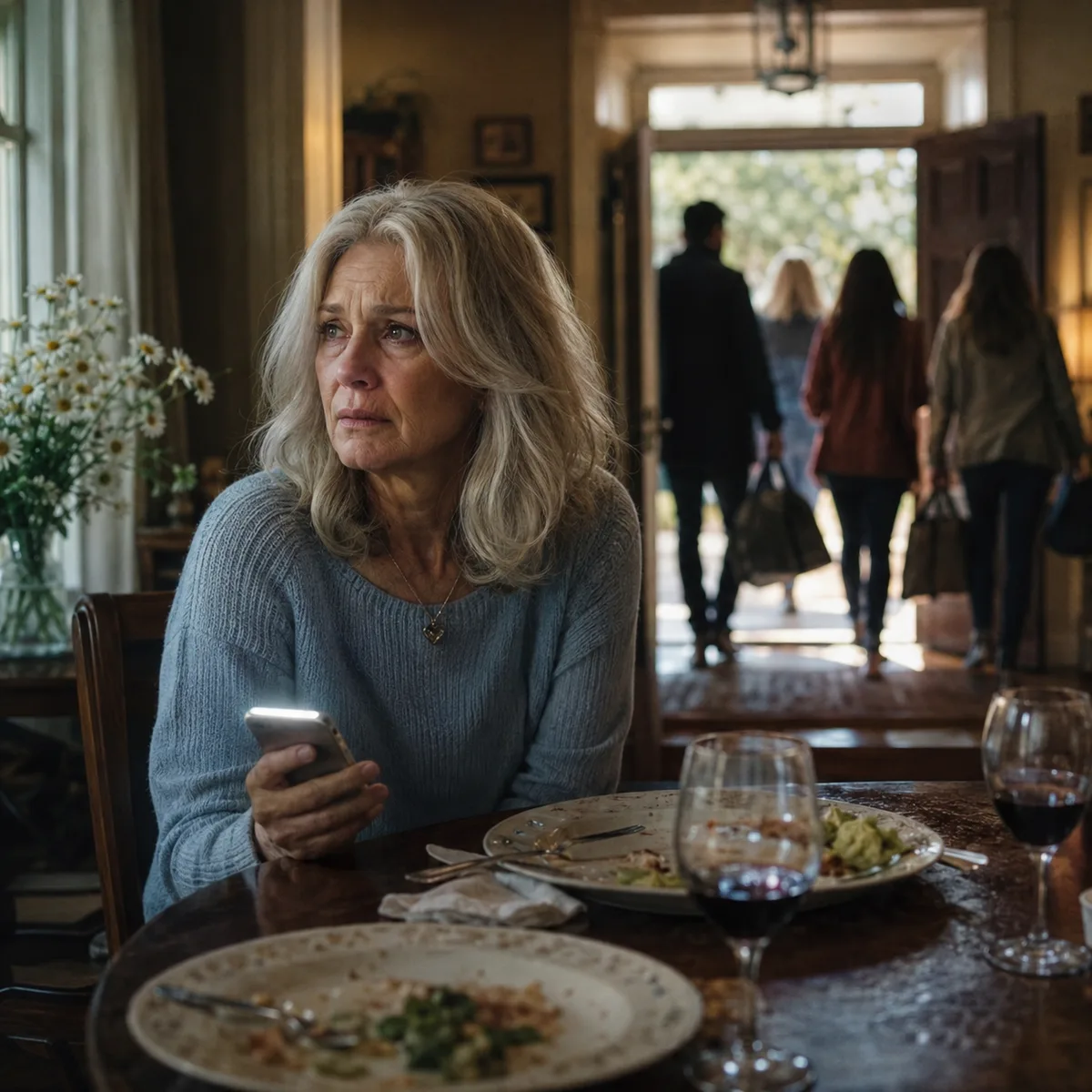
PART 4 — THE WILL THAT REVEALED WHAT LOVE WAS WORTH
Not from me, but from Tessa, who apparently discovered the documents while going through my files during one of her increasingly rare visits.
Chapter 4
PART 4 — THE WILL THAT REVEALED WHAT LOVE WAS WORTH
Not from me, but from Tessa, who apparently discovered the documents while going through my files during one of her increasingly rare visits.
Hazel called me that night crying, not because she’d inherited anything, but because she finally understood what had happened at that dinner table the year before.
“They really said that?” she asked. “They really left like that?”
“They did,” I told her.
“I’m so sorry, Grandma.”
“You have nothing to be sorry for,” I said. “You’re the only one who never asked me for anything except my time.”
Holden found out about the will at Christmas, the first holiday gathering since the diagnosis, where I finally told all three of my children the truth.
Not just about the will, but about the misdiagnosis. About the 20 minutes between their departure and the phone call that changed everything.
The silence in my dining room when I finished talking was unlike anything I had experienced in 63 years of family dinners.
“You’re punishing us for a mistake we made when we thought
you were dying,” Holden finally said, his voice tight with something between anger and disbelief.
“No,” I said. “I’m not punishing anyone. I’m simply choosing to build my future around the people who showed up for me without needing a financial incentive to stay. You showed me who you were when you believed there was nothing left to gain. I believed you.”
Tessa’s eyes filled, but I noticed even then that her tears came only after I mentioned the will.
Not when I described the dinner table.
Not when I described 20 minutes alone on my kitchen floor wondering how much time I had left.
Dashel, quiet as always, finally spoke.
“We were scared. We didn’t know what to do with that kind of fear.”
“Fear doesn’t ask about paperwork before it asks if I’m in pain,” I said. “Fear doesn’t bring up an estate attorney before it asks how
I’m feeling. What I watched in my dining room wasn’t fear, Dashel. It was math. And I happen to be very good at recognizing math, even when it’s dressed up as love.”
None of them had an answer for that.
Tessa tried one more time, her voice lower now, almost pleading.
“Mom, can we at least talk about this without lawyers and trusts? Just talk like a family?”
“We are talking like a family,” I said. “This is what it looks like when a mother finally tells her children the truth instead of managing their feelings for them. I spent 30 years doing that. I’m not doing it anymore.”
Holden pushed his chair back the same way he had the night the truth first started cracking open between us.
“So that’s it. One bad dinner decides everything.”
“It wasn’t one dinner,” I said. “It was 20 minutes. The 20 minutes
where you all decided exactly how much I was worth before you had any reason to believe you’d ever be caught.”
I watched something pass across his face that almost looked like recognition.
The way a person looks when they finally hear out loud a sentence they’ve been avoiding inside their own head for months.
I didn’t raise my voice.
I didn’t need to.
The quietest sentence in that room landed the heaviest, the way true things usually do.
Holden came back alone 3 weeks after that Christmas dinner, parking his car in the same driveway, but this time without the sport coat, without the cologne announcing him before he reached the door.
He stood on my porch, looking smaller than I’d ever seen him.
“Can we talk?” he asked. “Just us.”
I let him in.
We sat at the kitchen table, the same one where the whole thing had unraveled months earlier, and for a long moment, neither of us said anything.
“I keep replaying that dinner,” he finally said. “I keep trying to figure out when exactly I became someone who’d say something like that to his own mother.”
“What did you decide?” I asked.
“I don’t think it happened in one moment,” he said. “I think it happened slowly over years. Every time I let a phone call replace a visit. Every time I told myself I’d make it up to you later. By the time you actually needed me, I didn’t know how to show up as anything except the version of myself I’d been practicing the longest.”
It was the most honest thing he had said to me in over a decade.
And I told him so.
“Does that change anything?” he asked, glancing toward the hallway, toward nothing in particular, toward everything.
“It changes how I see you,” I said. “It doesn’t change the will. Those are two different things, Holden. One is about who you are. The other is about what I owe the people who showed up consistently, not the people who showed up sincerely 3 weeks too late.”
He nodded slowly, the same nod from that first morning, except this time there was no math behind it, only something closer to grief for a version of himself he hadn’t realized he’d been building all along.
He didn’t ask to be added back into the will.
I think for the first time in his adult life, he understood that some things can’t be renegotiated simply because you finally feel sorry.
I’m 64 now.
My treatment went well, exactly as Dr. Castellin predicted once she had the correct information in front of her.
I have my strength back most days.
I still live in the house with a wraparound porch, though now it’s filled more often with Hazel’s laughter than with a particular silence that follows people who only show up when they think there’s something to gain.
Last spring, true to her word, Hazel planted a row of daisies along the side of the porch, kneeling in the dirt in her school clothes, dirt smudged across her knees, completely unconcerned with ruining a perfectly good pair of jeans.
I watched her from the kitchen window and I thought about how strange it is that the people who give you the least reason to doubt them are so often the ones you almost overlook simply because they never made their love loud enough to notice.
She comes by most Sundays now, sometimes with takeout, sometimes with nothing but homework and a need for quiet company.
And I’ve started to understand that this ordinary, unremarkable togetherness was the thing I’ve been measuring love by all along, even before I had the language for it.
I see Holden, Tessa, and Dashel occasionally.
Holidays. The obligatory phone call on my birthday.
The relationship isn’t gone, but it isn’t what it once was, and I’ve made peace with that distinction.
Some bridges don’t burn completely.
They just stop being the road you walk every day.
What stays with me most even now isn’t the anger.
It’s the clarity.
It took a clerical error, a 20-minute gap between a lie and the truth, to show me something about my own children that 30 years of birthdays and holidays had somehow kept hidden in plain sight.
There are mornings still when I catch myself reaching for the phone to call Tessa about something small, a recipe, a piece of gossip from the neighborhood.
The kind of nothing conversation mothers and daughters have a thousand times over a lifetime.
Then I remember all over again exactly why that instinct doesn’t quite fit anymore.
Grief, I’ve learned, doesn’t only show up for the people we lose.
Sometimes it shows up for the people who are still alive, still reachable by phone, but who have become someone you no longer fully recognize.
I think about that often, how close I came to never knowing how easily a different set of circumstances could have let that performance of love stand uncorrected forever.
I think about how many people out there are living inside that same uncorrected performance right now, never getting the 20-minute phone call that reveals the truth.
So, I’ll leave you with this because I think it matters more than anything else I could say tonight.
If the people closest to you only show their truest selves in the moments they think nothing is being watched, what does that tell you about everything they’ve shown you up until now?
If this story moves something in you, I’d love to know. Have you ever discovered the truth about someone close to you in a moment they never expected to be tested?
If you came here from Facebook because of Eleanor’s story, please go back to the Facebook post, hit like, and comment exactly: Respect. That one small action means more than you know. It helps support the storyteller and gives them real motivation to keep bringing more stories like this to readers who need them.
THE END.
Chapter complete
You have reached the end of this chapter.
Continue reading
A few more worlds to get lost in after this chapter.




