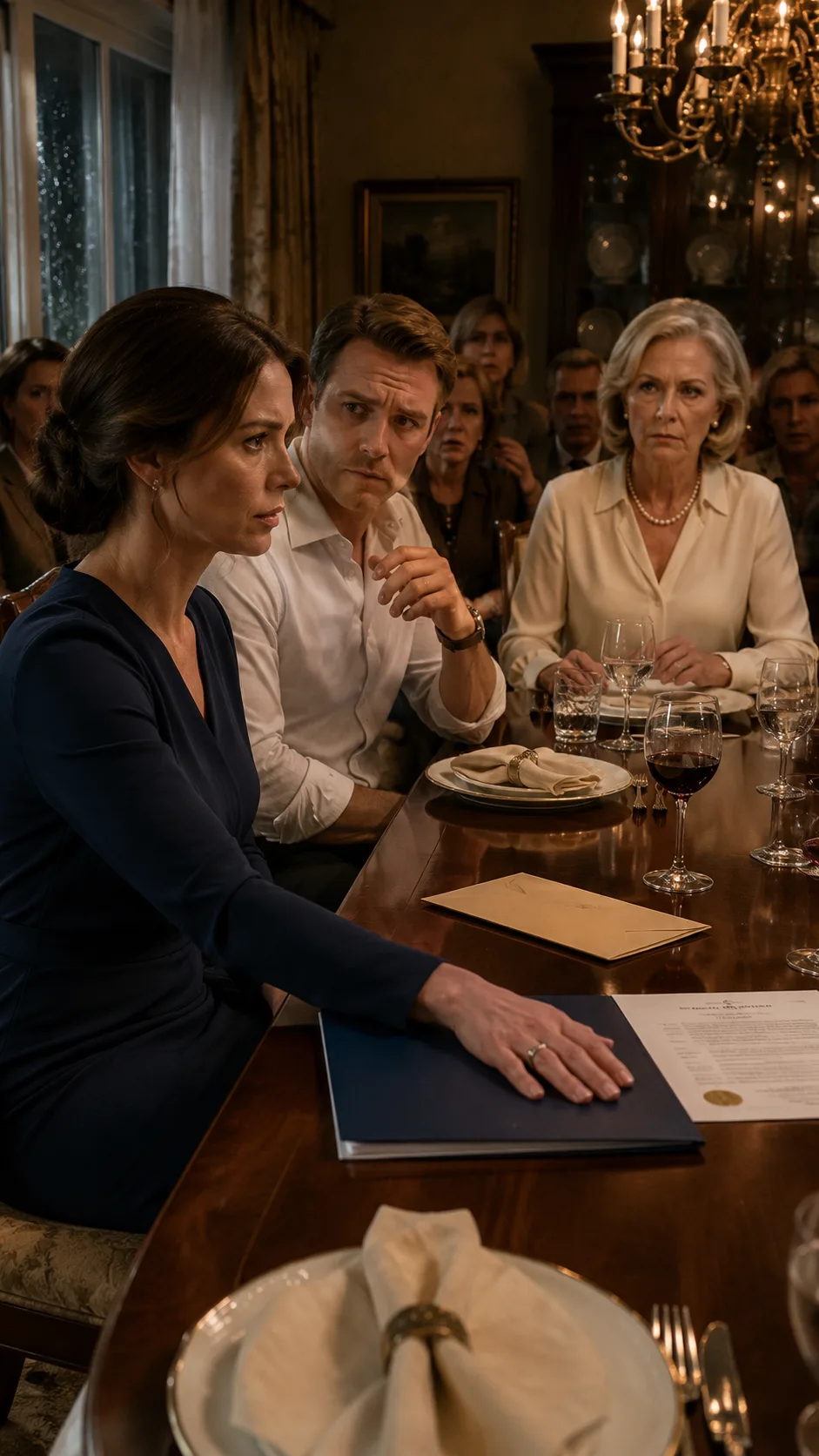
The deed was not even hidden.
Chapter 2
The deed was not even hidden.
It sat in a cream envelope with my name written across the front in Margaret’s sharp church-lady handwriting.
ELENA.
No last name.
No Mrs. Brooks.
No Elena Marlowe Brooks.
Just the five letters she used when she wanted to remind me I had arrived from somewhere else.
I carried the bread basket into the dining room and set it down between Aunt Patricia’s salad plate and Daniel’s grandfather’s medicine organizer. The room smelled like rosemary, old perfume, and furniture polish. Outside, rain tapped lightly against the windows, the kind of rain my father used to call “thinking weather.”
Every chair was filled except mine.
That was how I saw it.
Sixteen people around the table, laughing too loudly, passing serving spoons, pretending not to stare at the envelope.
My chair had been moved.
Not far. Just twelve inches back from the table, enough to make me notice that someone had
adjusted the room without me. Margaret’s chair, at the head, sat perfectly centered beneath the brass chandelier.
Daniel’s father looked at me, then looked down.
Richard Brooks always looked down at the exact moment decency required witnesses.
“Elena,” Margaret said warmly, “sit. We don’t want the food getting cold.”
I sat.
The envelope touched my wrist.
Lauren smiled at me from across the table. She had my wine glasses out — the hand-blown ones with tiny bubbles in the stems. She had always admired them. Once, after two glasses of champagne, she had said, “When you and Danny move somewhere smaller, I’m taking those.”
She probably thought that was a joke.
Daniel sat to my left. His knee bounced under the table.
I placed one hand on the envelope but did not open it.
Margaret noticed.
Of course she noticed.
“We’ll eat first,” she said. “Then we’ll talk like a
family.”
A family.
That word had been used against me so many times it no longer sounded warm. It sounded like a room with no exits.
Aunt Patricia asked about Daniel’s job. Cousin Mark told a story about his daughter’s soccer coach. Lauren showed everyone her engagement ring for the third time, tilting it toward the chandelier.
I ate three bites of roast and tasted nothing.
At the far end of the table, Daniel’s grandfather, Walter, watched me over the rim of his glass. He was ninety-one, half deaf, and more alert than anyone gave him credit for.
He had been friends with my father.
Not close friends. Hardware-store friends. Men who stood in aisles discussing hinges for twenty minutes. After my father died, Walter came to the funeral and touched the edge of the coffin with two fingers.
“Your dad loved that old house,” he had told me.
I
had forgotten until then that someone in the Brooks family knew.
Halfway through dinner, Margaret tapped her knife gently against her glass.
The room obeyed her.
That was the thing about Margaret. She never raised her voice because she had trained everyone to lower theirs.
“Before dessert,” she began, “I want to say how grateful I am that this family still understands legacy.”
I looked at the blue-veined hand around her wine glass. Her wedding ring was loose now; she twisted it when she wanted sympathy.
“When Daniel married Elena, we all welcomed her into our traditions. Into our home. Into the life we built.”
Our home.
Daniel shifted beside me.
I kept my hand flat on the envelope.
Margaret continued, “This property has always been more than walls. It represents the Brooks name. The gatherings, the children who will grow up running through these rooms, the decisions made together for the good of everyone.”
Lauren’s eyes shone.
Matt, her fiancé, looked confused but pleased, like a man watching money appear in fog.
“So,” Margaret said, “Daniel and I have spoken with a bank advisor.”
Daniel’s fork stopped halfway to his plate.
That was new.
Daniel and I had spoken, he had told me.
Now it was Daniel and I, meaning Margaret and Daniel.
She went on, “Lauren and Matthew are beginning their life together. Rather than see them struggle, we believe it makes sense to use part of the home’s equity in a way that benefits the entire family.”
I heard the rain again.
A steady tapping.
My father would have hated the word equity. He used to call this place “the old stubborn thing,” as if the house were a person with bad knees and good bones.
Margaret turned toward me with a smile so gentle it made my stomach tighten.
“Elena, dear. The envelope beside you contains a simple transfer agreement. Nothing frightening. Just a practical step so Daniel can act freely on behalf of the family.”
Daniel’s face had gone pale.
I said, “On behalf of which family?”
A fork clicked against porcelain.
Margaret’s smile did not move.
“The family you married into.”
There it was, clean and bright as a blade.
I looked down at the envelope.
For years, I had imagined speaking. I had practiced in the shower. In traffic. In the laundry room while folding Daniel’s shirts and wondering when he had stopped smelling like himself.
Every version of the speech had been stronger than I felt at the table.
My palms were damp.
My throat had narrowed.
The room seemed too full of breathing.
For a second, the edge of the envelope blurred. I pressed my thumb into the corner until the paper dented. Pain, small and ordinary, brought the room back into focus.
I opened the envelope.
Inside was a quitclaim deed.
My name already printed.
A yellow tab stuck beside the signature line.
SIGN HERE.
I held it up.
“Who prepared this?”
Margaret gave a small laugh. “Elena, don’t start.”
“I asked who prepared it.”
Daniel spoke softly. “Mom’s attorney drafted it.”
“Your attorney,” I said.
“Our family attorney,” Margaret corrected.
Walter set his glass down.
Richard looked at the ceiling.
Aunt Patricia leaned toward Lauren and whispered something that sounded like, “Is this necessary?”
Margaret heard her. She heard everything.
“It is necessary,” she said, still watching me. “Because for six years, I have carried the responsibility of this household while Elena has treated it like a private emotional museum.”
My hand tightened around the deed.
She nodded toward the hallway. “Rooms untouched. Boxes from her father still in storage. That carriage house sitting wasted until I made it useful. Bills that Daniel handles while she drifts through life as though marriage is just sentiment.”
Daniel whispered, “Mom.”
But he did not stop her.
Margaret leaned back. “I’m not being cruel. I’m being honest. Some women are not built to manage a family home.”
The room went quiet enough for the old radiator to hiss.
That sentence should have broken something in me.
Instead, it opened a door.
I folded the deed carefully and placed it back on the table.
Then I reached under my chair and lifted my leather work bag onto my lap.
Daniel turned toward me. “Elena.”
I unzipped it.
Margaret’s smile thinned.
“What are you doing?”
I pulled out the blue folder.
The one she had walked past for years.
The one she had seen on my desk and dismissed as lesson plans, recipes, maybe grief.
I set it beside the quitclaim deed.
The sound it made was soft.
Still, everyone heard it.
“I’m managing the family home,” I said.
Lauren’s eyebrows pulled together. “What is that supposed to mean?”
I opened the folder.
The certified deed was on top, stamped by the county recorder.
I turned it so the table could see the seal, though none of them were close enough to read the details.
Then I looked at Margaret sitting in my father’s chair.
“My father transferred this house into a trust two years before I met Daniel. I am the sole beneficiary and trustee. Daniel has never owned it. You have never owned it. The Brooks family has never owned one square foot.”
No one moved.
Daniel’s knee stopped bouncing.
Margaret looked at the paper, then at me, and for the first time since I had known her, she did not immediately find a sentence.
I slid the certified deed across the table.
It stopped beside her water glass.
“The house you’ve been running for six years,” I said, “was never yours.”
Chapter complete
You have reached the end of this chapter.
Continue reading
A few more worlds to get lost in after this chapter.




