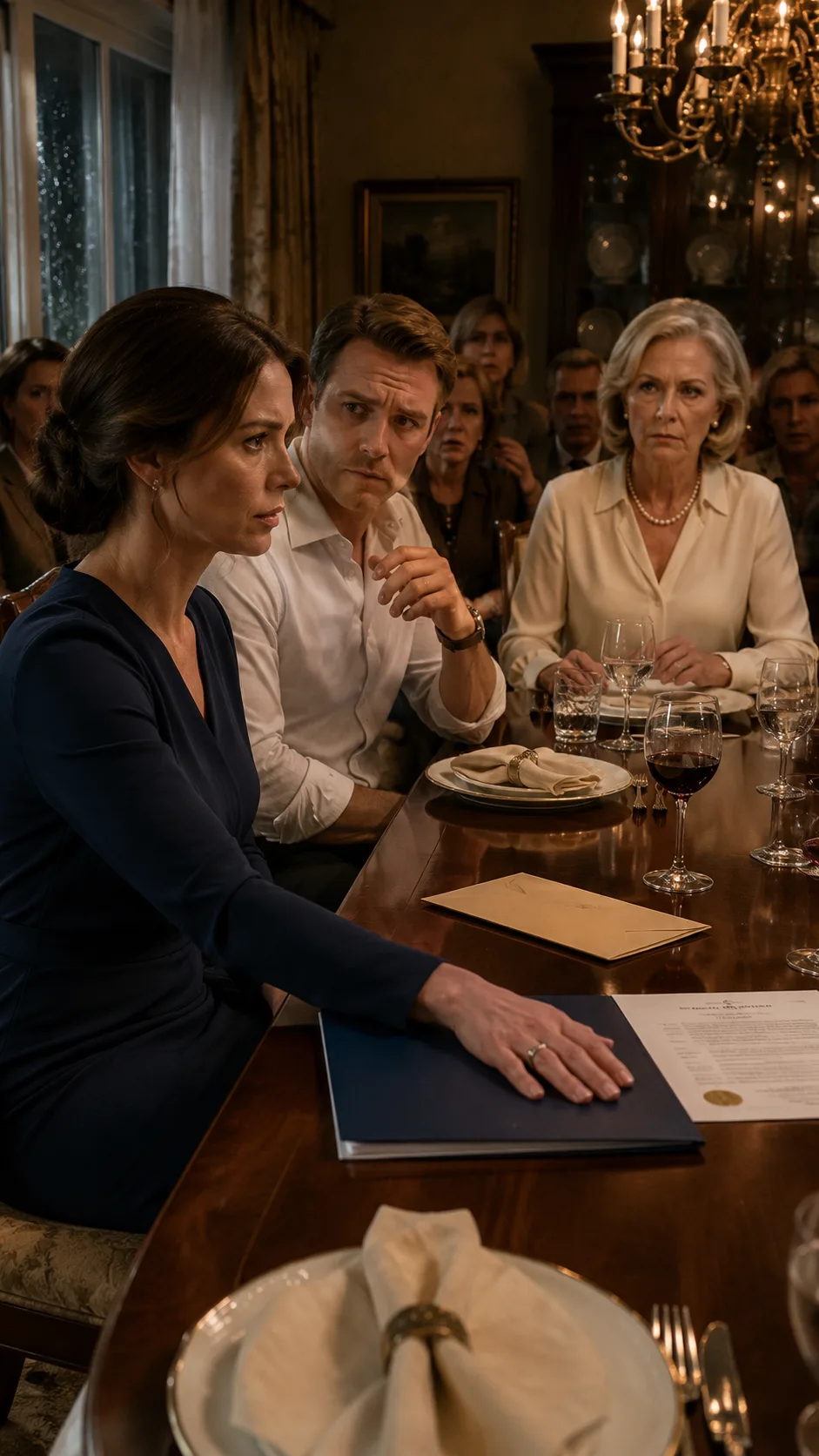
The first thing Margaret Brooks corrected that evening was the napkins.
Chapter 1
The first thing Margaret Brooks corrected that evening was the napkins.
Not the roast burning slightly in the oven. Not the dog scratching at the back door. Not her son Daniel standing in the hallway with his phone tilted away from me like it had become allergic to my eyes.
The napkins.
“They go point-down, Elena,” she said, lifting one between two fingers as if I had placed a dead moth on her dining table. “We’ve done it this way for thirty years.”
Her dining table.
That was how she said it. Not out loud, not exactly. But it was there in the way she moved around the kitchen, opening drawers without asking, lowering the flame under my soup, changing the flowers I had bought because white tulips were “funeral flowers if you knew anything.”
I watched her unfold the linen square and press it flat with the side of her hand.
The linen had belonged to my mother.
A tiny
yellow stain sat near one corner, almost invisible unless you knew where to look. Lemon curd, from my bridal shower. My mother had laughed when I spilled it. She had been alive then, sitting by the window with her hair wrapped in a silk scarf, pretending she was not tired.
Margaret did not know that.
To her, everything in that house was either useful, ugly, or hers.
“Point-down,” she repeated.
I said, “Of course.”
That was my talent in the Brooks family. I could make those two words sound like surrender when they were really just a locked door.
Daniel came in carrying a bottle of red wine and the expression he wore whenever his mother and I were in the same room. Soft apology around the mouth. Nothing behind it.
“Mom, leave her alone,” he said, but he said it while smiling, which meant he wanted credit without consequence.
Margaret laughed. “I’m helping. Somebody has to keep standards.”
His sister Lauren called from the dining room, “Mom, where do you want the good plates?”
Again. Mom, where do you want.
I leaned over the stove and stirred the soup because steam gave me something to hide behind.
Six years earlier, when Daniel and I came back from our honeymoon, Margaret had been waiting on the porch with a key.
Not a spare key in an envelope. Not a polite key. A brass one on her own ring, tucked between the key to her Lexus and the key to the family lake house.
“I had one made,” she said, stepping past me before my suitcase had even crossed the threshold. “A house this size needs someone who understands systems.”
Back then I had thought she meant drawer labels and watering schedules.
By winter, she had changed the curtains in the
front room.
By spring, she had moved Daniel’s childhood piano into the library because “the house needed a Brooks piece.”
By our second anniversary, she had started hosting Sunday dinners without asking me, texting me grocery lists as if I were staff.
By the third year, Daniel stopped saying, “It’s Elena’s house too.”
By the fourth, he said, “It’s just easier if Mom handles it.”
By the fifth, his cousins had begun calling it “the Brooks place.”
And by the sixth, I had learned to keep three things hidden: the blue folder in the bottom drawer of my desk, the original brass key from my father’s estate, and the small voice recorder I bought after Margaret told a contractor, “My daughter-in-law gets emotional. Speak to me about decisions.”
That evening, the entire family was coming.
Not just Sunday dinner. Not just Margaret, Lauren, and Daniel’s father, Richard, who had the nervous quietness of a man who had spent forty years choosing silence and calling it peace.
Everyone.
Aunts. Cousins. Daniel’s grandfather. Lauren’s fiancé. Even Aunt Patricia, who never drove after dark but had made an exception because Margaret said there would be “an announcement about the house.”
I found out from the group text.
Margaret had not meant to include me. Or maybe she had.
Either way, my name sat there among the others, bright and ridiculous on the screen.
Family dinner tomorrow. Seven sharp. We’ll discuss the future of the house together.
Under it, Lauren had sent three heart emojis.
Daniel had sent: Sounds good.
I had stared at those two words until my tea went cold.
Now, in my kitchen, Margaret was arranging my mother’s napkins point-down.
The roast timer rang.
I reached for the oven mitt, but Margaret stepped in front of me.
“Let me,” she said. “You always dry it out.”
I let her take the pan.
It was not weakness. Not exactly. Weakness would have been believing there was no other choice.
I had choices. I had been collecting them slowly, quietly, every time she mistook silence for permission.
The county recorder’s certified copy was in the blue folder.
So were the contractor invoices signed by Margaret as “property manager.”
So were the bank statements from the household account Daniel said was only for utilities.
So were seven printed screenshots from the short-term rental site where the carriage house had been listed for four years under the name “M.B. Heritage Stays.”
The carriage house had been my father’s studio.
He used to paint there in the mornings with the doors open, even in October, because he liked the smell of wet leaves. Margaret had turned it into weekend lodging with gray towels and a fake orchid.
I found the listing because a woman from Ohio knocked on my kitchen door one rainy Saturday and asked where to park.
“Your mother-in-law said breakfast was included,” she told me, holding a suitcase with one broken wheel.
I had made her coffee because she looked embarrassed.
Then I went upstairs, locked myself in the bathroom, sat on the edge of the tub, and pressed my fist into my mouth until the sound inside me had nowhere to go.
That was the day I stopped asking Daniel to see me.
That was also the day I called an attorney.
“Elena?” Daniel said now.
I turned. “Yes?”
He was standing too close, holding two wine glasses. He looked handsome in the careless way that still annoyed me because part of my body remembered loving him before my mind could stop it.
“Tonight,” he said quietly, “just let Mom talk.”
I wiped my hands on a towel. The towel had little blue stripes. I focused on those stripes instead of his face.
“What is she talking about?”
He glanced toward the dining room.
“Lauren and Matt need help with financing. The house has equity. Mom thinks if we restructure things, everybody wins.”
“Restructure,” I repeated.
“It’s just paperwork.”
There it was.
The phrase men used when they wanted a woman to sign away something they had not earned.
I asked, “What paperwork?”
Daniel lowered his voice. “A transfer. Not full. Just enough to make the bank comfortable.”
I looked past him into the dining room.
Margaret had placed herself at the head of the table.
My father’s chair.
She sat there with her spine straight, one hand resting beside the empty water glass, smiling as Lauren set down the good plates.
For one second — one ugly, honest second — I wanted to pick up the wine bottle and throw it against the wall. Not at anyone. Just to hear something break where everyone could finally see it.
Instead, I folded the dish towel once.
Then again.
Then I said, “Is that why everyone’s here?”
Daniel exhaled through his nose. “Please don’t make this dramatic.”
I almost laughed.
From the dining room, Margaret called, “Elena, dear, bring in the bread before it gets cold.”
Dear.
I opened the drawer beside the stove.
Not the drawer with serving spoons.
The one beneath it.
My fingers touched the blue folder.
For six years, Margaret Brooks had run my house as if I had been allowed to live there by kindness.
That night, under the folded linen napkins and the roast cooling on my mother’s platter, she had placed a quitclaim deed beside my plate.
Chapter complete
You have reached the end of this chapter.
Continue reading
A few more worlds to get lost in after this chapter.




