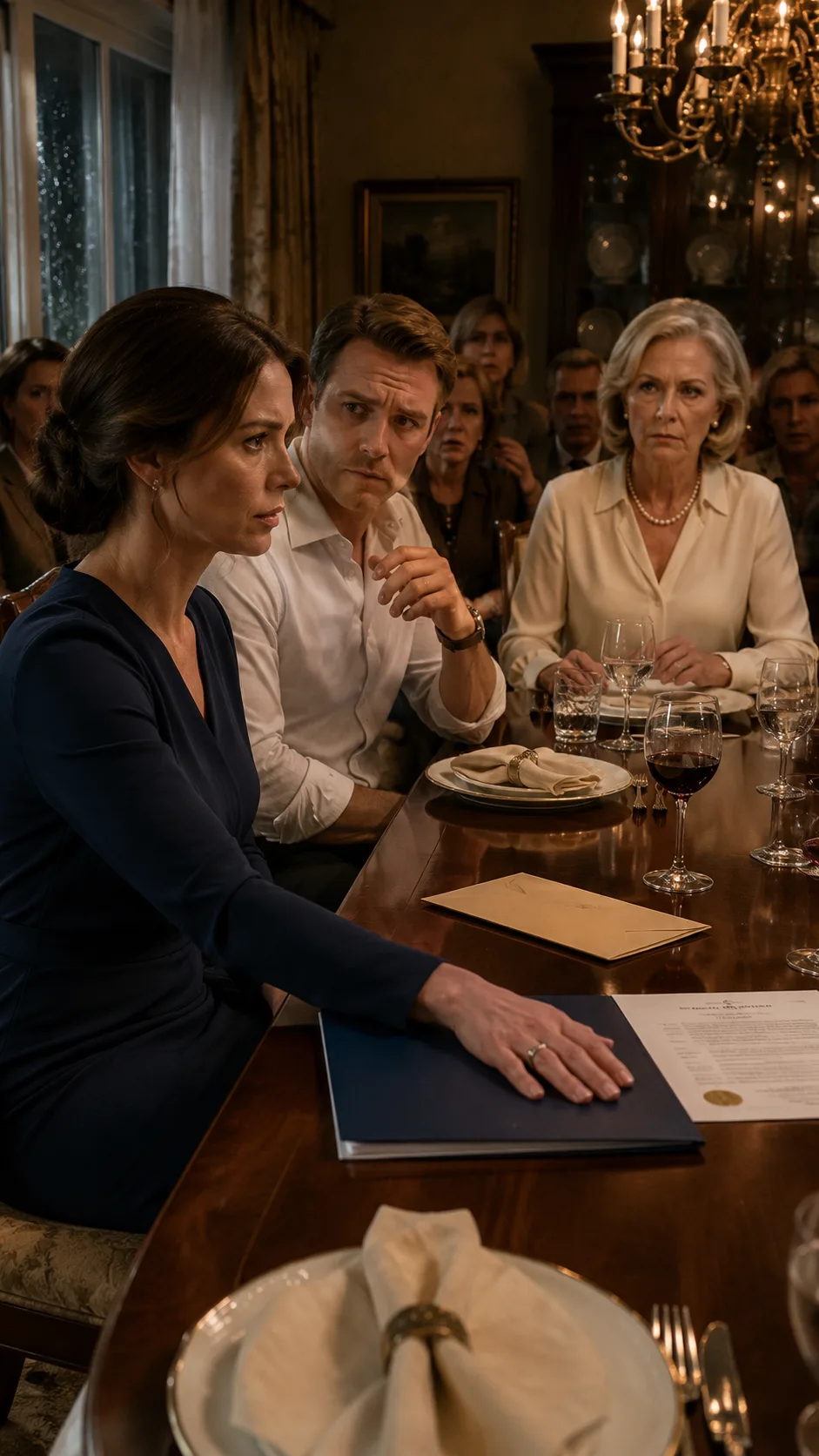
Margaret did not touch the deed.
Chapter 3
Margaret did not touch the deed.
That was how I knew she understood.
If she had thought I was bluffing, she would have snatched it up. She would have laughed, adjusted her pearls, called me dramatic, emotional, confused.
Instead, she stared at the county seal.
Daniel reached for the paper, but I placed my hand over it.
“Don’t,” I said.
One word.
He pulled back.
Lauren’s fiancé Matt looked from face to face, slowly lowering his fork. A small piece of potato slid off and landed on the tablecloth. No one cared.
Margaret found her voice in pieces.
“This is absurd.”
“It’s recorded.”
“You must have misunderstood something your father did.”
“I didn’t.”
“Daniel paid the bills.”
“Utilities. Groceries. Repairs he approved after your contractors sent him invoices.”
Margaret’s eyes sharpened. “Our family invested in this house.”
“No,” I said. “You spent money from an account Daniel and I funded. Then you rented out the carriage
house without a lease, without my permission, and deposited the money into an account under your name.”
The room changed.
Not loudly. Not dramatically.
People shifted back from the table by half an inch. Aunt Patricia pressed her napkin to her mouth. Richard closed his eyes.
Daniel turned to his mother.
“Mom?”
That one word did something ugly to her face. Not guilt. Anger that he had asked in front of everyone.
I opened the folder again.
“Four years of rental listings. Thirty-one guest reviews. Bank statements showing deposits. Three contractor invoices signed by you as property manager. And an email to the bank advisor stating that I was prepared to transfer title tonight.”
Lauren whispered, “Mom, what?”
Margaret lifted her chin. “I was protecting this family from Elena’s instability.”
There it was.
The old trick.
Make calm look cold. Make grief look incompetence. Make patience look weakness.
I could
feel my breath getting thin.
For a second, the dining room tilted at the edges. I saw my father’s old chair beneath her. I saw my mother’s napkins, point-down like Margaret had ordered. I saw Daniel beside me, not evil, not innocent, just smaller than I had allowed myself to believe.
My hand shook.
Not much.
Enough that Walter saw it.
The old man reached across the corner of the table and placed two fingers on the linen beside my wrist. Not touching me. Just there.
A small, ordinary witness.
It steadied me more than any speech could have.
I looked at Daniel.
“You knew she listed the carriage house?”
His mouth opened.
Closed.
Then, quietly, “I knew she had guests sometimes.”
“Guests,” I said.
He swallowed. “She said it helped cover maintenance.”
“Did you ask where the money went?”
He looked down.
Richard made a sound then. Not a
word. A tired breath that had waited years to become shame.
Margaret stood.
The chair legs scraped against the floor.
“Elena has always resented me,” she said, addressing the table now, not me. “From the beginning. I tried to teach her how this family works. I tried to help her become part of something bigger than her own grief. And now she humiliates us with paperwork.”
I laughed once.
It came out wrong. Too small. Too sharp.
“Paperwork?” I said.
I lifted another sheet.
“This is the notice my attorney sent this morning to the rental platform. The carriage house listing is suspended.”
Lauren’s face went white.
I lifted a second sheet.
“This is the letter to your attorney requesting all communications related to the quitclaim deed.”
Daniel rubbed his forehead.
I lifted the last sheet.
“And this is the formal demand for repayment of rental income collected from my property.”
Margaret’s mouth tightened.
Aunt Patricia whispered, “Margaret…”
“Be quiet, Patty,” Margaret snapped.
That did it.
Not the deed. Not the stolen rental income. Not even the quitclaim.
It was the way she said be quiet.
The whole table heard the voice behind six years of polished manners.
Aunt Patricia lowered her napkin slowly.
“No,” she said.
Her voice was fragile, but it carried.
Margaret turned. “Excuse me?”
Patricia’s hands trembled around the napkin. “No. I won’t. I watched you do this to Richard’s mother. Then to me after my divorce. Now her.”
The air in the room went still.
Richard opened his eyes.
Walter looked down at his plate.
Margaret stared at her sister-in-law as if betrayal had entered through the wrong door.
Patricia did not look away.
“She’s right,” Patricia said, nodding toward me. “You don’t help. You take over and call it love.”
No one breathed for a moment.
Then from the hallway came the smallest sound.
A ceramic clink.
I turned.
Marta, the woman who helped us with cleaning twice a week, stood half-hidden near the doorway with the coffee tray in her hands. She had worked for my father before she worked for me. She used to bring him black coffee in the carriage house and complain that artists made the worst messes.
Her eyes were wet, but her face was steady.
She looked at Margaret.
Then, very carefully, she carried the tray to the sideboard and set it down.
One cup rattled.
That tiny sound broke something open in the room.
Margaret sat back down, but not like a queen.
Like a woman whose chair had become too large.
Daniel leaned toward me. “Elena, we can fix this.”
I looked at him.
There had been a time when those words would have undone me. We can fix this. I would have heard apology inside them, even if none was offered. I would have filled the silence with hope because that was what wives are sometimes trained to do.
Not that night.
“What do you want fixed?” I asked. “The fraud? The marriage? Or the fact that I finally said it where everyone could hear?”
His face folded.
Not completely. Just enough.
“I didn’t know it was this bad.”
“I told you.”
He looked away.
“I told you for six years.”
The rain softened against the windows.
I gathered the papers, but I left the certified deed in the center of the table.
Let them look at it.
Let Margaret look at it.
Let Daniel’s family understand that the room they had treated like inheritance was someone else’s memory.
“I’m not signing anything,” I said. “The carriage house locks are being changed tomorrow. Margaret, you are not to enter this house without my written permission. Daniel, you and I will speak with my attorney this week.”
Lauren began to cry quietly.
Matt put a hand on her shoulder, then seemed unsure if he should.
Margaret’s voice dropped low. “You would throw your husband’s mother out?”
I stood.
My chair moved back into the place someone had pulled it from.
“No,” I said. “I’m asking a woman who took my key and used my grief as a weakness to return what was never hers.”
I walked to the head of the table.
My father’s chair.
Margaret did not move at first.
Then Walter cleared his throat.
“Margaret,” he said, his old voice rough. “Get up.”
She turned toward him as if he had slapped the air.
He looked exhausted.
But he did not look down.
Slowly, Margaret rose.
I did not sit in the chair.
That surprised everyone, maybe even me.
Instead, I picked up my mother’s napkin from beside Margaret’s plate. The point faced down. Perfectly arranged. Perfectly wrong.
I folded it the way my mother used to fold them — loose rectangle, no point, no performance — and placed it beside my own plate.
Then I left the dining room.
In the kitchen, the roast pan sat soaking in the sink. A film of grease floated on the water. The dog scratched once at the back door, patient as ever.
I opened it.
Cold rain-smelling air slipped inside.
For three seconds, with my hand still on the knob, I bent forward and let my breath come apart without making noise. Not crying exactly. Something smaller and more embarrassing. A shaking I could not negotiate with.
Marta came in behind me.
She did not hug me.
She knew better.
She picked up a towel and began drying the wine glasses, one by one, as if the house still needed ordinary things done.
“Your father,” she said quietly, “would have moved that chair years ago.”
I wiped my face with the back of my wrist.
“Maybe.”
“He was slower than you.”
That made me laugh, once, through my nose.
My phone buzzed on the counter.
A message from Daniel.
I’m sorry. Please don’t make decisions tonight.
I stared at it until the screen dimmed.
From the dining room, I heard low voices. Not Margaret’s. Others. Patricia. Walter. Lauren crying softly.
The house did not feel victorious.
It felt awake.
The next morning, I would call the locksmith. After that, the attorney. After that, maybe the bank.
There would be forms. Arguments. Apologies that came too late and explanations shaped like excuses.
But for the first time in six years, when I walked back into the dining room, my chair was exactly where I had left it.
And the brass key in my pocket was warm from my hand.
Chapter complete
You have reached the end of this chapter.
Continue reading
A few more worlds to get lost in after this chapter.




