PART 3 — THE WORD UNAUTHORIZED
I called the bank.
Chapter 3
PART 3 — THE WORD UNAUTHORIZED
I called the bank.
The woman in account services told me the request had come through their online form and had been flagged because the signature did not match my file.
“Did you fill this out with assistance from your daughter?” she asked.
“No.”
“Do you want to proceed?”
“No.”
“Would you like us to add a security phrase to your accounts?”
“Yes.”
The phrase I chose was Thomas’s old joke.
Drunk tulips.
No one but me would know.
That afternoon, Amanda came home with groceries and acted normal.
I watched her put almond milk in my refrigerator and talk about Brad’s new client.
I did not confront her.
Not yet.
I called David instead.
My son.
He answered from a school pickup line in Kansas City.
“Mom? Everything okay?”
“No.”
That got his attention.
I told him some of it.
Not all.
Enough.
He was quiet.
Then he said, “Do you want me
to come?”
I nearly said no.
I had said no too many times in my life because I did not want to be trouble.
This time, I said, “Not yet. But I want you to listen.”
So he did.
He listened while I told him about the bank letter, the county office, Brad asking about the mortgage, Amanda calling me overwhelmed.
He cursed under his breath.
Then said, “Mom, you need a lawyer.”
“I know.”
Saying that aloud felt strange.
Like turning on a porch light.
The lawyer’s name was Ellen Price.
She was a retired county attorney who still took elder-law cases because, as she said, “retirement is boring and people keep doing nonsense.”
She attended my church twice a month, always sat near the back, and wore tennis shoes with dress pants.
I liked her immediately.
I brought the folder to her office in a brick building near
downtown Des Moines.
She read everything.
Slowly.
No sighing.
No head tilts.
No treating me like a confused senior.
When she finished, she looked at me and said, “Carol, your daughter is building a record.”
“I know.”
“She is telling people you are declining so that when she asks for authority, it sounds like help.”
“I know.”
“Has she asked you to sign anything?”
“Not yet.”
“Has Brad?”
“No.”
“She will.”
That sentence settled over the desk.
Not like a prediction.
Like a weather warning.
Ellen pulled out a yellow pad.
“We are going to get ahead of her.”
That was the first time in months I felt less alone.
We did several things.
We recorded a sworn statement with Ellen’s office that I had not given Amanda power of attorney, guardianship rights, financial authority, property authority, or permission to speak for me in legal, medical, banking, or real estate
matters.
We filed a notice with the county recorder stating no transfer, lien, or conveyance of my home was authorized without my direct notarized signature and attorney verification.
We notified the bank.
We notified the pharmacy.
We changed my mailing address security with the post office.
We pulled a fresh copy of the deed.
We checked for filings.
That was when we found it.
Not a transfer yet.
A preliminary affidavit.
Amanda had attempted to file a statement with the county claiming she was acting as my “household manager and caregiver representative” in anticipation of a property transition.
The clerk had rejected it for lack of authority.
But the attempt existed.
Under reason for submission, she wrote:
Owner is elderly, increasingly confused, and unable to manage residence independently.
My own daughter had put that in a county file.
I read the words twice.
Unable to manage residence independently.
Then I laughed.
Ellen looked up.
“Carol?”
“I replaced the garbage disposal last year.”
“That may not be the legal standard, but I appreciate the point.”
The laughter did not last.
Hurt moved in behind it.
A daughter can move medicine.
Change Wi-Fi.
Talk over you at counters.
Those things sting.
But seeing your child place your supposed helplessness into a government file is another kind of betrayal.
It felt official.
That was the intent.
Ellen filed a response.
A county-stamped statement of unauthorized representation.
Then, because Amanda lived in my home and had begun holding herself out as manager, Ellen helped me prepare a formal notice.
Not eviction in the dramatic television sense.
A written notice to terminate her permission to reside in my home unless she signed a household agreement acknowledging my ownership, my authority, privacy boundaries, no financial/property representation, and no guests inspecting or discussing the property without my consent.
Amanda refused to sign.
Of course she did.
She said I was being manipulated by David and “church people.”
Then she hosted the neighborhood coffee.
My lawn.
My folding chairs.
My lemon pound cake.
My rocking chair by the trash cans.
She called me a burden.
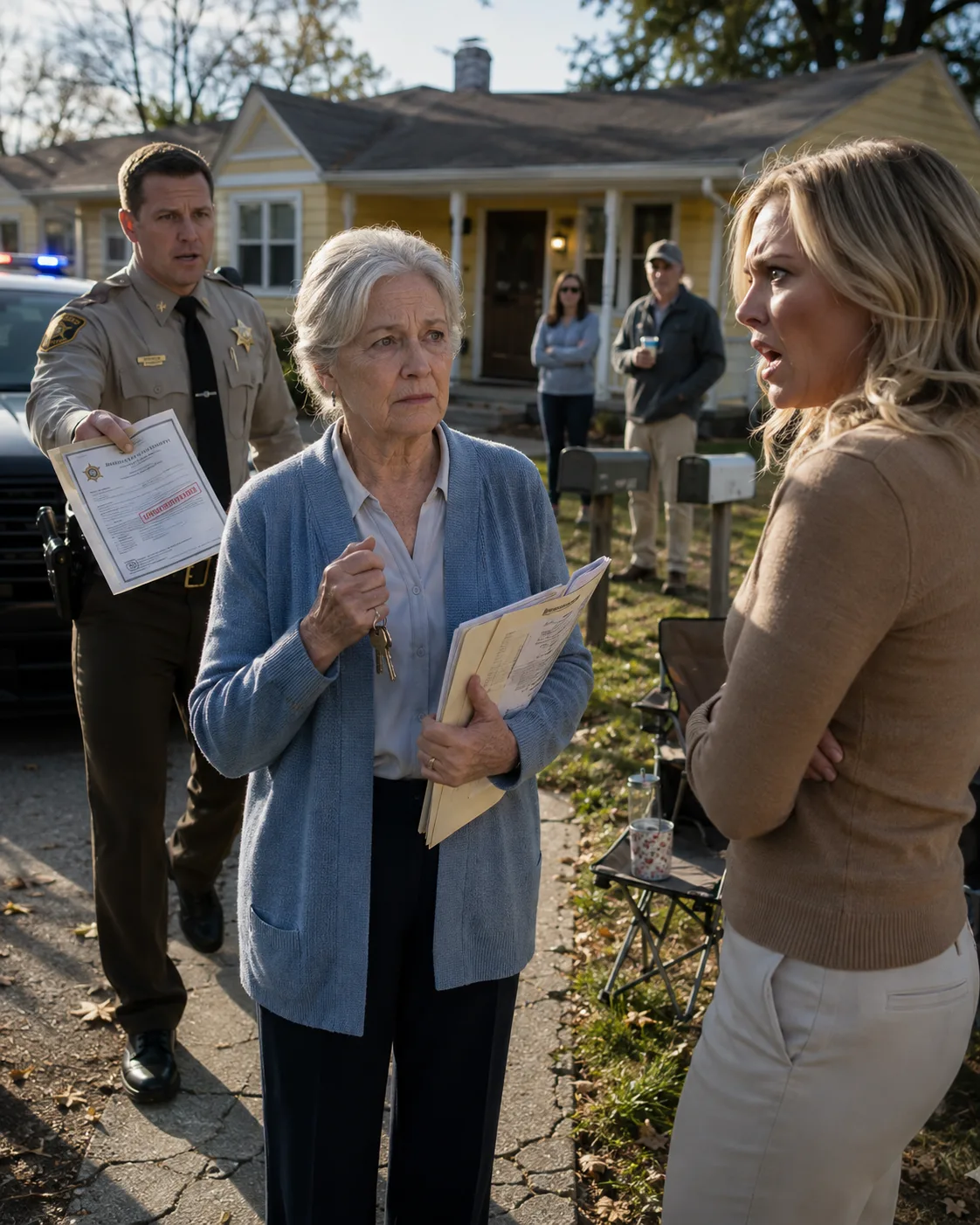
And the sheriff’s cruiser turned onto Briar Lane.
The deputy’s name was Michael Reeves.
He was young enough that Amanda probably thought she could charm him, but old enough to have seen family ugliness wrapped in nice sweaters.
He held the tan envelope and read from the notice.
“Polk County Civil Notice of Unauthorized Representation and Termination of Residential Permission. Respondent: Amanda Reed, also known as Amanda Whitman. The court-recognized filing states you have no current guardianship, conservatorship, durable power of attorney, property management authority, or financial authorization for Carol Ann Whitman.”
Amanda’s mouth opened.
“Officer, this is a misunderstanding. My mother—”
Deputy Reeves lifted one hand.
“Ma’am, I am serving the notice. I am not here to debate it.”
Brad stepped forward.
“I’m a mortgage professional, and this is a family care issue.”
The deputy looked at him.
“Sir, unless your name is on this notice, step back.”
Brad stepped back.
Not far.
Enough.
The neighbors stood frozen along the yard and sidewalk.
Mrs. Keller had one hand over her mouth.
Mr. Doyle from two houses down held a grocery flyer upside down.
Amanda’s face burned red.
“You called the sheriff on me?”
I looked at her.
“No. I filed paperwork. The sheriff serves paperwork. You of all people should appreciate proper management.”
That landed.
Not beautifully.
Accurately.
Deputy Reeves continued.
“The respondent is hereby notified that prior attempted filings asserting authority over the residence at 418 Briar Lane have been marked unauthorized. Respondent is directed to cease representing herself as legal, financial, or property agent for Carol Ann Whitman unless valid documentation is produced and accepted by the county.”
Amanda whispered, “Mom.”
“No,” I said softly. “You don’t get to use that now.”
The deputy handed her the notice.
“There is also a residential termination notice included. You have the response period listed on page two. Any questions should go through counsel.”
Amanda stared at the papers.
The word unauthorized sat near the top.
Black ink.
County stamp.
My name beneath owner.
Hers beneath respondent.
For months, she had spoken as though my age had moved me out of my own life.
One county stamp moved me back.
Rachel from next door, who had not said much all morning, finally spoke.
“Amanda, is this why you asked me whether my realtor cousin handled estate sales?”
Amanda turned on her.
“Not now.”
Mrs. Keller lowered her hand.
“You told me your mother wanted to downsize.”
Amanda’s eyes flashed.
“She did.”
I looked at my neighbor.
“No, I did not.”
Mrs. Keller’s face crumpled with shame.
“Carol, I’m sorry.”
I nodded once.
Not forgiveness yet.
Acknowledgment.
Brad tried to touch Amanda’s arm.
She jerked away.
The neighborhood coffee was over.
No one announced it.
People simply remembered they had laundry, phone calls, lives, somewhere else to be.
Amanda stood on my lawn holding the notice while the folding chairs sat in uneven rows, waiting for a performance that had ended badly.
When the deputy left, she turned to me.
“How could you humiliate me like that?”
There it was.
The question of a person who had built a stage and resented the lighting.
I looked at my porch.
At my rocker near the trash cans.
At my neighbors pretending not to walk too slowly back into their homes.
“At what point did you think humiliation began, Amanda?”
Her eyes filled.
I hated that it still hurt to see.
“I was trying to help you.”
“No,” I said. “You were trying to make me small enough to manage.”
Brad said, “Carol, with all due respect—”
I looked at him.
“You have shown my house more respect than you have shown me. Get off my lawn.”
His face hardened.
Amanda said, “Brad.”
But Brad had already started walking toward his SUV.
That told me something.
Men who measure walls rarely stay for consequences.
Inside the house, Amanda followed me into the kitchen.
The lemon pound cake sat on the counter, half sliced.
Coffee cups everywhere.
My medicine organizer, which I had moved back beside the coffee maker, sat in plain view.
Amanda slammed the notice on the table.
“You went behind my back.”
I turned.
“You filed papers behind mine.”
“You’re twisting this.”
“No. I am untwisting it.”
She paced near the stove.
“You don’t understand how hard it is living here.”
I stared at her.
“In my house?”
Her face crumpled.
“I lost my marriage.”
“I know.”
“I had nowhere to go.”
“I gave you somewhere.”
“And then what? I’m supposed to just be grateful forever?”
“No,” I said. “You were supposed to get back on your feet. Not stand on my neck.”
That stopped her.
Her mouth trembled.
“You make me sound like a monster.”
“No, Amanda. You did several ordinary cruel things and called them care. That is not the same as being a monster. It is still wrong.”
She sat down at the kitchen table.
For the first time all morning, she looked tired.
Not polished tired.
Real tired.
“I couldn’t be nothing again,” she whispered.
That sentence opened a door.
I did not step through too quickly.
“What does that mean?”
She wiped her cheek angrily.
“When I moved back here, everyone knew. Divorced. Broke. Back in Mom’s guest room at forty-three.” She looked around the kitchen. “Then Brad said the house had equity. He said I was in a position to help us both. He said if I managed things, people would respect that.”
I closed my eyes briefly.
Brad.
Of course.
Not the only cause.
But an accelerant.
“And you chose to earn respect by making me look helpless.”
She flinched.
“Yes.”
One honest word.
Ugly enough to matter.
I sat across from her.
“Did Brad tell you to file that affidavit?”
She looked down.
“He drafted it.”
Of course he did.
“Did you sign it?”
“Yes.”
“Did you believe it?”
A long silence.
Then, barely, “Sometimes I wanted to.”
That hurt.
Because it was true.
Because wanting someone to be weaker so you can feel stronger is one of the quieter sins families commit.
I took a breath.
“You have thirty days under the notice.”
Click the blue “PART 4” below to read the final part:
Chapter complete
You have reached the end of this chapter.
Continue reading
A few more worlds to get lost in after this chapter.




