PART 2 — PAPER HAS A LONG MEMORY
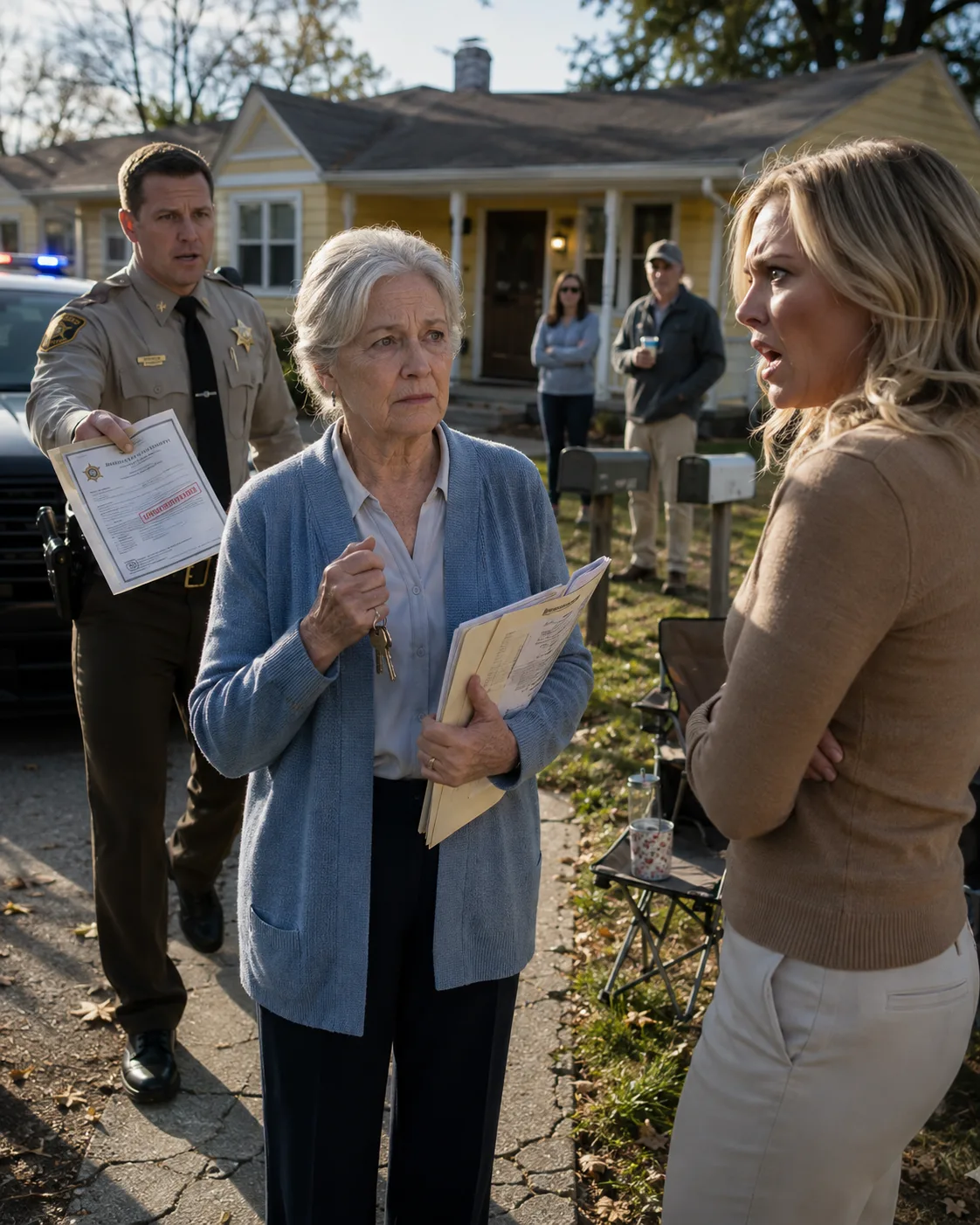
“Can I help you?” she asked.
Chapter 2
PART 2 — PAPER HAS A LONG MEMORY
“Can I help you?” she asked.
The deputy looked at his clipboard.
“I’m looking for Mrs. Carol Whitman.”
I raised my hand.
“That’s me.”
He removed the notice from the envelope.
Amanda took one step forward.
“Officer, if this is about my mother, I handle her affairs.”
The deputy glanced at the paper, then at her.
“No, ma’am,” he said. “According to the county filing, you do not.”
The yard went perfectly still.
Brad’s hand dropped from Amanda’s back.
Mrs. Keller stopped pretending to look at the hydrangeas.
And when the deputy began reading the notice aloud, Amanda’s face changed before the first paragraph was finished.
My husband’s name was Thomas Whitman.
Most people called him Tom.
I called him Thomas when he left fishing worms in the refrigerator or tracked garage dust across a floor I had just mopped.
He was an electrician for thirty-nine years, the kind of man who could walk into a
basement, listen to a panel hum, and tell you where trouble was hiding.
He loved practical things.
Good boots.
Sharp pencils.
Receipts kept in envelopes.
A garage pegboard where every tool had a shape drawn behind it because, according to him, “a thing should know where it belongs.”
He built the planter on our porch the first spring after we bought the house.
I was thirty-three then.
Amanda was five.
Our son, David, was nine.
Money was tight enough that we used lawn chairs in the living room for six months and called it temporary until temporary became funny.
The house had yellow siding even then, brighter than it is now. The maple tree was small enough to wrap both hands around. The kitchen smelled like coffee, crayons, and whatever I could stretch into dinner before payday.
That house was not valuable to anyone else at first.
Not the way
people use that word now.
It was valuable because it was ours.
Thomas fixed the basement after the big rain in 1993.
He replaced the front steps with help from our neighbor, Mr. Keller, who argued about measurements for two whole Saturdays and then stayed for hamburgers.
He painted the mailbox every April because Iowa winters had a way of chewing up anything left outside.
He planted tulips along the front walk that never came up straight.
“They have character,” he said every year.
“They look drunk,” I said.
He kissed my cheek and planted more.
When Thomas died, the house became too quiet in strange places.
The bathroom in the morning.
The garage after supper.
The kitchen table at tax time.
I learned that grief is not only missing a person.
It is missing the way life made sense because they were in their usual chair.
For the first
year, I kept his boots by the back door.
Not because I thought he would walk in.
Because moving them felt like admitting the door had stopped expecting him.
Amanda visited often then.
She was still married to Joel, still living in Ankeny, still wearing her life like it fit.
She brought casseroles.
Told me to eat.
Checked the smoke detectors.
Called me every other evening, sometimes too brightly, but I let her fuss because daughters need something to do with grief too.
My son David lived in Kansas City by then with his wife and two boys. He called. He came when he could. He loved me, but distance turns love into scheduled calls if nobody fights it.
Amanda was nearer.
That mattered.
When her marriage fell apart, I did not hesitate.
She stood in my kitchen on a cold February afternoon, mascara under her eyes, two suitcases beside her, and said Joel had “chosen himself.”
That was how she put it.
I did not ask for details.
Not then.
I opened the guest room.
The guest room had once been David’s room.
Then a sewing room.
Then a place where Christmas bins, extra blankets, and things I meant to sort went to retire.
I cleared it that night.
Amanda slept until noon the next day.
I made soup.
She cried into it.
For a while, having her there felt like a second life being handed back to me.
Someone else in the house.
A light under a door.
Coffee brewing before I woke up.
A purse on the chair.
A woman humming in the laundry room.
She was grateful at first.
“Mom, I don’t know what I would do without you.”
“You don’t have to know today,” I told her.
That was true.
For a while.
Then she began to recover.
I expected that.
I wanted it.
But Amanda’s recovery had a strange direction.
She did not move toward independence.
She moved toward management.
At first, it was small.
She reorganized the pantry.
I did not mind.
She said expired soup made her anxious.
Fine.
She moved the phone charger from the kitchen counter to the side table because cords looked messy.
Fine.
She bought matching gray bins for the hallway closet and labeled them with a little machine.
Fine.
Then she moved my medicine organizer.
That one bothered me.
It had always sat near the coffee maker because I took my blood pressure pill after breakfast.
One morning, it was gone.
I found it in the laundry room cabinet beside light bulbs and furniture polish.
“Amanda?”
She appeared in the doorway with her hair wet from the shower.
“What?”
“Why is my medicine in the laundry room?”
She smiled like I had asked where Christmas went.
“Mom, it was depressing sitting out. Guests don’t need to see all that.”
“What guests?”
“You never know.”
“I know when I take my pills.”
Her smile thinned.
“No one said you don’t.”
That was Amanda’s gift.
She could make the denial sound like kindness while keeping the insult standing.
The next week, my church friends came after Wednesday Bible study.
We had done that for years.
Coffee at my table.
Store-bought cookies if I had forgotten to bake.
Prayer requests that turned into gossip if left unsupervised.
Amanda came home halfway through and stood in the kitchen doorway watching us.
Later, she said, “Mom, they stayed almost two hours.”
“That’s what they do.”
“It’s a lot of stimulation.”
I looked at her.
“Stimulation?”
“For you.”
I laughed because I thought she was joking.
She was not.
By summer, she had changed the Wi-Fi password because, she said, I had clicked too many things.
I had clicked one link from a quilt shop.
One.
She began answering my phone if it rang while she was nearby.
She called it helping.
She started standing beside me at the pharmacy counter.
“She gets confused about refill dates,” she told the pharmacist once.
I turned to her.
“No, I don’t.”
The pharmacist, a young man named Corey who had known me for twelve years, looked uncomfortable.
Amanda touched my shoulder.
“It’s okay, Mom.”
It was not okay.
But I did not start a fight at the pharmacy.
I went home and wrote it down.
That is what I mean about inventory.
I started keeping a notebook.
Not because I thought I was in danger at first.
Because I needed to prove to myself I was not imagining the pattern.
March 12 — medicine moved.
March 19 — Amanda answered pharmacy question for me.
April 2 — church friends described as too much stimulation.
April 15 — Wi-Fi password changed without asking.
May 5 — Amanda told Mrs. Keller she was managing the house.
May 23 — Brad walked through garage, asked age of roof.
I wrote dates.
Times.
Words.
Who was present.
Then I taped receipts into a folder.
Bank receipts.
Property tax receipts.
Utility payments.
Pharmacy slips.
The locksmith receipt from 2018 when Thomas and I replaced the back door lock.
The county recorder copy of the deed, which listed Carol Ann Whitman as sole owner after Thomas’s estate closed.
My daughter thought I was helpless because I still wrote checks and sorted envelopes.
She forgot paper has a long memory.
Brad arrived in June.
He drove a white SUV and wore sunglasses even on cloudy days.
Amanda said he was in mortgage finance.
“He helps people understand their options,” she said.
I had been alive long enough to know options can be a lovely word for debt.
The first time Brad came to dinner, he complimented the house before he complimented the meal.
“Great lot,” he said, looking out the kitchen window. “Mature tree, nice frontage. These older ranches are getting attention.”
I said, “Attention from whom?”
He smiled.
“Buyers who see potential.”
“I see my laundry line.”
He laughed like I was charming.
I was not trying to be.
After that, he came often.
Too often.
He opened closet doors without asking.
Asked whether the basement was finished.
Wanted to know if the mortgage was paid off.
“It is,” Amanda said before I answered.
Brad looked pleased.
I looked at my daughter.
She avoided my eyes.
That night, I took my deed out of the folder and read it again.
Not because I had forgotten.
Because reading your own name on paper can steady you when someone is measuring your walls.
The property tax exemption incident happened in August.
I went to the county office to renew the homestead and elderly credit paperwork. Amanda insisted on driving.
“You hate parking downtown,” she said.
“I dislike parking downtown. That is not the same as needing a handler.”
She laughed.
“Mom.”
That one word had become a little leash.
At the county office, she stood too close.
When the clerk asked me a question, Amanda answered.
“My mother is renewing, but I’m handling the documents now.”
I turned.
“You are not.”
The clerk looked from her to me.
Amanda gave him a warm, embarrassed smile.
“She gets proud.”
The clerk was older than Amanda.
Young enough to be my son.
Old enough to recognize trouble.
He looked at me directly.
“Mrs. Whitman, would you like me to speak with you privately?”
Amanda stiffened.
I should have said yes.
I did not.
I said, “No, thank you. I’m fine.”
Because I was embarrassed.
Because I did not want my daughter corrected in public.
Because mothers are trained to protect children even after those children start using protection as cover.
But on the way home, Amanda was furious.
“You made me look controlling.”
I stared out the passenger window.
“No, Amanda. You did that.”
She did not speak to me for the rest of the drive.
Three weeks later, a letter arrived from First County Bank.
My bank.
Not Amanda’s.
It asked me to confirm whether I had authorized a request to add Amanda Reed as a financial contact on my checking account and safe-deposit box.
Amanda’s married name was still Reed, though she had gone back to Whitman socially whenever it made her sound more wounded.
I sat at the kitchen table with the letter in my hand.
My pulse beat in my ears.
I had not authorized anything.
Click the blue “PART 3” below to read the next part:
Chapter complete
You have reached the end of this chapter.
Continue reading
A few more worlds to get lost in after this chapter.




