PART 4 — TAKING BACK MY LIFE
She looked up, panicked.
Chapter 4
PART 4 — TAKING BACK MY LIFE
She looked up, panicked.
“You’re throwing me out?”
“I am ending permission for you to live here without terms. If you want to stay during the response period, you sign the household agreement Ellen prepared. No Brad in this house. No answering for me. No bank, pharmacy, county, mail, or property matters. You pay toward utilities. You attend counseling. And you tell the neighbors the truth.”
Her mouth opened.
“The neighbors?”
“You used them as witnesses when you called me a burden. You can use them as witnesses when you correct it.”
She stared at me.
“That’s humiliating.”
“Yes,” I said. “It is uncomfortable when a public lie has to be publicly cleaned.”
She cried then.
Not beautifully.
Not dramatically.
Like a woman whose borrowed power had cracked in her hands.
I did not rush to hold her.
That may sound cold.
It was not.
I loved my daughter.
I also finally understood that
love without boundaries had become one more tool she used to enter rooms she had no right to control.
That evening, David arrived from Kansas City.
He had driven straight through after I called.
When Amanda saw him, she began crying again.
He hugged her.
Then looked at me.
Then at the notice on the table.
“What do you need?” he asked.
Not what happened.
Not are you sure.
What do you need.
I could have kissed his forehead like he was six years old again.
“First, change the locks,” I said.
Amanda looked up.
“Mom.”
“Not today,” I said. “But soon.”
David nodded.
“I’ll call someone.”
“No,” I said. “I already did.”
That surprised them both.
The locksmith was coming Friday.
I had a receipt.
Of course I did.
The next few weeks were not easy.
People like clean endings because they do not have to live in the
hallway between harm and repair.
Amanda signed the household agreement after two days of sulking and one long meeting with Ellen, who did not tolerate performance.
Brad sent two angry texts, then vanished when Ellen sent him a letter instructing him not to contact me regarding my property.
Amanda later learned he had been discussing my home with a private buyer who specialized in “senior transition properties.”
Senior transition.
Another soft phrase with teeth.
She cried when she told me.
I believed those tears too.
But believing tears does not require undoing consequences.
She paid utilities.
She went to counseling.
She apologized to Corey at the pharmacy.
That one mattered to me.
She stood beside me at the counter and said, “I spoke over my mother here and implied she was confused. She is not. I was wrong.”
Corey blinked, then said, “Thank you for saying that.”
I bought shampoo.
Normal life continued in the strangest places.
The neighborhood apology took longer.
Amanda resisted that one the hardest.
She said it was nobody’s business.
I said she had made it their business over lemon pound cake.
So on a cool Saturday morning in October, she walked with me across the street to Mrs. Keller’s porch.
Then Mr. Doyle’s.
Then Rachel’s.
Then the young couple at the corner whose names she had never bothered to learn while using their attention.
At each house, she said some version of the same truth.
“I told people my mother was a burden and that I was managing her life. That was not true. She owns her home and manages her own affairs. I was wrong to speak about her that way.”
Some neighbors were gracious.
Some were embarrassed.
Mrs. Keller cried and hugged me too tightly.
Mr. Doyle said, “Families get messy,” which annoyed me because messy is spilled soup, not attempted control of a woman’s house.
But he apologized for not speaking up.
That counted.
By Thanksgiving, Amanda had found an apartment in West Des Moines.
Not fancy.
Second floor.
Small balcony.
Carpet that had seen things.
She was not thrilled.
Good.
Humility rarely comes with granite countertops.
David helped her move.
I did not.
I stayed home and made soup.
When she came by that night to return the garage door opener, she stood in the kitchen holding it like a peace offering.
“I hated that apartment when I first walked in,” she said.
“I hated this house when your father first showed it to me.”
She looked around, surprised.
“You did?”
“Oh, yes. The kitchen wallpaper was orange. Not charming orange. Criminal orange.”
She smiled a little.
“What changed?”
“We worked on it. And I stopped expecting a house to make me feel established before I had established myself.”
She looked down.
“I don’t know how to do that.”
“You learn.”
“Did you?”
“I’m still learning.”
That was true.
After she left, I put the garage opener in a drawer.
Not the one with batteries.
A different one.
Some things no longer get returned to their old place.
The house became mine again slowly.
At first, the quiet was sharp.
No Amanda’s shoes near the door.
No Brad’s SUV at the curb.
No labels on bins I had not asked for.
No one saying, “Mom, let me handle that,” while reaching around me.
I moved my rocking chair back to the porch.
I put my medicine organizer beside the coffee maker.
I changed the Wi-Fi password to ThomasTulips93, then wrote it on a card and taped it inside the junk drawer like a free woman.
My church friends came back on Wednesdays.
They stayed two hours and fifteen minutes the first time, purely out of spite.
I made more coffee.
Mrs. Keller came over with banana bread and an apology.
“I should have said something when Amanda called you a burden,” she said.
“Yes,” I said.
She looked down.
Then nodded.
“I will next time.”
“I hope there isn’t one.”
“So do I.”
We sat on the porch and ate banana bread in silence.
Sometimes that is enough.
Amanda and I are not what we were before.
That is not entirely sad.
Before, we were mother and daughter inside a pattern neither of us had examined closely enough.
I rescued.
She collapsed.
I made room.
She expanded.
I stayed quiet.
She called quiet agreement.
Now we speak more carefully.
Some weeks we do well.
Some weeks we do not speak.
She is still my daughter.
She is also the woman who tried to make my age into a door she could open.
Both are true.
At Christmas, she asked if she could come by.
I said yes, for lunch, not overnight.
She brought a pie from Hy-Vee and a small wrapped box.
Inside was a new keychain.
Yellow enamel house.
Tiny.
A little silly.
“I saw it and thought of this place,” she said.
I held it in my palm.
“Thank you.”
“I know it doesn’t fix anything.”
“No.”
She nodded.
“I’m learning not to ask objects to do apologies for me.”
That sounded like counseling.
Good counseling.
Then she said, “I’m sorry I called you a burden.”
I looked at her.
“You have said that before.”
“I know. I’m saying it again because I still hate that I did.”
That was different.
I placed the keychain on the table.
“I am not a burden, Amanda.”
Her eyes filled.
“I know.”
“No. Say it.”
She swallowed.
“You are not a burden.”
I nodded.
We ate pie.
It was too sweet.
We ate it anyway.
A year has passed since the sheriff’s cruiser turned onto Briar Lane.
The porch light works on a timer now because David installed one and said I should not have to remember everything manually.
I told him I was capable of turning on a porch light.
He said capability and convenience were allowed to know each other.
He had a point.
The crack in the front walk is still there.
I have decided not to fix it yet.
It looks like lightning.
Or maybe a map.
The maple tree still drops leaves into the gutters. Mr. Doyle cleaned them last fall without being asked, then said he was “already doing his.” That was his apology continuing in chore form.
I accepted.
Mrs. Keller and I hosted the Christmas cookie exchange together.
At my house.
Amanda came for one hour and behaved herself.
When someone asked whether she was helping me manage things, she said, “No, Mom manages her own life. I’m here to eat cookies.”
It was the best thing she could have said.
I keep a folder in my kitchen cabinet.
Not hidden.
Not displayed.
Just there.
Inside are the bank letter.
The county recorder notice.
The rejected affidavit.
The sheriff’s service copy.
The household agreement.
The locksmith receipt.
The new deed copy.
The little card with Drunk Tulips crossed out because that was the bank password from another story, another family, another woman I once read about and admired.
My own bank phrase is Maple Light.
Thomas would have liked that.
I do not keep the folder because I want to stay angry.
I keep it because families are skilled editors.
Given enough time, someone would say Amanda was overwhelmed.
Carol was getting older.
Brad was pushy.
The neighbors misunderstood.
No.
My daughter moved into my house after her divorce.
She slowly turned help into authority.
She told neighbors I was a burden.
She tried to file herself into control of a home she did not own.
That happened.
And so did this:
I kept receipts.
I called the bank.
I hired counsel.
I recorded the truth before she could turn concern into paperwork.
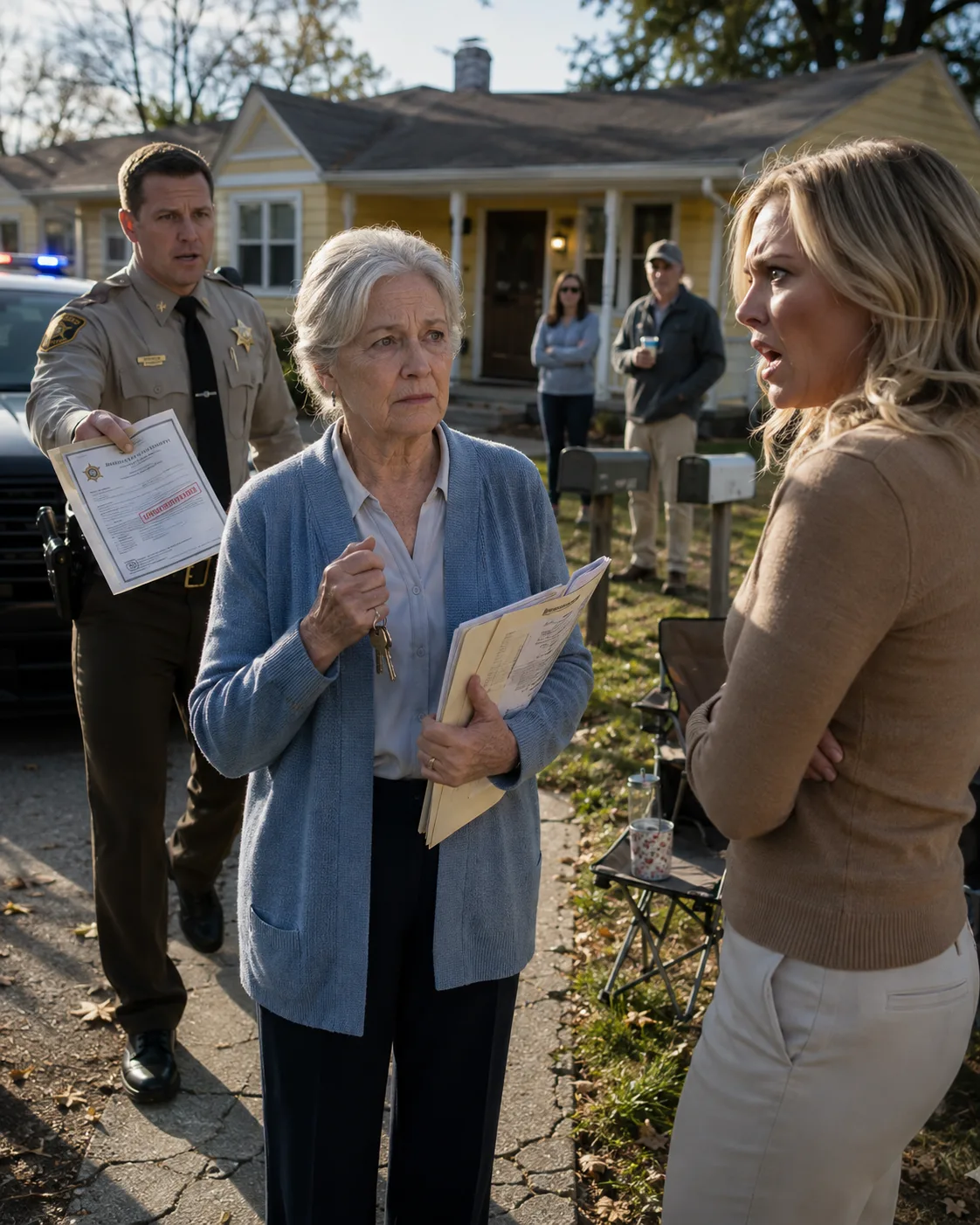
The sheriff served notice in the same yard where she tried to make me look helpless.
My name is Carol Whitman.
I am seventy-one years old.
I am a widow.
I am a mother.
I am not helpless.
I forget names sometimes.
I talk to my dead husband when the house gets too quiet.
I still sort paper bills by hand because I like seeing what leaves my account.
I need help with the smoke detector when it starts screaming from the hallway ceiling.
None of that means my life is available for takeover.
Age has changed me.
It has not erased me.
That morning on Briar Lane, Amanda thought the cul-de-sac was her audience.
She thought if enough neighbors saw me as weak, the story would become true before the county paper caught up.
But women who have run households for decades know something about records.
We know which drawer holds the tax bill.
Which envelope holds the deed.
Which receipt proves the repair was paid.
Which neighbor heard what.
Which child is confusing love with permission.
Amanda prepared a performance.
I brought the paperwork.
And when the deputy read the word unauthorized aloud on my own front lawn, the whole neighborhood finally understood what I had known for months.
I had not been losing control.
I had been taking notes.
THE END.
Chapter complete
You have reached the end of this chapter.
Continue reading
A few more worlds to get lost in after this chapter.




