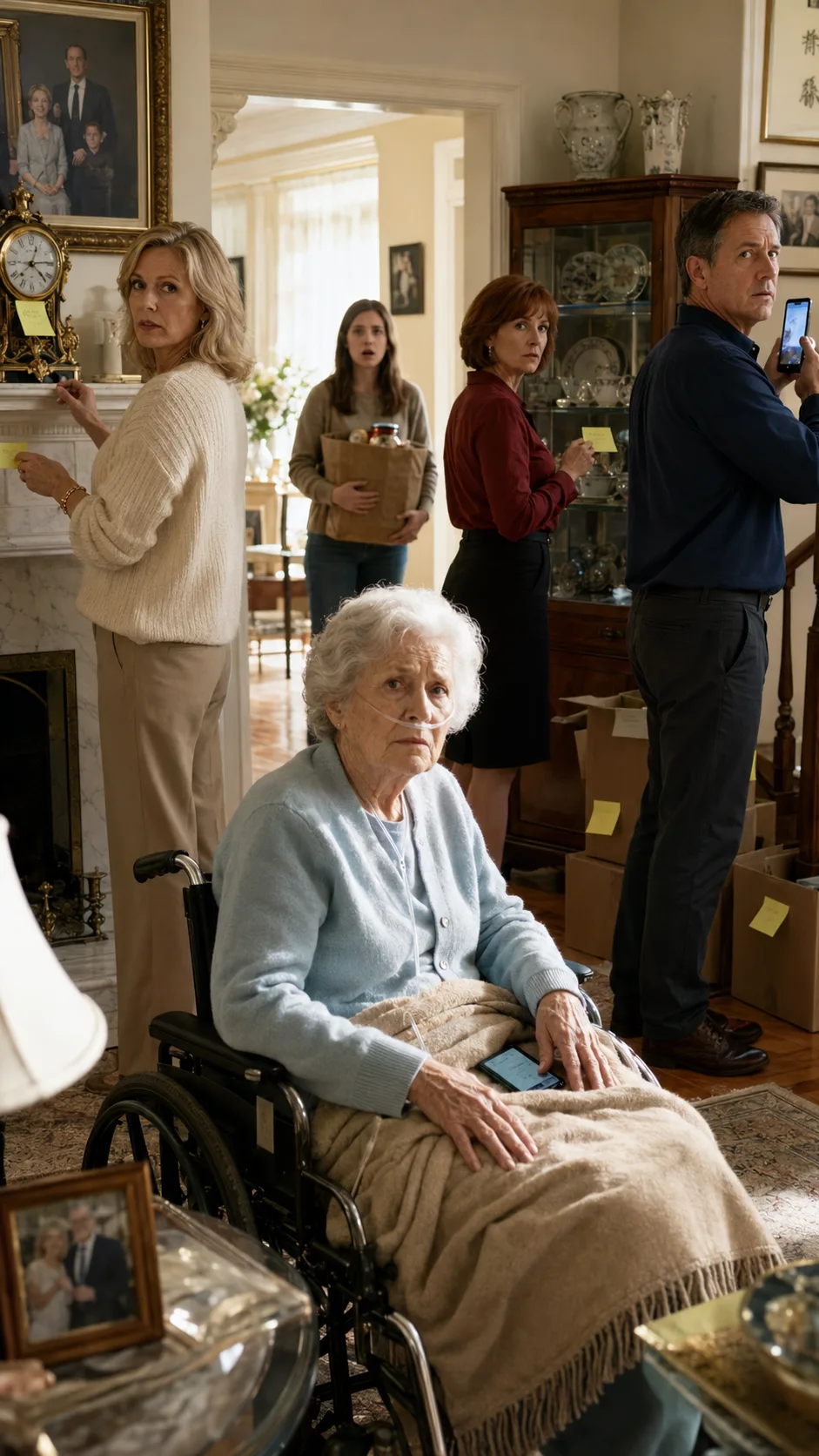
She closed her folder slowly and looked from my mother to my grandmother.
“I think I should leave,” she said.
My mother tried to smile. “No, wait, there’s been a misunderstanding.”
Grandma did not blink.
“There has,” she said. “But not hers.”
The realtor nodded once, whispered an apology to Grandma, and walked out so fast her heels clicked across the floor like a countdown.
The front door shut.
Then the house went silent.
Uncle Stephen stepped forward first.
“Mom, whatever Lily told you—”
Grandma raised one thin hand.
He stopped.
That small gesture shocked me more than yelling would have. Grandma had not raised her hand to silence anyone in years. She had always listened. Always softened. Always made space for other people’s excuses.
Not today.
“Lily didn’t tell me who you are,” Grandma said. “You did.”
My mother’s eyes filled instantly. “Mom, please don’t say that.”
Grandma looked
at her daughter for a long moment.
“Claire, yesterday you stood three feet away from me and chose the clock.”
My mother pressed a hand to her chest. “I was scared.”
“Scared people sit beside the bed,” Grandma said. “They don’t invite realtors.”
Janice began crying quietly near the china cabinet.
Grandma turned toward her.
“Put every plate back.”
Janice nodded quickly and began unpacking the box with shaking hands.
Uncle Stephen’s jaw tightened. “This has gone too far.”
I almost laughed. “You measured her walls.”
He turned on me. “Stay out of this.”
“No,” Grandma said.
Everyone looked at her.
“She stays.”
The room changed then. I felt it. My mother felt it. Uncle Stephen definitely felt it.
For the first time, Grandma was not asking to be included in her own life.
She was taking the room back.
The doorbell rang.
My mother flinched.
I opened it.
Martin
Hale stood on the porch in a dark suit, holding a leather folder.
“Mrs. Whitmore asked me to come,” he said.
Uncle Stephen’s face went pale.
Grandma nodded toward the coffee table.
“Martin, please.”
He stepped inside and placed three white envelopes on the table.
One for Claire.
One for Stephen.
One for Janice.
My mother stared at them. “What are those?”
Grandma answered softly.
“What you earned.”
Claire picked hers up with trembling fingers and opened it.
A single dollar bill slipped into her palm.
Under it was a small printed note.
My mother read it silently.
Then her face broke.
Uncle Stephen snatched his envelope open.
His face darkened immediately.
“One dollar?” he said. “You’re leaving your son one dollar?”
Grandma looked at him. “And your own voice.”
Martin reached into the folder and placed a small flash drive beside each envelope.
Nobody touched them.
They didn’t need
to.
They knew.
My mother whispered, “You recorded us?”
Grandma’s voice was gentle, and somehow that made it hurt worse.
“Yes.”
Janice covered her mouth.
Uncle Stephen pointed at me. “This was Lily’s idea.”
Grandma’s head turned slowly toward him.
“Stephen, you are fifty-two years old. Stop blaming a young woman for the sound of your own mouth.”
He stepped back as if she had slapped him.
Then Martin spoke.
“Mrs. Whitmore revised her will yesterday. The house will become Rose House after her passing. The lake property will fund its care program. Lily Whitmore will oversee the transition.”
My mother stared at me.
I shook my head. “I didn’t ask for this.”
Grandma reached back and took my hand.
“That is why I trusted you.”
Uncle Stephen laughed bitterly. “So Lily gets everything because she brought soup?”
“No,” Grandma said. “Lily gets responsibility because she came when there was nothing to get.”
That line landed harder than anything else.
My mother sat down like her legs had weakened.
Grandma looked at her first.
“Claire, when your boutique failed, I gave you thirty thousand dollars. You told your friends it came from private investors.”
My mother’s tears fell.
Then Grandma looked at Stephen.
“When you lost your job, I paid your mortgage for six months. I paid Mason’s school tuition and let you call it a scholarship.”
Uncle Stephen looked away.
Finally, Grandma turned to Janice.
“And Janice, when my silver candlesticks disappeared last Christmas, I told myself you were struggling. I chose silence over shame.”
Janice began sobbing.
“I’m sorry,” she choked out.
Grandma’s eyes shone.
“I believe you are sorry now,” she said. “But yesterday, you were shopping.”
Nobody spoke after that.
Not for a long time.
Then Stephen said the thing he should never have said.
“Dad would never have allowed this.”
Grandma went completely still.
Even Martin looked down.
Grandma’s hand tightened around mine.
“Your father,” she said, “married a woman with land, savings, and a backbone. He never once confused my silence with weakness.”
Stephen’s face changed.
Grandma continued.
“This house was built on land my aunt left me. The lake property was mine before I married Henry. I let you call it his legacy because I loved him. But I will not let you erase me to make your greed sound sentimental.”
My mother covered her mouth.
Uncle Stephen had no answer.
Because that was the final truth.
Grandpa had loved this house.
But Grandma had owned it.
Grandpa had been honored in every story.
Grandma had been the foundation under all of them.
And they had tried to divide that foundation while she sat breathing in the corner.
Grandma looked at the boxes spread across the living room.
“Put everything back,” she said.
And they did.
Slowly.
Quietly.
My mother peeled sticky notes off the clock, the lamps, the picture frames. Janice returned every plate to the china cabinet. Stephen carried boxes back to the garage without making eye contact.
Grandma watched them from her wheelchair.
She did not smile.
She did not gloat.
She simply watched the truth work.
Three months later, Grandma Rose passed away just before sunrise.
She was in her own bed, wearing her soft white nightgown, with fresh flowers on the dresser and my hand wrapped around hers.
Her last words were not dramatic.
She looked toward the window, where morning light touched the curtains, and whispered, “Henry’s waiting.”
Then she was gone.
At the memorial, my mother cried so hard she could barely stand. Uncle Stephen sat in the back row, staring at his shoes. Janice returned the silver candlesticks in a paper bag and left them by the front door.
The will reading happened one week later.
There were no surprises.
Only consequences.
Claire received one dollar.
Stephen received one dollar.
Janice received one dollar.
And each of them received a copy of the recording.
Nobody challenged it.
Nobody could.
Six months later, the sign went up outside the house.
ROSE HOUSE.
The first woman who came to stay there was named Margaret. She was eighty-one, widowed, and shaking when she arrived with two suitcases and no coat warm enough for Oregon rain.
I opened the door myself.
“Come in,” I said. “There’s soup on the stove.”
She cried before she crossed the threshold.
After that, more came.
A retired teacher whose children stopped answering calls.
A grandfather recovering from surgery with no one to drive him home.
A woman who said she had not sat at a family table in eight years.
Every Sunday, we used Grandma’s wedding china.
I could almost hear her voice.
Beautiful things are not meant to sit behind glass forever, Lily. They are meant to serve someone.
My mother started volunteering in the kitchen that winter.
At first, I didn’t trust it.
She didn’t ask me to.
She washed dishes. Folded blankets. Drove residents to appointments. She never mentioned the house. Never mentioned the will. Never asked for forgiveness in a way that demanded comfort.
One evening, I found her standing in the living room, staring at the antique clock she had once claimed with a yellow sticky note.
“I hear that recording in my head every day,” she said.
I stood beside her.
“Good,” I said quietly. “Maybe that means you’re finally listening.”
She nodded, tears sliding down her face.
On the first anniversary of Grandma’s passing, I found one final envelope hidden inside her wooden box.
My name was written on the front.
Inside was a letter.
My dearest Lily,
If this house is noisy, keep it that way.
If the china breaks, let it break while feeding someone.
If people call you foolish for giving too much, remember this: kindness needs doors, keys, and boundaries.
I did not leave you a house because you were my favorite.
I left it to you because you were the only one who entered without measuring the walls.
You did not inherit my property.
You inherited my purpose.
I pressed the letter to my chest and cried on the porch until the lights inside Rose House began turning on, one by one.
Behind me, people were laughing in the kitchen.
Soup was simmering.
The old clock was ticking.
And for the first time, I understood Grandma’s final act completely.
It was not revenge.
It was not punishment.
It was correction.
They had divided her belongings while she was still alive.
So she left them the only inheritance they had truly earned.
The sound of themselves.
THE END.