stays here.”
Janice’s cheeks turned red. “Aunt Rose, I was only looking.”
“No,” Grandma said. “You were deciding.”
The room went painfully quiet.
Uncle Stephen shoved his phone into his pocket. “Mom, this is getting ridiculous.”
Grandma looked at him. “Is it?”
“Yes,” he said. “Nobody is stealing. Nobody is doing anything wrong. We’re trying to make practical decisions before things get chaotic.”
“Chaotic,” I repeated. “You mean before she dies?”
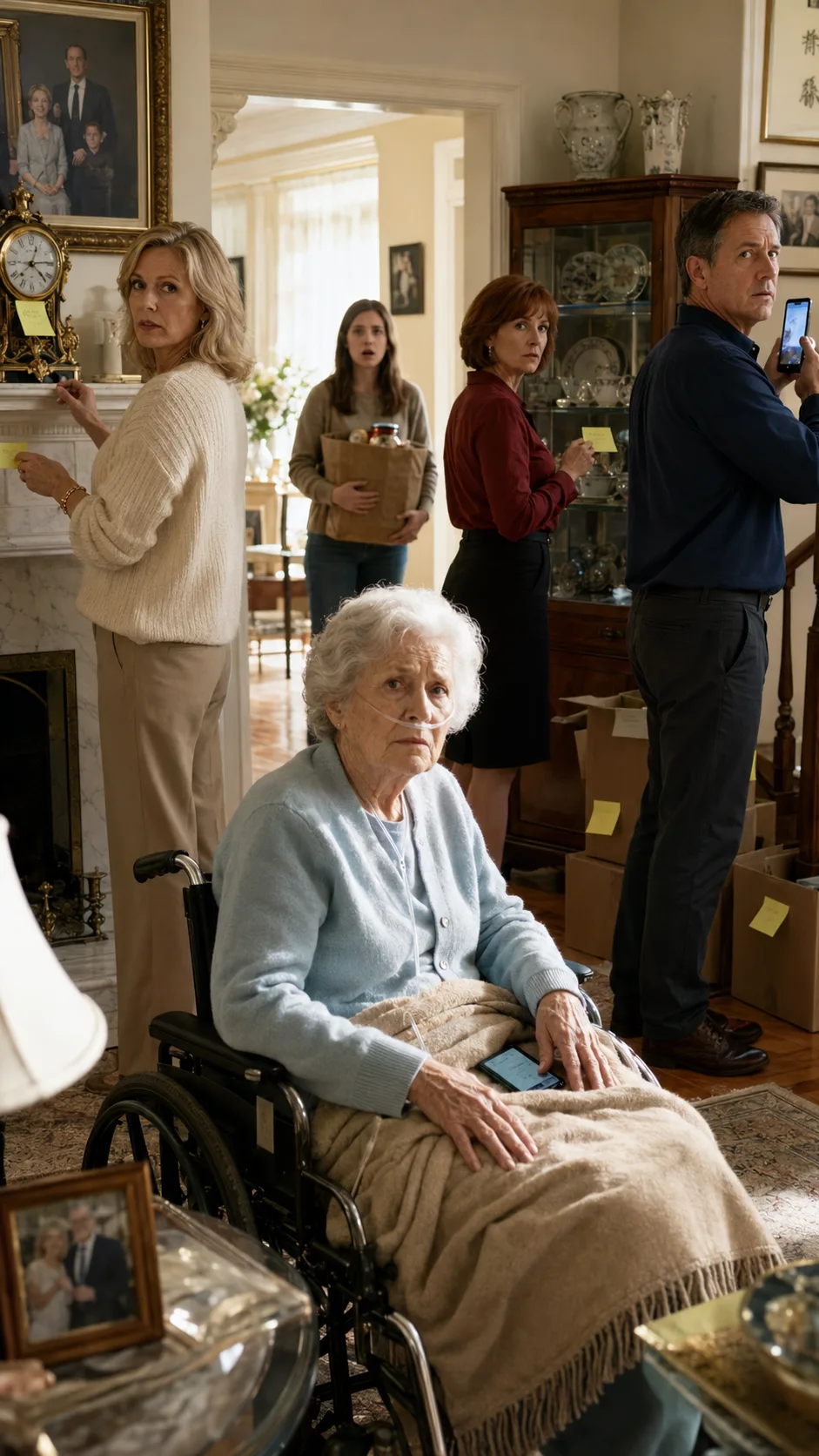
My mother slapped the sticky notes down on the mantel. “That is enough.”
“No, Mom. Enough was when you called a realtor before Grandma even left this house.”
My mother went still.
That was the first crack.
Grandma’s eyes turned toward her.
“Claire?” she whispered.
My mother’s lips parted. “Mom, I only made a call.”
Uncle Stephen rubbed his forehead. “Don’t make it sound ugly. We needed numbers.”
“Numbers,” Grandma said.
Her voice was weak, but there was something new underneath it. Something sharp.
“You needed numbers for my house?”
My mother stepped closer to Grandma and softened her face in that careful way she used when she wanted to look kind.
“Mom, you know you can’t live here forever.”
Grandma blinked once.
“No,” she said. “I suppose I can’t.”
My mother relaxed, thinking she had won.
That hurt more than the sticky notes.
Because I knew what Grandma had done for every person in that room.
She had paid my mother’s mortgage twice when the boutique almost failed. She had given Uncle Stephen money for his son’s private school and let him pretend he had earned a scholarship. She had let Janice stay in this house for six months after a breakup and never once asked why pieces of silver went missing from the dining room.
Grandma had spent her life making everyone feel less ashamed.
And now they were turning her kindness into an inventory list.
I walked to Grandma’s chair and knelt beside her.
“Do you want them to leave?” I asked.
Uncle Stephen scoffed. “This is our family home.”
Grandma’s head lifted slowly.
“Our?” she asked.
He hesitated. “I mean, Dad built this family.”
Grandma looked toward the portrait over the fireplace.
My grandfather, Henry Whitmore, smiled from inside the gold frame, handsome and proud in his gray suit.
I had heard the story my whole life. Grandpa built the life. Grandpa chose the land. Grandpa made the family name respected.
But Grandma’s expression told me there was more.
A lot more.
“Your father loved this house,” she said.
“Exactly,” Uncle Stephen replied. “And he would want us to handle it properly.”
Grandma stared at him for a long moment.
Then she looked down at the blanket.
Her phone was still recording.
I saw the red numbers climbing.
Forty-one minutes.
Forty-two.
Forty-three.
Finally, Grandma said, “Lily, take me to my room.”
My mother stepped forward. “Mom, we’re not finished.”
Grandma looked at her.
“Yes,” she said. “You are.”
I pushed her wheelchair down the hallway. Behind us, nobody apologized. Nobody rushed to hug her. Nobody begged her to understand.
They whispered.
That was worse.
In Grandma’s bedroom, I locked the door and turned around with tears already burning my eyes.
“Grandma,” I whispered, “I’m so sorry.”
She pulled the phone from under the blanket and placed it in my hands.
“Don’t be sorry,” she said. “Play it back.”
I pressed play.
The room filled with their voices.
“The lake property will sell faster if we list it before fall.”
“She doesn’t even use half this stuff anymore.”
“This is our family home.”
“Mom, please. We’re just trying to prepare.”
Grandma closed her eyes.
Not because she was surprised.
Because she was done pretending.
When the recording ended, she pointed to the nightstand.
“Open the bottom drawer.”
Inside was a small wooden box. I lifted it out and set it on her lap. Her fingers shook as she touched the lid.
“Your grandfather gave me this box the year we moved in,” she said.
Inside were letters, faded photographs, old keys, and a business card for Martin Hale, the family attorney.
Grandma took the card and handed it to me.
“Call him.”
I stared at her. “Now?”
“Now.”
My voice trembled when I called. Martin Hale answered on the third ring. When I told him Rose Whitmore needed an appointment, he offered next week.
Grandma took the phone from me.
“Martin,” she said, her voice suddenly clearer than it had been all day. “If you ever respected Henry, you’ll see me tomorrow morning.”
There was silence on the other end.
Then he said, “Ten o’clock.”
The next morning, I drove Grandma to Martin Hale’s office.
She wore pearl earrings, lipstick, and the navy cardigan Grandpa had loved. She looked fragile, yes, but not helpless.
Martin listened to the entire recording without speaking.
By the end, his face had changed.
“I’m sorry, Rose,” he said.
Grandma folded her hands in her lap.
“I don’t need sorry,” she said. “I need the truth written clearly.”
For two hours, she told him exactly what she wanted.
The house would not go to Claire.
The lake land would not go to Stephen.
The china, silver, furniture, and antiques would not be divided among people who had tried to claim them before she was gone.
The house would become Rose House, a place where elderly people with nowhere safe to go could stay temporarily, eat warm meals, and be treated like human beings.
The lake property would fund it.
I would manage it.
My mother, Uncle Stephen, Janice, and every relative who had placed a claim on Grandma’s belongings would receive one dollar each.
And a copy of the recording.
Martin looked at me, then back at Grandma.
“Are you certain?”
Grandma smiled faintly.
“For the first time,” she said, “I’m not protecting them from themselves.”
When we came home that afternoon, my mother’s car was in the driveway.
Beside it was a silver sedan with a real estate logo on the door.
Grandma looked at the car, then at me.
“Push me in.”
Inside, Claire was walking a realtor through the living room.
Stephen stood near the staircase, pointing toward the second floor.
Janice was packing the china into a cardboard box.
My mother turned and froze.
“Mom,” she said. “You’re home early.”
Grandma looked around the room.
At the boxes.
At the sticky notes.
At the stranger preparing to sell her life.
Then she looked straight at my mother.
“You’re trying to sell a house,” Grandma said, “that you were never going to inherit.”
To be continued, Part 3 now




