THEY PASSED THEIR MOTHER FROM HOUSE TO HOUSE UNTIL THE DAY SHE REMOVED HERSELF FROM THEIR CALENDAR
PART 3
Daniel called first.
Chapter 2
THEY PASSED THEIR MOTHER FROM HOUSE TO HOUSE UNTIL THE DAY SHE REMOVED HERSELF FROM THEIR CALENDAR
PART 3
Daniel called first.
Then Claire.
Then Megan.
Then Daniel again, three times in a row, as if panic could push through voicemail if it knocked hard enough.
I let the phone ring on the passenger seat while the highway curved toward the coast. The sound was strange. For years, that ringtone had meant somebody needed me. A fever. A ride. A forgotten permission slip. A dinner nobody planned. A grandchild who had to be picked up because someone else had a meeting.
This time, the phone meant they had discovered absence.
Mine.
I stopped at a roadside café forty minutes from Cannon Beach. The place smelled like coffee and cinnamon rolls. A young waitress with a nose ring called me “hon” and didn’t know I had spent the morning breaking my children’s idea of me.
I ordered tea.
My phone buzzed again.
Daniel: Mom, where are you?
Claire: Please call me. I’m scared.
Megan: This is extremely unfair.
I almost laughed at Megan’s message.
Unfair.
That word again, chasing me all the way to the ocean.
I opened Daniel’s voicemail.
His voice came through tight and breathless. “Mom, we saw the note. I don’t know what you’re doing, but you can’t just leave like this. We need to know where you are. Call me back.”
Not: Are you safe?
Not: I’m sorry.
Not: I should have protected your dignity.
Just: You can’t leave like this.
A command dressed as concern.
I played Claire’s next.
“Mom, please. The kids are asking questions. Lily thinks she said something wrong. I don’t know what to tell them.”
My hand tightened around the phone.
Then Megan’s.
“Mom, I really think you’re overreacting. Families make arrangements. That’s normal. You disappearing makes all of us look terrible.”
There it was.
Not pain.
Image.
I put the phone face down
on the table and watched steam rise from my tea.
A woman at the next table was reading a paperback. Two older men argued softly about fishing weather. Outside, cars moved past rain-dark pavement.
The world continued without needing me to fix it.
That should have felt lonely.
Instead, it felt like air.
By noon, I reached the cottage.
Marjorie had left the key under a ceramic turtle by the door, just as promised. When I stepped inside, the house smelled faintly of lemon cleaner and cedar. The floors creaked. The kitchen was small. The living room had a faded blue sofa, two bookshelves, and windows that turned the gray sea into a moving painting.
I carried in my suitcases one by one.
No one told me where to put them.
No one sighed at the space they took.
No one said, “Just for a few months.”
I placed Henry’s
notebook on the little table by the window.
Then I sat down and cried.
Not the kind of crying I had done quietly in bathrooms, with the faucet running so nobody would hear. Not the careful kind that ended before someone walked in. This was ugly and open and mine. My shoulders shook. My mouth twisted. My chest hurt.
I cried for Henry.
I cried for the house we sold after he died because Daniel said it was “too much for me.”
I cried for all the guest rooms that were not mine.
I cried for every time I thanked my children for crumbs and called it love.
When the crying stopped, the ocean was still there.
Steady. Unbothered. Waiting.
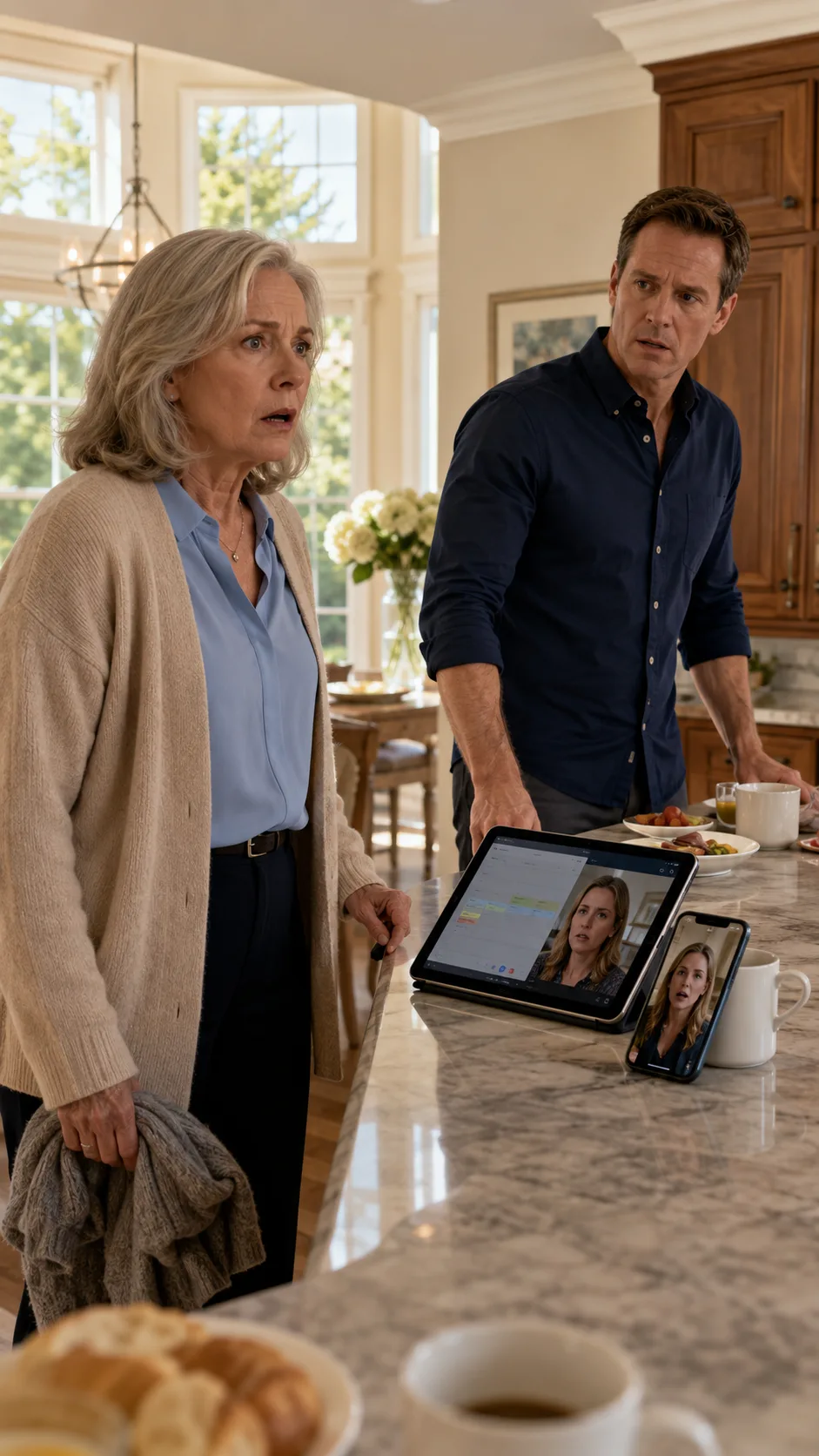
That evening, I answered Daniel’s video call.
All three of my children were together in Daniel’s kitchen, which almost made me smile. Nothing gathered them faster than inconvenience.
Daniel leaned close to the camera. “Mom. Thank God. Where are you?”
“In my living room.”
Claire’s eyes were red. “What living room?”
“My living room.”
Megan squinted at the screen. “Is that the beach?”
“Yes.”
Daniel’s jaw tightened. “You rented a place?”
“I did.”
“For how long?”
“As long as I want.”
The silence that followed was the first honest thing between us in years.
Claire pressed her fingers to her mouth. “Mom, why didn’t you tell us?”
I looked at my daughter, the little girl who used to bring me broken toys and believe I could repair anything.
“Because when I needed room to be a person, you gave me a schedule.”
Daniel flinched.
Megan crossed her arms. “That is not fair.”
I leaned closer to the phone. My reflection in the screen looked different. Older, yes. But clearer.
“No, Megan. Fair is not splitting your mother into three-month portions so nobody feels burdened.”
Her face changed. Just slightly. Not guilt yet. The crack before guilt.
Daniel said, “We were trying to manage a hard situation.”
“I was not a situation,” I said. “I was your mother.”
Claire began to cry. “I didn’t mean to make you feel unwanted.”
“I know,” I said. “That’s what hurts most. None of you meant to. You just got comfortable doing it.”
Daniel looked down.
For once, he had no meeting to run to.
Megan said quietly, “So what happens now?”
It was the question I had been waiting for. The question they should have asked before making a calendar.
“Now,” I said, “you call before visiting. You ask, not assign. You invite me because you want me there, not because you need help. And I decide whether I come.”
Claire wiped her face. “Are you cutting us off?”
“No.”
Daniel’s shoulders loosened, but I kept speaking.
“I am cutting off the version of me that accepted being passed around so I wouldn’t be alone.”
Megan looked away.
Behind Daniel, Lily appeared in the doorway.
“Is that Grandma?” she asked.
Daniel turned. “Yes, honey.”
Lily rushed into frame, her little face filling the screen. “Grandma, did you find your own days?”
My heart broke and healed in the same second.
“I did, sweetheart.”
“Are they nice?”
I looked out the window. The last light was spreading over the water like gold.
“They’re beautiful.”
Daniel covered his mouth with his hand.
Maybe it was the innocence of Lily’s question. Maybe it was hearing, out loud, what his own daughter had absorbed from him. Whatever it was, something in my oldest son finally gave way.
“Mom,” he said, voice rough, “I’m sorry.”
I waited.
He swallowed hard. “Not because you left. Because you had to.”
Claire sobbed then, not dramatically, not to pull me back into comforting her, but like someone finally seeing the damage in daylight.
Megan stayed silent the longest.
Then she said, “I didn’t want my house to feel crowded.”
I nodded.
She blinked fast. “But I made you feel like you were clutter.”
That was the first true thing she had said.
“Yes,” I said softly. “You did.”
She pressed her lips together and nodded once, like the admission cost her something.
The weeks that followed changed everyone.
Not quickly. Real change never arrives with music swelling in the background. It comes in awkward phone calls and uncomfortable silences. It comes when Daniel starts cooking badly for his own children and realizes dinner does not appear because someone loves you. It comes when Claire misses a school pickup and finally hires help instead of assuming I would save her. It comes when Megan posts a family photo without me, then deletes it because the caption about gratitude suddenly feels dishonest.
They visited three weeks later.
Not all at once at first. Daniel came alone.
He stood on my porch holding grocery bags like an apology he didn’t know how to word.
“I brought coffee,” he said.
“I have coffee.”
“I know.” He looked embarrassed. “I brought the kind Dad liked.”
That opened something in me.
We sat by the window. He cried before I did.
“I thought being the oldest meant organizing things,” he said. “After Dad died, I kept trying to solve you.”
I looked at him. “I didn’t need solving.”
“I know that now.”
Claire came the next weekend with the kids. She did not ask me to babysit. She brought flowers and helped Lily collect shells. Before leaving, she hugged me and whispered, “I miss you, but I don’t want to need you the same way anymore.”
“That,” I told her, “is the beginning of loving me better.”
Megan came last.
She arrived in cream-colored pants entirely wrong for sand and stood at my blue door with no makeup around her eyes.
“I almost didn’t come,” she admitted.
“Why?”
“Because I didn’t know who I was if I wasn’t the daughter who looked good in pictures.”
I stepped aside.
Inside, she noticed the old framed photo of Henry and me by the window.
“Dad would have loved this place,” she said.
“Yes.”
Her voice dropped. “Did we take his someday from you?”
I looked at the ocean for a long moment.
“No,” I said. “But I almost let you.”
She cried then. Quietly. Without checking her face.
Months later, the family calendar changed.
Daniel deleted MOM ROTATION SCHEDULE.
In its place, he created something new.
Mom Visits — Only When She Says Yes.
He showed it to me like a child bringing home a repaired toy.
I didn’t praise him too quickly. Some lessons should leave a mark long enough to matter.
But I did smile.
By spring, my cottage had lavender in pots, a stack of library books by the sofa, and neighbors who knew me as Rose, not Daniel’s mom, Claire’s help, or Megan’s inconvenience.
Sometimes my children visited. Sometimes I visited them. Sometimes I said no.
The first time I said no without explaining, my hands shook for an hour afterward.
The second time, only ten minutes.
The third time, I made tea and watched the sunset.
On my sixty-sixth birthday, they all came to the coast. Daniel grilled salmon badly. Claire’s kids ran barefoot through the sand. Megan took photos but asked first before posting one.
At dusk, Lily climbed into my lap on the porch swing.
“Grandma,” she said, “are you lonely here?”
I looked at my three children standing near the water, talking to each other like people learning a new language.
Then I looked at the cottage behind me. My books. My tea. Henry’s notebook. My own quiet life.
“No, sweetheart,” I said. “For the first time in a long time, I’m not.”
That night, after they left, the house settled into silence.
No one called my name from another room.
No one needed a ride.
No one asked what was for dinner.
I opened the window and let the ocean fill the cottage.
Then I sat in my chair, lifted my cup of tea toward Henry’s photograph, and whispered, “Someday finally came.”
THE END.
Chapter complete
You have reached the end of this chapter.
Continue reading
A few more worlds to get lost in after this chapter.




