THEY PASSED THEIR MOTHER FROM HOUSE TO HOUSE UNTIL THE DAY SHE REMOVED HERSELF FROM THEIR CALENDAR
PART 1
The glass slipped from my hand at exactly 11:43 p.m.
Chapter 1
THEY PASSED THEIR MOTHER FROM HOUSE TO HOUSE UNTIL THE DAY SHE REMOVED HERSELF FROM THEIR CALENDAR
PART 1
The glass slipped from my hand at exactly 11:43 p.m.
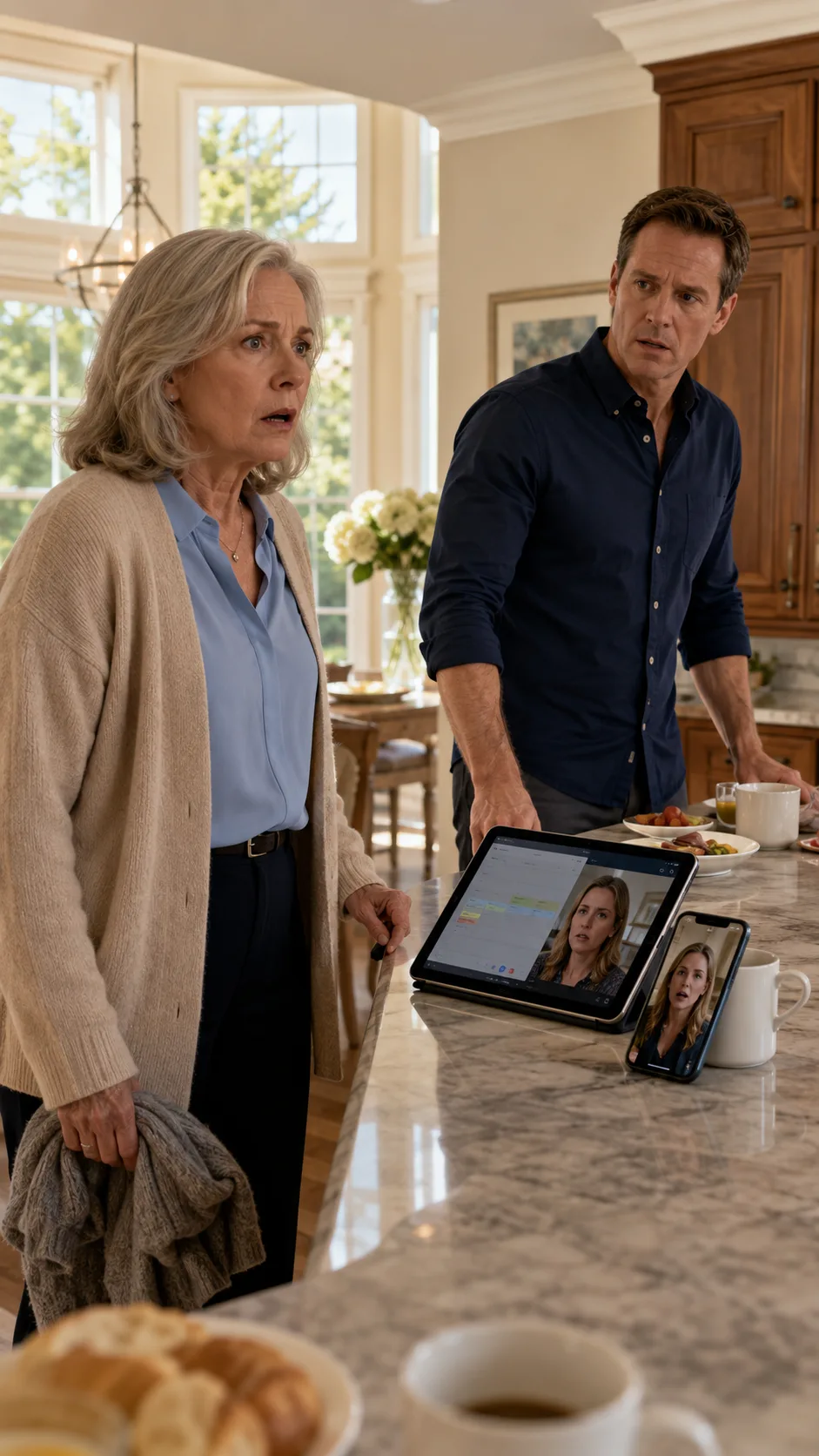
It hit Daniel’s kitchen floor and shattered so loudly that all three of my children froze on the video call.
Daniel, my oldest, was standing by the island in his expensive gray robe. Claire’s face glowed from the iPad screen. Megan’s voice was still coming through the speaker, sharp and impatient.
“Mom can’t stay with me past September,” Megan had just said. “We agreed on the rotation.”
Rotation.
That word sank into me harder than the broken glass under my slippers.
Daniel turned slowly. “Mom.”
I didn’t answer. My eyes were on the shared family calendar open on the iPad.
MOM ROTATION SCHEDULE.
Daniel: January–March. No extensions.
Claire: April–June. Only if Mom helps with school pickups.
Megan: July–September. Basement room only.
Holiday exception: nobody keeps Mom more than ten days.
Nobody keeps Mom.
For sixty-five years, I had been Rose Whitmore. A wife. A mother. A nurse. A woman who
raised three children, buried one husband, and retired with hands that still reached for people before they asked.
But in that kitchen, under Daniel’s warm pendant lights, I realized my children had turned me into an obligation with a calendar slot.
Claire whispered through the screen, “Mom, it isn’t what it looks like.”
I looked at my son, then at my daughters.
“When,” I asked, my voice barely steady, “did I become something you had to take turns keeping?”
No one answered.
And that silence told me everything.
PART 2
The next morning, Daniel acted like the night before had been a bad dream we had all agreed not to mention.
He came downstairs in his pressed white shirt, kissed his wife Lauren on the cheek, poured coffee into a travel mug, and said, “Mom, can we talk later? Big meeting today.”
I was standing at the stove making pancakes
for his two children.
His daughter, Lily, was six and still young enough to run into my arms without checking whether her mother approved. His son, Mason, was nine and old enough to notice grown-up silence.
“Grandma,” Lily said, swinging her feet from the breakfast stool, “Mommy says you make better pancakes because you have old hands.”
Lauren’s face tightened. “Lily.”
I smiled because that was what I had trained myself to do for decades. Smile before people saw the bruise.
“Old hands know things,” I said.
Daniel checked his phone. “Mom, about last night—”
“Not now,” Lauren cut in quickly, glancing at the kids.
Not now.
Those two words had followed me through every house.
Not now, Mom, we’re tired.
Not now, Mom, the kids are busy.
Not now, Mom, Megan has guests.
Not now, Mom, Claire’s overwhelmed.
Not now, Mom, Daniel’s stressed.
I flipped another pancake and listened
to the butter hiss.
After Daniel left, Lauren stood by the sink with her arms folded. She was not cruel in a loud way. She was polite enough to make cruelty sound like household management.
“Rose,” she said, “I hope you understand we were just trying to be fair.”
“Fair to whom?”
She blinked. “Everyone.”
“Everyone except me.”
Her mouth opened, then closed.
I expected an apology. I got a sigh.
“You know Daniel loves you,” she said. “But we have routines. The kids have routines. It’s just hard when there’s another adult in the house.”
Another adult.
Not mother. Not grandmother. Not family.
Another adult.
I wiped the stove clean, folded the dish towel, and said nothing.
By noon, Claire called.
“Mom, please don’t be mad.”
I was sitting in Daniel’s guest room, which had stopped being a guest room the day Lauren moved my suitcase into the corner and stacked storage bins in the closet. My clothes hung beside winter coats and old Halloween decorations.
“I’m not mad,” I said.
“You sound mad.”
“I sound awake.”
Claire went quiet.
Claire was my middle child, the one who had cried every first day of school until fifth grade, the one who used to crawl into my bed during thunderstorms. Now she had two children, a mortgage, a husband who traveled too much, and the constant exhausted voice of a woman who believed her stress excused everything.
“We didn’t mean rotation like that,” she said. “It was just a word.”
“It was a schedule.”
“Mom, we all have lives.”
The sentence was simple. But it landed like a door closing.
I looked at the framed photo on Daniel’s nightstand. Henry and me at our thirty-fifth anniversary party. My husband’s arm around my waist. My hair still mostly brown. His smile still alive.
“I had a life too,” I said.
Claire exhaled. “That’s not what I meant.”
“But it is what you believe.”
She began to cry. Softly at first, then with that familiar little break in her breathing that used to make me abandon everything and run to her.
This time, I stayed seated.
“Mom, I need you,” she whispered. “April is impossible without you. The kids love when you come.”
“Do they love when I come,” I asked, “or do you love when I help?”
“That’s not fair.”
There it was again.
Fair.
I had spent forty-two years making life fair for my children. Daniel got braces even when Henry worked overtime for six months. Claire got ballet lessons because she said dance made her feel brave. Megan got the expensive college dorm because she cried and said commuting would ruin her chance to make friends.
I had cut coupons. Worked double shifts. Worn the same winter coat for eleven years.
And now they were measuring fairness by who had to keep me longest.
“Claire,” I said quietly, “when I stayed with you last spring, where did I sleep?”
She hesitated. “In the playroom.”
“On what?”
“The pullout couch.”
“Between what?”
Silence.
“Between the dollhouse and the laundry baskets,” I answered for her. “Your son told his friend I was staying in the toy room because Grandma didn’t have a real room.”
“Mom—”
“And when my back hurt, you said it was only for three months.”
Claire didn’t speak.
I hung up before she could cry her way into making me comfort her.
That afternoon, I walked to the small park two blocks from Daniel’s house. November leaves scraped across the sidewalk. I sat on a bench, wrapped my coat tighter, and opened my purse.
Inside was Henry’s old leather notebook.
I had carried it from house to house without knowing why. Maybe because it was the only thing nobody had assigned a storage rule to. Maybe because Henry’s handwriting made me feel less invisible.
On the last page was a picture he had cut from a travel magazine years ago. A little white cottage near the Oregon coast. Blue shutters. A porch facing the water. Under it, Henry had written:
Someday, Rosie. No alarms. No hospital calls. No kids needing rides. Just coffee, waves, and you laughing again.
My thumb moved over the word someday.
Henry had died before someday came.
And I had let my children inherit even that.
My phone buzzed.
A text from Megan.
Mom, I heard there was drama. Please don’t bring negative energy when you come in July. Our house is very peaceful.
Then another.
Also, the basement is finished now, but please don’t move furniture around. It took forever to decorate.
I stared at the screen until the letters blurred.
Megan, my youngest, had always loved beautiful things. As a child she rearranged her dolls by dress color. As a teenager she cried if a family photo caught her from the wrong angle. Now she lived in a large modern house with white couches nobody sat on and glass tables nobody touched without coasters.
When I had stayed with her the year before, she posted a photo of us on Facebook.
Three generations of love, she wrote, though her children were not in the picture and she had asked me to change my sweater because “the brown one photographs sad.”
I typed back slowly.
Don’t worry. I won’t disturb your peace.
Then I deleted it.
I put the phone away.
For the first time since I retired, I did not ask myself where my children needed me.
I asked myself where I wanted to wake up.
The answer came so fast it scared me.
The ocean.
The next week, I told Daniel I was going to visit an old nursing friend.
“Sure,” he said without looking up. “Need a ride?”
“No.”
“You sure?”
“Yes.”
He nodded, already gone from the conversation.
I rented a car and drove two hours west to Cannon Beach.
The road wound through dark green forest, then opened suddenly to sky. When the ocean appeared, silver and endless under a pale afternoon sun, I had to pull over because my hands started shaking on the steering wheel.
I had seen the Pacific before, of course. Family vacations. Weekend trips. A rushed anniversary dinner once, when Henry and I spent more time checking on teenage children than watching the sunset.
But this time, nobody needed a bathroom. Nobody complained about the cold. Nobody asked when we were going home.
I drove until I found the cottage.
It was smaller than the picture in Henry’s notebook, but close enough to feel like a message. White siding. Blue door. A narrow porch. Wild grass bending in the wind. From the front window, I could see a slice of water between two dunes.
The owner was a widow named Marjorie, seventy-three, with bright red glasses and a laugh that sounded like a screen door swinging open.
“You alone?” she asked during the tour.
The question hit me strangely.
I almost said no. I have three children. Four grandchildren. A family calendar full of my name.
Instead, I said, “Yes.”
Marjorie studied me for a second. “Good. This house is kind to women who finally hear themselves think.”
I signed a six-month lease that afternoon.
Not because I was angry.
Because I was alive.
For three weeks, I said nothing.
I packed slowly. A sweater here. A box of books there. Henry’s photo album. My good tea cups. My nursing pin. The blue quilt my mother made.
Nobody noticed.
Daniel noticed when the freezer was not stocked.
“Mom, did you make the chicken casserole?”
“No.”
He looked confused, like appliances had stopped working.
Lauren noticed when Lily asked why Grandma wasn’t folding laundry anymore.
Claire noticed when I stopped answering every call on the first ring.
Megan noticed only when I replied to one of her long texts with: That won’t work for me.
On my last morning in Daniel’s house, snow threatened but never fell. The sky hung gray over the windows. I woke before everyone, dressed in my cream sweater and dark jeans, and carried my suitcases to the front door.
Lily appeared at the top of the stairs in pink pajamas.
“Grandma?” she whispered. “Is it Megan’s turn already?”
My throat tightened.
“No, sweetheart.”
She rubbed her eyes. “But Daddy said after Christmas nobody gets stuck with extra Grandma days.”
I closed my eyes.
There it was. The truth, filtered through a child’s innocent mouth.
Extra Grandma days.
I climbed the stairs, hugged her small warm body, and kissed her hair.
“You tell your daddy,” I whispered, “Grandma found her own days.”
I left a note on the guest room pillow.
Then I walked out before Daniel’s house woke up and remembered I existed.
By the time my children read the note, I was already halfway to the coast.
TO BE CONTINUED, PART 3 NOW
Chapter complete
You have reached the end of this chapter.
Continue reading
A few more worlds to get lost in after this chapter.




