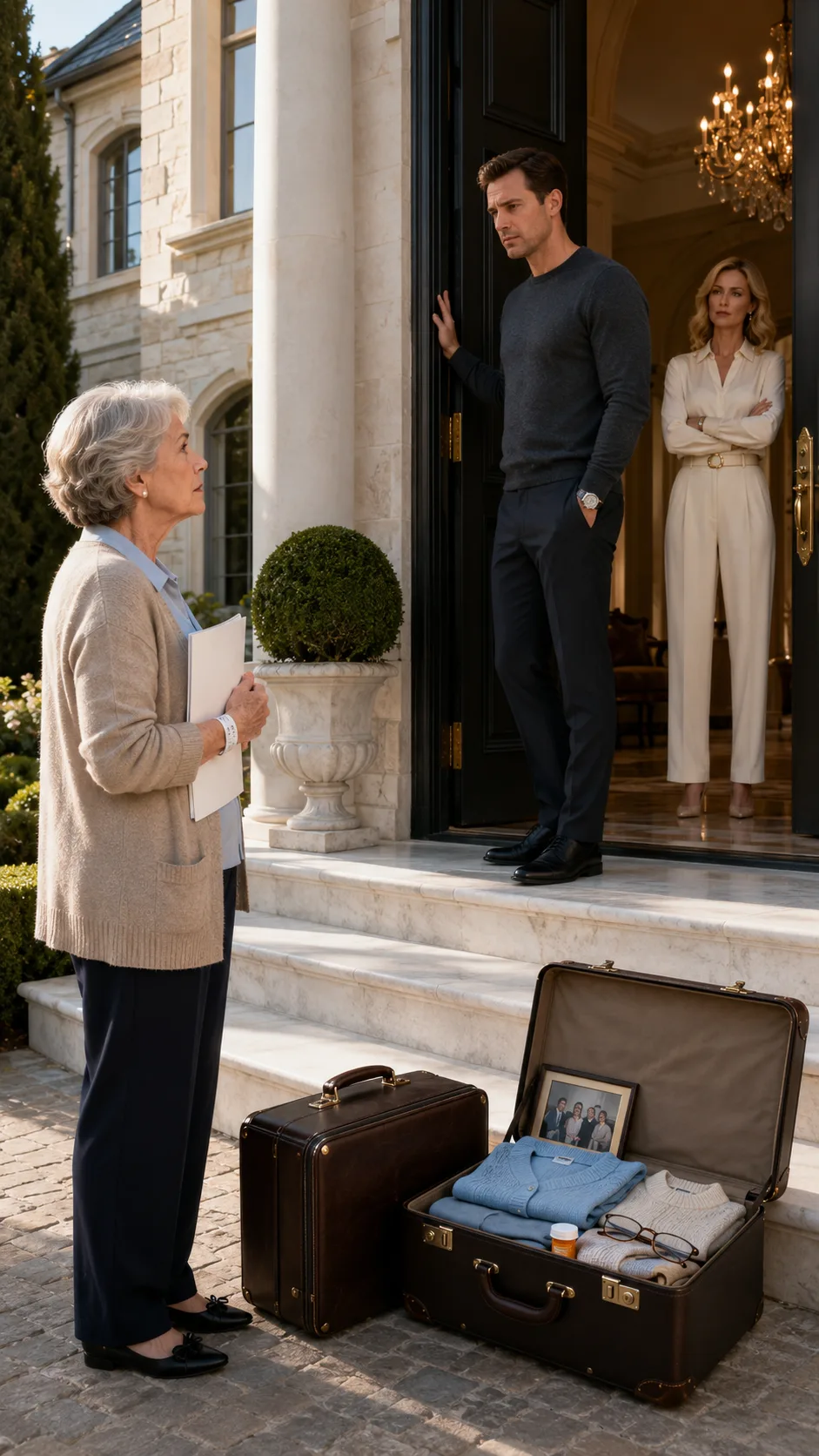
THE SON WHO THREW HIS SICK MOTHER OUT FOR HIS WIFE LEARNED THE HOUSE WAS NEVER HIS
PART 3
Harold’s handwriting shook across the page, but every word still felt like his voice in my ear.
Chapter 2
THE SON WHO THREW HIS SICK MOTHER OUT FOR HIS WIFE LEARNED THE HOUSE WAS NEVER HIS
PART 3
Harold’s handwriting shook across the page, but every word still felt like his voice in my ear.
I did not read the whole letter.
Some words between husband and wife are not meant to be used as weapons, even when you have been wounded.
But I read enough.
“My dearest Margaret,” I began, and Daniel’s face turned gray.
Rachel looked annoyed at first, like she thought this was another old memory she would have to tolerate. Then she saw Daniel’s expression and went quiet.
I continued.
“If Daniel keeps his promise, give him the grace we always gave him. If he builds a life with kindness, let this house shelter him too. But if the day comes when our son forgets who stood beside him, do not lose yourself trying to remind him.”
My voice almost broke on the next line.
“This home is yours, Maggie. Not because I left it to you, but because you made it one.”
Daniel covered his mouth with one hand.
“Stop,”
he whispered.
I lowered the letter.
Rachel stared at him.
“You knew?”
Daniel shook his head, but not convincingly.
“I knew Dad left it to Mom. I just thought eventually…”
“Eventually she’d die?” Rachel said.
The words were cruel, but they were not wrong enough for Daniel to defend himself.
He looked at me, horrified.
“That’s not what I meant.”
I folded Harold’s letter carefully.
“You may not have said it out loud, but you lived like it was already happening.”
Rachel stepped away from him.
“You told me your mother was staying with us temporarily.”
I looked at her.
“Temporarily?”
Rachel’s face flushed.
“That’s what he said. He said after his father died, you couldn’t manage alone. He said he let you move in.”
For a moment, even the birds seemed to stop.
I turned to Daniel.
“You told her I moved into my own house?”
His eyes filled
now.
“Mom, I was embarrassed.”
That word almost made me laugh again.
Embarrassed.
Not by Rachel’s cruelty.
Not by his broken promise.
By the truth.
I stepped onto the porch and stood close enough to see the tiny lines around his eyes, the same eyes I had kissed when he was a baby with a fever.
“Embarrassed of what?”
He wiped his face with the heel of his hand.
“That I didn’t have more. That I couldn’t give Rachel the life she wanted. She came from people with money. Her friends all had houses, vacations, new kitchens. I didn’t want her to think I was still depending on my mother.”
Rachel whispered, “So you let me treat her like a burden?”
Daniel turned sharply.
“You wanted her gone!”
Rachel’s mouth opened.
“Yes, because you told me she had nowhere else to go. You told me she guilted you into letting
her stay.”
I stood between them, hearing pieces of my life being rearranged into lies.
So Rachel had been cruel.
But Daniel had handed her the story that made cruelty feel reasonable.
That was the second breaking.
The first was seeing my suitcases.
The second was realizing my son had not merely failed to defend me.
He had prepared the world to misunderstand me.
I looked at him and said, “You made me small so you could look bigger.”
Daniel sank onto the porch step.
His shoulders folded inward. For the first time that day, he looked like the boy who used to hide under the dining table when Harold raised his voice at football games.
“I’m sorry,” he said.
Not dramatic. Not loud.
Just small.
But sorry did not carry my suitcases back inside. Sorry did not erase three years of shrinking my life into corners. Sorry did not restore the dinners I ate alone while hearing laughter from the dining room.
Rachel’s eyes shifted toward the suitcases.
“I didn’t know everything,” she said quietly.
“No,” I answered. “But you knew enough.”
She looked at me.
The arrogance had drained from her face, leaving something younger and less polished underneath.
“I was wrong,” she said.
I believed her.
And it changed nothing.
That is the part people never understand. Sometimes an apology can be real and still arrive too late to save what it broke.
Daniel stood again.
“Mom, we’ll move. But please don’t cut me out.”
I looked at the maple tree Harold planted.
Its branches had grown wider than the roofline now. Daniel used to climb it even after I warned him not to. Once, he fell and split his chin open. I drove him to the emergency room with one hand on the wheel and one hand holding a towel to his face.
He had cried, “Don’t leave me, Mom.”
I had said, “Never.”
I had kept that promise longer than I should have.
“I won’t cut you out,” I said. “But I won’t keep giving you a home while you treat me like a problem to solve.”
Daniel nodded, crying silently now.
Rachel picked up one of my suitcases.
For one brief second, I thought she was going to carry it inside.
Instead, she handed it to Daniel.
“You packed it,” she said. “You carry it back.”
Daniel took it like it weighed a hundred pounds.
He carried both suitcases into the house while Rachel stood aside. I followed slowly, one step at a time.
The hallway smelled like lemon cleaner and Rachel’s expensive candles. Not like Harold’s coffee. Not like my Sunday roasts. Not like the home I remembered.
But homes can be reclaimed.
Not all at once.
Room by room.
Memory by memory.
Daniel placed my suitcases in the living room. He looked around as if seeing the house for the first time.
The empty spaces where my pictures had been.
The polished surfaces where Rachel’s decorations sat.
The corner where Harold’s old chair had been removed because it “didn’t match.”
“Where’s Dad’s chair?” he asked.
I looked at Rachel.
She looked at the floor.
“In the garage,” Daniel whispered, answering himself.
That night, I slept in my old bedroom for the first time in eight months.
Not the small room beside the garage.
My room.
Harold’s side of the bed was cold, but not empty in the way it had been before. His letter sat on the nightstand. His photograph leaned against the lamp.
Downstairs, I heard Daniel and Rachel arguing in low voices.
I did not listen.
The next morning, Daniel knocked on my door.
He looked like he had not slept.
“Rachel’s going to stay with her sister for a while,” he said.
I nodded.
“And I’m going to look for an apartment.”
“Good.”
He flinched at how calm I sounded.
“I called a counselor,” he added. “For me. Not for you. I need to understand why I became this.”
That was the first thing he said that sounded like my son.
I softened, but only a little.
“I hope you do.”
He stood there, twisting his wedding ring.
“Can I still come by sometimes?”
I looked at him for a long moment.
“Not as the owner. Not as the man of the house. Not as someone doing me a favor.”
He nodded.
“As your son?”
I swallowed.
“As my son,” I said. “If you remember what that means.”
Thirty days later, Daniel moved out.
Rachel did not come back with him. Their marriage did not end in one explosive scene. Real life rarely does. It cracked in quiet places first. In the lies he told her. In the resentment she fed him. In the porch where they both finally saw what they had become.
On the last afternoon, Daniel carried Harold’s chair back from the garage.
The leather was dusty. One arm was scratched. But when he placed it by the front window, sunlight fell across it exactly the way Harold used to like.
Daniel stood beside it, crying openly.
“I forgot him,” he said.
I touched the back of the chair.
“No,” I said. “You forgot what he taught you.”
He nodded.
Then he handed me his house key.
I did not take it right away.
For a second, his hand trembled between us, holding the proof that everything had changed.
Finally, I took the key.
Not because I hated him.
Because I loved myself enough to lock the door when love stopped being safe.
Months passed.
Daniel visited on Sundays. At first, we sat stiffly across from each other drinking coffee neither of us finished. Then slowly, awkwardly, he started fixing things around the house without acting like he owned them.
A loose cabinet hinge.
A squeaky porch step.
The garden hose Harold never replaced.
One Sunday, he brought a framed photo with him. My wedding picture. The one Rachel had taken down.
“I found it in a box,” he said.
I looked at Harold’s young face, at my own smile, at the woman I had been before grief and motherhood taught me how much a heart could carry.
Daniel hung it back in the hallway.
He stepped down from the ladder and looked at it for a long time.
“I’m sorry I moved you out of your own life,” he said.
This time, I believed every word.
But forgiveness is not the same as forgetting. And love is not the same as permission.
So I let him hug me.
Then I let him leave.
That evening, I made tea in my own kitchen. I took out the rose-patterned cup Rachel had packed away. I sat in Harold’s chair by the window and watched the maple leaves move in the golden light.
For years, I thought losing my husband was the loneliest thing that could happen to me.
I was wrong.
The loneliest thing was realizing my son had been living under my roof while slowly moving me out of his heart.
But that night, with my wedding photo back on the wall, my chair by the window, and my key resting safely in my palm, I understood something Harold had tried to tell me in his final letter.
A home is not just the place where people stay.
It is the place where you are allowed to remain whole.
And at sixty-eight years old, after being packed into two suitcases by the boy I raised, I finally chose to stay.
THE END.
Chapter complete
You have reached the end of this chapter.
Continue reading
A few more worlds to get lost in after this chapter.




