THE SON WHO THREW HIS SICK MOTHER OUT FOR HIS WIFE LEARNED THE HOUSE WAS NEVER HIS
PART 1
My son put my suitcases on the porch the same afternoon I came home from my heart appointment.
Chapter 1
THE SON WHO THREW HIS SICK MOTHER OUT FOR HIS WIFE LEARNED THE HOUSE WAS NEVER HIS
PART 1
My son put my suitcases on the porch the same afternoon I came home from my heart appointment.
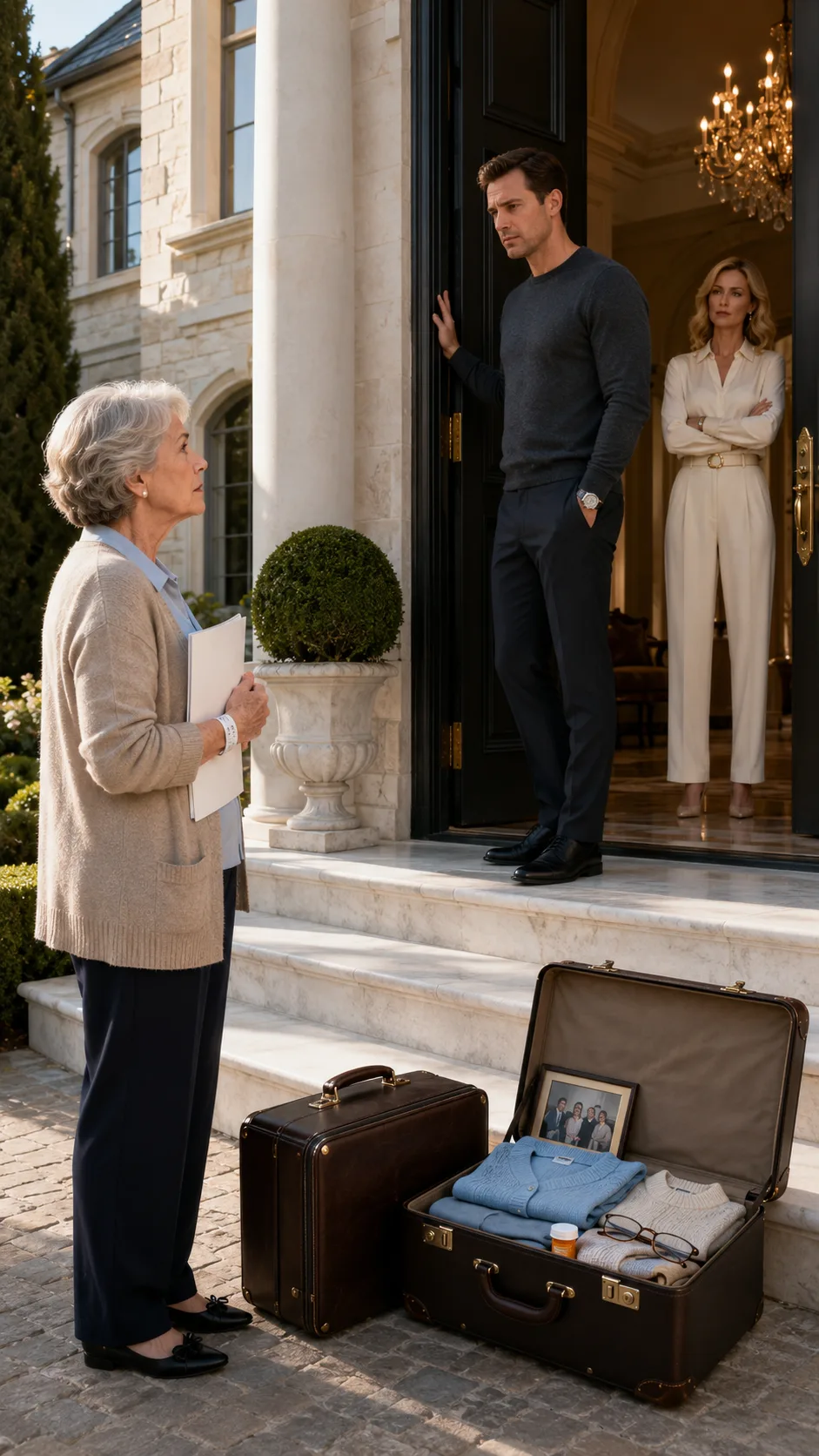
I was sixty-eight years old, still wearing the paper hospital bracelet on my wrist, still holding the little folder with my test results inside. The taxi had barely pulled away when I saw them: two faded brown suitcases lined up beside the front door like stray dogs waiting to be claimed.
One of them was open just enough for me to see my blue cardigan folded on top.
The cardigan my late husband, Harold, bought me on our thirtieth anniversary.
Daniel stood in the doorway with one hand gripping the frame. My only child. My boy. Forty years old now, clean-shaven, tired-eyed, dressed in the expensive gray sweater I had bought him last Christmas.
Behind him stood Rachel, his wife, arms crossed over her cream blouse, lips pressed into a thin line.
I looked from the suitcases to my son.
“Daniel,” I whispered, “what is this?”
He did not come
down the steps. He did not touch my arm. He did not ask about my appointment.
He just looked past me, toward the street, and said the sentence that split my life in two.
“Mom, you need to stop ruining my marriage.”
For a moment, I could hear nothing except the wind pushing dry leaves across the driveway.
Then Rachel stepped forward and said, almost gently, “We packed the things you’ll need.”
I looked at my son.
“You packed my life?”
Daniel swallowed.
“It’s better for everyone.”
PART 2
I stood there with my hospital folder in my hand while the house behind Daniel glowed with warm afternoon light.
My house.
The white shutters Harold painted every summer. The porch swing he built after Daniel was born. The front window where I used to stand with a baby on my hip, waiting for my husband’s truck to pull into the
driveway.
Rachel had changed almost everything inside since she moved in. The yellow curtains were gone. The family photos were moved upstairs. My rose-patterned dishes had disappeared into boxes in the basement because Rachel said they made the kitchen look “old.”
But the bones of that house still knew me.
The floorboards knew my steps.
The walls knew my prayers.
The doorway knew the day I carried Daniel home from the hospital wrapped in a blue blanket.
And now he stood there like a stranger, telling me I no longer belonged.
I walked slowly up the path, my legs weaker than I wanted them to be. Daniel shifted, uncomfortable, but he did not move to help me.
Rachel looked at the hospital bracelet on my wrist and then quickly looked away.
I stopped at the bottom step.
“Where exactly am I supposed to go?”
Daniel rubbed his forehead.
“There’s a
senior apartment complex on Maple Street. Rachel found it. It’s clean. Safe.”
Rachel corrected him softly. “Assisted living community.”
I stared at her.
“I cook my own breakfast, Rachel. I fold your laundry when you leave it in the dryer. I water your plants because you forget they exist. What part of me needs assisted living?”
Her eyes hardened.
“That’s not fair.”
I almost laughed.
Fair.
Fair was not a word I had heard in that house for a long time.
Fair was not watching my son slowly stop sitting beside me at dinner because Rachel preferred “couple time.”
Fair was not eating alone in the breakfast nook because Rachel said my stories about Harold made the room “too heavy.”
Fair was not Daniel knocking on my bedroom door one night and asking if I could move into the smaller room by the garage because Rachel wanted to turn my room into a guest suite.
A guest suite.
In the house my husband and I paid for with double shifts, coupon clipping, and thirty-five years of never buying anything unless we could afford it twice.
Daniel stepped down one stair.
“Mom, please don’t make this dramatic.”
My hand tightened around the hospital folder.
“You put my suitcases on the porch.”
“You’ve been making things difficult.”
“How?”
He opened his mouth, then closed it.
Rachel answered for him.
“You correct everything I do. The way I cook. The way I decorate. The way Daniel and I run our home.”
Our home.
The words hit harder than they should have.
I looked at Daniel.
“Is that what you think too?”
He looked tired. Not cruel, exactly. Just tired in the way weak people look when they want someone else to be the villain so they do not have to admit they chose wrong.
“I think,” he said, “that you and Rachel can’t live together anymore.”
“And because she is your wife, I’m the one who leaves.”
His jaw tightened.
“She is my future, Mom.”
I nodded slowly.
“And what am I?”
He said nothing.
That silence hurt more than the suitcases.
Rachel stepped beside him now, close enough that her shoulder brushed his. She looked triumphant, but careful. Like she had won something and wanted the victory to look polite.
“We’re not trying to be cruel, Margaret,” she said. “But marriage has boundaries.”
I looked at my son again.
“Did your father teach you that word?”
Daniel flinched.
“Don’t bring Dad into this.”
“Why not? He built this porch. He planted that maple tree. He held your hand right there on the driveway when you were sixteen and cried because your first girlfriend left you.”
Daniel’s face reddened.
“Mom.”
“And before he died, he asked you one thing.”
His eyes dropped.
I remembered that night too clearly. Harold’s breathing machine humming beside the bed. Daniel sitting on one side, me on the other. Harold’s hand, thin and cool, wrapped around Daniel’s fingers.
“Take care of your mother,” Harold had whispered. “She gave everything for this family.”
Daniel had cried then. Real tears. He had pressed his forehead to his father’s hand and promised, “I will, Dad. I swear.”
Now that same son stood in front of me, asking me to leave before dinner.
Rachel’s voice cut through the memory.
“This is exactly what I mean. You use guilt to control him.”
Something in me went very still.
Not angry.
Not loud.
Still.
I looked at Rachel and saw her clearly for the first time. Not as the woman my son loved. Not as the woman I had tried to welcome. Not as the daughter-in-law I had defended when Harold’s sister said she seemed “too polished.”
I saw a woman who had spent three years removing me from my own life one small object at a time.
First my chair.
Then my room.
Then my place at the table.
Now the front door.
I looked back at Daniel.
“Did you tell her?”
His brows pulled together.
“Tell her what?”
I stepped onto the first stair.
Rachel’s confidence flickered.
“Margaret, this isn’t the time for one of your speeches.”
I ignored her.
“Daniel,” I said, “did you tell your wife whose house this is?”
The porch went silent.
The wind moved the edge of my cardigan inside the suitcase.
Rachel’s head turned slowly toward him.
“What does she mean?”
Daniel did not answer fast enough.
That was his mistake.
Rachel’s face changed.
“Daniel.”
He swallowed.
“Mom, don’t.”
I climbed the second step. My knees ached, but my voice stayed steady.
“For three years, I let you call it your home because you were my son. I let Rachel replace my curtains, repaint my kitchen, move my photographs, and treat me like a guest who had overstayed.”
Rachel’s mouth opened slightly.
I kept going.
“But this house was never yours.”
Daniel looked at the porch floor.
Rachel stepped back from him as if the space between them had suddenly caught fire.
“What?” she whispered.
I reached into my purse and pulled out the small brass key I had carried since Harold died.
Not a house key.
A key to Harold’s old desk drawer.
“Your father left everything organized,” I said. “Every receipt. Every tax record. Every deed. Every note he wanted me to remember.”
Rachel stared at Daniel.
“You told me this house was yours.”
Daniel’s face went pale.
“It was going to be,” he muttered.
I shook my head.
“No. It was never going to be yours if you forgot what your father asked of you.”
His eyes lifted, wounded now that the wound belonged to him.
“Mom, I didn’t mean—”
“Yes, you did,” I said.
The sentence came out sharper than I expected.
Daniel blinked.
I pointed to the suitcases.
“You meant every folded sweater. Every packed pill bottle. Every family photograph you decided I could keep. You meant all of it.”
Rachel’s voice rose.
“You lied to me?”
Daniel turned to her.
“Rachel, I thought—”
“You thought what?” she snapped. “You let me spend money on renovations for a house you don’t own?”
I almost told her whose money paid for half those renovations.
The marble counter she bragged about.
The nursery she turned into an office.
The patio furniture she picked out after telling Daniel she needed “one beautiful place that felt like hers.”
All of it had been paid from the account Harold left me, because Daniel said he was struggling and I wanted my son’s marriage to start gently.
I said nothing yet.
Rachel looked at me now, not with guilt, but calculation.
“Fine,” she said. “Then we’ll work something out. Daniel is your son. You can’t just throw him out.”
I laughed once.
It sounded strange coming from my own mouth.
“You put my suitcases on the porch.”
Her face tightened.
“That was different.”
“No,” I said. “That was honest.”
Daniel stepped down to the porch, finally reaching for me.
“Mom, please. Let’s go inside and talk.”
I looked at his hand.
For a second, I saw him at eight years old, reaching for me after falling off his bike. I saw him at twelve, holding my hand at his grandfather’s funeral. I saw him at twenty-one, hugging me so hard after college graduation that my ribs hurt.
Then I saw him at forty, standing behind his wife while my belongings sat outside like trash.
I stepped back before he could touch me.
“No.”
His hand froze in the air.
Rachel crossed her arms again, but there was less strength in it now.
“What do you want, Margaret?”
I looked past them into the hallway.
The house was too clean. Too beige. Too empty of me.
“I want my home back.”
Daniel’s mouth trembled.
“Mom…”
“You and Rachel have thirty days to find another place.”
Rachel gasped.
“Thirty days?”
I looked at her.
“That is more kindness than you gave me.”
Daniel’s eyes filled, but no tears fell.
“You’d really make your own son leave?”
That question broke something open in me.
Not because it hurt.
Because it finally showed me how little he understood.
I leaned on the stair rail, looked directly at the child I had raised, and said, “No, Daniel. You already left me. I’m just changing the locks.”
For the first time that afternoon, Rachel had nothing to say.
Behind her, on the hallway wall, I saw the faint rectangle where my wedding photo used to hang.
I had allowed them to remove it because I did not want to be difficult.
I had allowed too much.
Daniel stood there breathing hard, caught between the wife he had chosen and the mother he had discarded.
Then I opened my purse again and pulled out one more thing.
A folded letter, yellowed at the edges.
Daniel recognized his father’s handwriting immediately.
His face crumpled before he even read it.
“What is that?” Rachel asked.
I held it against my chest.
“The last letter Harold wrote to me,” I said. “And he was afraid this day might come.”
Daniel whispered, “Mom, please don’t read that here.”
I looked at the suitcases, then at the porch, then at the son who once promised I would never be alone.
“Why not?” I asked. “You were willing to end my life in this house out here.”
Then I unfolded the letter.
To be continued, Part 3 now
Chapter complete
You have reached the end of this chapter.
Continue reading
A few more worlds to get lost in after this chapter.




