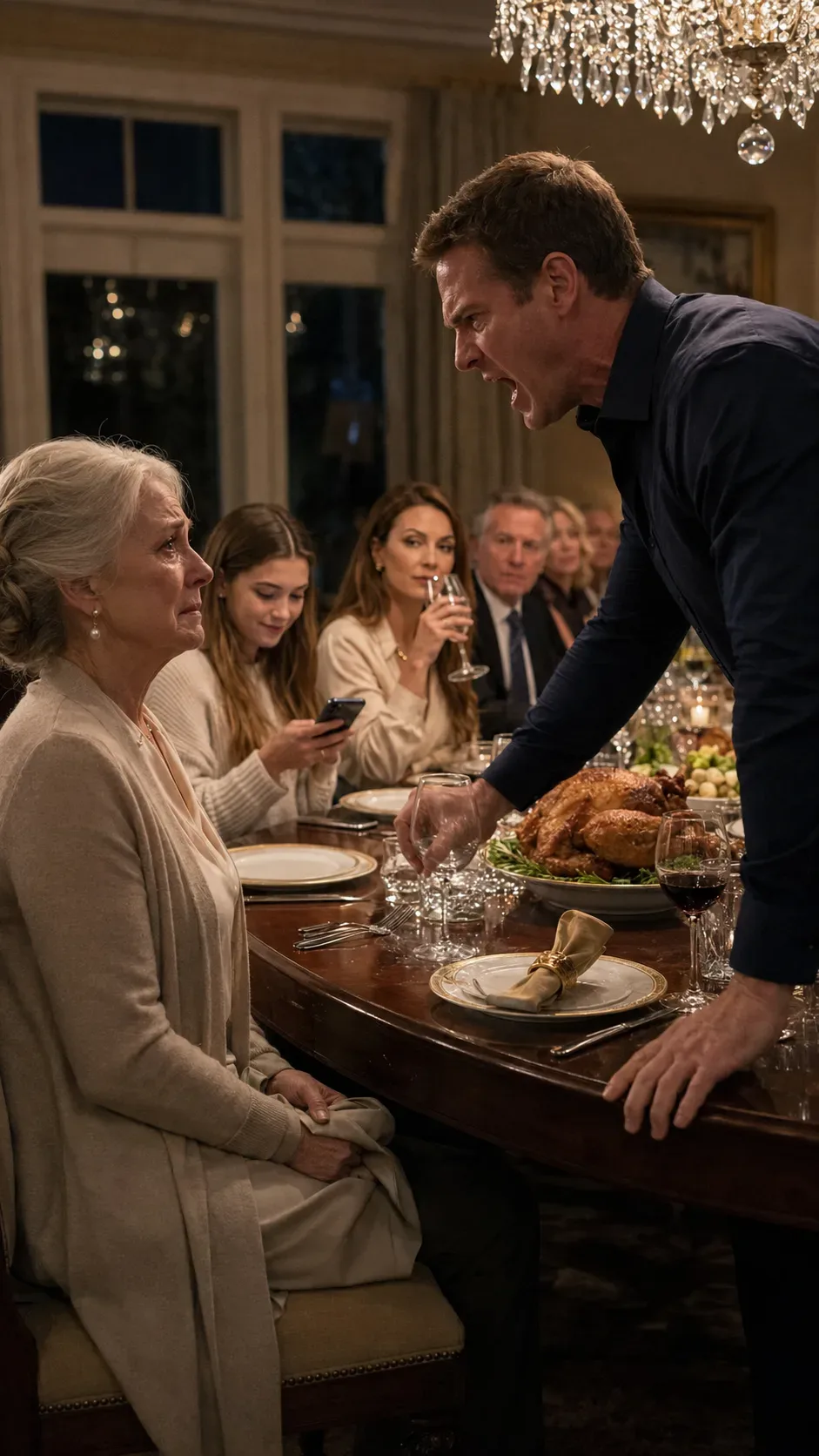
THE RETIRED MOTHER THEY MOCKED — UNTIL HER SECRET FORTUNE SAVED EVERYONE BUT THEM
PART 3 — THE PRICE OF BEING IGNORED
Michael followed me into the house without being invited.
Chapter 2
THE RETIRED MOTHER THEY MOCKED — UNTIL HER SECRET FORTUNE SAVED EVERYONE BUT THEM
PART 3 — THE PRICE OF BEING IGNORED
Michael followed me into the house without being invited.
That was something he had done since he was a child, moving through my rooms as if love automatically erased boundaries. Lauren came behind him, quieter than usual. Emily lingered near the doorway.
The three of them looked strange in my kitchen.
Too polished.
Too desperate.
Michael put both hands on the back of a chair.
“Mom, I’m sorry if I hurt your feelings.”
If.
That tiny word told me everything.
I filled the kettle with water.
Lauren stepped forward. “Rose, please. We’re not here to fight.”
“Then why are you here?”
She looked at Michael.
He looked at the floor.
For the first time in years, my son seemed younger than his age.
“My company is in trouble,” he said.
I set the kettle down.
“How much trouble?”
He swallowed. “Serious trouble.”
Lauren’s voice broke in quickly. “Not because Michael did anything reckless.”
I looked at her.
She stopped.
Michael rubbed his forehead.
“The platform I told you about at dinner,” he said. “I invested.”
“How much?”
He hesitated.
“How much, Michael?”
“Almost everything liquid.”
The kitchen seemed to shrink.
Lauren whispered, “And there’s a loan.”
I looked from her to him.
“A loan against what?”
Neither spoke.
Then Emily said from the doorway, “The house.”
Lauren turned sharply. “Emily.”
The girl’s eyes filled with tears, but she kept looking at me.
“I heard you fighting,” she said. “Dad said if Grandma helped, everything would be fine.”
There it was.
Not an apology.
A plan.
Michael’s face tightened. “I didn’t say it like that.”
I pulled out a chair and sat down because suddenly my legs felt tired in a way that had nothing to do with age.
“You came here because you need money.”
Michael’s voice softened. “I came because we’re family.”
“No,” I said. “You came because
the article had a number in it.”
He flinched.
Lauren sat across from me, her perfect posture collapsing slightly.
“Rose, I know we haven’t always made you feel included.”
I almost laughed.
Included.
Such a neat little word for being dismissed in your own family.
She continued, “But losing the house would destroy Emily.”
Emily whispered, “Mom, don’t put that on me.”
Lauren’s face went white.
I looked at my granddaughter.
For the first time that day, I saw something real in her. Not attitude. Not teenage boredom. Shame.
“Come here, sweetheart,” I said.
Emily walked to me slowly.
I reached for her hand.
She let me take it.
“I’m sorry,” she whispered. “For laughing that night.”
Michael closed his eyes.
Lauren looked away.
Emily’s chin trembled. “I thought it was just a joke. But then Dad kept saying you were being dramatic, and Mom said you’d get over it
because old people always want attention, and I—”
“Emily,” Lauren snapped.
“No,” Emily said, louder. “I’m tired of pretending we’re nice.”
The room went silent.
There are moments in a family when the youngest person becomes the only honest one.
Emily wiped her cheek with her sleeve.
“Grandma remembered everything about me. My recital dates. My allergies. My favorite cake. And we treated her like she was annoying.”
I squeezed her hand.
Michael sat down heavily.
“Mom,” he said, his voice hoarse. “I made mistakes.”
“Yes.”
“I was under pressure.”
“Yes.”
“I wanted to prove I could build something without help.”
I looked at him carefully.
“That part I understand.”
His eyes lifted.
“But you didn’t want to build without help,” I said. “You wanted help that didn’t look like help. You wanted my cooking, my babysitting, my praise, my quiet support, my emergency money. You wanted me available and invisible.”
He had no answer.
Lauren began to cry silently.
I did not enjoy it.
That surprised me. Part of me had imagined this moment. The moment they saw my worth. The moment they regretted every laugh, every eye roll, every little cut.
But revenge is much sweeter in imagination than it is at a kitchen table with your son looking ruined.
Michael leaned forward.
“Can you help us?”
There it was.
The question beneath every apology.
I stood and walked to the window above the sink. Outside, my garden moved gently in the wind. Daniel’s roses were blooming late that year, stubborn and bright.
“I will pay for Emily’s final year of school directly,” I said.
Lauren gasped with relief.
I turned back.
“And I will pay for a financial counselor for both of you.”
Michael stared at me. “What about the loan?”
“No.”
His face changed.
“Mom.”
“No,” I repeated. “I will not rescue your pride and call it love.”
Lauren pressed a hand to her mouth.
Michael stood. “So you’re going to let us lose the house?”
“You risked the house after telling me I didn’t understand risk.”
“That’s not fair.”
“Neither was laughing at me in front of my family.”
He looked like I had slapped him, though I had not moved.
I continued, “I spent my life catching you before you hit the ground. Maybe that is where I went wrong. Maybe you began to think falling was impossible.”
His eyes shone.
I hated seeing it.
I loved him.
That was the cruelest part. Love does not disappear just because respect does.
Emily stepped beside me.
“I can get a job,” she said softly. “For college stuff. I don’t need everything.”
Lauren began crying harder.
Michael sank back into the chair.
“I don’t know how to fix this,” he admitted.
That was the first true thing he had said all day.
I walked over and placed a hand on his shoulder.
“Start by telling the truth. To yourself first. Then to your wife. Then to your daughter.”
He covered his face.
Weeks later, Michael and Lauren sold the house before the bank could take it. They moved into a smaller rental with old cabinets and no chandelier. Lauren cried the first time I visited, not because the house was ugly, but because she had never realized how much of her identity had been built on rooms she could photograph.
Michael took consulting work under another firm while rebuilding his business slowly. For the first time, he asked questions before making decisions. Sometimes he even listened to the answers.
Emily came to my house every Saturday.
At first, she said it was to help me in the garden. But mostly we talked.
She told me about school, friends, fear, and the strange pressure of growing up in a family that confused success with performance. I told her about Daniel, about work, about the early days when I was often the only woman in a room full of men who repeated my ideas ten minutes later as if they had invented them.
One afternoon, Emily asked, “Why didn’t you tell them sooner? About the money?”
I pruned a rose stem and thought about it.
“Because money changes how people listen,” I said. “I wanted to know if they could hear me before they knew I had it.”
She nodded slowly.
“And they couldn’t.”
“No,” I said. “Not then.”
A month after the acquisition closed, I launched the Bennett Second Spring Fund, a foundation for retired women who wanted to start businesses, return to school, or invest in ideas everyone else dismissed as too late. Priya spoke at the opening event.
So did Emily.
She stood at the podium in a simple blue dress, hands shaking around her notes.
“My grandmother taught me something my family learned too late,” she said. “People don’t become useless when they get older. Sometimes they become powerful in ways younger people are too arrogant to recognize.”
I cried then.
Openly.
Without hiding in a car.
Michael was in the audience. He cried too.
After the event, he approached me with his hands in his pockets.
“I’m proud of you, Mom,” he said.
I smiled. “Thank you.”
He looked down. “I should have been proud before.”
“Yes,” I said softly. “You should have.”
He nodded, accepting the weight of it.
That was new.
Months later, he invited me to dinner at their smaller place. The table was scratched, the chairs mismatched, and Lauren burned the chicken slightly. It was the best meal I had eaten with them in years.
Halfway through dinner, Michael started talking about a new business idea.
Then he stopped.
He looked at me.
“Mom,” he said, “would you mind looking at the numbers?”
The room went still.
Lauren looked nervous.
Emily smiled into her water glass.
I took the folder from him, opened it, and read the first page.
Then I looked up.
“There are three problems,” I said.
Michael nodded.
This time, he did not laugh.
This time, he picked up a pen.
And for the first time in a very long time, my son listened.
But I never forgot that night under the crystal chandelier. I never forgot the laughter, or the way my own family made me feel like my mind had expired the day my career ended.
Forgiveness came slowly.
Trust came slower.
And when relatives who had ignored me for years suddenly began calling with investment ideas, medical bills, tuition problems, and business dreams, I answered politely.
Sometimes I helped.
Sometimes I didn’t.
But when Michael once joked gently, “Mom, you really do understand the world better than all of us,” I looked at him over my coffee and smiled.
Then I said the words he had earned.
“I thought I didn’t understand the world anymore.”
His face turned red.
Emily burst out laughing.
And this time, I laughed too.
Not because the joke was cruel.
Because finally, everyone at the table understood exactly who it was about.
THE END.
Chapter complete
You have reached the end of this chapter.
Continue reading
A few more worlds to get lost in after this chapter.




