at a balance sheet and smell danger.
Michael used to be proud of that.
When he was younger, he would tell his friends, “My mom runs money for a whole company.”
After I retired, that changed.
Suddenly, I was “old school.”
Suddenly, I “didn’t understand the modern market.”
Suddenly, my years of experience were something to smile at politely before ignoring completely.
The change was slow at first.
At Thanksgiving, I suggested that Michael slow down before expanding his consulting firm into three new states. He laughed and said, “Growth doesn’t wait, Mom.”
At Christmas, I warned Lauren not to put so much money into a luxury vacation club she had heard about from a neighbor. She smiled too brightly and said, “Rose, this isn’t like balancing a checkbook.”
When Emily told me she was posting videos from outside her school, showing the building name and street, I told her to be careful. She rolled her eyes.
“Grandma, you don’t get how the internet works.”
Maybe I didn’t get every new app.
But I understood people.
People had not changed nearly as much as they liked to think.
That Sunday dinner was supposed to be ordinary. Michael had invited his in-laws, two cousins, and a neighbor couple he liked to impress. He wanted the house full because he had news.
I knew that look on his face.
The polished smile. The shoulders held too high. The little bounce in his voice. Michael only looked like that when he wanted applause before anyone had checked whether applause was deserved.
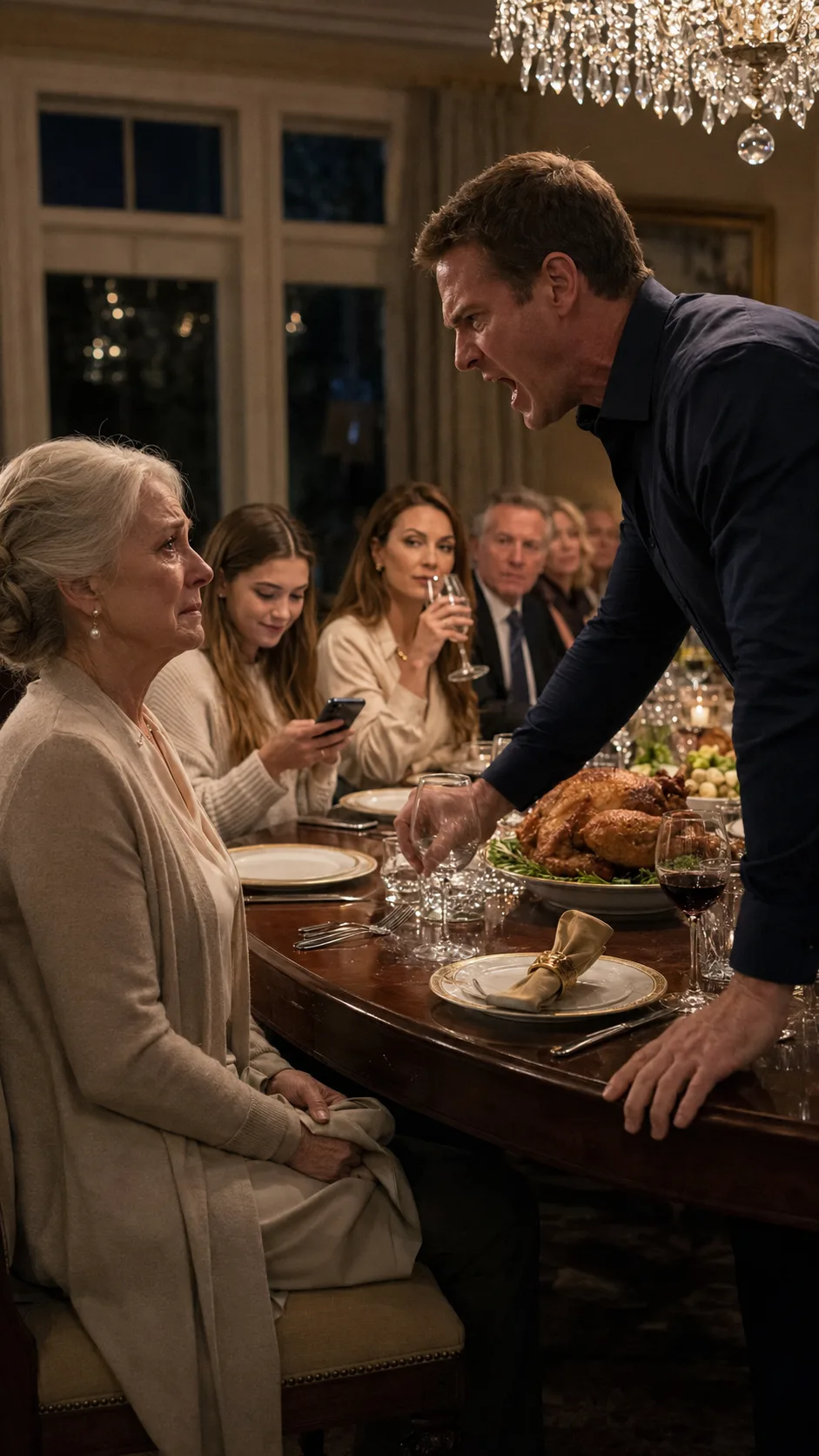
We sat at the dining table under Lauren’s crystal chandelier, the one she had bought after telling me she and Michael were “tight this month.” The table was long, white, and cold-looking, decorated with candles no one was allowed to light because Lauren said smoke stained ceilings.
I sat at the far end.
I always seemed to end up there now.
Michael stood near the head of the table with a glass of wine in his hand.
“So,” he said, smiling. “I wanted family here tonight because we’re stepping into something big.”
Lauren’s face tightened, but she kept smiling. That was the first sign she was nervous.
Michael continued, “I’ve been speaking with a founder out in California. He’s building a platform that uses predictive behavioral mapping for consumer health choices.”
One of the cousins nodded like he understood.
I did not nod.
I listened.
Michael talked for ten minutes. He used words like disruptive, scalable, frictionless, and future-proof. The longer he spoke, the more uneasy I became.
“What’s the revenue?” I asked gently.
He looked at me.
The room paused.
“Revenue?” he repeated, with a little laugh.
“Yes,” I said. “Actual revenue. Not projected. Not possible. Actual.”
Lauren’s fork stopped halfway to her mouth.
Michael smiled, but his eyes hardened. “Mom, it’s early-stage.”
“That doesn’t answer the question.”
“It’s not that kind of company.”
“All companies become that kind of company eventually.”
A couple of people chuckled softly, like I had made a cute old-person joke.
Michael took a sip of wine.
“They’re building users first,” he said. “Revenue comes later.”
“Sometimes,” I said. “And sometimes later never arrives.”
The table went quiet again.
I should have stopped. I know that now. Not because I was wrong, but because Michael had already decided the truth was disrespectful if it came from me.
He set his glass down harder than necessary.
“Mom, please.”
His voice had changed.
I looked at him. “I’m only saying you should look carefully before risking too much.”
He laughed then. Not warmly. Not kindly.
A sharp, embarrassed laugh meant to put me back in my place.
“You don’t understand this world anymore,” he said.
The words landed in the middle of the table like a dropped knife.
No one moved.
Then Lauren gave a small laugh. One of the cousins smiled into his napkin. Emily glanced up, saw her parents’ faces, and smirked like she had been given permission.
Michael kept going.
“You had a good career, Mom. Nobody’s taking that away from you. But you’re retired. Things are different now. Markets move faster. Technology moves faster. People don’t make decisions the way they did in 1985.”
I stared at my son.
My own son.
The boy whose college tuition I had paid by working sixty-hour weeks. The man whose first office lease I had quietly guaranteed when no bank trusted him yet. The child who once cried in my arms because he was afraid he would never be as smart as his father.
Now he was looking at me like I was a sweet old woman who had wandered into the wrong conversation.
Then he said the sentence that changed everything.
“Mom, you don’t understand anything about the world now.”
The room laughed.
Not loudly.
That would have been kinder.
It was worse than that. It was a ripple of polite laughter, the kind people use when they agree but want to pretend they don’t.
I looked at Emily.
She was smiling at her phone.
I looked at Lauren.
She lifted her wineglass.
I looked at Michael.
He looked relieved, as if he had finally said what he had wanted to say for years.
I folded my napkin and placed it beside my plate.
“You’re right,” I said quietly.
Michael blinked.
“I am?”
I stood up.
The chandelier light made the silver in my hair shine in the dark window behind him.
“I won’t offer advice anymore.”
Lauren’s smile faded slightly.
“Rose, don’t be dramatic.”
I looked at her. “I’m not.”
Then I picked up my purse, walked out of the dining room, and left my untouched dinner cooling on the plate.
No one followed me.
Not one person.
PART 2 — THE SECRET ROSE KEPT
I did not cry until I reached my car.
Even then, I did it carefully.
Old habits.
When you spend decades being the calm woman in every emergency, you learn how to fall apart quietly. You learn to keep tissues in the glove box. You learn to breathe through your nose so no one hears the sob.
I sat in Michael’s driveway with both hands on the steering wheel and watched his beautiful house glow behind the windows.
They were still eating.
Of course they were.
My absence had not ruined anything.
That was the part that hurt most.
On the drive home, I passed the little pharmacy where Michael once threw up in the parking lot because he had the flu and was too embarrassed to tell his teacher. I passed the elementary school where I had stood in the rain for two hours selling raffle tickets so his class could afford a field trip. I passed the baseball field where his father, Daniel, used to cheer so loudly that Michael would blush and pretend not to love it.
Daniel would have been furious if he had heard our son tonight.
Or maybe he would have been heartbroken.
That was harder to imagine.
My house was smaller than Michael’s but warmer. A brick colonial with blue shutters, a creaking back door, and a garden Daniel had planted the year before he died. I liked the imperfections. They made the house feel alive.
I hung my coat in the hallway, made tea, and sat at my kitchen table.
Then I opened my laptop.
There was an email waiting from a woman named Priya Shah.
Subject line: Nexora Health — Acquisition Timeline Update.
I read it twice.
Then I sat very still.
Sixteen years earlier, I had met Priya at a community business event in Cambridge. She had been twenty-nine then, brilliant, exhausted, and wearing shoes that looked painful because she could not afford better ones yet. She had created software that helped older patients track medications, appointments, and symptoms in a way doctors could actually use.
Everyone else at that event wanted to fund young men building social apps, delivery apps, dating apps, or something with advertising.
Priya wanted to help people like my husband.
Daniel had been sick then, though we had not told many people. Some days he forgot whether he had taken his heart medication. Some days I had to call three different doctors just to make sure one prescription would not interfere with another.
When Priya showed me her early demo, I saw more than software.
I saw relief.
I invested seventy-five thousand dollars.
It was not pocket change. It was money I had saved for years. Daniel thought I was taking a risk, but he trusted me.
Michael did not.
He had been twenty-five then, freshly graduated and full of opinions he had borrowed from men in expensive suits.
“Mom, health tech is crowded,” he told me. “You should put that money somewhere safe.”
I asked him if he had read Priya’s plan.
He said, “I don’t need to. I know the space.”
That was Michael’s problem, even then.
He often knew things before learning them.
For years, Nexora grew slowly. Then faster. Then quietly exploded.
Hospitals adopted it. Insurance companies partnered with it. Care networks depended on it. Priya never forgot the early investors who had believed in her before believing was fashionable.
I never told Michael how much my stake had become.
At first, because it felt private.
Later, because I started noticing how differently people treated me when they needed something.
After Daniel died, Michael and Lauren became generous with advice about my life.
They thought I should sell my house.
They thought I should move closer.
They thought I should let Michael “help” manage my retirement accounts.
They thought I should stop driving at night, stop trimming my own roses, stop volunteering at the library because “standing that long can’t be good.”
They wanted me smaller.
Safer.
Easier to place.
But they never asked if I was lonely.
They never asked what I missed.
They never asked whether retirement felt like freedom or exile.
So I kept Nexora to myself.
The email from Priya confirmed what I already knew was coming: a major acquisition by a national health network. My shares, after all conversions and adjustments, would be worth more than forty-eight million dollars.
Forty-eight million.
I looked around my kitchen.
At the chipped mug by the sink. At Daniel’s old reading glasses still in the drawer because I could never bring myself to throw them away. At the magnet Emily made when she was six that said, “Rosie makes the best pancakes.”
I laughed once.
Then I cried again.
Not because of the money.
Because my son had sat across from me and told me I did not understand the world while I was holding a fortune built entirely on understanding it before he did.
The next morning, Michael called.
I let it go to voicemail.
“Mom,” he said, his voice stiff. “I think last night got a little out of hand. I don’t want things to be awkward. Call me.”
No apology.
Just management.
Lauren texted two hours later.
Dinner was tense last night. Let’s move forward with grace.
I stared at that message for a long time.
Grace.
People loved asking for grace after spending years spending someone else’s patience.
I did not answer.
For the next two weeks, I did something my family had not seen me do in years.
I lived for myself.
I met Priya for lunch in Boston. She hugged me so tightly that people turned to look.
“You changed my life,” she said.
I smiled. “You built the company.”
“You wrote the first check that made me believe I wasn’t crazy.”
We talked for two hours about the acquisition, taxes, philanthropy, and what came next. Priya wanted to start a foundation for older patients and caregivers who were drowning in medical confusion. I wanted in immediately.
“You know,” she said, stirring her coffee, “the press team wants to include you in the announcement.”
I froze.
“As what?”
“As one of Nexora’s first investors. One of the people who saw the future before everyone else.”
I almost said no.
Then I heard Michael’s voice again.
You don’t understand anything about the world now.
I looked at Priya and said, “Use my name.”
The article came out on a Thursday morning.
By noon, my phone had become a fireworks show.
Texts.
Calls.
Emails.
Old colleagues. Neighbors. A local reporter. A woman from my book club who had apparently discovered emojis.
Then Michael called seventeen times.
I was in my garden when he arrived.
Not called.
Arrived.
His black SUV pulled up too fast, tires crunching over gravel. Lauren got out on the passenger side wearing oversized sunglasses, though the sky was cloudy. Emily climbed out slowly, her face pale and uncertain.
Michael walked toward me holding his phone.
“Is this real?” he demanded.
I kept watering my hydrangeas.
“Hello to you too.”
“Mom.”
I turned off the hose.
Water dripped from the leaves between us.
“Is what real?”
He held up the screen. My picture was on it. I was standing beside Priya at a Nexora event, wearing a cream blazer and the pearl earrings Daniel gave me for our thirtieth anniversary.
Under the photo was a headline calling me an early investor whose stake had grown into a multimillion-dollar windfall.
Lauren removed her sunglasses.
“Rose,” she whispered. “Forty-eight million?”
Emily stared at me like I had become a stranger.
Michael’s mouth opened and closed once.
“You had this,” he said, “and you never told us?”
I folded my gardening gloves in my hands.
“You told me I didn’t understand the world.”
His face flushed. “That was one dinner.”
“No,” I said. “That was one sentence. The dinner was years long.”
To be continued… Click “PART 3” to read the final part : 👉 PART 3 👈