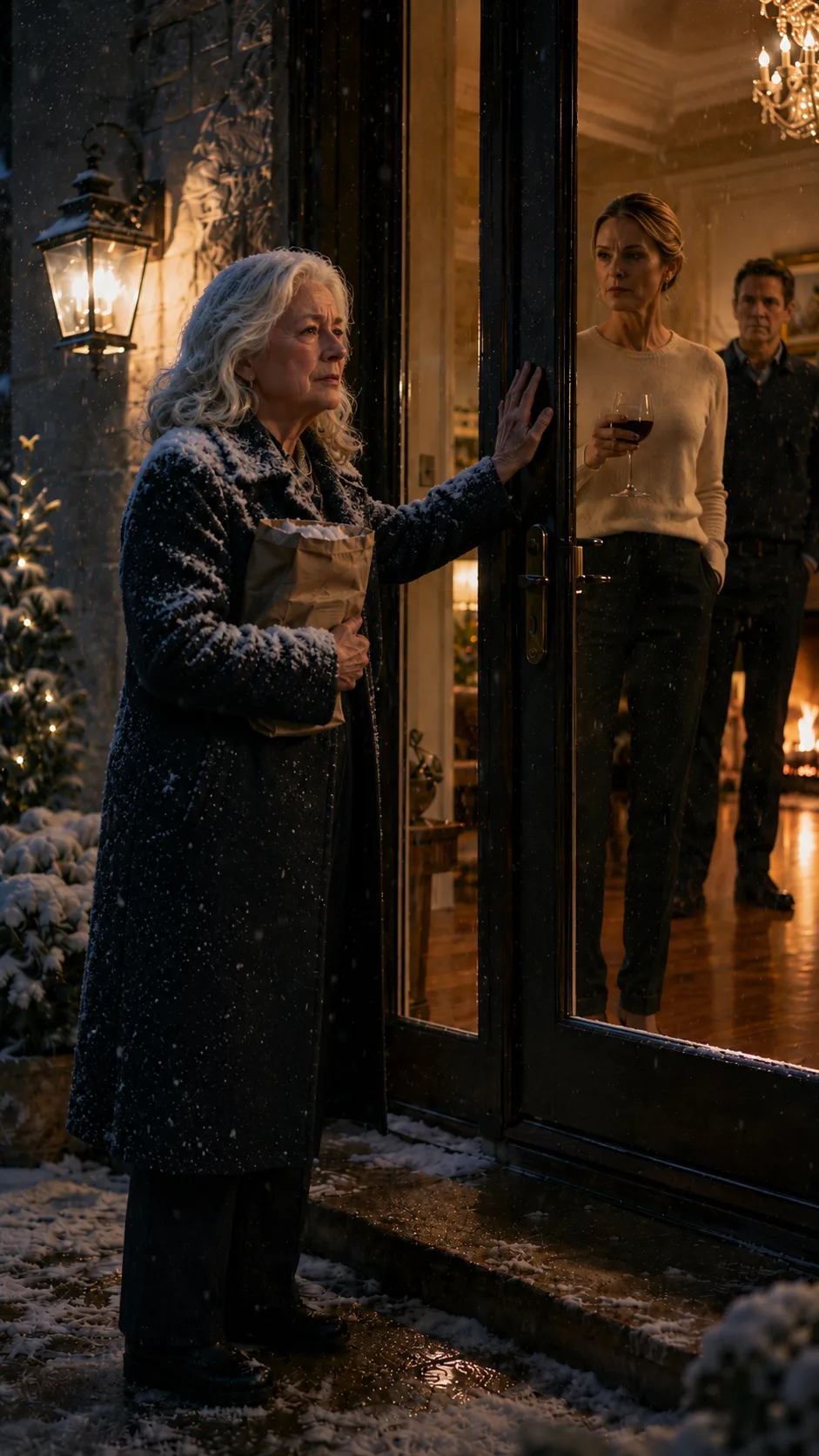
THE NIGHT MY SON LEFT ME OUTSIDE IN THE SNOW AND LEARNED WHO REALLY OWNED HIS HOME
PART 3 — THE WOMAN WHO FINALLY CHOSE HERSELF
By morning, Michael had called fourteen times.
Chapter 2
THE NIGHT MY SON LEFT ME OUTSIDE IN THE SNOW AND LEARNED WHO REALLY OWNED HIS HOME
PART 3 — THE WOMAN WHO FINALLY CHOSE HERSELF
By morning, Michael had called fourteen times.
I did not answer.
Stephanie called once.
I did not answer that either.
At ten-thirty, I returned to the house in Linda’s SUV. Paul sat in the passenger seat with a leather folder on his lap. Behind us, a real estate agent named Marcy followed in her own car.
I watched the house come into view.
For months, I had entered through the side door like a delivery person. That morning, I walked up the front steps.
Stephanie opened the door wearing a pale blue sweater and annoyance.
“Rose,” she said. “This is not a good time.”
I looked at the keypad beside the door.
“For once,” I said, “I agree.”
Her eyes moved to Linda, then Paul, then Marcy.
“Who are these people?”
Michael appeared behind her, unshaven and hollow-eyed.
“Mom,” he said quickly. “Please. Can we talk?”
“We are talking.”
Stephanie crossed her arms. “If this is about
last night, everyone was emotional. You can’t just show up with strangers because you got upset.”
Linda stepped forward. “She got left in the snow after a doctor’s appointment.”
Stephanie ignored her.
“Rose, you’re making this bigger than it needs to be.”
I stepped into the foyer.
“No. I made it smaller for too long.”
Michael looked at Paul’s folder, and his face went gray.
“Mom…”
Stephanie noticed.
“What?” she said. “What is that?”
Paul placed the folder on the entry table and opened it.
“Mrs. Carter asked me to review the property arrangement.”
Stephanie frowned. “Property arrangement?”
Marcy spoke gently. “I’m here to evaluate the house for sale.”
Stephanie laughed.
It was not a nervous laugh at first. It was sharp, almost amused.
“Sale? This house is not for sale.”
I looked at Michael.
He could not meet my eyes.
Stephanie turned to him slowly.
“Michael?”
He swallowed. “Steph—”
“What is she talking about?”
I answered before he could hide behind another weak explanation.
“This house was saved with the money from my apartment,” I said. “And when Michael could not qualify to keep it, I took responsibility for it.”
Stephanie stared at me.
“What does that mean?”
“It means the house is mine.”
The words fell into the foyer like glass breaking.
Stephanie grabbed the papers from the table. Her eyes scanned them too fast, then slower, then again.
“No,” she whispered.
Michael pressed both hands against his face.
Stephanie turned on him.
“You told me she helped with a payment.”
“She did,” he said hoarsely.
I shook my head.
“I sold my home. I paid off what had to be paid. I let you live here because I believed family meant safety.”
Stephanie’s face flushed.
“You tricked us.”
That almost made me laugh.
“No, Stephanie. I trusted
you. That was my mistake.”
Michael came closer.
“Mom, please don’t do this.”
I looked at him.
“Do what?”
“Sell the house.”
“Why not?”
“Because the kids live here.”
“The kids will be protected,” I said. “I am setting aside money for their education. They will not suffer for your choices.”
Stephanie’s voice rose. “And where are we supposed to go?”
I turned to her.
“I believe you mentioned hotels.”
Her mouth shut.
For the first time since I had moved in, Stephanie had no polished answer.
Michael’s eyes filled with tears.
“Mom, I’m sorry.”
The words landed softly, but not deeply enough.
“Are you sorry I was outside,” I asked, “or sorry the house is being sold?”
He flinched.
“That’s not fair.”
“No, Michael. What wasn’t fair was asking your mother to give up her only home, then standing behind your wife while she locked me out of yours.”
He looked at the floor.
I wanted him to defend himself. I wanted him to say something strong enough to change the shape of the room.
But again, there was only silence.
Marcy walked through the house with her clipboard. Stephanie followed her like a ghost, watching every room become a number. Square footage. Lighting. Flooring. Updated kitchen. Finished basement.
Finished basement.
When Marcy opened the basement door, I stopped.
“I’ll show her that part,” I said.
Downstairs, the air smelled faintly of detergent. My small bed was neatly made. Henry’s photograph sat on the nightstand. My blue vase was wrapped in tissue inside a box because Stephanie had said it did not match the house.
Marcy looked around quietly.
“This was your room?” she asked.
“Yes.”
She glanced at the laundry machines, the storage shelves, the low ceiling.
Then she wrote something down without speaking.
When we returned upstairs, Stephanie was crying.
Not soft tears. Angry tears.
“You’re destroying this family,” she said.
I looked at the staircase, the chandelier, the door I had stood behind in the snow.
“No,” I said. “I’m refusing to disappear inside it.”
The listing went live three days later.
Stephanie told relatives I was confused. She said I was bitter, dramatic, unstable. She told everyone I was punishing her for setting boundaries.
But stories change when the missing pieces arrive.
Linda told Aunt Carol. Aunt Carol told my niece. My niece called Michael and asked one question: “Did you really leave your mother outside during a snowstorm?”
After that, Stephanie stopped receiving sympathy.
The house sold within two weeks.
A young couple with a baby and another child on the way loved the backyard. They said the place felt warm.
I almost told them warmth depended on who was allowed inside.
On moving day, I came to collect my last boxes.
Stephanie was gone already. According to Michael, she had taken the children to her sister’s and said she needed time to think. I knew what that meant. She had loved the life more than the man.
Michael stood in the empty living room surrounded by cardboard boxes.
Without furniture, the house echoed.
“I found an apartment,” he said.
“That’s good.”
“It’s small.”
I nodded.
“Small can still be honest.”
He looked at me then. Really looked. His face was thinner than before, his eyes red.
“Do you hate me?”
I held Henry’s photo against my chest.
“No.”
His shoulders dropped with relief.
“But I don’t trust you,” I said.
That hurt him more than anger would have.
“Can I earn it back?”
I looked toward the front door.
“I don’t know.”
He swallowed.
“What do I do?”
“Start with your children,” I said. “Teach them that love is not proven by words after damage is done. It is proven by what door you open when someone is standing outside.”
Michael began to cry.
For once, I did not rush to comfort him.
Two weeks later, I moved to Florida.
I rented a small bungalow near the Gulf Coast with white shutters, a sunny kitchen, and a porch just wide enough for two rocking chairs. The first morning, I opened the windows and smelled salt air instead of laundry soap.
I placed Henry’s photograph on the mantel.
I placed my mother’s blue vase beside it.
Then I bought three pots of red geraniums and lined them along the porch rail, the way I had done in Chicago before I gave up the place that had once been mine.
No one told me where to keep my medication.
No one moved my memories into boxes.
No one made me feel like I had to earn space by being useful.
For the first time in years, I slept through the night.
A month later, a postcard arrived from Michael.
The front showed a snowy Chicago street.
On the back, he had written:
Mom, I understand now what it feels like to stand outside a door and wonder why no one is coming.
I sat with that postcard for a long time.
Then I took out a pen.
Michael,
I still love you. I always will. But love is not a key you use only when you need shelter. If you want a place in my life again, build it with honesty, patience, and change. Become the man who opens the door before anyone has to knock.
Mom
I mailed it the next morning.
That evening, I sat on my porch while the Florida sunset turned the sky pink and gold. My neighbor Evelyn waved from across the street and asked if I wanted to join her walking group.
For once, I did not think about whether Michael needed me.
I did not think about whether Stephanie hated me.
I did not think about the house, the snow, or the glass door.
I simply stood, picked up my keys, and walked into the warm evening.
My knees still ached. My heart still carried scars. I was still a mother.
But I was also Rose Carter.
A woman with her own name, her own home, her own front door, and a code no one could change without her permission.
And at seventy-two years old, I finally understood the truth.
Being needed can feel like love when you have spent your whole life giving.
But real love does not leave you outside in the cold.
Real love opens the door.
The end.
Chapter complete
You have reached the end of this chapter.
Continue reading
A few more worlds to get lost in after this chapter.




