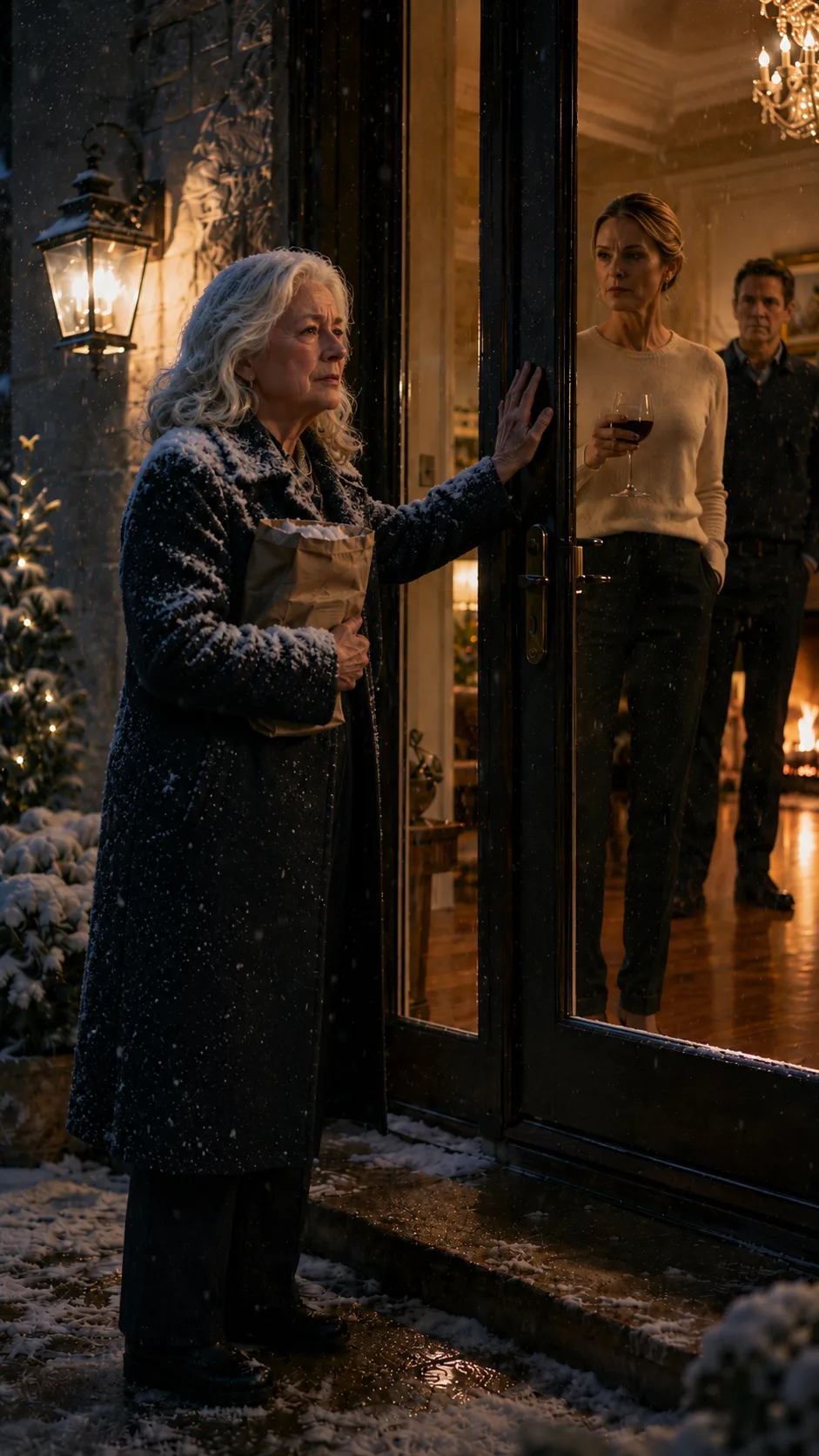
THE NIGHT MY SON LEFT ME OUTSIDE IN THE SNOW AND LEARNED WHO REALLY OWNED HIS HOME
PART 1 — THE DOOR THAT DID NOT OPEN
The snow was falling so hard I could barely see the house number.
Chapter 1
THE NIGHT MY SON LEFT ME OUTSIDE IN THE SNOW AND LEARNED WHO REALLY OWNED HIS HOME
PART 1 — THE DOOR THAT DID NOT OPEN
The snow was falling so hard I could barely see the house number.
I stood on my son Michael’s porch, clutching a brown pharmacy bag against my chest, my white shoulder-length hair damp beneath my hood, my dark coat covered with snow. My fingers shook as I typed the door code.
Red light.
Wrong.
I tried again.
Red.
Inside, warm golden light spilled through the glass door. I could see the fireplace, the chandelier, the cream couch Stephanie picked out after I sold my apartment to help save this house.
Then Stephanie appeared behind the glass, holding a glass of red wine.
“Stephanie,” I said, forcing my voice not to shake. “The code isn’t working. Please open the door.”
She did not move.
“We changed it, Rose.”
I blinked through the snow. “What?”
“We need space,” she said coldly. “This living arrangement isn’t working anymore.”
Behind her, I saw Michael.
My son.
He stood near the fireplace, one hand on the back of
the couch, his face pale and frozen.
“Michael,” I called. “I just came from the doctor. My chest was hurting.”
He took half a step forward.
Stephanie turned her head and said, “Don’t.”
And he stopped.
That was the moment I understood everything.
Not when Stephanie insulted me. Not when she moved my things to the basement. Not when she made me eat dinner alone.
It was when my own son stood ten feet away from his mother, warm and dry, and chose silence.
I lifted the pharmacy bag so he could see it.
“Tell me one thing, Michael,” I whispered through the glass. “When did I stop being your mother and become someone you could leave outside?”
PART 2 — THE HOUSE BUILT FROM MY SACRIFICE
Before that night, I had tried very hard to be grateful.
At seventy-two, gratitude becomes a habit. You tell yourself you are lucky
your son has a home. Lucky your grandchildren still hug you sometimes. Lucky there is a bed waiting for you, even if that bed is in the basement beneath the laundry room.
But I had once had my own home.
It was a small apartment in Chicago, nothing fancy, but every corner of it held a piece of my life. My late husband Henry had built the bookshelf beside the window. I grew red geraniums on the balcony every summer. In the kitchen, I kept a blue ceramic vase my mother gave me on my wedding day.
After Henry died, that apartment became my last safe place.
Then Michael came to me one evening looking like a man about to drown.
“Mom,” he said, sitting at my kitchen table, “I made a mistake.”
He told me about the loans. The failed business deal. The missed payments. The bank calls. The
fear that he, Stephanie, and the children would lose the suburban house they loved.
“I can fix it,” he promised. “I just need help getting through this part.”
“How much help?” I asked.
He looked down.
The number made my stomach turn cold.
I should have said no. Or at least, I should have asked questions. But Michael was my only child. I remembered him at six years old, running into my arms after school. I remembered Henry’s last words about him: “Take care of our boy.”
So I sold my apartment.
I told myself walls were just walls. Family mattered more.
Michael cried when I handed him the money.
“Mom, I swear you’ll never regret this,” he said. “Our home is your home now.”
Stephanie hugged me too, but her arms were stiff.
“We’re so grateful, Rose,” she said.
For the first two weeks, she was polite. She made coffee in the mornings. She told the children to help me carry boxes. She even called me “Mom” once, though the word sounded strange in her mouth.
Then the small cuts began.
“Rose, could you not leave your pills on the kitchen counter? Guests might see.”
“Rose, please don’t use the white towels. They’re for the upstairs bathroom.”
“Rose, maybe don’t tell those old stories at dinner. The kids get bored.”
At first, I laughed it off.
Then my framed photos disappeared from the living room.
I found them in a plastic storage bin in the garage.
Stephanie said, “I was just decluttering. The house looked crowded.”
Crowded.
That became her favorite word.
The house was crowded when I sat in the family room.
The fridge was crowded when I bought my own yogurt.
The schedule was crowded when I asked Michael to drive me to the doctor.
And Michael?
Michael heard all of it.
Sometimes his eyes would flicker toward me, ashamed. Sometimes his jaw would tighten. But he never corrected her. Never once.
One evening, my granddaughter Emma asked, “Grandma, why do you sleep downstairs?”
Stephanie answered before I could.
“Because Grandma likes privacy.”
I looked at Michael.
He stared at his plate.
That silence became the language of the house.
The night of the snowstorm, I had gone to see my cardiologist alone. My chest had been tight for three days. Michael said he had a work emergency. Stephanie said she had a school committee dinner and told me to call a cab.
The doctor changed my medication and told me to avoid stress.
“Do you have support at home?” he asked.
I smiled.
“Yes,” I lied.
By the time I got back, the wind was cutting sideways across the street. The taxi driver offered to wait until I was inside, but I said no. Pride is a foolish coat in winter, but I wore it anyway.
Then the code failed.
Then Stephanie came to the glass.
Then Michael stood behind her and did nothing.
After I asked him that question — when did I stop being your mother? — nobody answered.
Stephanie reached for the curtain.
I pressed my palm flat against the glass.
“Don’t close it,” I said.
She paused.
I looked directly at Michael.
“I sold my home for you.”
His face twisted.
“Mom, please—”
“No,” I said. “You watched me give up the last place that was mine. Then you let your wife make me a guest in the house my sacrifice saved.”
Stephanie’s eyes narrowed.
“Rose, you’re being dramatic.”
I turned to her.
“No, Stephanie. I am being clear.”
Her mouth opened, but before she could speak, Michael finally moved toward the door.
For one second, I thought he had remembered who he was.
But Stephanie stepped in front of the lock panel.
“Michael,” she snapped. “We agreed.”
He stopped again.
The final piece of hope inside me gave way.
I lowered my hand from the glass.
“All right,” I said softly.
Stephanie looked relieved. She thought she had won.
Michael looked terrified. Maybe he knew something she did not.
I stepped backward into the snow.
“Mom, where will you go?” he asked through the glass.
I looked at him, my son, the boy I had protected from every storm I could reach.
Then I said, “Somewhere with a door that opens.”
I turned and walked down the icy steps. My knees ached. My chest hurt. The pharmacy bag crumpled against my coat. Snow covered my shoulders like someone was burying me while I was still standing.
At the end of the driveway, I called my older sister Linda.
“Rose?” she answered. “What’s wrong?”
I looked back at the glowing house.
“My son just left me outside.”
Linda was silent for one beat.
Then her voice changed.
“Stay where you are.”
Twenty minutes later, she pulled up in a red SUV, got out in boots and a wool coat, and wrapped me in a blanket so fiercely I almost cried.
“Did Michael do this?” she asked.
I could not answer.
She looked toward the house.
“That weak little fool.”
At Linda’s apartment, she made tea while I sat at her kitchen table with wet socks and numb fingers. She called Paul, an old friend who had handled real estate paperwork for half the families in our church.
“Tell him,” Linda said. “Tell him whose name is on that house.”
I stared into my tea.
Because that was the part Stephanie had never known.
When Michael’s credit collapsed, he could not refinance. The bank would not work with him. To save the house, I did more than give him money.
I bought the house through a private arrangement.
I let Michael and Stephanie live there because I wanted to protect my family. I never wanted to hold it over them. I never wanted control.
I wanted peace.
Paul listened carefully, then said, “Rose, that house is legally yours.”
“I know.”
“And after tonight?”
I closed my eyes.
Linda placed her hand over mine.
Paul’s voice softened. “You have options.”
I looked down at my shaking hands. For years, those hands had packed Michael’s lunches, washed his fevered forehead, signed school forms, baked birthday cakes, buried his father, sold my home, and carried boxes into a basement.
That night, those same hands reached for the phone.
“What kind of options?” I asked.
To be continued, Part 3 Now!
Chapter complete
You have reached the end of this chapter.
Continue reading
A few more worlds to get lost in after this chapter.




