THE MOTHER WHO RETURNED ON LIVE TELEVISION AFTER TWENTY YEARS AND ASKED ME TO FORGIVE HER
PART 1
The night I received the Woman of Resilience Award, my mother came back from the dead.
Chapter 1
THE MOTHER WHO RETURNED ON LIVE TELEVISION AFTER TWENTY YEARS AND ASKED ME TO FORGIVE HER
PART 1
The night I received the Woman of Resilience Award, my mother came back from the dead.
Not literally.
Worse.
She came back on live television.
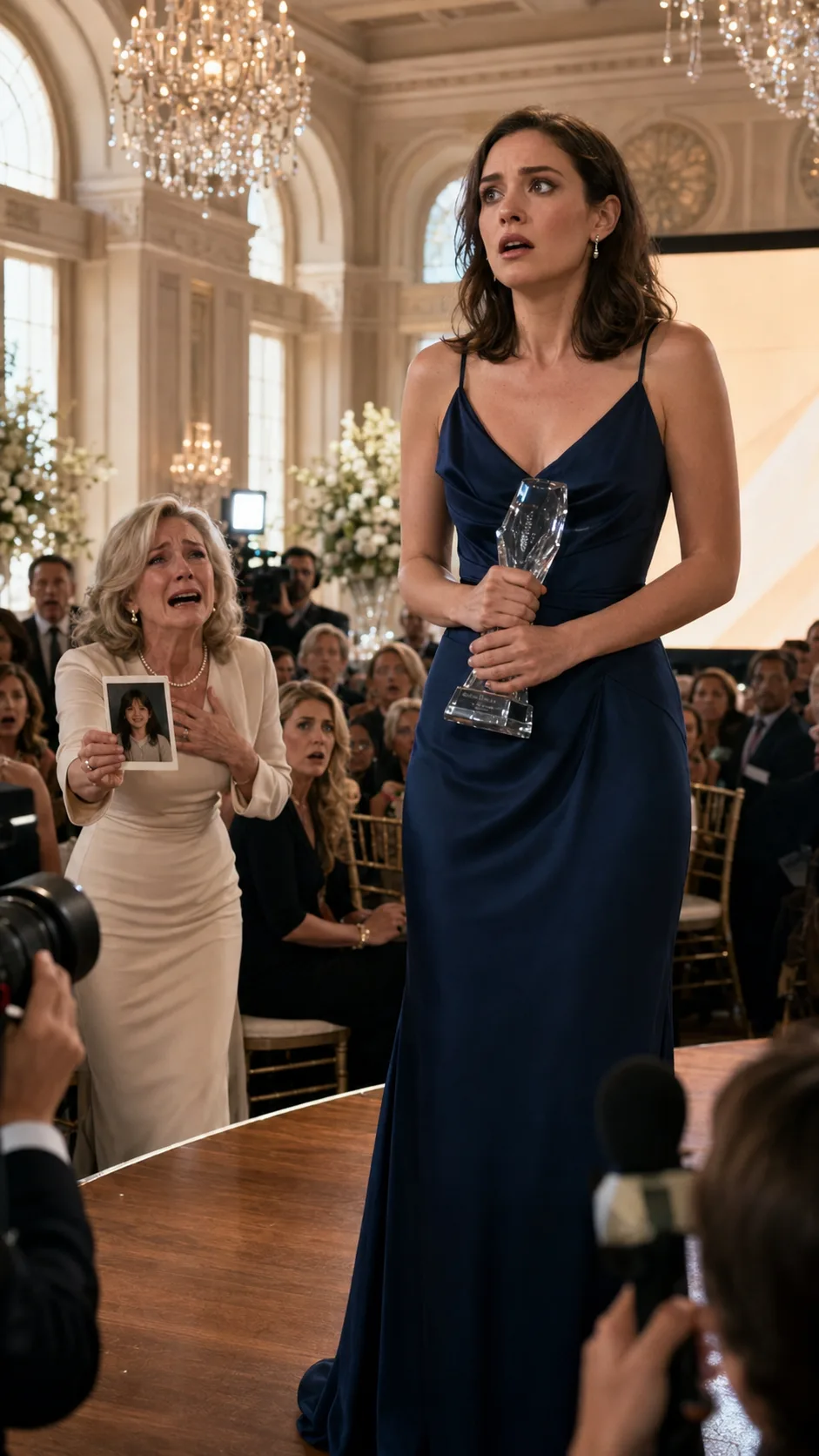
I was standing beneath the lights of the Grand Meridian Hotel in Chicago, holding a crystal award with my name engraved across the front: Ava Carter, Founder of the Carter Promise Fund. Six hundred people were on their feet, clapping because I had turned my childhood wound into scholarships for abandoned children.
Then the giant screen behind me flickered.
The applause died.
A woman appeared on screen, sitting on a morning-show couch, clutching a faded photograph of a six-year-old girl with crooked bangs and missing front teeth.
Me.
Her eyes were red. Her hair was silver-blonde now, softer than I remembered, styled like a woman who knew exactly where the cameras were.
“My name is Marilyn Carter,” she whispered. “And I am Ava Carter’s real mother.”
The room froze.
My fingers tightened around the award.
The host leaned closer. “Marilyn, people
believe you abandoned Ava when she was a little girl.”
Marilyn pressed the photo to her chest and began to cry.
“I never abandoned my daughter,” she said. “They took her from me.”
A low gasp rolled through the ballroom.
Then the side doors opened.
And she walked in.
My mother.
After twenty years.
She came down the aisle with cameras following behind her, one hand covering her mouth, tears shining under the chandelier light.
“Ava,” she sobbed. “Baby, I have spent twenty years trying to come home to you.”
Every phone lifted.
Every lens turned.
Someone shouted, “Ava, will you forgive your mother tonight?”
Marilyn reached for me.
I stepped back.
Her face cracked for the cameras.
I heard myself say, very softly, “Then why do I remember you leaving with a suitcase?”
PART 2
For three seconds, nobody breathed.
Not the donors in their black gowns. Not the
board members near the stage. Not Ryan, my public relations manager, who stood ten feet away with both hands pressed to his headset like he was trying to stop a plane crash.
Marilyn’s hand stayed frozen in the air between us.
Then she lowered it slowly, and the cameras loved her for it.
They loved the trembling fingers. The wounded mouth. The way she seemed too heartbroken to defend herself.
“Ava,” she whispered, loud enough for the front row microphones. “You were six. You don’t know what they told you.”
“They?” I asked.
Her eyes flicked, just once, toward the cameras. Then back to me.
“Your father’s family,” she said. “They had money. They had lawyers. I had nothing.”
That was the first lie.
My father, Thomas Carter, had never had money. When I was seven, he drove a delivery truck by day and cleaned offices at night. He learned
to braid my hair from library books. He burned pancakes every Sunday until I pretended to like them. When my school asked for a mother’s name on a form, he wrote his own number in both spaces and said, “Call me twice if you need to.”
He died two years before Marilyn returned.
Convenient timing.
Marilyn took another step toward me.
“I was young,” she said, voice shaking. “They scared me. They told me if I came back, they would make sure you hated me.”
The room shifted.
I felt it happen.
People who had applauded me five minutes earlier were now looking at me like I was standing between a grieving mother and her child.
Ryan rushed onto the stage, smiling too hard.
“Let’s take a private moment,” he said into the nearest camera. “This is obviously very emotional.”
Marilyn turned just enough to show her wet cheek to the press.
“I don’t need anything private,” she said. “I just want my daughter.”
Someone in the crowd made a soft sound, like a sigh.
That sound followed me offstage.
Within an hour, the clip was everywhere.
MARILYN CARTER REUNITES WITH DAUGHTER AFTER 20 YEARS.
SUCCESSFUL CEO REFUSES TO EMBRACE LONG-LOST MOTHER.
HAS AVA CARTER BUILT AN EMPIRE ON A LIE?
By midnight, strangers were calling me cruel.
By morning, they had found old interviews where I said my mother abandoned me and clipped them next to Marilyn crying into a tissue.
Ryan came to my condo at 8:00 a.m. with coffee and the face of a man about to ask me to swallow glass.
“You need to sit down with her,” he said.
“No.”
“Ava, the public doesn’t understand silence.”
“I don’t owe the public a reunion.”
“You built a foundation for abandoned children,” he said gently. “That makes this complicated.”
I turned from the window.
“What does that mean?”
“It means people think you made abandonment your brand. And now the woman you accused is saying she was kept away.”
I laughed once. There was no humor in it.
“She left, Ryan.”
“I believe you.”
“No. You believe the crisis is real.”
He looked down.
That was enough answer.
The second interview aired that afternoon.
Marilyn sat across from Eleanor Hayes, one of the most respected journalists in the country. Eleanor had gray hair cut sharp at her jaw and the patient face of a woman who could make a liar feel safe.
Marilyn wore cream.
She had always looked good in cream.
“I kept a birthday candle for her every year,” Marilyn said, her voice breaking beautifully. “Every January tenth, I lit one and told her I loved her.”
I turned off the television.
My birthday was January twelfth.
The first crack.
It should have been nothing. People make mistakes. Mothers under pressure misremember. But my body knew before my mind admitted it. Something in her story was too polished in some places and careless in others.
That night, my phone buzzed.
Unknown number.
A message appeared.
Ava, this is Marilyn. I know I don’t deserve kindness, but please meet me. No cameras. Just us.
For a moment, I stared at it until the screen dimmed.
Then another message came.
I never stopped loving you.
I wanted to throw the phone across the room.
Instead, I drove to the only place I trusted with the truth.
My father’s old house sat forty minutes outside the city, small and beige and sagging at the porch. I had kept it after he died but never moved back in. Too many ghosts lived in the walls.
Inside, dust coated everything.
The kitchen still smelled faintly like lemon cleaner and old wood. His red mug was still in the cabinet. The one that said WORLD’S OKAYEST DAD because I bought it for him when I was thirteen and angry at everything.
I walked through the living room slowly.
There was the corner where he let me build blanket forts. The hallway where he measured my height in pencil marks. The bedroom door I slammed at sixteen when he refused to let me go to a party.
He had never slammed back.
He would knock once and say, “You can be mad, kiddo. I’ll be in the kitchen when you’re hungry.”
I found what I was looking for in the garage.
When my father was dying, he told me, “There’s a box under the loose board near the workbench. Don’t open it unless the past comes knocking.”
At the time, I thought the pain medication had confused him.
Now, on my knees beside his rusted tools, I pried up the warped floorboard with a screwdriver.
The box was small. Wooden. Wrapped in a dish towel.
My hands shook before I opened it.
Inside were photographs, receipts, school drawings, every birthday card I ever made him, and a stack of letters tied with blue string.
On top was a note in my father’s handwriting.
Ava,
If you found this, then someone has tried to rewrite what happened. I kept these because one day you might need proof that your memory was not a lie.
I sat back on my heels.
My breath stopped halfway out.
The first letter was from Marilyn.
The paper had yellowed at the edges. Her handwriting was round and familiar in a way that made me sick.
Thomas,
I understand what you’re asking. I also understand what I’m giving up. I accept the $75,000, and I agree that I will not contact Ava again. She will be better off without me coming in and out of her life.
Please do not make this harder by asking me to explain it to her.
Marilyn
I read it once.
Then again.
Then a third time, slower, as if the words might rearrange themselves into something less unforgivable.
They didn’t.
There were copies of cashier’s checks. Photographs of Marilyn outside a beauty salon in Arizona. A newspaper clipping from two years after she left: LOCAL WOMAN OPENS LUXURY SALON AFTER FRESH START.
Fresh start.
That was what she called the money she took for my childhood.
Under the letters was one more envelope.
Inside was a birthday card addressed to me.
Ava, age 7.
The envelope had never been mailed.
The card showed a cartoon bear holding balloons. Inside, Marilyn had written only three sentences.
I hope you grow up happy. I hope you forget me. I hope your father never tells you I chose myself.
I folded over the garage floor.
Not gracefully. Not cinematically. My body just quit.
For twenty years, I had carried one image: Marilyn standing in the doorway with a suitcase, sunglasses on her head, telling my father, “She’ll adjust.”
For twenty years, people told me memory was unreliable.
But there it was.
She’ll adjust, written in ink across my life.
The next morning, I invited Marilyn to my condo.
No cameras.
No Ryan.
No Eleanor.
Just us.
She arrived wearing pale blue, carrying flowers, looking nervous in the exact way a person looks when she wants to be forgiven before she confesses.
She stepped inside and glanced around at the tall windows, the expensive furniture, the skyline view.
Her eyes lingered too long on everything success had bought me.
Then she turned to me and opened her arms.
I did not move.
Her arms fell.
“I know you’re angry,” she said.
I gestured toward the dining table. “Sit down.”
She sat.
I placed two cups of coffee between us. She smiled faintly.
“You remembered I take cream.”
“You took cream twenty years ago.”
Her smile faded.
For a while, neither of us spoke.
Then Marilyn reached into her purse and pulled out a folded tissue, though she wasn’t crying yet.
“I know how this looks,” she began.
“How does it look?”
“Like I came back at the worst possible time.”
“You came back at the most profitable time.”
Her mouth opened.
Closed.
Then she sighed, almost annoyed.
“You sound just like Thomas.”
I felt my hand tighten around my mug.
“Good.”
She looked away toward the window.
“He poisoned you against me.”
“No,” I said. “He fed me. Clothed me. Took night shifts. Sat through every parent-teacher conference alone. Don’t confuse absence with being poisoned.”
Her eyes filled quickly. Too quickly.
“I was scared,” she whispered. “I was twenty-six. I had no money. No support. Your father made it clear there was no place for me.”
Another lie.
I reached beside my chair and lifted the wooden box onto the table.
Marilyn stared at it.
Something moved behind her face.
Not sadness.
Recognition.
I opened the lid and removed the first letter.
Her skin went pale beneath her makeup.
“Where did you get that?”
“My father left it for me.”
She sat back.
For the first time since she came back, Marilyn Carter forgot to perform.
I unfolded the letter and laid it flat in front of her.
“I accept the $75,000,” I read aloud. “I agree that I will not contact Ava again.”
She whispered, “Ava…”
I looked up.
“Keep listening.”
“She will be better off without me coming in and out of her life,” I continued. “Please do not make this harder by asking me to explain it to her.”
Her hands started shaking.
Not for the cameras.
For herself.
“That is not the whole story,” she said.
“It’s your handwriting.”
“I was desperate.”
“You opened a luxury salon.”
“I needed to survive.”
“You told America you lit birthday candles for me on January tenth.”
Her lips parted.
“My birthday is January twelfth.”
Silence.
She looked older suddenly.
Not because the years appeared, but because the mask disappeared.
“I mixed up the date,” she said weakly.
“You mixed up the child.”
She flinched.
For a second, I almost felt cruel.
Then I remembered the seven-year-old birthday card she never mailed.
I pulled it from the box and set it beside the first letter.
Her face crumpled when she saw it.
“You kept that?” she whispered.
“No. Dad did.”
Her eyes lifted to mine.
“He kept everything you threw away.”
Marilyn pressed both hands over her mouth.
And somehow, even then, part of me wanted her to say the right thing.
I wanted her to say she was sorry with no audience. No excuse. No story. No blame. Just sorry.
Instead, she lowered her hands and said, “We could still fix this.”
My chest went cold.
“Fix what?”
“The narrative,” she said, too fast. “I mean, us. I mean… people already care. Eleanor wants a follow-up. There’s a production company interested in a documentary. We could tell the complicated version. Healing. Forgiveness. Mothers and daughters finding their way back.”
I stared at her.
There it was.
The real reason she came home.
Not because she found a memory.
Because America found me first.
“How much?” I asked.
She blinked.
“What?”
“How much did they offer you?”
Her silence answered before her mouth did.
“Ava, it’s not like that.”
“How much?”
Her eyes filled again, but this time the tears had nowhere to land.
“Enough to start over,” she whispered.
I almost laughed.
The same words from the newspaper clipping.
A fresh start.
Twenty years later, she had come back to sell my pain twice.
I stood up.
She reached across the table.
“Ava, please. I am still your mother.”
I looked down at her hand near the letter.
Then I said the words that broke the room in half.
“Then tell me why your heart had a price.”
To be continued, Part 3 now
Chapter complete
You have reached the end of this chapter.
Continue reading
A few more worlds to get lost in after this chapter.




