THE KINGDOM CALLED HER DREAM USELESS, UNTIL HER MOTHER’S LAST DRESS MADE THE CROWN BOW IN SILENCE
PART 3 — THE DRESS THAT BROUGHT HER MOTHER BACK TO THE PALACE
Bennett House looked exactly the same the night I returned.
Chapter 2
PART 3 — THE DRESS THAT BROUGHT HER MOTHER BACK TO THE PALACE
Bennett House looked exactly the same the night I returned.
That was the cruelest part.
The iron gates still carried my father’s initials. The windows still glowed with warm gold light. The front steps were still lined with white roses trimmed so perfectly they looked afraid to grow.
I stood outside with Princess Helena beside me, both of us dressed in plain dark coats, while rain whispered through the garden.
“You do not have to go in alone,” Helena said.
“Yes,” I answered. “I do.”
She did not argue. Maybe she understood that some rooms have to be entered by the child who was kept out of them.
I used the side key I had hidden years ago behind a loose stone in the greenhouse. My father had forgotten that as a little girl, I used to escape his rules long before I had words for freedom.
The house was quiet.
Too quiet.
I moved through the corridor past portraits
of Bennett men in black coats and medals. Doctors. Scholars. Royal advisers. Men who had been praised for saving bodies while quietly breaking spirits.
At the end of the east wing, I found the locked door.
My hand shook when I touched the handle.
For twelve years, that door had been a warning.
Do not ask.
Do not remember.
Do not become her.
The lock was newer than the door, but Madame Colette had taught me how old houses worked. The hinges were weaker than the keyhole. It took me seven minutes, a sewing needle, and a silver hairpin to lift the latch from the inside gap.
The door opened.
Dust breathed out.
I stepped into my mother’s life.
The room was not empty.
It was full.
Full of mannequins covered in muslin. Full of trunks, ribbons, folded silk, velvet wrapped in tissue, sketches pinned to the walls, dried flowers
hanging from beams, boxes labeled in my mother’s handwriting.
My father had told me she left nothing behind.
But she had left an entire universe.
In the center of the room stood a dress form draped in unfinished white silk. The bodice was only half-stitched. One sleeve had been pinned but never sewn. Silver thread curved around the waist like two rivers meeting.
I covered my mouth.
It was almost identical to the gown I had designed for Helena.
Not because I had copied it.
Because some part of my mother had lived inside me all along.
On the table beside the dress lay a leather journal.
I opened it with both hands.
The first pages were filled with fabric notes, measurements, sketches, ideas for the Coronation Peace Gown. Then the writing changed. The lines grew heavier. The ink pressed harder into the paper.
Thomas says the court laughs when
I am not in the room.
Thomas says they praise my dresses but will never respect the woman who makes them.
Thomas says I must stop before I teach Grace that applause matters more than safety.
I turned the page, my throat closing.
But when Grace touches fabric, her whole face lights. She does not know yet that joy can be a compass. If she ever chooses fabric over fear, let her know I was never ashamed of that dream.
I sat down on the floor and cried without making a sound.
Not because my father had lied.
Because my mother had been loving me from a locked room for twelve years.
A noise came from the doorway.
I looked up.
My father stood there.
For a long moment, neither of us moved.
His face was pale. His eyes went from the open trunks to the journal in my hand, then to the unfinished dress.
“You broke into this room,” he said quietly.
“No,” I answered. “I came home to the part of my mother you buried.”
He walked in slowly, as if the room itself hurt him.
“You don’t understand what this place did to her.”
“I understand what you did after she was gone.”
His mouth opened, but no words came.
I stood, holding the journal.
“You let me think she was weak.”
“She was tired, Grace.”
“You let me think her gift was useless.”
“I was trying to protect you.”
“From what?” I shouted, my voice breaking. “From becoming brilliant? From being seen? From missing her in a way you couldn’t control?”
His eyes shone.
That was the first time I had ever seen my father look old.
“She changed after the court began using her,” he said. “They wanted more gowns, more appearances, more perfection. She stopped sleeping. She stopped eating. She smiled for them and came home empty. I hated them for it.”
“So you punished her dream.”
“I tried to save what was left.”
“You saved nothing,” I whispered. “You locked her away and called it love.”
His shoulders fell.
Outside, the rain hit the windows harder.
Then he looked at the half-finished gown.
“She was making that for Queen Adela’s final gala,” he said. “She said it would be her last royal piece. She wanted to name it after you.”
My breath caught.
“After me?”
He nodded once.
“The Grace Gown.”
The name broke something in both of us.
He stepped toward the table and picked up one of my stolen sketches from a folder I had not even noticed. My designs were there, all of them, neatly stacked beside my mother’s.
“I took them because when I saw your work, I thought I was losing her again,” he said.
“No,” I said. “You were seeing that she had not disappeared.”
He closed his eyes.
For years, I had imagined this moment as a victory. I thought I would expose him, shame him, make him feel small the way he made me feel small.
But standing there in my mother’s room, I did not see a villain.
I saw a man who had mistaken grief for authority.
That did not excuse him.
But it explained the locked door.
I took back my sketches.
Then I lifted my mother’s unfinished pattern.
“I am finishing the gown,” I said.
My father looked at me.
“The gala is in four days.”
“Then I have four days.”
“You cannot do it alone.”
I held his gaze.
“I was never alone. She left me everything.”
For three days and four nights, I worked in that room. Madame Colette came. Princess Helena came. Even two retired palace seamstresses arrived after hearing whose design it was. They brought old hands, sharp needles, quiet stories, and tears they tried to hide.
My father did not touch the fabric.
But on the final night, he came to the doorway carrying coffee.
He stood there awkwardly, like a guest in his own house.
“Your mother used to forget to eat when she worked,” he said.
I looked up.
“So do I.”
He placed the tray on the table.
Then, very carefully, he unfolded a bundle wrapped in blue silk.
Inside was my mother’s old gold measuring tape.
“I kept this,” he said. “I told myself it was because I could not throw it away.”
I took it from him.
For the first time, his hands were the ones shaking.
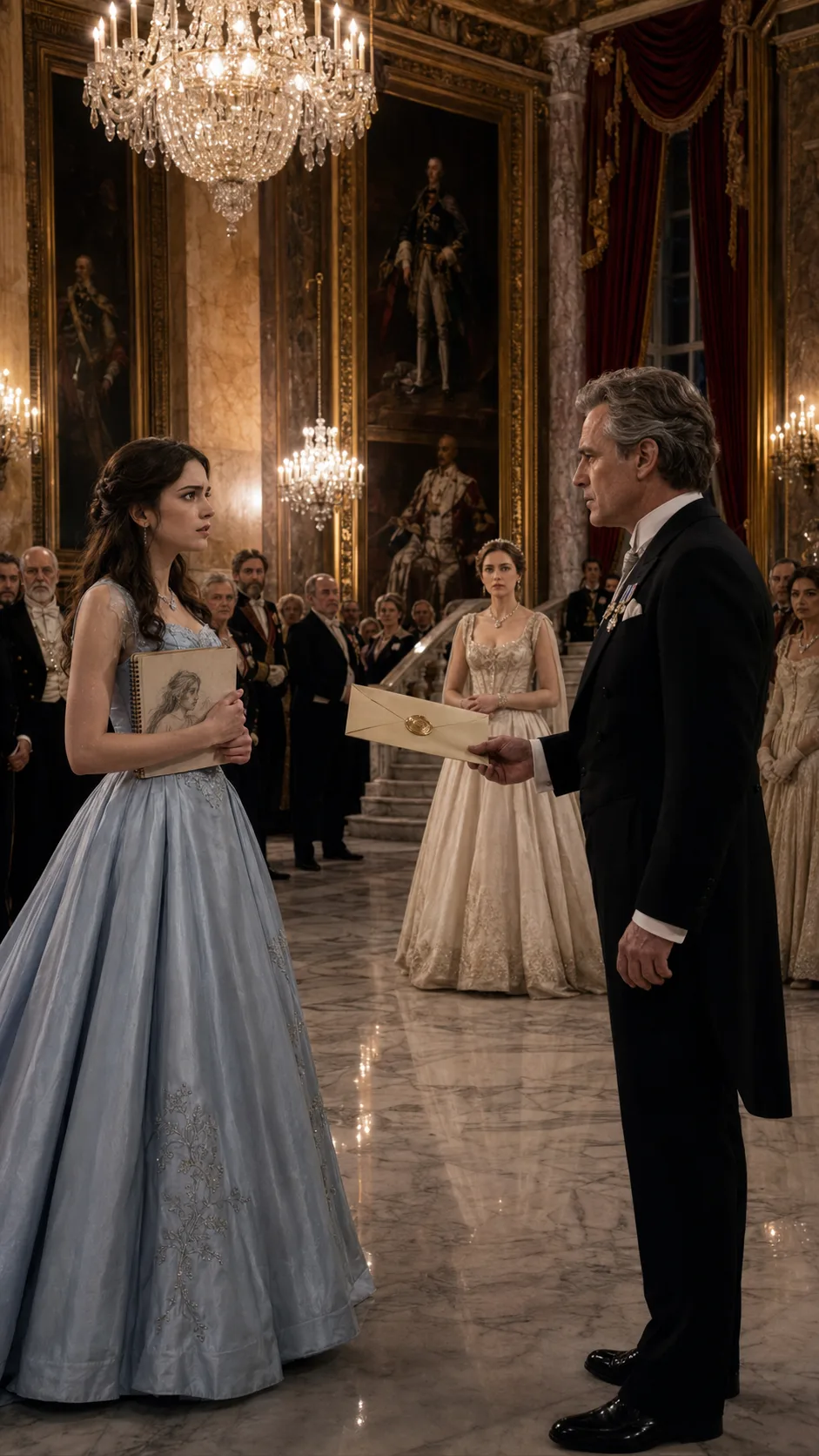
The Royal Unity Gala was held beneath the glass dome of Asterbourne Palace. Every noble house attended. Cameras flashed outside. Ambassadors from Valcoria lined the marble staircases. Designers whispered behind jeweled fans, wondering who had won the princess’s favor.
My father stood near the king, dressed in formal black, his medals bright against his chest.
He looked like the same man who had torn my letter.
But I knew better now.
At exactly nine o’clock, the orchestra stopped.
The doors opened.
Princess Helena entered wearing the gown.
The entire hall fell silent.
White silk moved like moonlight. Silver embroidery flowed from her shoulder to her waist, forming two rivers that met over her heart. Tiny white roses climbed the sleeves, each one stitched from both my mother’s pattern and mine. The train shimmered with pale blue thread, the color of Asterbourne, blending into deep green, the color of Valcoria.
It did not look like a dress made for a princess.
It looked like peace learning how to breathe.
Helena reached the center of the room, then turned toward the crowd.
The palace announcer stepped forward.
“The winning designer of the Royal Unity Gala gown is Grace Bennett.”
Gasps moved like wind.
My father did not move.
Then the screen behind Helena lit up.
Not with my face.
Not at first.
With my mother’s.
An old photograph appeared: Lady Eleanor Bennett, young and smiling, standing in the same palace gallery with pins between her fingers and white roses at her feet.
Under the photograph were the words:
Inspired by the unfinished work of Lady Eleanor Bennett.
Completed by her daughter, Grace Bennett.
My father covered his mouth.
Not to hide shame.
To hold in the sob that escaped anyway.
I stepped onto the stage in a simple black gown I had sewn myself. My heart pounded so hard I could feel it in my wrists.
The applause began slowly.
Then it rose.
Not polite applause.
Not royal applause.
Real applause.
Princess Helena took my hand and raised it.
For a moment, I looked at the crowd, the chandeliers, the kingdom that had once made my mother feel small.
Then I looked at my father.
He was crying openly now.
And when everyone else sat, he remained standing.
Clapping.
After the gala, he found me in the empty gallery where he had torn my letter.
The marble floor had been polished clean. No paper remained. No proof of what had happened except the girl who had survived it.
He stopped a few feet away.
“I owe you more than an apology,” he said.
“Yes,” I answered.
He swallowed.
“I was wrong about your dream.”
“Yes.”
“And wrong about your mother.”
My eyes burned.
“Yes.”
He looked down, then back at me.
“She would have been proud of you.”
I held my mother’s measuring tape in my hand.
“I know,” I said softly. “I just wish you had let me know sooner.”
He nodded, and that hurt more than another argument would have.
Six months later, I left for Paris.
Not as a runaway.
Not as Sir Thomas Bennett’s disobedient daughter.
As Grace Bennett, founder of White Rose Atelier, royal designer of Asterbourne, and daughter of Eleanor Bennett, the woman whose dream had waited behind a locked door until I was brave enough to open it.
On the morning my first collection debuted, I pinned a small white rose inside every gown.
The final piece was called Eleanor.
When the model walked out, the audience stood before the dress even reached the end of the runway.
And in the front row, my father rose with them.
This time, he was not clapping because the kingdom approved.
He was clapping because he finally understood.
A daughter does not honor her parents by becoming their copy.
Sometimes she honors them by finishing the dream they were too afraid to protect.
THE END
Chapter complete
You have reached the end of this chapter.
Continue reading
A few more worlds to get lost in after this chapter.




