THE KINGDOM CALLED HER DREAM USELESS, UNTIL HER MOTHER’S LAST DRESS MADE THE CROWN BOW IN SILENCE
PART 1 — THE LETTER HE TORE IN FRONT OF THE PALACE
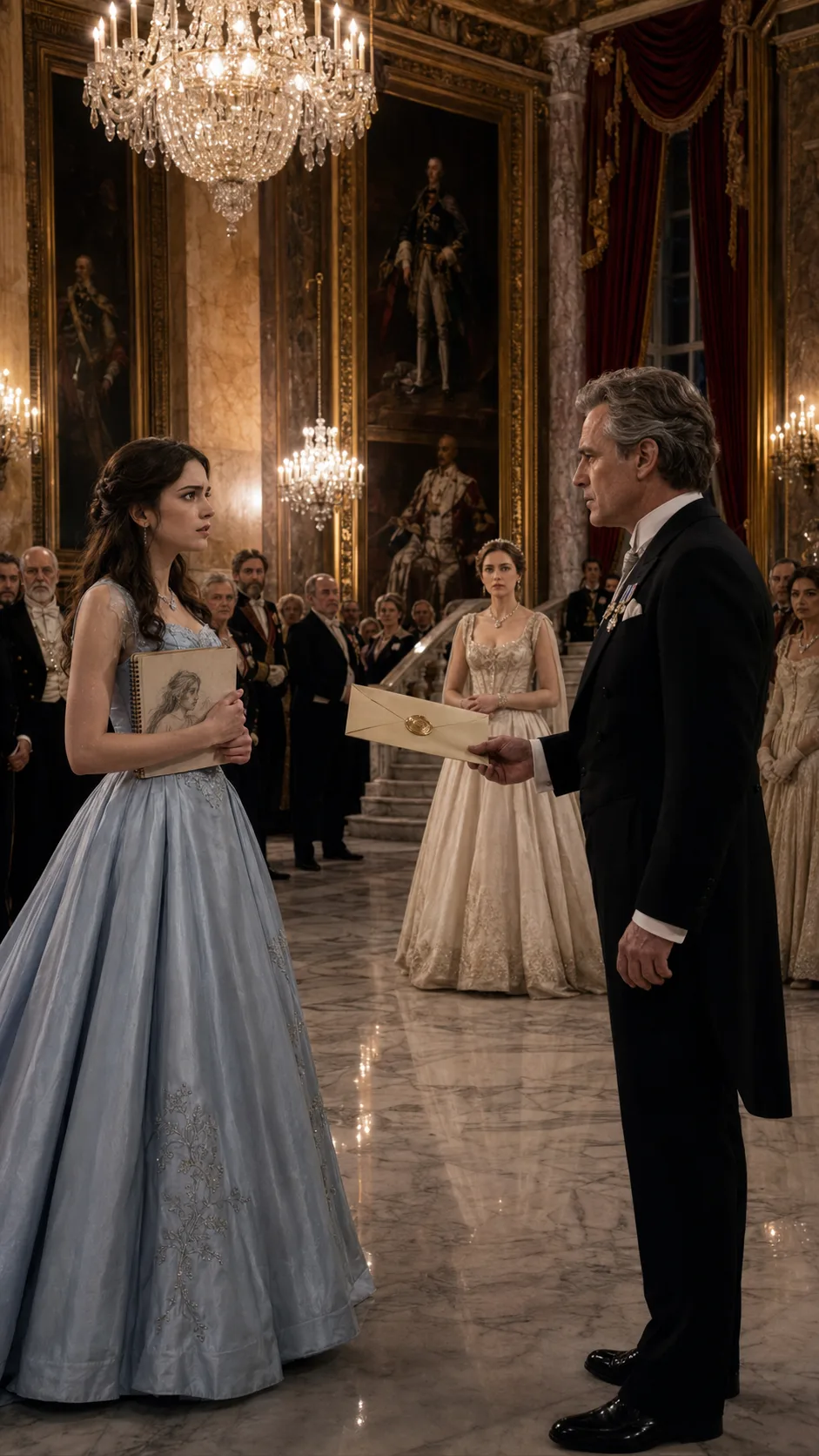
Sir Thomas Bennett tore my future in half beneath the crystal chandeliers of Asterbourne Palace.
Chapter 1
PART 1 — THE LETTER HE TORE IN FRONT OF THE PALACE
Sir Thomas Bennett tore my future in half beneath the crystal chandeliers of Asterbourne Palace.
Not in private.
Not in anger behind closed doors.
He did it in the Royal Gallery, in front of dukes, ministers, palace physicians, and Princess Helena herself.
The acceptance letter from the Royal Academy of Couture in Paris had arrived that morning, sealed in cream paper with gold lettering. I had hidden it inside my sketchbook because I already knew what my father would say.
But Thomas Bennett always found what he wanted to destroy.
His fingers tightened around the letter. His face stayed calm, polished, almost noble, the way it always did when he wanted people to believe cruelty was discipline.
“You applied behind my back,” he said.
“I applied for my life,” I answered.
A murmur moved through the gallery.
My father’s mouth tightened. Then he ripped the letter down the middle.
The sound cut louder than music.
He ripped it again.
And again.
White pieces fell over
the marble floor like dead petals.
“I didn’t raise a daughter to waste her life making dresses.”
My chest burned, but I did not lower my eyes.
I knelt slowly and picked up the torn pieces one by one.
When I stood, my hands were shaking.
My voice was not.
“No,” I said. “You raised a daughter who finally stopped being afraid of you.”
For the first time in my life, my father looked at me like he had lost control of something he had owned for twenty-one years.
He was right.
That night, I walked out of the palace with one suitcase, one broken letter, and the name of a mother he had tried to erase.
PART 2 — THE ROOM WHERE MY MOTHER’S DREAMS WERE LOCKED AWAY
My name is Grace Bennett, and in Asterbourne, the Bennett name meant obedience wrapped in silk.
My father, Sir Thomas Bennett,
was the most famous physician in the kingdom. He had saved King Edward during a royal surgery twelve years ago. Since then, his portrait hung in the Palace Medical Hall, his opinion carried weight in court, and every noble family treated him like a man who could hold life itself between two fingers.
To everyone else, he was brilliant.
To me, he was a wall.
He decided what I studied, what I wore, which invitations I accepted, which friends were “too ordinary,” and which dreams were “too dangerous.” By the time I turned eighteen, my life had already been arranged like a medical chart.
Oxford pre-med.
Royal Hospital internship.
A future appointment as junior physician to the palace.
Then one day, his chair.
His title.
His life.
But every time I sat in anatomy lectures, I drew gowns in the margins of my notebooks. Every time he handed me a
medical journal, I saw fabric, movement, embroidery, light. I could look at a woman standing still and know exactly what kind of dress would make her feel powerful. I could see a sleeve before I touched cloth. I could imagine a waistline from a shadow.
My father called it distraction.
My late mother had called it vision.
At least, that was what little I remembered.
Lady Eleanor Bennett died when I was nine. My father told everyone it was a long illness. He told me she had been fragile, impractical, and too sensitive for palace life. Whenever I asked about her designs, his face would close.
“Your mother wasted too much time chasing applause,” he would say. “You will not repeat that mistake.”
For years, I believed him.
I believed my mother had been a beautiful but weak woman who liked pretty things and could not survive the world.
Then Princess Helena changed everything.
Three days after my father tore my acceptance letter, I was renting a narrow room above an old dressmaker’s shop near the river. The ceiling leaked when it rained. The windows rattled when carriages passed. I slept beside rolls of secondhand fabric and ate toast over my sketchbook because I had twenty-seven pounds left and too much pride to go home.
Madame Colette, the elderly owner, let me use the back table if I repaired gowns for her clients.
Most of those clients were palace staff.
Maids with torn hems. Junior secretaries with sleeves too long. Violinists from the royal orchestra whose black dresses had been worn for ten seasons.
I said yes to everything.
One rainy afternoon, a palace courier brought in a velvet evening cloak from the Royal Wardrobe. The lining had split, and it needed repair before Princess Helena’s charity gala.
When I turned the cloak inside out, my fingers froze.
There, hidden beneath the collar, was an embroidered mark.
A curved letter E stitched inside a white rose.
I knew that mark.
Not from memory.
From a small silver thimble I had found years ago in my mother’s old jewelry box before my father locked everything away.
I took the cloak under the lamp and examined the stitches. They were impossibly delicate, almost alive. The white rose was not decoration. It was a signature.
“Madame Colette,” I whispered, “who made this?”
The old woman looked over her spectacles.
Then her face changed.
“You do not know?”
“Know what?”
She closed the shop door, turned the sign, and lowered her voice.
“Lady Eleanor Bennett made half the royal wardrobe before she vanished from public life. The queen wore her white rose collection at the Silver Jubilee. The Duchess of Marwick cried when Eleanor designed her wedding gown. People used to say your mother could sew courage into a dress.”
My stomach turned cold.
“My father said she only made little things.”
Madame Colette stared at me as if I had just repeated a lie too large to fit in the room.
“Your mother was the greatest designer Asterbourne ever lost.”
That night, I did not sleep.
I went through every old fashion archive I could find at the public library. Page after page, my mother’s name appeared in yellowed newspapers.
Lady Eleanor Bennett Redefines Royal Elegance.
The White Rose Collection Stuns Europe.
Queen Adela Praises Bennett’s “Gift for Clothing the Soul.”
And then, suddenly, nothing.
No farewell show.
No retirement announcement.
No explanation.
Only silence.
The next twist came two days later, when Princess Helena herself arrived at Madame Colette’s shop wearing sunglasses and a gray coat with the hood pulled low.
She was twenty-six, elegant, sharp-eyed, and far more direct than any princess was supposed to be.
“You repaired my cloak,” she said.
“Yes, Your Highness.”
“You repaired it using Eleanor’s old stitch.”
My breath stopped.
“I didn’t know anyone could still recognize it.”
“My grandmother taught me,” Helena said. “She said Lady Eleanor once made her feel brave enough to become queen.”
I looked down.
“My father never told me that.”
Helena studied me for a long moment. “Then your father kept more than grief from you.”
She placed a folded invitation on the table.
“The Royal Unity Gala is in eight weeks. Asterbourne needs a gown that represents peace with Valcoria. Every famous designer has sent something cold, expensive, and lifeless.” She paused. “Submit one design.”
I almost laughed.
“I have no studio, no money, no title anymore, and my father would make sure no one takes me seriously.”
“Then don’t submit as Grace Bennett,” Helena said. “Submit as White Rose.”
The name hit me so hard I had to grip the table.
White Rose.
My mother’s mark.
My father’s forbidden memory.
I spent the next three weeks creating as if hunger had become fuel. I sketched until my wrist cramped. I dyed fabric in cracked ceramic bowls. I stitched tiny roses along translucent sleeves and used silver thread to create the shape of two rivers meeting at the waist.
The gown was not just beautiful.
It told a story.
Asterbourne and Valcoria had once been divided by war, pride, and old royal marriages gone wrong. But I designed the gown as if two wounded families could become one fabric without losing their own colors.
When Helena saw the sketch, she did not speak for nearly a minute.
Then she said, “This is the one.”
For one impossible moment, I thought winning would be enough.
I was wrong.
My father found out.
Not because I told him.
Because the palace always whispered, and my father had built his life on hearing whispers before they became storms.
He came to Madame Colette’s shop at dusk in his black coat, polished shoes shining against the wet pavement. He did not look at the poor walls, the secondhand mannequins, or the half-finished gowns.
He looked only at me.
“You have embarrassed yourself long enough,” he said.
Madame Colette stepped forward. “Sir Thomas—”
“This is family business.”
I wiped my hands on my apron. “No. Family business is what you hid from me.”
His face stilled.
I held up the cloak with my mother’s white rose mark.
“You lied about her.”
“I protected you from fantasy.”
“You erased her.”
His jaw tightened. “Your mother’s dreams destroyed her peace. She became obsessed with work, with praise, with proving herself to people who never truly accepted her.”
“That was her choice to make.”
“She was my wife.”
“And she was my mother.”
The words landed between us like a blade.
For a second, I saw something flicker in him. Pain, maybe. Regret. But then his expression hardened again.
“You will withdraw from the gala selection.”
“No.”
His eyes darkened.
“Grace, do not mistake rebellion for strength.”
I stepped closer.
“And do not mistake fear for love.”
He turned away first.
That should have felt like victory.
Instead, it felt like the door to something worse opening.
Three nights later, I returned to the shop and found my worktable empty.
The sketches were gone.
The fabric samples were gone.
The unfinished bodice was gone.
Only one thing remained on the table.
A small silver thimble.
My mother’s thimble.
Beside it was a note in my father’s handwriting.
Come home before you destroy what is left of her.
My knees almost gave out.
But behind the thimble, tucked beneath a loose wooden board, I found something my father had not noticed.
A torn piece of old pattern paper from the cloak lining.
On the back, in faded ink, was an address written in my mother’s hand.
East Wing Archive.
Bennett House.
The locked room.
The room my father had forbidden me to enter since I was nine years old.
That was when I realized he had not just stolen my designs.
He was guarding hers.
And if I wanted my future back, I would have to walk into the house that had taught me to be afraid.
To be continued, Part 3 now
Chapter complete
You have reached the end of this chapter.
Continue reading
A few more worlds to get lost in after this chapter.




