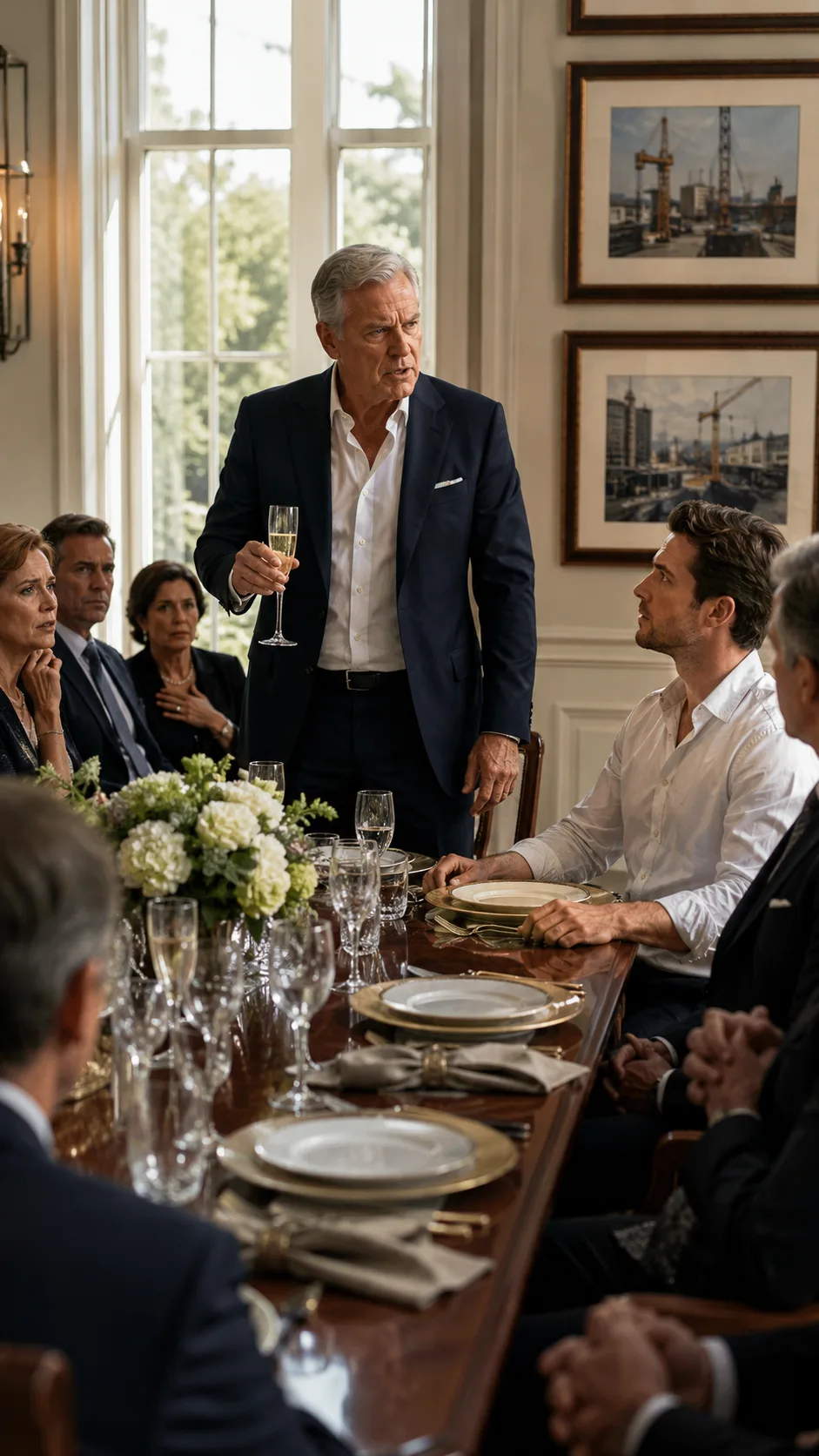
THE FATHER WHO CALLED HIS SON USELESS AT DINNER NEVER SAW THE EMPIRE BURNING BEHIND HIM
PART 3
My father stood in my restaurant surrounded by the men he had forgotten, and I watched the strongest man I had ever feared begin to shrink.
Chapter 2
THE FATHER WHO CALLED HIS SON USELESS AT DINNER NEVER SAW THE EMPIRE BURNING BEHIND HIM
PART 3
My father stood in my restaurant surrounded by the men he had forgotten, and I watched the strongest man I had ever feared begin to shrink.
Not physically.
Charles Whitmore was still tall. Still broad-shouldered. Still dressed like he belonged at the head of every table. But the room had changed the rules on him. No one there needed his approval. No one there was waiting for his permission.
Manny stepped forward first.
“You remember my son, Mr. Whitmore?”
Dad swallowed. “College, right?”
“Graduated last month,” Manny said. “Ethan helped cover what I couldn’t after the layoff.”
Dad looked at me.
I said nothing.
Russell crossed his arms. “My wife had surgery that year. Ethan gave me a job before I even asked.”
Dean nodded toward the dining room. “He didn’t ask what title we had before. He asked what we could do next.”
My father’s face hardened, but this time it looked less like anger and more like a man trying not to fall.
Mom stood slowly beside the booth.
“Charles,” she said, “listen to
them.”
He looked at her sharply.
“I listened to everyone for forty years.”
“No,” she said, voice shaking. “You heard everyone. You listened to yourself.”
That silence was heavier than the dinner table three years earlier.
Dad turned toward me.
“So what is this?” he asked. “A show? You wanted me to walk in here and see your little victory?”
I almost laughed.
Because even broken, he still thought everything was a contest.
“No. You walked in here because you’re scared.”
His jaw tightened.
“I am not scared of you.”
“You should be scared of what you built.”
His eyes flashed.
“I built homes. Towers. Jobs. A name.”
“You built a company where nobody could tell you the truth.”
He stepped closer.
“And you think soup and biscuits make you better than me?”
I stepped closer too.
“No. I think feeding people taught me something you never learned.”
“What?”
“That
nobody comes back to a table where they are only judged.”
For once, he looked away first.
Mom covered her mouth.
Then I pulled a framed photo off the wall.
It was from the first Hearth & Stone opening night. I was younger, thinner, terrified, standing between three cooks and two servers. In the corner of the photo, almost hidden behind a tray, was my mother. She had come that night, though she never told Dad. She was smiling through tears.
I turned the frame toward him.
“You know who believed in this place before anyone else?”
Dad stared at the photo.
His eyes found Mom.
“You went?”
She nodded.
“The night it opened.”
“You told me you were at church.”
“I was,” she whispered. “Afterward, I came here.”
Dad looked wounded, and for a second, I saw the twist: he had not only lost me. He had missed years
of my mother quietly choosing hope where he chose pride.
Then I gave him the second blow.
“Mom invested in my first oven.”
His head snapped toward her.
“What?”
Mom wiped her cheek. “From my own savings.”
“You funded this?”
“I helped our son when he needed one person to believe in him.”
Dad looked back at the kitchen, the tables, the framed photos, the full restaurant.
His voice dropped.
“And you never told me.”
“You made it clear,” Mom said, “that love in our house needed your approval first.”
My father gripped the back of a chair.
I could see his knees bend slightly, just enough to make him seem suddenly old.
Then my phone buzzed.
It was a message from my finance director.
Final numbers confirmed. We can absorb the worker relief fund and purchase selected Whitmore assets without touching expansion cash.
I read it twice.
Dad noticed.
“What is it?”
I put the phone face down.
“The banks won’t save you.”
His face went pale.
Mom whispered, “Ethan…”
I looked at her, then at him.
“But I can save the workers. I can save the equipment yard. I can save the training center. And I can make sure Mom keeps the house.”
Dad stared at me.
“The company?”
“No.”
His eyes sharpened. “You’d let Whitmore Construction die?”
“I’d let the version of it that hurt people die.”
He stepped back like I had struck him.
“That company is my life.”
“No,” I said. “It was your altar. And you put all of us on it.”
His face changed then.
Not anger.
Not pride.
Something worse.
Understanding.
The kind that arrives too late.
For a long moment, all I heard was the soft clink of dishes from the kitchen and a child laughing at a table near the window, unaware that a dynasty was ending beside the host stand.
Dad lowered himself into a chair.
The man who once told me I was too weak to lead suddenly looked too tired to stand.
“What happens now?” he asked.
I sat across from him.
“Whitmore Construction closes under your name. The safe parts become Whitmore Hearth Foundation. Job training. Trade apprenticeships. Kitchen maintenance certification. Housing repairs for elderly families. The workers come first.”
He blinked. “You already planned this.”
“I planned for the people you left behind.”
His mouth trembled once, barely.
“And me?”
That question was smaller than I expected.
Not “my title.”
Not “my office.”
Not “my legacy.”
Just me.
I looked at the man who had taught me how to tie a tie but never how to survive his disappointment. I remembered being ten years old on a job site, trying to lift a toolbox too heavy for me. He had shouted, “Use your back, Ethan. Stop acting soft.” I remembered being sixteen, making dinner because Mom was sick, and him refusing to eat because “men don’t hide in kitchens.” I remembered being twenty-nine, standing in that dining room, placing his watch on the table like I was burying a version of myself.
Then I remembered something else.
The night I opened Hearth & Stone, Mom hugged me in the alley and said, “Your father was not always this hard. He is terrified that if he stops building, he will disappear.”
At the time, I didn’t care.
Now, watching him sit in my restaurant with shaking hands, I finally understood.
Fear had been driving him for so long that it started wearing the mask of strength.
“I’m not giving you a company,” I said.
His eyes closed.
“But if you want to work,” I continued, “there’s a place for you.”
He opened his eyes.
“In what position?”
I stood and walked to the kitchen. When I came back, I held a clean white apron.
The room seemed to hold its breath.
I placed it on the table in front of him.
“Dish station starts at six tomorrow morning.”
Manny coughed once, trying not to react.
Dad stared at the apron like it was a foreign object.
For a second, the old fire returned to his eyes.
“You want me washing dishes?”
“No,” I said. “I want you starting where everyone here starts. With service.”
He looked around the restaurant. At the workers. At Mom. At me.
His fingers touched the apron.
Then he laughed once, quietly, brokenly.
“I spent forty years building towers.”
I waited.
His eyes filled, but he didn’t wipe them.
“And you built people.”
My throat tightened.
Mom began to cry openly then.
Dad stood slowly, holding the apron in both hands.
“I don’t know how to be small,” he said.
I looked at him.
“Then learn.”
The next morning, he arrived at 5:42.
Navy slacks. White shirt. No tie. No gold watch. His hair was combed, but his face looked like he had not slept.
Manny showed him the sink.
Russell handed him rubber gloves.
Nobody mocked him.
That was the first lesson.
In the weeks that followed, Charles Whitmore washed dishes, scrubbed stockpots, carried flour sacks, and burned his hand on a sheet pan because he refused to ask where the towels were. He listened more than he spoke. Sometimes pride rose in his face like an old reflex, but then he would swallow it and keep working.
The news called it “the fall of a construction titan.”
They were wrong.
Falls are fast.
This was slower.
This was a man being dismantled piece by piece until something human appeared beneath the steel.
Three months later, we opened the first Whitmore Hearth Training Center inside the old equipment yard. The sign was simple. No gold letters. No giant portrait. Just a plaque near the entrance.
For the workers who built more than buildings.
At the opening, my father stood behind me, not beside the microphone.
I looked back at him.
“You want to say something?”
His eyes widened.
The old Charles would have taken the stage before I finished asking.
This Charles shook his head.
“No,” he said. “Today, I’ll listen.”
That was when I forgave him.
Not all at once.
Not cleanly.
Not like stories pretend forgiveness happens.
But enough to breathe.
That night, after everyone left, Dad and I sat alone at Hearth & Stone. He placed the old gold watch on the table between us.
“I kept it,” he said.
I stared at it.
“I thought you threw it away.”
“I almost did.”
“Why didn’t you?”
His voice cracked.
“Because it was the last thing you gave back before I understood what I had lost.”
I picked up the watch, feeling the weight of it in my palm.
Then I slid it back toward him.
“Keep it.”
His face fell.
“Ethan—”
“When you’re ready to give it without conditions,” I said, “we’ll talk.”
He nodded slowly.
For the first time, he didn’t argue.
Outside, the restaurant windows glowed warm against the Dallas night. Inside, my father sat across from me in a clean white apron, hands red from dishwater, eyes wet with regret.
He was no longer a king.
And I was no longer the son waiting to be chosen.
I had built my own table.
And this time, everyone who came hungry was welcome.
THE END.
Chapter complete
You have reached the end of this chapter.
Continue reading
A few more worlds to get lost in after this chapter.




