THE FATHER WHO CALLED HIS SON USELESS AT DINNER NEVER SAW THE EMPIRE BURNING BEHIND HIM
PART 1
My father destroyed me in front of thirty people before the prime rib was even served.
Chapter 1
THE FATHER WHO CALLED HIS SON USELESS AT DINNER NEVER SAW THE EMPIRE BURNING BEHIND HIM
PART 1
My father destroyed me in front of thirty people before the prime rib was even served.
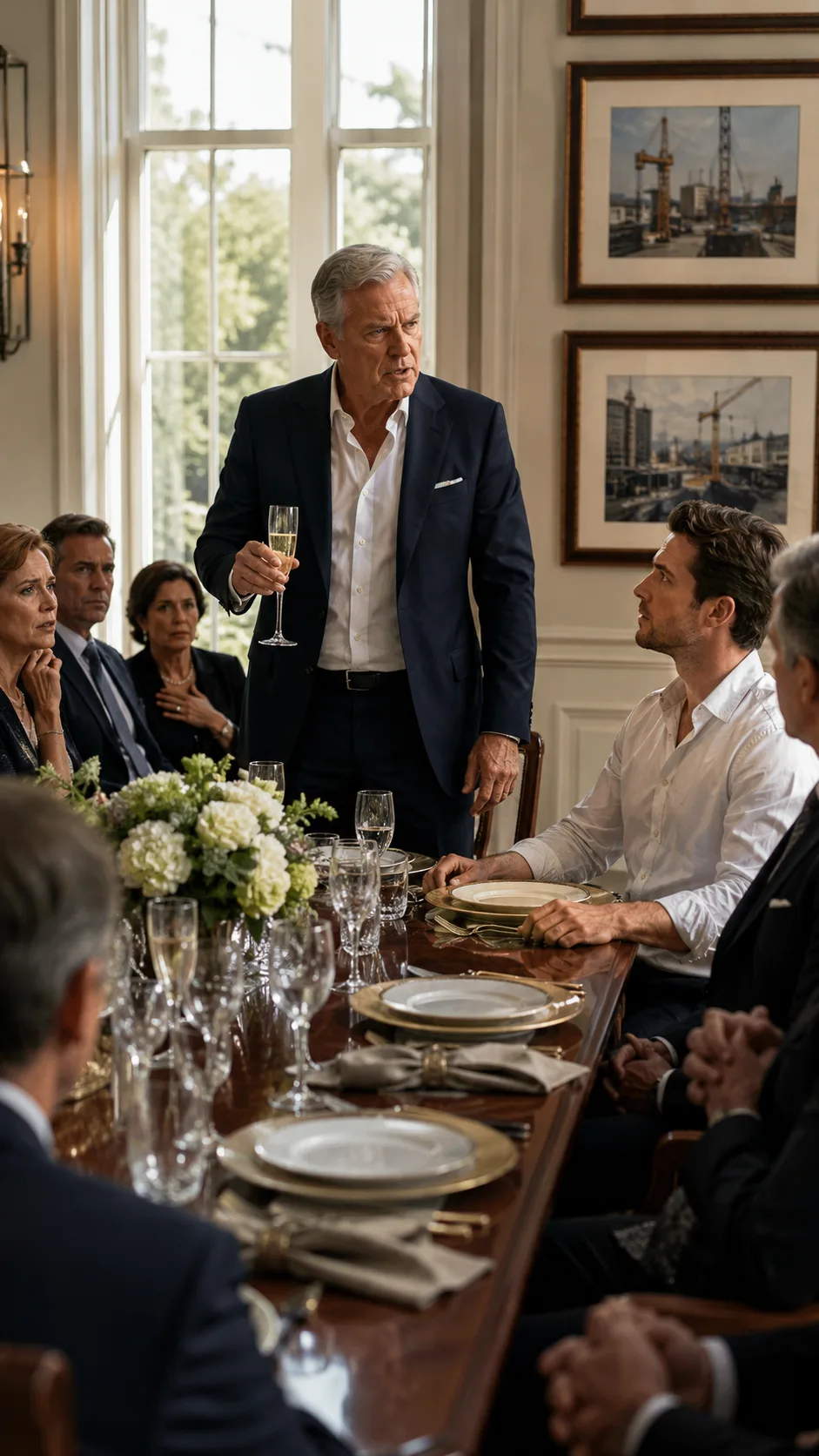
It happened in the dining room of our Dallas estate, under a chandelier he imported from Italy and framed photos of buildings he swore would outlive all of us. Charles Whitmore stood at the head of the table in his navy suit, champagne glass in hand, smiling like a king who had already chosen his heir.
Only the heir was not me.
It was Brian Keller, his polished vice president, the man who laughed too loudly at Dad’s jokes and called me “Chef Boy” whenever my father wasn’t listening.
My mother, Meredith, sat stiffly beside him, fingers curled around her napkin. She knew that look on my father’s face. So did I.
“Tonight,” Dad said, “Whitmore Construction enters a new era.”
Everyone clapped.
I sat near the far end of the table in a white button-down with flour still faintly dusting one sleeve because I had come straight from my
restaurant. Hearth & Stone. My little place. My shame, according to him.
Dad’s eyes landed on me.
“My son had every opportunity to become a man in this family,” he said.
The clapping stopped.
“Charles,” Mom whispered.
He slammed his glass down hard enough to rattle the plates.
Then he pointed at me.
“I would rather hand my company to a stranger than leave it to a useless son like you.”
The room froze.
I stood slowly, took off the old gold watch he gave me when I turned eighteen, and placed it beside my untouched plate.
“Then tonight,” I said, “you don’t have to call me your son anymore.”
And I walked out before anyone saw my hands shaking.
PART 2
For three years, I let my father believe he had won.
That was the part he loved most.
Charles Whitmore didn’t just want obedience. He wanted witnesses. He
wanted the whole room to see him choose Brian Keller over me. He wanted my cousins, his investors, his golf friends, and half the people who had watched me grow up to understand one thing: Ethan Whitmore had disappointed his father so badly that blood no longer mattered.
I didn’t go back to the estate after that dinner.
Not for Thanksgiving.
Not for Christmas.
Not even when my mother called and left messages that started strong but ended with silence.
“Ethan, honey, your father is just… he’s under pressure.”
Or:
“Your father asks about you sometimes, but you know how he is.”
No, I thought every time. I knew exactly how he was.
He was a man who measured love in square footage, steel beams, signed checks, and whether you could walk across a construction site without flinching when someone yelled. He had built his company from one truck and
two employees into a regional giant. Hotels. luxury apartments. shopping centers. His name was on cranes all over Texas.
My name was on a brick building with a green awning downtown.
Hearth & Stone.
The first year, he called it “your hobby.”
The second year, he called it “a cute little diner.”
By the third year, he had stopped saying its name.
But the truth was, while my father was busy pretending I didn’t exist, my restaurant had become impossible to ignore.
We opened a second location in Fort Worth.
Then Austin.
Then Denver.
Then Phoenix.
By the time Dad finally saw my face again, Hearth & Stone had eighteen locations, a frozen meal line in three grocery chains, and a training program for line cooks who had lost jobs during layoffs.
Many of those men had once worn Whitmore Construction helmets.
Dad didn’t know that part.
He didn’t know that when his company quietly cut older workers to protect executive bonuses, I hired them as kitchen maintenance managers, delivery supervisors, facilities trainers, and regional operations leads.
He didn’t know that Manny Cruz, the foreman he fired after twenty-one years, now ran logistics for my entire Texas division.
He didn’t know that Russell Dean, who once drove cement mixers for Whitmore, now handled vendor contracts for eight restaurants.
He didn’t know because he never asked.
Then Rivergate Towers happened.
At first, I heard it from a customer at the bar.
“Hey, aren’t you Charles Whitmore’s son?”
I was wiping down a counter after closing, sleeves rolled to my elbows, the smell of smoked brisket still hanging in the air.
I looked up.
“Depends who’s asking.”
The man turned his phone toward me. A news clip was playing without sound. The headline moved across the bottom of the screen.
Whitmore Construction Faces Massive Fallout After Rivergate Towers Shutdown.
My chest tightened.
“What happened?”
He shrugged. “Structural concerns. Materials issue. Investors pulling back. City shut it down this morning.”
I stared at the screen.
Rivergate Towers had been my father’s dream project. Forty-seven stories. Luxury residences. Retail space. Rooftop gardens. He had talked about it for years, even when I still came home for dinner.
“That building,” he once told me, “will be the Whitmore legacy.”
I had said, “I thought family was the legacy.”
He had laughed like I’d told a joke.
By midnight, every local station was running the story. By morning, national business sites had picked it up. By noon, vendors were calling, partners were panicking, and former Whitmore employees were texting me one sentence again and again.
Boss, did you see?
They called me boss now.
That should have made me proud.
Instead, it made my stomach twist.
Because behind all the headlines was my mother’s house, my father’s pride, hundreds of workers, and a name I had spent years trying to outrun.
Two days later, my mother came to the restaurant.
Not Dad.
Mom.
I saw her through the front window before she saw me. She stepped out of a black car wearing a cream coat and sunglasses even though the sky was gray. She looked smaller than I remembered.
I met her at the host stand.
“Mom.”
Her lips trembled, but she smiled anyway.
“Your place is beautiful.”
I almost said, You’ve never been here before.
Instead, I said, “You want coffee?”
She nodded.
We sat in the back booth, the one with family photos on the wall. Not my family. My restaurant family. Cooks with arms around each other. Servers holding trays. Manny cutting the ribbon on our San Antonio location.
Mom looked at the photos for a long time.
“You built all this?”
“With help.”
“Your father said it was one restaurant.”
“Dad says a lot of things.”
She flinched.
I hated myself for enjoying that for half a second.
Then she opened her purse and pulled out a folded newspaper clipping. My father’s face was on the front. Not the strong, polished face from magazine covers. This one looked gray.
“He won’t call you,” she said.
“I know.”
“He can’t.”
“No,” I said. “He won’t.”
Her eyes filled. “Ethan, the company is bleeding money. Brian Keller resigned yesterday.”
That caught me.
“Brian left?”
“He walked out with three senior partners. They’re saying your father made all the decisions.”
I leaned back.
Of course they were.
Brian had always known how to stand close enough to power to benefit, but far enough away to deny responsibility when the room caught fire.
“Mom, what do you want from me?”
She looked down at her coffee.
“Your father may lose everything.”
I waited.
She whispered, “Including the house.”
That hit harder than I expected.
Not because of the marble floors, the imported chandelier, or the stupid dining room where he broke my heart. But because my mother’s roses were behind that house. Because my height marks were still carved into the pantry doorway. Because my grandmother had died in the downstairs bedroom with Mom holding her hand.
Still, I kept my voice steady.
“He chose Brian.”
“I know.”
“He said I was useless.”
“I know.”
“In front of everyone.”
A tear slipped down her cheek.
“I know, baby.”
For the first time, I saw something I had been too hurt to notice before.
My mother hadn’t been silent because she agreed with him.
She had been silent because she was trapped beside a man whose pride took up every room.
I looked through the glass wall into the kitchen. My team moved like a living machine. Orders called. Pans hissed. Bread came out of the oven.
Everything Dad had mocked was feeding people.
Everything Dad had built was collapsing.
“Does he know you’re here?” I asked.
Mom shook her head.
“He told me never to ask you for help.”
I laughed once, but there was no humor in it.
“At least he’s consistent.”
Then the front door opened.
The restaurant went quiet in waves.
First the hostess stopped smiling.
Then the servers slowed.
Then Manny looked through the kitchen window and froze.
I turned.
My father stood inside Hearth & Stone for the first time in his life.
He wore the same navy suit style, but now it hung loose at the shoulders. His silver hair was neat, his jaw still hard, but his eyes moved around the room like he had entered a country where he did not speak the language.
He saw my mother.
Then me.
For a moment, none of us moved.
Then he walked toward the booth.
“Meredith,” he said, low and sharp. “Get your coat.”
Mom stiffened.
I stood.
“No.”
His eyes snapped to mine.
The old Charles Whitmore flashed back immediately.
“This is between me and my wife.”
“She came to me.”
“She shouldn’t have.”
The room was dead silent now.
I could feel every employee watching. Every customer pretending not to.
Dad’s gaze moved over my apron, my rolled sleeves, the burn scar near my wrist.
“Still playing restaurant,” he said.
Something inside me went cold.
I stepped closer.
“And you’re still playing king.”
His nostrils flared.
“You have no idea what I’m dealing with.”
“I know Rivergate is frozen. I know Brian left. I know vendors haven’t been paid. I know workers are scared. I know Mom came here because the house is at risk.”
His face changed.
Just slightly.
Not fear.
Recognition.
“How do you know that?”
I pointed toward the kitchen.
“Because half the men you threw away work for me now.”
Manny stepped out from behind the kitchen door.
Dad turned and saw him.
“Manny?”
Manny wiped his hands on a towel.
“Mr. Whitmore.”
Dad blinked like the room had tilted.
Then Russell appeared behind him.
Then Dean.
Then two more former Whitmore workers.
Men my father had once called “family” at company picnics before spreadsheets made them inconvenient.
Dad looked back at me.
“You hired them?”
“No,” I said. “I invested in them.”
The words landed harder than I expected.
My father’s mouth opened, but nothing came out.
And for the first time in my life, Charles Whitmore had no speech ready.
To be continued, Part 3 now
Chapter complete
You have reached the end of this chapter.
Continue reading
A few more worlds to get lost in after this chapter.




