PART 3
At breakfast, Rose came downstairs wrapped in her pale blue robe and gray wool blanket.
Chapter 2
PART 3
At breakfast, Rose came downstairs wrapped in her pale blue robe and gray wool blanket.
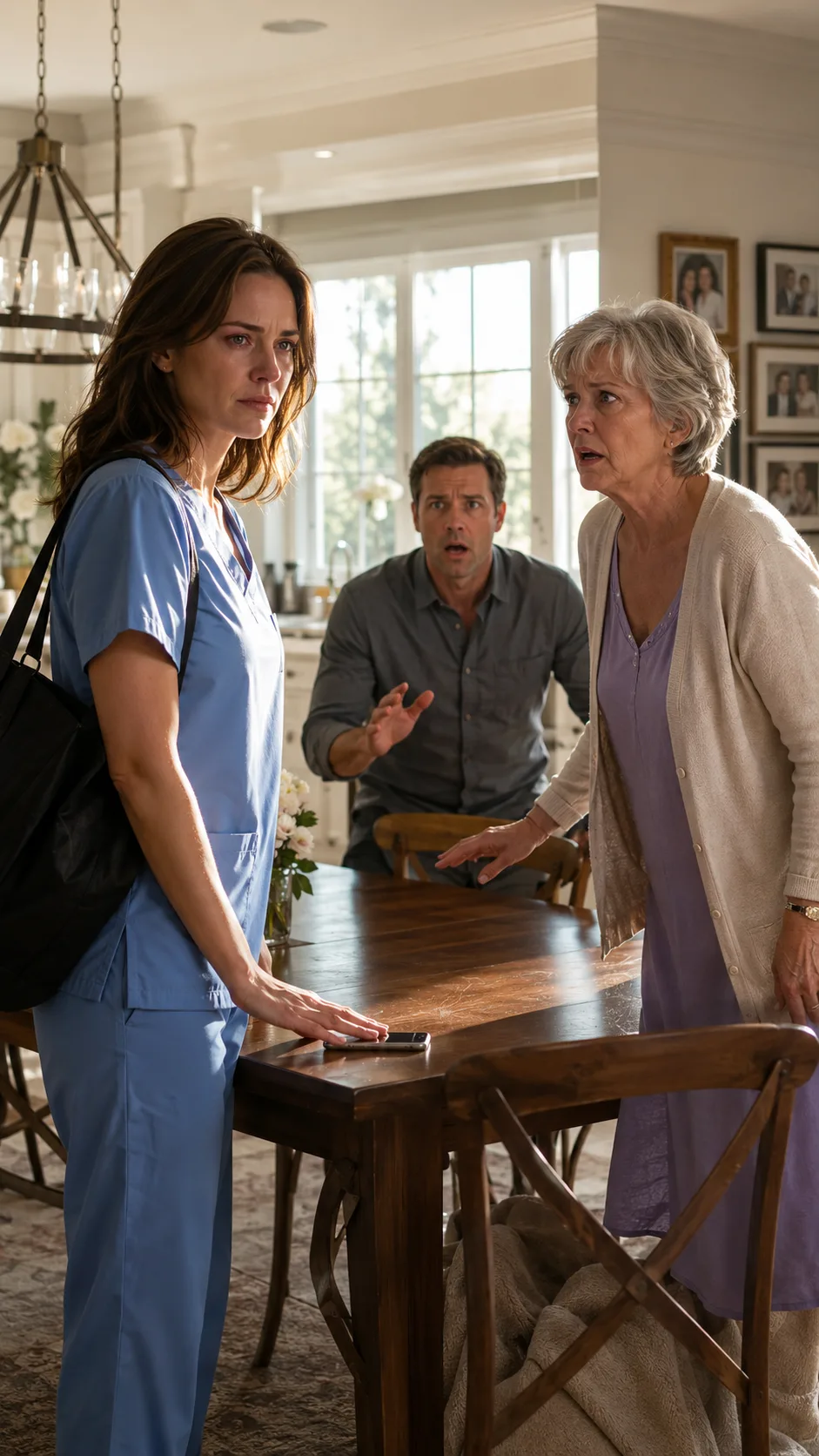
She moved slowly, one hand along the wall, lips parted as if every step cost her something. Michael jumped up to help her into the chair at the dining table.
“Mom, you should have called me.”
“I didn’t want to bother anyone,” she whispered.
I stood at the kitchen counter in my light blue scrubs.
Michael noticed first.
“You’re dressed for work.”
“Yes.”
Rose’s head snapped toward me.
“Work?”
I zipped my black bag.
“I’m going to the hospital after breakfast.”
Rose’s hand flew to her chest.
“Claire, how can you say that when I had such a terrible night?”
Michael looked between us.
“Maybe today isn’t the day.”
“It is exactly the day,” I said.
Rose’s eyes filled.
“Michael, I told you. She resents me.”
I walked to the table and placed my phone in the center.
The sound it made against the wood was soft.
But both of
them looked at it.
“Before this goes any further,” I said, “you need to hear something.”
Rose went still.
Not sick-still.
Caught-still.
“Claire,” she said carefully, “what is that?”
“The truth.”
I pressed play.
Rose’s voice filled the kitchen.
“I only need to keep pretending for a few more months.”
Michael’s face emptied.
The recording continued.
“Claire was getting too independent. If she stays home long enough, she’ll lose that job. Then she won’t have anywhere to run.”
Rose stood up so fast the wool blanket slid from her shoulders and fell to the floor.
“Turn that off!”
Michael stared at his mother.
The recording played one more line.
“Of course I’m not sick. Dr. Foster keeps saying I’m healthy.”
I stopped it.
For three seconds, no one moved.
Sunlight poured through the kitchen windows, bright and ordinary, falling across the table where Michael’s coffee sat untouched, where Rose’s untouched
toast had gone cold, where my phone lay like a small black witness.
Michael’s voice came out broken.
“Mom.”
Rose turned to him.
“No. Don’t look at me like that.”
“You lied?”
Her mouth opened, then closed.
“I was protecting this family.”
“From what?” he asked.
Rose pointed at me.
“From her.”
I almost smiled, because even now, with her own voice betraying her, Rose still reached for the same weapon.
“She was pulling away from you,” Rose said. “You didn’t see it. Always working. Always tired. Always too busy. I was losing my son.”
Michael’s eyes filled with tears.
“So you made my wife your servant?”
Rose flinched.
“I made her remember what family means.”
I stepped forward.
“No, Rose. You made me question my own sanity.”
She turned on me.
“You recorded a private conversation.”
“You tried to ruin my life.”
“I gave you a home.”
I laughed
once.
It sounded nothing like me.
“I helped pay for this home.”
Michael looked at me.
I had never said that in front of Rose.
When we bought the house, I had put down nearly half the deposit from my savings. Rose knew, but she liked to pretend everything belonged to Michael because it made the story easier for her.
Rose’s face tightened.
“That is not the point.”
“It is exactly the point,” I said. “You kept saying this was your son’s house. Your son’s family. Your son’s future. But you forgot I built part of it too.”
Michael sat down slowly, like his legs could no longer hold him.
“Claire,” he whispered, “why didn’t you tell me how bad it was?”
I looked at him.
“I did.”
His face changed.
Not because I was cruel.
Because he knew I was right.
“I told you when she insulted me,” I said. “I told you when she lied to neighbors. I told you when the hospital warned me about my job. I told you when her symptoms didn’t make sense.”
Michael covered his mouth with one hand.
“And every time,” I said, “you told me she was sick.”
Rose grabbed the edge of the table.
“She is turning you against me.”
“No,” Michael said.
His voice was quiet, but it stopped her.
Rose stared at him.
“What?”
Michael looked up at his mother with tears standing in his eyes.
“She isn’t turning me against you. You did that.”
Rose took a step back.
For the first time since I had known her, she looked old. Not sick. Not fragile. Old in the way people look when the story they used to survive no longer works.
“Michael,” she whispered, “I’m your mother.”
“I know,” he said. “That’s why this hurts.”
The room went silent again.
Then Rose began to cry.
But this time, nobody moved toward her.
Not me.
Not Michael.
She looked from him to me, waiting for the old pattern to resume. Waiting for guilt to pull us back into position. Waiting for me to apologize for making her uncomfortable. Waiting for Michael to defend her before he even understood what she had done.
No one did.
I picked up my phone. I picked up my bag.
Michael stood.
“Claire, wait.”
I stopped at the doorway.
He looked wrecked.
“I’m sorry.”
I nodded once.
“I believe you.”
Hope crossed his face.
But I wasn’t finished.
“I believe you’re sorry now,” I said. “But sorry doesn’t erase the fact that you left me alone in this house with her.”
His eyes dropped.
“I know.”
“I am going back to work,” I said. “Today. Tomorrow. Next week. I am not asking permission.”
“You don’t have to.”
“And I am staying with my sister for a while.”
That made Rose lift her head.
Michael looked like I had struck him.
“Claire—”
“I need space,” I said. “Not because I don’t love you. Because I forgot what my own life sounded like without someone calling my name every ten minutes.”
Michael nodded slowly, tears spilling now.
“I’ll pack a bag tonight,” he said.
“No,” I replied. “You stay here.”
He stared at me.
“With her?”
“With the truth,” I said.
Then I looked at Rose.
“If she is truly sick, call a doctor. If she is lonely, hire a companion. If she is afraid of losing control, that is not a medical emergency.”
Rose’s mouth trembled.
“You’re cruel.”
I shook my head.
“No. I’m finally awake.”
I went to work that morning.
When I walked through the hospital doors, the smell of antiseptic nearly made me cry. The sound of monitors, rolling carts, distant voices, shoes against polished floors—it all felt like proof that the world had kept moving while I was trapped in that house.
Denise saw me at the nurses’ station and froze.
Then she walked around the desk and hugged me.
“You made it back,” she said.
I closed my eyes.
“Barely.”
But I had made it.
My first patient that day was an elderly man recovering from surgery. He apologized every time he needed water. Every time I adjusted his blanket, he thanked me like I had handed him gold.
At one point, he looked at me and said, “You nurses must get tired of taking care of people.”
I thought of Rose.
Then I thought of the recording.
Then I thought of myself standing in that kitchen, finally refusing to shrink.
I smiled at him.
“No,” I said. “Not people who truly need care.”
That evening, I went to my sister’s apartment. She opened the door before I even knocked twice and pulled me into her arms.
I cried then.
Not pretty tears. Not quiet ones. I cried from my chest, from my bones, from every moment I had swallowed because I thought being a good wife meant being endlessly patient.
For two weeks, I did not go back to the house.
Michael called, but he did not pressure me. For once, he listened more than he spoke.
He told me Rose had tried to stage another dizzy spell.
This time, he called Dr. Foster.
Rose was furious.
Then embarrassed.
Then silent.
He told me he had arranged for a part-time home aide, but Rose refused to open the door.
He told her that was her choice.
He told me he had started therapy.
That surprised me.
“My mother raised me to believe needing me was the same thing as loving me,” he said over the phone one night. “I didn’t know how much damage that did until I watched her do it to you.”
I didn’t answer right away.
Then I said, “That’s the first honest thing you’ve said in months.”
Three weeks later, I met him at a small coffee shop near the hospital.
He looked tired. Thinner. But different. Less defended.
“I moved Mom into her own apartment,” he said.
I blinked.
“What?”
“It’s five minutes away. Safe building. Elevator. I’ll check on her. But she can’t live with us right now.”
I wrapped my hands around my coffee cup.
“How did she take it?”
“Badly.”
I almost laughed.
“I’m sure.”
“She said you won.”
I looked out the window.
“I didn’t want to win.”
“I know.”
I turned back to him.
“I wanted a husband who believed me before I had to collect evidence.”
His eyes reddened.
“I know.”
That was the beginning of our repair.
Not the end. Not a perfect movie ending where one apology fixes everything. Trust is not a light switch. It is a floorboard. Once it breaks, you test every step.
But Michael kept showing up.
He apologized without demanding forgiveness.
He corrected Rose when she blamed me.
He came to my hospital on my dinner breaks with food, then left when my break ended instead of asking for more time than I had.
And Rose?
Rose called me once.
I almost didn’t answer.
When I did, she was quiet for so long I thought the line had dropped.
Then she said, “I was afraid.”
I said nothing.
“I thought if Michael didn’t need me, I would disappear.”
For a moment, I heard something real in her voice. Not performance. Not strategy. Just an old woman facing the emptiness she had tried to fill with control.
“I’m sorry you felt that way,” I said.
She exhaled shakily.
“But you tried to make me disappear instead.”
Silence.
Then she whispered, “Yes.”
It was not enough.
But it was the first true thing she had ever given me.
Months later, I stood in our kitchen again. The same sunlight poured through the windows. The same wooden table sat in the center. The same family photos lined the wall, though Michael had moved some and added new ones.
There was one of me at the hospital, smiling in my scrubs.
I noticed it immediately.
Michael came up beside me.
“I should have put that there years ago,” he said.
I looked at the picture.
Then at the table where my phone had once exposed everything.
Rose did not live with us anymore. She visited sometimes, always by invitation, always with boundaries. She still made comments. She still struggled with not being the center of Michael’s world.
But now, when she said something sharp, Michael heard it.
And when I said no, the room did not collapse.
That was the part nobody tells you about taking your life back.
It isn’t always loud.
Sometimes it is simply putting on your work shoes in the morning without asking if anyone approves.
Sometimes it is letting a phone call go unanswered.
Sometimes it is realizing that compassion without boundaries is not kindness.
It is self-abandonment.
I am still a nurse.
I still care for people every day.
I still bring water, adjust pillows, hold hands, listen to fear, and stand beside people on the worst days of their lives.
But I learned something from Rose Wilson that no hospital ever taught me.
A person can need help.
And a person can use need as a leash.
The difference matters.
Because I can care for the sick.
I can comfort the frightened.
I can stand beside someone in pain.
But I will never again serve someone who pretends to be helpless just to make me forget my own strength.
THE END.
Chapter complete
You have reached the end of this chapter.
Continue reading
A few more worlds to get lost in after this chapter.




