you work very hard.”
I turned slightly.
“But I’m frightened,” she continued. “I don’t want to be alone in that house.”
Michael’s hands tightened on the steering wheel.
“Mom, you won’t be.”
I glanced at him.
He didn’t look at me.
That night, after Rose went to bed, Michael and I stood in the kitchen. The broken glass had been cleaned up, but I could still see the tiny cut on my foot, a red line across my skin.
“She needs someone,” Michael said.
“She needs follow-up appointments,” I replied. “Maybe a cardiac monitor. Maybe anxiety screening. But she doesn’t need me watching her twenty-four hours a day.”
“She collapsed, Claire.”
“And her tests were normal.”
Michael rubbed his face.
“You’re a nurse. You know how fragile older people can be.”
That sentence hit me harder than I expected.
“I also know when something doesn’t match the symptoms,” I said.
His eyes sharpened.
“What are you saying?”
“I’m saying we should be careful before we make big decisions.”
He looked toward the hallway, where Rose’s bedroom door was closed.
“She’s scared.”
“So am I,” I said. “I can’t just disappear from my job.”
“It would only be for a few weeks.”
That was how it started.
A few weeks.
I took unpaid leave from the hospital where I had worked for eleven years. I told my supervisor, Denise, that there had been a family medical situation. She understood, but I heard the concern in her voice.
“Claire, we’re already short-staffed,” she said. “I’ll do what I can, but I can’t hold your exact schedule forever.”
“I know,” I said. “I’ll be back soon.”
I believed that.
For the first week, Rose needed everything.
Water at the right temperature. Soup with no onions. Pillows arranged exactly behind her back. The curtains opened halfway in the morning and closed by three because the sunlight “hurt her nerves.” Her tea had to be made with honey, not sugar. Her socks had to be warmed in the dryer before she put them on.
Every hour, she called my name.
“Claire, my head hurts.”
“Claire, my blanket slipped.”
“Claire, I feel dizzy.”
“Claire, the soup is too salty.”
“Claire, the soup has no flavor.”
I told myself she was scared. I told myself illness made people difficult. I had cared for patients who snapped at me because pain had stolen their patience. I knew better than to take it personally.
But Rose was different when Michael came home.
The moment she heard his car in the driveway, her voice changed. It became softer, weaker. Her shoulders sank. Her hand floated to her chest.
“Michael,” she would whisper, “Claire has been trying, but I don’t want to be a burden.”
And Michael would look at me like I had somehow failed a test I had not known I was taking.
“She’s doing everything, Mom,” he would say.
Rose would smile sadly.
“I know. She has a good heart when she remembers to use it.”
I would stand there holding her dinner tray, too stunned to answer.
By the third week, I was no longer Claire Wilson, nurse.
I was Claire, bring the water.
Claire, warm the towel.
Claire, call the pharmacy.
Claire, cancel your plans.
Claire, don’t leave me alone.
One afternoon, I was folding Rose’s laundry in the hallway when I heard her talking to our neighbor, Mrs. Harris, in the living room.
I paused, because Rose’s voice sounded stronger than it had all morning.
“She’s home now,” Rose said. “Finally. A wife should care for family first.”
Mrs. Harris murmured something I couldn’t hear.
Rose sighed.
“Claire means well, but she’s always been too proud of that hospital job. Some women hide behind careers because they don’t know how to be wives.”
My fingers tightened around a towel.
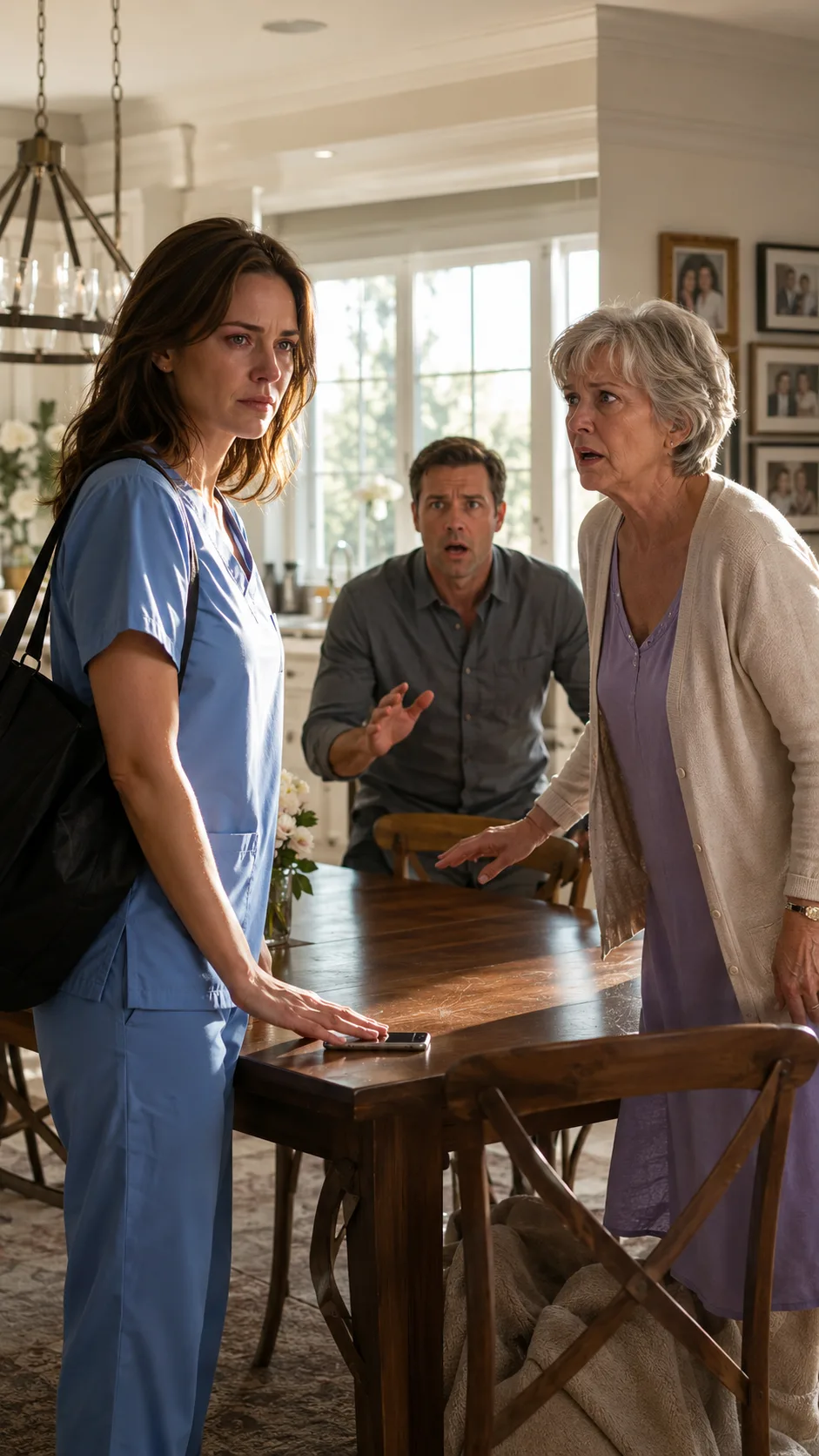
I stepped into the room.
Rose looked up and immediately leaned back into the sofa cushions.
“Oh,” she said faintly. “Claire. I didn’t hear you.”
Mrs. Harris looked embarrassed.
I smiled because I didn’t know what else to do.
“Your towels are done,” I said.
Rose reached for her water glass with a trembling hand.
“You see?” she said to Mrs. Harris. “She helps, but there’s always that tone.”
There had been no tone.
There had only been me, standing there with her laundry in my hands, feeling smaller than I had felt in years.
That night, I told Michael.
He frowned, but not in the way I needed him to.
“Maybe you misunderstood.”
“I didn’t.”
“Mom is old-fashioned.”
“She told Mrs. Harris I don’t know how to be a wife.”
“She’s sick, Claire.”
That word became a wall.
Sick.
Every time Rose crossed a line, Michael hid behind it.
When Rose criticized my cooking, she was sick.
When Rose told his aunt that I was impatient, she was sick.
When Rose cried because I took twenty minutes to shower instead of staying beside her, she was sick.
When she asked Michael if I resented her for being alive, she was sick.
And slowly, something began to change inside me.
Not rage. Not yet.
Observation.
Because I had spent too many years in hospital rooms not to notice patterns.
Rose was dizzy when I wanted to leave the house.
Rose was weak when Michael was watching.
Rose was breathless when I mentioned returning to work.
But when she thought she was alone, Rose moved differently.
One night, I came downstairs for water and saw her in the kitchen. No walker. No trembling hands. She stood on her toes to reach a tin of cookies from the top cabinet.
The next morning, she couldn’t lift a spoon.
Another afternoon, I saw her carry a heavy ceramic plant pot across the patio. Ten minutes later, when Michael called, she told him she could barely stand.
I said nothing.
But I started taking notes.
Dates. Times. Symptoms. Inconsistencies.
At first, it made me feel guilty.
Then it made me feel sane.
PART 2
The call from the hospital came on a Tuesday.
I was in the laundry room, shaking out Rose’s bedsheets, when Denise called.
“Claire,” she said, “I need to be honest with you.”
My chest tightened.
“Okay.”
“We’ve held your position as long as we can. If you’re not back by next Monday, we’ll have to replace you on the day shift.”
I sat down on the edge of the laundry basket.
“I understand.”
“I don’t want to lose you,” Denise said. “You’re one of the best nurses we have. But I need to know what to tell administration.”
I stared at the washing machine as it hummed in front of me.
My job was not just a paycheck.
It was the life I had built before marriage, before Rose, before I learned how easily a woman’s kindness could be turned into a cage. I had worked double shifts through nursing school. I had passed exams while eating vending-machine dinners. I had held strangers together when their families were falling apart.
And now I was about to lose it because my mother-in-law wanted her tea reheated.
“I’ll call you back,” I whispered.
When I walked into the living room, Rose was sitting upright on the couch, watching a game show at full volume. The moment she saw my face, she muted the television and pressed a hand to her temple.
“Claire, I feel one of my spells coming on.”
I looked at her.
“Denise called. The hospital needs me back Monday.”
Rose’s mouth tightened for half a second before her weak expression returned.
“Monday? That soon?”
“I’ve already been gone too long.”
Her eyes watered immediately.
“So that’s it? You’re leaving me?”
“I’m not leaving you. We can arrange help. We can schedule check-ins. Michael can—”
“Michael works.”
“So did I.”
Rose stared at me.
Then she began to cry.
Not loud sobs. Not at first. Just a slow, practiced trembling of the mouth, tears gathering at the corners of her eyes like she had summoned them.
“I knew this day would come,” she whispered. “I knew you would get tired of me.”
I closed my eyes.
“Rose, please don’t do that.”
“Don’t do what? Be old? Be frightened? Need someone?”
“You don’t need me the way you say you do.”
The room went silent.
Rose’s tears stopped.
For one second, her face changed.
It was not fear.
It was warning.
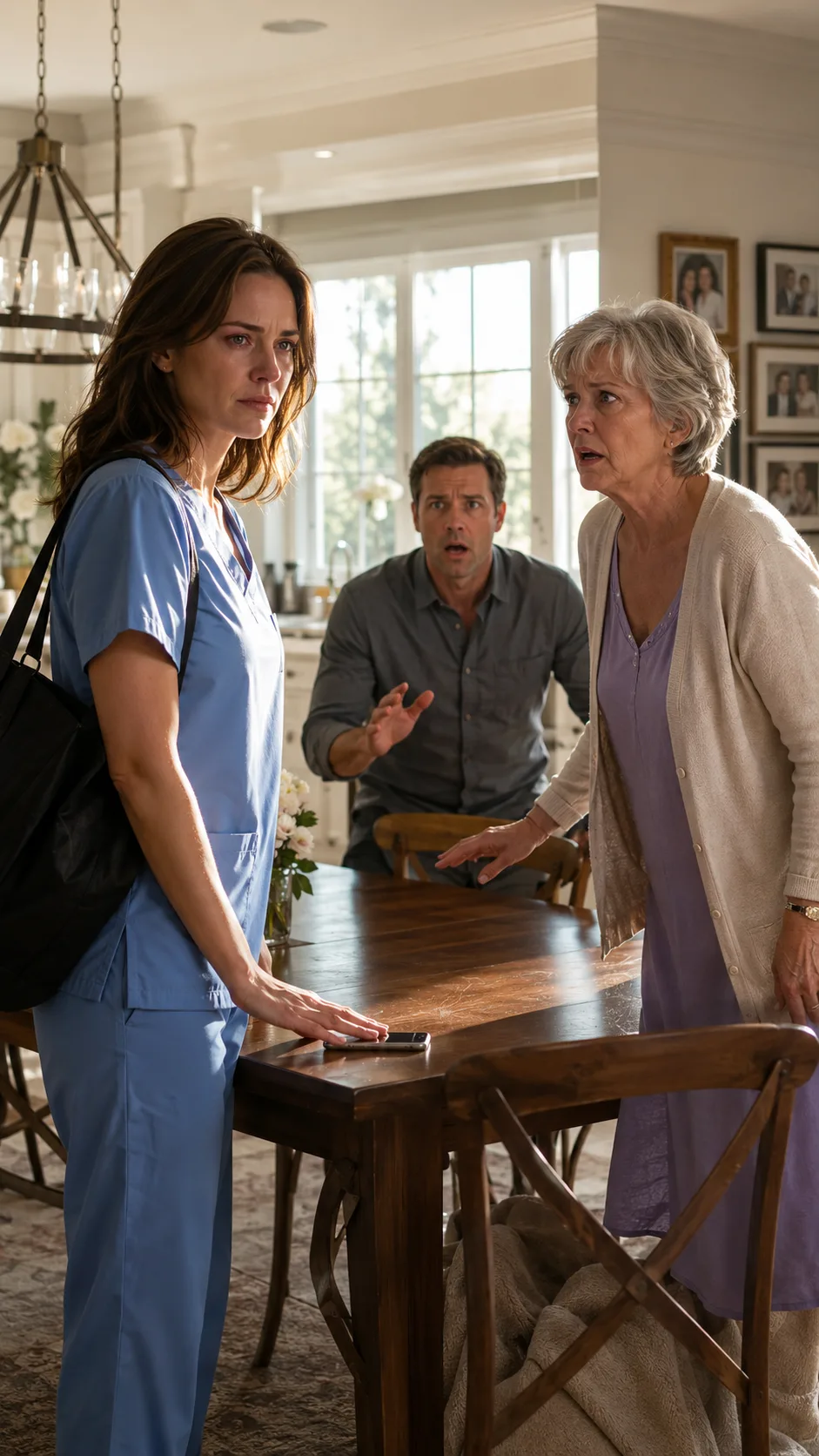
Then Michael walked in.
Rose made a small choking sound and bent forward, clutching her chest.
Michael dropped his keys.
“Mom?”
Claire, I told myself, breathe.
Michael rushed to her side.
“What happened?”
Rose shook her head.
“I don’t want to cause trouble.”
I almost laughed. The sound rose in my throat, bitter and sharp, but I swallowed it.
“Tell him,” I said.
Rose looked up at Michael with wet eyes.
“Claire says I don’t need her.”
Michael turned to me.
“Is that true?”
“I said she doesn’t need twenty-four-hour care.”
“She almost fainted just now.”
“She started clutching her chest when you walked in.”
Michael stood slowly.
“Claire.”
There it was again.
My name, said like a warning.
“No,” I said. “Don’t use that tone with me.”
His face hardened.
“My mother is terrified.”
“And I am losing my career.”
“She’s family.”
“So am I.”
Rose whispered, “Michael, don’t fight because of me.”
That was when I realized how perfectly she played him.
She didn’t have to yell. She didn’t have to demand.
She simply made herself small, and Michael rearranged the entire room around her.
That night, I did something I had never done before.
I called Dr. Elaine Foster, Rose’s private physician.
I knew it was a delicate line. Rose was an adult. Her medical information was private. But I wasn’t asking for secrets.
I was asking for guidance.
“Dr. Foster,” I said, “I’m Rose Wilson’s daughter-in-law. I’ve been caring for her at home. I need to know what level of care she actually requires.”
The doctor was quiet for a moment.
“I can’t disclose details without Mrs. Wilson’s permission.”
“I understand.”
“But I can say this,” she continued carefully. “Based on what Mrs. Wilson has allowed me to discuss in the past, I have not recommended full-time home care.”
I gripped the phone.
“She told us she could collapse if left alone.”
“Then she should come in for another evaluation.”
“I’ve tried. She cancels.”
Dr. Foster sighed.
“Bring her in. If she claims worsening symptoms, she needs to be assessed.”
The next morning, I told Rose she had an appointment.
She refused.
“I’m too weak.”
“Then we’ll call an ambulance.”
Her eyes flashed.
“That’s unnecessary.”
“If you’re too weak to go by car, it’s necessary.”
Rose stared at me for a long time.
Then she smiled.
It was a small smile. Almost invisible.
“Fine,” she said. “Take me.”
At the clinic, Rose performed like an actress in the final scene of a tragedy. She walked slowly, leaning on me with half her weight. She paused twice in the hallway to breathe. She told the nurse she had chest pressure, weakness, dizziness, and “a sense of doom.”
But tests do not respond to drama.
Dr. Foster reviewed everything.
“Mrs. Wilson,” she said, “your vitals are stable. Your exam is reassuring. I don’t see evidence that you require constant supervision.”
Rose blinked.
“But I feel ill.”
“I’m not saying you feel nothing,” Dr. Foster replied. “I’m saying your physical condition does not explain the level of care you’re requesting.”
Rose looked at me.
I looked back.
For once, I did not soften my face.
On the drive home, Rose sat in silence. She didn’t lean against the window. She didn’t moan. She didn’t ask me to slow down.
When we reached the house, she walked inside without waiting for me.
That evening, Michael had to work late. Rose ate dinner in her room, claiming she had no appetite. I cleaned the kitchen, packed my scrubs into a bag, and tried to calm the shaking in my hands.
I had decided.
I was going back to work Monday.
Rose could be angry. Michael could be uncomfortable. The neighbors could whisper. But I was not going to let my life shrink down to one woman’s demands.
Around nine, I went upstairs to bring Rose a cup of tea.
Her bedroom door was partly open.
I heard her voice before I reached it.
But it was not weak.
It was sharp and clear.
“I only need to keep pretending for a few more months,” Rose said.
I stopped.
My hand tightened around the mug.
Rose laughed softly.
“No, Michael has no idea. He believes whatever I tell him.”
My heartbeat filled my ears.
I slowly set the mug down on the hallway table and pulled my phone from my pocket.
I pressed record.
Rose continued.
“Claire was getting too independent. Always at that hospital, always praised by everyone. If she stays home long enough, she’ll lose that job. Then she won’t have anywhere to run.”
My fingers trembled so badly I almost dropped the phone.
There was a pause, then Rose said, “Of course I’m not sick. Dr. Foster keeps saying I’m healthy. That woman is becoming a problem.”
I covered my mouth with one hand.
Not because I was surprised.
Because I finally had proof.
Rose laughed again.
“Once Claire loses her job, she’ll learn her place. Michael needs a wife at home, not some woman running around playing hero for strangers.”
I stood in the hallway until the call ended.
Then I picked up the tea, walked into Rose’s room, and placed it on her nightstand.
She looked at me with sleepy eyes.
“Oh, Claire,” she whispered, weak again. “You startled me.”
I smiled.
“Sorry.”
“Could you fluff my pillow?”
I looked at the woman who had stolen weeks of my life, who had almost stolen my career, who had turned my own husband against me with tears and lies.
Then I fluffed her pillow.
Because the next morning, I wanted her comfortable when everything collapsed.
To be continued… wait until you see the ending she never saw coming.