SHE FILMED HERSELF LOVING HER GRANDMOTHER UNTIL THE NEIGHBOR RECORDED WHAT HAPPENED AFTER EVERY PERFECT TAKE
PART 3
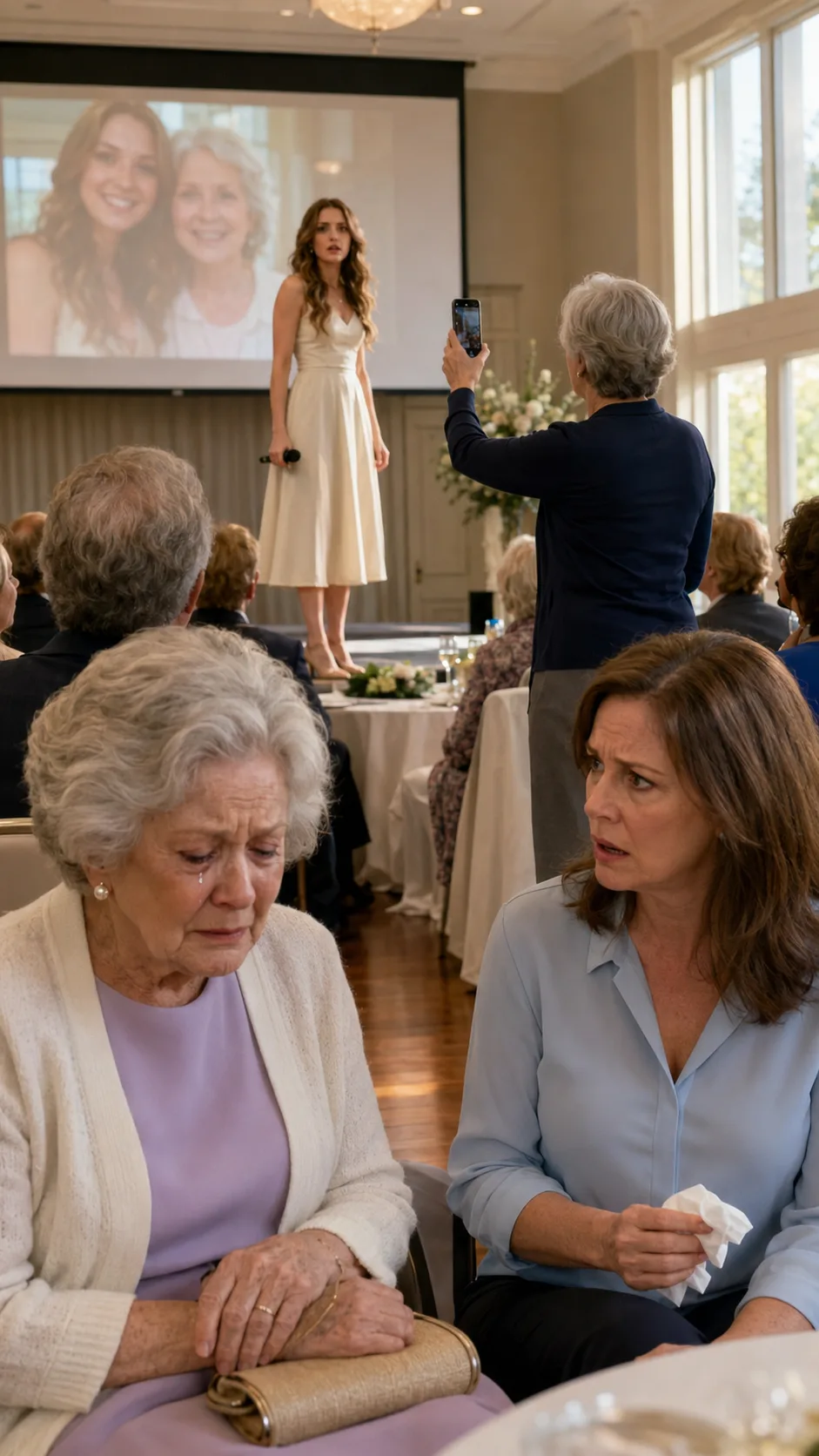
At first, the room thought Grace was part of the program.
Chapter 2
PART 3
At first, the room thought Grace was part of the program.
Madison recovered quickly, smiling into the microphone with the same bright expression she used when a video started badly and she needed to save the take.
“Oh,” she laughed softly, “that’s our neighbor Grace. She checks on Grandma sometimes too. It takes a village, right?”
A few people chuckled.
Grace did not.
She walked down the center aisle in a navy blouse and gray slacks, her silver cross necklace catching the overhead lights. Her steps were slow, but the room seemed to part for her anyway.
Madison’s fingers tightened around the microphone.
“Grace,” she said carefully, “we’re actually in the middle of something.”
Grace stopped below the stage.
“Yes,” she said. “That’s why I stood up.”
The room went quiet.
Linda leaned toward me. “Mom, what’s happening?”
I couldn’t answer. My throat had closed.
Grace turned toward the audience.
“You have all seen what Madison posts,” she said. “Now you
need to see what happens after she stops recording.”
Madison’s smile vanished.
“Don’t,” she said.
The word was low, but the microphone caught it.
Grace looked at her. “Rose asked me not to make trouble. So I waited. But today, you asked this room to honor a lie.”
Someone gasped.
Madison stepped down from the stage. “You don’t know anything about our family.”
Grace lifted her phone.
“I know what my window saw.”
The screen behind Madison changed.
My living room appeared.
Not the warm, golden living room from Madison’s videos. The real one. Dim corners. Old carpet. My walker near the wall. A bowl of soup on the side table.
On the screen, Madison leaned toward me with a spoon and smiled.
“Grandma raised me,” recorded Madison said. “Now it’s my turn.”
Then the video cut forward.
Madison’s smile dropped. She took the bowl away from me and said,
“I got the shot, Grandma.”
A cold sound moved through the hall.
Madison spun toward the audience. “That is taken out of context.”
Grace pressed play again.
Another clip.
Madison wrapping the pink blanket around me for a video.
Then, after filming, Madison pulling it off my lap and folding it into her bag.
“It’s sponsored,” recorded Madison said. “I can’t leave it here.”
My daughter Linda made a small broken noise beside me.
The next clip showed Madison tossing away the diabetic cupcake she had made me hold for a birthday post, though my birthday had been months earlier.
The next showed her laughing after a livestream.
“It worked,” recorded Madison said into her own phone. “They ate it up.”
No one spoke.
Not the women at the tables. Not the sponsors. Not the host holding the award plaque near the podium.
Madison looked at me.
For once, she
was not performing for the audience. She was begging me to perform for her.
“Grandma,” she said, walking toward me. “Tell them they don’t understand.”
Her voice echoed through the microphone still in her hand.
I stared at my granddaughter.
I saw the little girl who used to sleep on my couch during thunderstorms. I saw the teenager who cried when she didn’t get invited to prom. I saw the young woman who wanted so desperately to be loved by strangers that she forgot the person who had loved her first.
Then I saw myself.
Sitting alone after every visit.
Defending her.
Hiding her.
Shrinking so her image could grow.
I reached for the arms of my chair and stood.
Grace moved to help me, but I shook my head.
I wanted to stand by myself.
Someone handed me a microphone. My hand trembled around it.
“I taught second grade for thirty-two years,” I said. “Every year, I told my students the same thing. Kindness only counts when nobody is clapping for you.”
Madison’s face crumpled.
“Nana Rose,” she whispered.
The old name hurt.
But I kept speaking.
“You didn’t have to be perfect. You didn’t have to give up your life. You didn’t even have to come every week.”
My voice shook, but it did not break.
“You only had to stop turning my loneliness into something people could applaud.”
Linda began to cry.
Madison covered her mouth with one hand.
I turned to my daughter.
“And you, Linda.”
She froze.
“I called you in April. I called you in May. I told you I was tired.”
Tears slid down her face.
“Mom, I thought Madison was there.”
“No,” I said gently. “You hoped Madison was there. That is not the same thing.”
That broke her completely.
Linda came to me in front of everyone and knelt beside my chair like she was the child now.
“I’m sorry,” she sobbed. “I am so sorry. I should have come. I should have asked.”
I touched her hair.
“I know.”
Madison stood alone near the stage, still holding the microphone, still surrounded by the perfect flowers, perfect banner, perfect photographs of a life she had never truly lived.
The host slowly lowered the award plaque.
No announcement was made.
No one needed one.
By evening, Grace’s video was online.
Not edited beautifully. Not filtered. Not captioned with dramatic music. Just plain truth.
The caption read: “This is Rose after the camera stops.”
It spread faster than any of Madison’s videos ever had.
Sponsors vanished. Comments turned. People who had called her an angel now asked how many times they had praised a performance. Madison deleted posts, then restored them, then deleted the entire account.
But the internet was not the real punishment.
The real punishment came three days later, when Madison stood on my porch with no makeup, no tripod, no phone in her hand.
She looked younger than twenty-four. Smaller somehow.
“I deleted everything,” she said.
I stood in the doorway.
“Okay.”
“I’m giving the money back.”
“Okay.”
“I started calling places. Volunteer places. Real ones.”
I nodded.
Her eyes filled.
“I liked who they thought I was,” she whispered. “I liked her more than I liked myself.”
That was the first honest thing Madison had said to me in months.
The porch was quiet.
Across the street, Grace’s curtain moved and quickly dropped again.
“I loved you before anyone followed you,” I said.
Madison’s chin shook.
“I know.”
“No,” I said. “I don’t think you did.”
She started crying then. Not pretty tears. Not useful tears. Her mouth twisted, her shoulders folded, and both hands covered her face.
“I’m sorry, Nana Rose.”
I wanted to pull her into my arms.
Every grandmother instinct in me begged to fix it, soften it, make her feel forgiven before she had to sit with what she had done.
But love without truth had already cost me too much.
So I stayed where I was.
“I believe you’re sorry,” I said. “But I am not ready to make you feel better.”
She nodded through tears.
“I understand.”
“You can come by Saturday.”
Her head lifted.
“Really?”
“For one hour,” I said. “No phone. No camera. No posting. No telling anyone you came.”
She wiped her face quickly. “Yes. Of course.”
“And we are not filming soup.”
For the first time, something almost real passed across her face.
A small, ashamed laugh.
“No soup.”
On Saturday, Madison arrived with two turkey sandwiches, a container of fruit, and a deck of cards. She did not rearrange my furniture. She did not open the curtains. She did not check the light.
She sat across from me at the kitchen table and said, “I don’t remember how to play gin rummy.”
“You used to cheat,” I said.
Her mouth opened. “I did not.”
“You hid queens under your leg.”
A laugh escaped her before she could stop it.
It surprised us both.
We played badly. We ate slowly. She asked me about my students, my late husband, the year Linda was born, the first house I ever lived in. For once, she listened without waiting for a moment to record.
Later, Linda came over with groceries and fixed the loose porch rail. Grace brought banana bread and sat with us until sunset.
No one took a picture.
No one needed proof.
Weeks passed.
Madison kept coming. Sometimes I let her in. Sometimes I told her I was tired. She accepted both.
That was new.
Linda began visiting every Wednesday after work. At first, she cried too much and tried to fix everything in one afternoon. Eventually, she learned that love was not always an apology. Sometimes love was sitting quietly beside me while I folded towels.
One evening, Madison looked at the empty corner where her tripod used to stand.
“I thought being seen would make me feel loved,” she said.
Linda looked at her. “Did it?”
Madison shook her head.
I reached for both their hands.
“Being seen is not the same as being known.”
Neither of them answered.
Outside, Grace’s porch light came on. The same gold sunlight filled my living room that Madison once used to make herself look kind.
Only now, there was no camera.
And for the first time in a long while, the room was warm for real.
THE END.
Chapter complete
You have reached the end of this chapter.
Continue reading
A few more worlds to get lost in after this chapter.




