SHE FILMED HERSELF LOVING HER GRANDMOTHER UNTIL THE NEIGHBOR RECORDED WHAT HAPPENED AFTER EVERY PERFECT TAKE
PART 1
The first time my granddaughter Madison pointed a camera at my face and called it love, I almost believed her.
Chapter 1
PART 1
The first time my granddaughter Madison pointed a camera at my face and called it love, I almost believed her.
She came into my little Ohio living room with grocery bags, fresh flowers, a soft pink blanket, and the kind of smile people save for church photos. She set her phone on a tripod, adjusted the curtains, then knelt beside my chair and tucked the blanket over my knees.
“Grandma raised me,” she said to the camera, lifting a spoonful of soup toward my mouth. “Now it’s my turn to take care of her.”
Her voice cracked beautifully. Her eyes shined. Her hand rested gently over mine.
I heard the phone ding as people joined her live video.
“She’s an angel,” someone commented.
I smiled because Madison squeezed my fingers under the blanket.
When the recording ended, her hand disappeared.
She stood, took the bowl from me, and dropped the spoon into it with a sharp clink.
“Okay, don’t move yet,” she said, already checking the video. “I need a
better thumbnail.”
“Are you staying for dinner, honey?” I asked.
Madison didn’t even look up.
“I can’t. I’m meeting friends downtown.”
“But you just got here.”
“I got the shot, Grandma.”
The words landed quietly, but they cracked something inside me.
She picked up the flowers, the groceries, even the pink blanket. All props. All leaving with her.
Then she walked out, forgetting to move my phone back within reach.
Across the street, my neighbor Grace Miller stood behind her lace curtain, holding her own phone up to the window.
She had recorded everything.
PART 2
My name is Rose Whitaker. I am seventy-six years old, and I spent most of my life teaching second grade children how to read, share, and tell the truth even when lying felt easier.
Maybe that was why Madison’s pretending hurt me so deeply.
Because I had helped raise her.
My daughter Linda had
Madison young. Her marriage ended before Madison learned to say “Dada,” and Linda worked long hours as a dental assistant to keep a roof over their heads. Most evenings, she brought Madison to my house with tired eyes and apologies.
“Mom, I don’t know what I’d do without you,” Linda would whisper.
And I would take that baby from her arms and say, “Go. We’re fine.”
Madison took her first steps in my kitchen, holding onto my yellow cabinets. I taught her how to tie her shoes, how to make pancakes, how to write thank-you notes. When she had nightmares, she slept in my bed with one tiny hand wrapped around my sleeve.
She used to call me Nana Rose.
Not Grandma. Nana Rose.
When she was seven, she told me, “Don’t ever leave me.”
I promised I wouldn’t.
I never imagined that one day she would be the one
leaving me, again and again, while millions of strangers thanked her for staying.
Madison was twenty-four when she started trying to become famous online. At first, she posted makeup videos, coffee-shop outfits, morning routines, apartment tours. They were pretty, polished, and forgettable. She wanted more. She wanted people to feel something when they saw her.
Then one afternoon, she came to visit me after almost two months without calling.
I was so happy I ignored the tripod in her hand.
“Nana Rose,” she said brightly. “Let’s make a little video together.”
I thought it would be a memory.
To Madison, it was strategy.
That first video showed her brushing my hair, feeding me soup, and kissing my forehead. It went viral overnight. The comments were full of praise.
“This generation needs more girls like her.”
“She’s so selfless.”
“Grandma is so lucky.”
The next morning, Linda called me crying.
“Mom, did you see Madison’s video? I’m so proud of her.”
I looked around my silent kitchen.
Madison had stayed twenty-three minutes.
“She came by,” I said carefully.
Linda sighed with relief. “I felt so guilty that I haven’t been able to check on you as much. But knowing Madison is there helps.”
I wanted to say, She isn’t really here.
But mothers are foolish. Grandmothers are worse.
I protected Madison because I still remembered the little girl who needed me.
So I said nothing.
After that, Madison visited every Thursday at two in the afternoon because that was when the sunlight made my living room look golden. She brought flowers she took home afterward. She brought food I was not allowed to eat. She brought blankets, mugs, vitamins, books, everything that looked good beside my old recliner.
Before filming, she became tender.
She would kneel beside me and say, “How’s my favorite lady today?”
After filming, she became impatient.
“Grandma, don’t talk while I’m checking the comments.”
“Don’t wrinkle the blanket.”
“Hold the mug higher.”
“Can you smile like you’re actually happy?”
The worst part was not her cruelty. It was that she never thought of it as cruelty.
To Madison, I was part of the set.
A wrinkled face. A soft voice. A reason for strangers to call her good.
Soon, brands began sending her products. Heated blankets. Meal kits. Skin lotion. Supplements. A company that made home safety alarms offered her a paid campaign.
She filmed herself saying, “Caring for an elderly loved one is a full-time commitment.”
Then she left before changing the battery in my hallway smoke detector.
One Thursday, I asked if she could pick up my prescription.
She frowned at her phone. “Can’t Linda do it?”
“Your mother’s working.”
“I have a content meeting.”
“Madison, it’s important.”
She sighed like I had asked for her kidney.
“Fine. Text me the address.”
She never went.
Grace Miller brought it to me the next morning.
Grace lived across the street and had known me for eleven years. She was sixty-eight, widowed, sharp-eyed, and kind in a way that did not announce itself. She noticed things other people missed.
She noticed Madison’s car only stayed in my driveway for half an hour.
She noticed Madison carrying the grocery bags back out after filming.
She noticed me sitting too long by the window after Madison left.
That morning, Grace set the prescription bottle on my kitchen table and said, “Rose, how often is that girl actually helping you?”
I looked down at my hands.
“Don’t start trouble,” I whispered.
Grace sat across from me. “Trouble already started. I’m asking who’s going to stop it.”
“She’s young.”
“You were young once too. You didn’t use people.”
I closed my eyes. “She’s my granddaughter.”
“And you are not her prop.”
The word made me flinch.
Prop.
I hated how true it felt.
The final straw came three weeks later.
Madison had been invited to receive a local community award for “Young Caregiver of the Year.” She arrived at my house with a lavender dress for me and a script.
“A script?” I asked.
“Just some thoughts,” she said. “When they ask you about me, say I changed your life.”
I stared at the page.
Madison had written my pain in neat little lines.
“She gives up everything to make sure I’m never alone.”
“She is my blessing.”
“I don’t know what I’d do without her.”
My hands began to shake.
“Madison,” I said, “this isn’t true.”
Her face hardened.
“It’s emotionally true.”
“No. It’s not.”
She grabbed the paper from me.
“Do you know what this award could do for me? Sponsors, interviews, maybe a whole caregiver platform.”
“A platform built on what?”
Her eyes flashed.
“On family. On love. On you.”
“No,” I said softly. “On pretending.”
For the first time, Madison looked frightened. Then angry.
“You know what, Grandma? People love you because of me.”
I could not breathe for a moment.
She put the script in her purse, lifted her phone, and said, “Fine. Don’t help. I’ll make it work.”
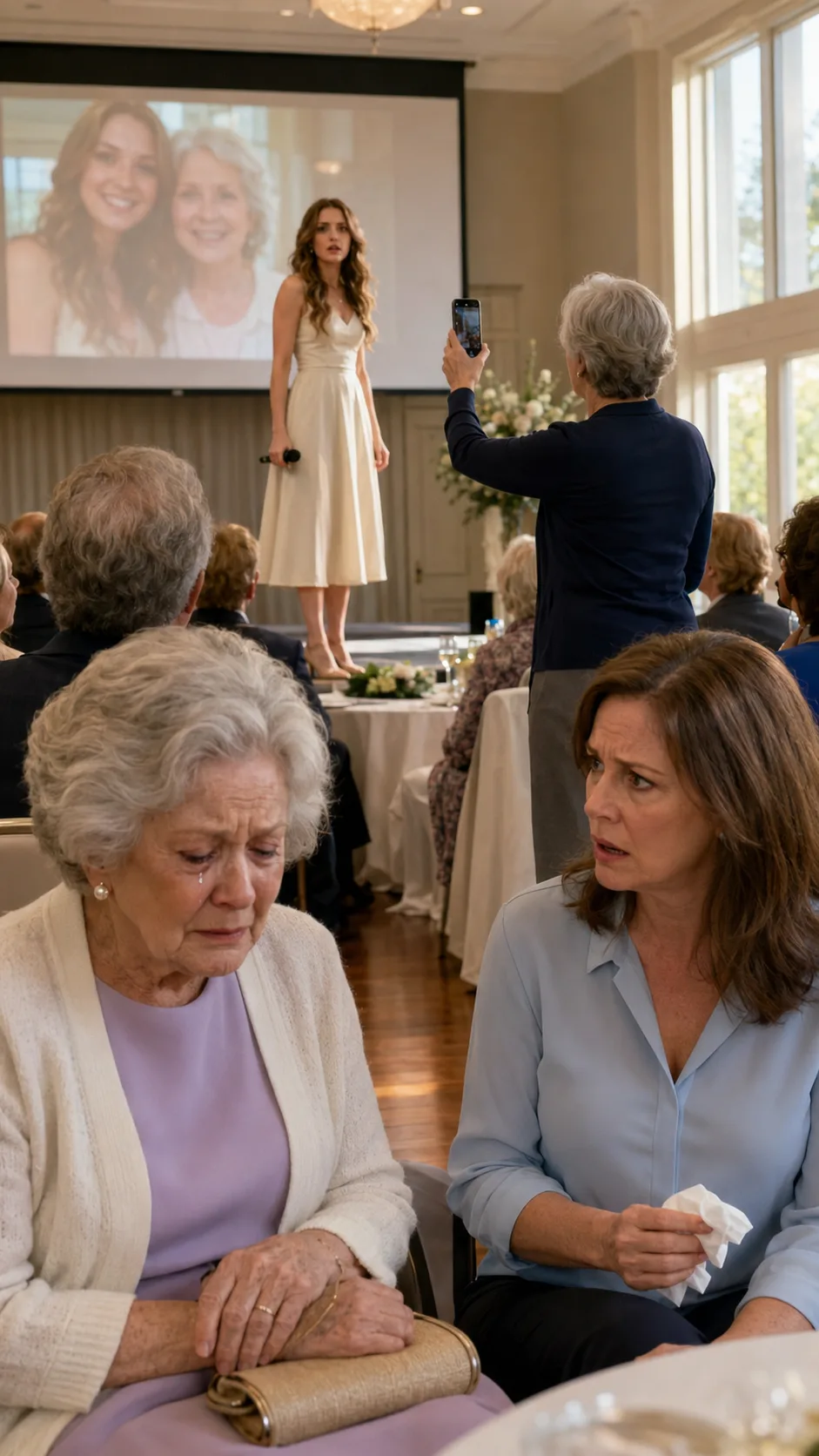
On the day of the ceremony, Madison sat beside me in a bright community hall filled with white tablecloths, flower centerpieces, and women who recognized me from her videos.
They squeezed my hand and said, “You must be so proud.”
I looked at Madison posing for photos under a banner with her own face printed on it.
“I raised a little girl once,” I said.
They smiled because they did not understand.
Then Madison walked onto the stage.
She was beautiful under the lights. Her cream dress fit perfectly. Her hair fell in soft waves. Her voice trembled as she told the room she had rearranged her whole life to care for me.
Linda sat in the front row, crying.
“My baby,” she whispered.
I wanted to ask which baby she meant.
Madison lifted one hand toward me.
“My grandmother never spends a lonely afternoon anymore,” she said. “Not while I’m alive.”
At the back of the room, Grace Miller stood up.
Her face was pale. Her phone was in her hand.
And Madison stopped smiling.
To be continued, Part 3 now
Chapter complete
You have reached the end of this chapter.
Continue reading
A few more worlds to get lost in after this chapter.




