Four years earlier, I was sitting beside my husband Martin in a hospice room that smelled like antiseptic, rain, and goodbye.
Chapter 2
Four years earlier, I was sitting beside my husband Martin in a hospice room that smelled like antiseptic, rain, and goodbye.
He had been sick for eleven months.
Pancreatic cancer is not merciful. It does not knock politely. It walks into your life, sits at your table, and eats everything you love while you watch.
Martin had lost weight until his wedding ring slipped from his finger. His voice had become so thin that every sentence sounded borrowed. But his eyes were still his. Clear. Steady. Kind.
“Sylvia,” he whispered.
I leaned close. “I’m here.”
His hand rested inside mine, light as paper.
“Don’t let them waste it.”
At first, I thought he meant time.
Then he swallowed, gathered the last of his strength, and said, “The money. Our life’s work. Don’t let it buy compliance.”
The words confused me then.
Derek was our son. Rachel was our daughter. We had raised them with love, structure, and the kind of values people claim they have until money tests them.
But Martin
knew something I wasn’t ready to admit.
“Money should build futures,” he whispered. “Not buy loyalty.”
He died less than an hour later.
For months, I heard those words every time I opened a bank statement.
Martin and I had not been flashy rich. We were disciplined rich. Quiet rich. We drove cars until they coughed. We packed lunches. We bought the smaller house when the bank approved us for the bigger one. Then Martin’s software patents paid out, my retirement stock options matured, and suddenly our careful life had become a legacy.
After his funeral, Derek cried beside me at the cemetery.
“Mom,” he said, wrapping his arm around my shoulders, “you’ll never be alone. We’re here for you.”
I believed him because grief makes you desperate to believe beautiful lies.
Rachel, my daughter, stayed with me for two weeks. She cooked. She sorted Martin’s clothes. She slept on
the couch because she said the house felt too quiet for me to be alone in it.
One night, while folding Martin’s old gray sweater, she paused.
“Mom, be careful with Derek,” she said.
I looked at her sharply. “What does that mean?”
Her face tightened. “Amber asked me in the church bathroom how much Dad left you.”
I stared at her.
“At the funeral?”
Rachel nodded. “Before the graveside service.”
I wanted to defend Amber. I wanted to say grief makes people strange. I wanted to say she was just worried about the children.
So I ignored the warning.
Three months later, I met with Thomas Brennan, our family lawyer and financial adviser. His downtown office smelled like leather chairs and old coffee, the same way it had for twenty years.
“I want to create trust funds,” I told him. “For the grandchildren.”
He nodded. “Education only?”
“Education, health
care, first homes, emergency support. But controlled. Protected.”
Thomas looked over his glasses. “Protected from whom?”
The question landed harder than I expected.
I thought of Martin’s voice.
Don’t let them waste it.
“From anyone who forgets what it is for,” I said.
So we built the Morrison Family Legacy Trust.
Lucas, Sophie, and Owen each had separate protected accounts. Derek and Rachel were named as family beneficiaries, but only for approved uses. I was sole trustee. Thomas was successor trustee. No spouse could withdraw directly. No beneficiary could liquidate assets without trustee approval.
Amber didn’t know the details.
That was my first mistake.
For the first year, everything looked fine. Derek asked for help with Lucas’s therapy appointments. Approved. Sophie needed a specialist. Approved. Owen’s school fees rose. Approved.
Then the requests changed.
Amber wanted a new SUV “for the children’s safety.”
Approved.
Then a kitchen renovation because “the old layout was bad for hosting family.”
Approved, though I reduced the amount.
Then private preschool deposits, vacation deposits, furniture, a country club initiation fee disguised as “networking for Derek’s career.”
I started saying no.
That was when Amber’s politeness changed.
She stopped calling me Mom. Then she stopped calling at all unless she needed something.
Derek became quieter. He still loved me, I think. But love becomes weak when it is filtered through a resentful spouse.
By the fourth year, Amber had learned to smile while punishing me.
She forgot to invite me to Sophie’s school performance. She changed Christmas plans without telling me. She posted family photos online where I was cropped out, my shoulder still visible at the edge like proof of a ghost.
When I asked Derek about it, he sighed.
“Mom, Amber just feels like you judge her.”
“I ask questions because trust money has rules.”
“She says you use money to control us.”
That sentence hurt because it came wearing Martin’s warning like a mask.
“I use structure to protect the children,” I said.
Derek rubbed his forehead. “Can we not do this right now?”
We did not do it right then.
We did it at Lucas’s sixth birthday party.
I arrived with a wrapped set of illustrated science books, a handmade card, and the foolish hope that maybe things were getting better.
The house looked perfect. White walls. Gold balloons. A custom cake shaped like a rocket. Amber gliding through the living room in silk and diamonds, accepting compliments like she had invented motherhood.
Lucas ran to me first.
“Grandma Sylvia!”
He hugged my waist so tightly that I nearly cried.
For two hours, I let myself believe I still belonged.
Then I heard Amber in the kitchen.
“She needs boundaries,” Amber told one of her friends. “Sylvia thinks because she has money, she gets an opinion.”
I stood frozen outside the doorway.
Her friend laughed softly. “At least she pays for things.”
Amber’s voice dropped.
“Not for long. Once the new house closes, we’ll be done depending on her.”
The new house?
My stomach turned.
That was when I understood.
They weren’t planning to ask me. They were planning around me.
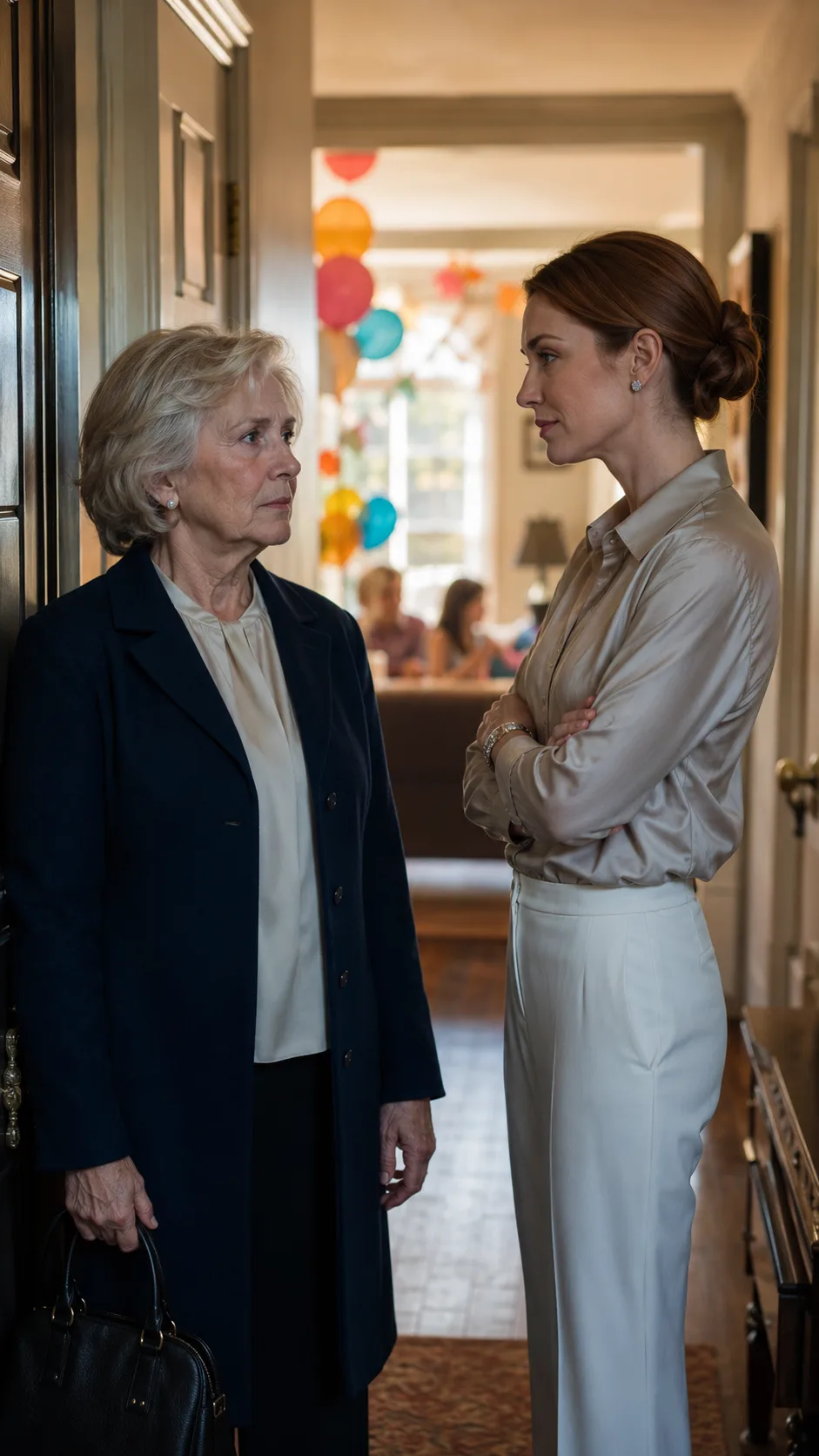
Ten minutes later, Amber cornered me in the hallway near the front door.
“Stop interfering in our lives,” she whispered.
I looked at her, really looked at her, and saw no embarrassment. No guilt. Only confidence.
“We don’t need your help anymore,” she added.
Behind her, Derek laughed at something a neighbor said. My grandson’s candles waited to be lit. The party went on as if my heart had not just cracked down the middle.
I walked outside.
I called Thomas.
“Freeze the trust fund.”
There was a brief silence on his end.
“Effective immediately?”
“Yes.”
“All discretionary access?”
“All of it.”
Two weeks later, Amber sat across from a private banking officer wearing a cream blazer, diamond earrings, and the expression of a woman who believed doors opened because she approached them.
She had a purchase contract for a four-million-dollar down payment.
She had Derek’s signature.
She had confidence.
What she did not have was authority.
The banker typed for several seconds, then frowned.
“I’m sorry, Mrs. Morrison,” he said. “The trust has been frozen pending trustee review.”
Amber blinked.
“That’s impossible.”
The banker folded his hands. “Only the trustee can release funds.”
Amber’s face went pale.
Because in that moment, she finally understood.
The trustee was me.
TO BE CONTINUED, PART 3 NOW
Chapter complete
You have reached the end of this chapter.
Continue reading
A few more worlds to get lost in after this chapter.




