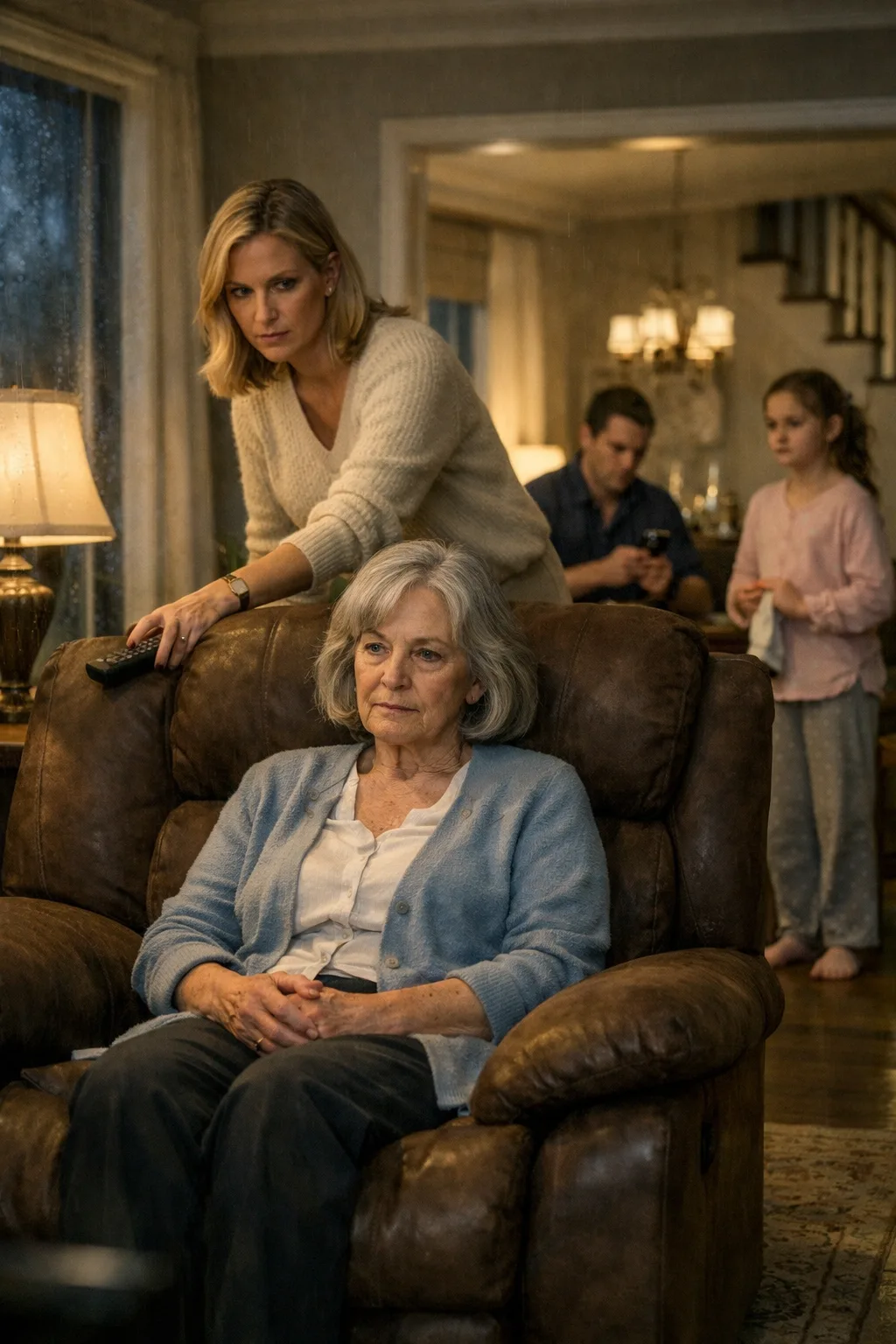
I did not sleep much that night.
Chapter 2
I did not sleep much that night.
Greg’s debt sat in my mind like a stone dropped into water, sending ripples backward through every awkward dinner, every sigh over bills, every “helpful” question Christine had asked about my finances. Once I saw the pattern, I could not unsee it.
The expensive steaks.
The kitchen renovation they claimed was “suddenly necessary.”
Greg’s habit of checking market prices on his phone while pretending not to eavesdrop.
Christine asking whether I had made a will, then laughing too quickly and saying, “Morbid topic, sorry.”
It was never about my presence alone.
It was about my potential.
The next week, Denise arranged for a forensic review of my recent account activity—not because money was missing, but because I wanted certainty. Everything came back clean. No withdrawals, no fraud, no direct access.
That should have comforted me.
Instead, it confirmed something uglier.
They had not stolen from me because they were waiting
for permission.
Or leverage.
Or guilt.
Meanwhile, life on Clover Street began to stitch me back together.
I joined a book club at the library.
I learned the name of the woman next door—Marta, widowed, fond of hydrangeas and very strong opinions about tomato plants.
I bought two rocking chairs for the porch, though only one would be used.
I started sleeping with the bedroom window cracked open so I could hear the creek at night.
For the first time since Richard died, the future did not feel like an empty hallway.
Then Christine called again.
I let it go to voicemail.
“Mom,” she said, voice soft and strained, “I know things got ugly. But we need to talk. There are some financial issues I didn’t explain before. Greg and I are under a lot of pressure. Please call me.”
An hour later came a second message.
“Mom, I’m serious.
We may need to refinance the house, and the bank is asking questions because of some old family contributions. This could affect all of us.”
That one was interesting enough that I called Denise first.
She listened, then said, “Do not discuss anything over the phone. If they want a conversation, do it in writing or in my presence.”
So I replied with a single text:
If you need to discuss a financial matter, contact my attorney.
Christine responded almost immediately.
Attorney? Mom, what is wrong with you?
Nothing, I thought.
That was precisely the point.
Three days later, Denise called me into her office.
Christine and Greg had not contacted her. Instead, they had gone in a different direction. They had tried to approach my old bank branch in Dayton, claiming they were helping me “manage confusion” and asking broad questions about my accounts.
The branch manager had refused
and, thankfully, documented the interaction.
When Denise finished explaining, I sat very still.
Confusion.
They had implied I might not be competent.
At sixty-nine.
A retired English teacher who still balanced her checkbook to the penny and could quote half of King Lear by memory.
I laughed once, but there was no humor in it.
“What happens now?” I asked.
“That depends on you,” Denise said. “You can ignore it. Or you can create boundaries so firm they’ll never test them again.”
I looked at the neat stack of papers on her desk.
“Show me the firm version.”
That was how I came to rewrite everything.
My will.
My healthcare directives.
My financial power structure.
My property documents.
I set up a trust administered by a professional fiduciary. I made specific gifts to Becca, to my church scholarship fund, and to the literacy nonprofit where I had volunteered for years. I also wrote a private letter to Becca for her eighteenth birthday.
For Christine, I left something too.
Not money.
A letter.
Denise asked if I was sure.
“Yes,” I said. “If she ever earns understanding, she can start there.”
A month later, the confrontation came.
Becca had a school choir performance, and I attended because she had asked me in a whisper over the phone, “Will you still come if Mom’s there?”
“Especially if your mom’s there,” I told her.
The auditorium was bright and crowded, full of proud parents and the smell of paper programs. I sat three rows back, near the aisle. When Becca spotted me before the concert, her whole face lit up. That alone was worth coming.
Christine saw me too.
She crossed the aisle before the performance even began, Greg right behind her.
“Mom,” she said in a low voice, smiling too widely for the watching parents. “Can we talk outside?”
“No,” I said. “You can talk here, or you can enjoy your daughter’s concert.”
Her smile slipped. “Please don’t do this.”
Do what? Refuse to be cornered quietly? That had once been my specialty.
Greg stepped in. “Eleanor, we’re in real trouble.”
I looked at him.
His suit was nice, but not new. His tie slightly crooked. There was a sheen of sweat at his temple despite the air-conditioning.
“What kind of trouble?” I asked.
He exhaled. “I had a business investment go bad.”
Christine cut in quickly, “It was supposed to turn around.”
“How much?” I asked.
No one answered.
That told me it was worse than bad.
Finally Greg muttered, “A little over three hundred thousand.”
I blinked slowly.
“Three hundred thousand dollars is not ‘a little over’ anything.”
Christine’s eyes filled with tears, but they did not move me the way they might once have.
“We thought we could handle it,” she said. “Then the credit cards piled up, and the loan payments—Mom, we could lose the house.”
There, in a public school auditorium before a children’s choir performance, the truth finally stepped out into the light.
“You thought I was going to save you,” I said.
A long pause.
Then Christine whispered, “You’re my mother.”
It was such a simple sentence. Such a dangerous one. Because in her mouth, it did not mean love. It meant obligation.
I held her gaze.
“And you are my daughter,” I said. “Do you know what that should have meant to you the night you turned off my television?”
Her eyes dropped.
Greg rubbed a hand over his face. “We made mistakes.”
“Yes,” I said. “You did.”
He took a breath. “Christine told me you had resources. She said maybe from the Dayton house, maybe from your retirement. We assumed—”
“Assumed what?”
“That if things got bad enough, family would help family.”
I almost admired the shamelessness.
“Family also speaks with respect,” I said. “Family does not hint to banks that an elderly woman is confused because she refuses to hand over access to her money.”
Christine’s head jerked up. “Who told you that?”
“It doesn’t matter. Is it true?”
She looked trapped. “We were desperate.”
“And willing to make me look incompetent to get what you wanted.”
She began to cry for real then, but I had crossed some invisible bridge inside myself. I no longer mistook tears for truth.
Becca’s choir began gathering at the front of the auditorium. Children in neat uniforms, whispering and fidgeting.
I lowered my voice. “This is not the place.”
Christine grabbed my wrist lightly. “Please. Just tell me one thing. Is it true?”
I knew instantly what she meant.
She had found out somehow—through gossip, a lawyer’s leak, Howard’s probate, something. The amount. Or enough of it.
I removed her hand from my wrist.
“Yes,” I said. “It’s true.”
Her face went white.
Greg stared at me. “How much?”
“Enough,” I said, “to know with perfect certainty that you are not entitled to a dollar.”
For a second I thought Christine might argue, might plead, might perform one final version of the wounded daughter who had just gotten lost under pressure.
Instead, she said the ugliest thing she had said yet.
“So you were testing us?”
The words landed between us like broken glass.
Testing us.
As if kindness under uncertainty were some unfair exam.
As if basic human decency should only be expected when millions were involved.
“No,” I said, and my voice was colder than hers had been the night of the remote. “I was living. You were measuring.”
The choir director lifted her hands. Parents began to settle.
I looked toward the stage, where Becca stood in the second row, searching the audience for my face.
“This conversation is over,” I said. “I will always love you, Christine. But I will not finance your disrespect.”
I moved back to my seat.
Neither of them followed.
After the concert, Becca ran into my arms with spring concert flowers clutched in one hand. “Did you hear my solo line?”
“I did,” I said. “You were perfect.”
She glanced behind her at her parents, then back at me. “Are you mad?”
At children, the truth should be gentle.
“I’m disappointed in some grown-up choices,” I said. “But never in you.”
That summer, Christine and Greg sold the house.
Not because I forced them to.
Because they had no choice left.
Greg took a smaller job. Christine returned to full-time work. There were no dramatic apologies on my porch, no sudden transformation into saints. Real life is rarely that tidy.
But there was distance.
And distance, in some families, is the first honest thing anyone has ever built.
Becca visited me twice a month. We baked lemon squares, read novels on the porch, and planted hydrangeas by the fence. On her twelfth birthday, I opened a trust account for her education—not because her parents deserved rescue, but because she deserved possibility.
In late autumn, Christine came alone.
She stood on my porch with no sunglasses, no bakery box, no script.
“I got your attorney’s letter,” she said.
In it, Denise had formally rejected any further attempts to contact my financial institutions and made clear that all future interference would be documented.
Christine looked older somehow.
“I was angry,” she said. “And ashamed. Greg kept saying if we could just get through this month, then the next one, things would turn around. I started looking at you and seeing… a solution.”
I nodded once. “I know.”
Her eyes filled. “I don’t know how to undo what I did.”
“No,” I said softly. “You don’t.”
We stood there with the truth between us. Not repaired. Not denied.
Finally I said, “If you want a relationship with me, build one. Don’t bargain for it.”
She cried then—not dramatically, just quietly, like someone finally hearing herself clearly.
It was not forgiveness.
Not yet.
But it was the first honest moment we had shared in a long time.
When she left, I sat in one of the rocking chairs and watched the creek move under the last gold light of day.
Howard had left me money.
Richard had left me memories.
Life, in its rough and surprising mercy, had left me one more thing too:
The chance to choose peace before it was too late.
And this time, I did.
THE END
Chapter complete
You have reached the end of this chapter.
Continue reading
A few more worlds to get lost in after this chapter.




