PART 1 — THE NIGHT MY DAUGHTER TOOK THE REMOTE AND SPOKE TO ME LIKE I WAS A BURDEN
My brother left me 4.3 million dollars, but I told no one.
Chapter 1
PART 1 — THE NIGHT MY DAUGHTER TOOK THE REMOTE AND SPOKE TO ME LIKE I WAS A BURDEN
My brother left me 4.3 million dollars, but I told no one.
Not my daughter Christine. Not her husband Greg. Not even Becca, my granddaughter, who still slipped her hand into mine when nobody was looking. I kept that number hidden the way some women keep old love letters—folded close, private, untouched.
By then, I had been living in Christine’s house for six months.
Long enough to notice which chair was “mine” because no one else wanted it. Long enough to understand that “stay with us as long as you want” had quietly turned into “how soon can we have our space back?” Long enough to become useful, but not welcome.
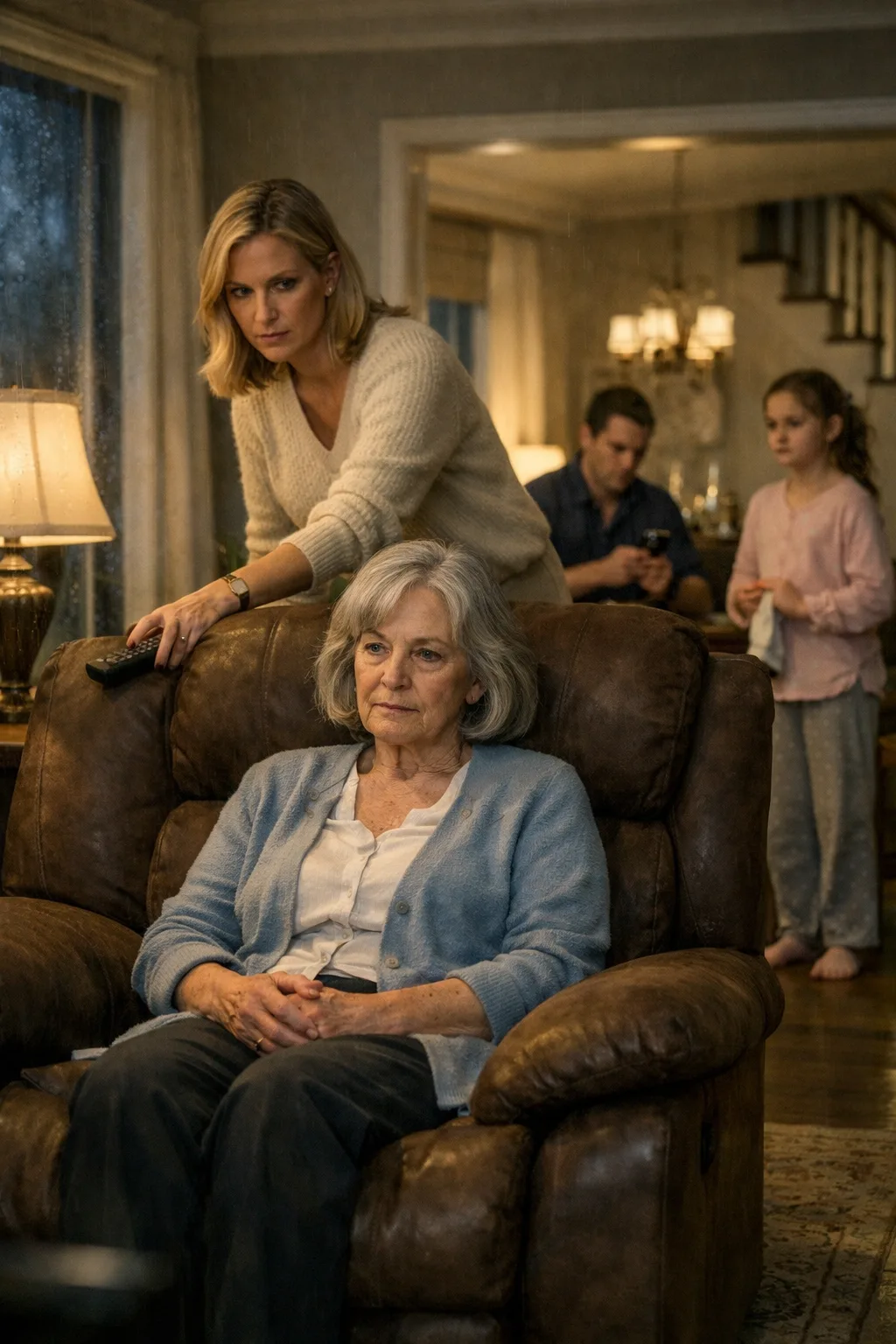
That evening, I was watching television when Christine walked over, took the remote off the cushion beside me, and turned the screen black.
Then she said, “Mom, do you know how much money you have cost us?”
The room went still.
Greg stared at his phone. Becca froze on the staircase
with one sock in her hand. And I sat there looking at my reflection in the dark television screen, seeing not an old woman—but a mother who had spent a lifetime giving and had finally been asked to apologize for existing.
I could have reminded Christine that I had helped with the down payment on that house years ago. I could have listed the meals, the laundry, the school pickups, the quiet ways I had kept their life running.
Instead, I only said, “I’m sorry you feel that way.”
The next morning, when they woke up, I was gone.
And for the first time in years, I was standing at the front door of a home that belonged only to me.
PART 2 — THEY THOUGHT I LEFT IN SHAME, BUT I WALKED AWAY WITH THE ONE SECRET THAT CHANGED EVERYTHING
My new house stood on Clover Street, tucked behind
a row of old maple trees with a small creek running behind the backyard. It was the kind of place Richard and I used to talk about buying “someday,” back when someday still felt endless. A screened porch. White trim. A garden already beginning to bloom. Quiet so deep it felt holy.
When I unlocked the front door that morning, I stood in the foyer for a long time and let the silence settle around me.
No one calling from another room.
No heavy footsteps overhead.
No careful measuring of whether I was in the way.
Just peace.
I set my suitcase down, placed my blue ceramic bowl on the kitchen counter, and whispered, “Well, Richard. I made it.”
Then I laughed, because if I didn’t, I might have cried.
The house had been ready for weeks. I had bought it quietly after my brother Howard’s estate was settled. He
had never married, never had children, and for most of our lives had been the charming, impossible younger brother who drifted from one state to another and showed up with outrageous gifts at Christmas. No one expected him to leave me anything significant. Least of all me.
But Howard had changed in his later years. He invested well, lived simply, and in the end, left almost everything to me.
When the lawyer slid the documents across the table and told me the number, I actually thought she had misspoken.
Four point three million dollars.
I remember blinking at her and saying, “I beg your pardon?”
She smiled and repeated it.
I was sixty-nine years old and suddenly wealthier than I had ever imagined being.
Yet the first feeling wasn’t excitement. It was caution.
Because money does not simply reveal character. It rearranges it.
And I had spent too many years teaching human nature not to know that.
So I said nothing.
Not when I sold my old house in Dayton.
Not when Christine invited me to move in.
Not when Greg joked that retirement must be nice “if you don’t mind living on a fixed income.”
Not even when Christine started sighing over grocery bills loud enough for me to hear.
I wanted time. I wanted to understand what kind of life I wanted next. And perhaps, though I hate admitting it, I wanted to see whether my daughter wanted me—or only the version of me she thought she could manage.
The answer had come with a click of a remote.
By noon on my first day in Clover Street, I had unpacked two boxes, made tea, and hung Richard’s watch on the little brass hook beside my bed. I was carrying folded towels into the linen closet when my cellphone began to ring.
Christine.
I watched the screen light up, then go dark. A minute later it rang again.
Then Greg.
Then Christine again.
I let them call.
At three in the afternoon, I finally answered Becca.
“Grandma?” she said, her voice shaky and hopeful all at once. “Are you okay?”
My throat tightened. “I’m all right, sweetheart.”
“Mom’s been crying all day.”
That was interesting. Christine had not cried the night before.
“She says you left because you were upset.”
“I did leave because I was upset.”
Becca was quiet for a moment. Then, very softly, “I heard what she said.”
Of everything, that hurt the most.
Children should never have to become witnesses in their own homes.
“I know you did,” I said. “And I’m sorry.”
“Are you coming back?”
I looked around the kitchen—the sun spilling across the floor, the bowl of lemons on the counter left by the realtor, the open back door with the sound of creek water beyond it.
“No, honey,” I said gently. “Not to stay.”
She sniffled. “Will I still see you?”
“Always. If you want to.”
“I do.”
I smiled, though my eyes stung. “Then you will.”
When I hung up, I made a list.
Change mailing address.
Call the church ladies.
Find a gardener.
Meet the neighbor with the golden doodle I had seen next door.
And finally: Call attorney.
Not because I wanted revenge.
But because women my age learn the difference between forgiveness and foolishness.
The next morning, I met with my lawyer, Denise Calder, in her office downtown. Denise was in her early fifties, sharp as glass, with silver streaks in her black hair and the kind of calm that made foolish people nervous.
After I told her everything, she took off her glasses and said, “Before we discuss next steps, let me ask one important question. Did you ever give your daughter money for the purchase of the Columbus house?”
“Yes,” I said. “Twenty years ago. Richard and I contributed sixty thousand dollars toward the down payment. We never called it a loan. It was a gift.”
She nodded. “And anything else?”
“A lot of babysitting. A lot of groceries. Countless unpaid hours of being available.”
Denise smiled faintly. “Unfortunately, emotional labor is rarely recoverable in court.”
“I assumed as much.”
She leaned forward. “But there is another issue. Did Christine or Greg have any access to your financial accounts?”
I paused.
Three months earlier, Christine had insisted on “helping” me organize my paperwork. She had asked casual questions about my pension, my savings, what remained from the Dayton house sale. At the time, I thought she was concerned.
Now I remembered the way Greg had once lingered near the desk drawer where I kept my bank envelopes. The way Christine had asked, twice, whether I had updated my beneficiaries.
“No direct access,” I said slowly. “But they were very interested.”
Denise’s expression cooled. “Good. Keep it that way.”
By Friday, Christine appeared on my porch.
She stood behind the screen door in oversized sunglasses, though the sky was cloudy. Greg was beside her carrying a bakery box as if reconciliation could be frosted and tied with string.
I stepped outside and closed the door behind me.
For a second, none of us spoke.
Then Christine pulled off her sunglasses. Her eyes were swollen. “Mom, what is this?”
“This,” I said, “is my house.”
“I know that.” Her voice sharpened. “I mean what are you doing here?”
“Living here.”
Greg forced a thin smile. “Eleanor, we all said things in the heat of the moment.”
“No,” I said. “Christine said something in the heat of the moment. You said nothing at all.”
He looked embarrassed, which was almost worse.
Christine stepped closer. “Mom, Becca is miserable. You just disappeared. Do you understand how that looks?”
I stared at her. “How it looks?”
“Yes! To the neighbors, to my friends—”
I laughed then, a small incredulous laugh I hadn’t known I still had.
“Christine,” I said, “do you hear yourself?”
She folded her arms. “I came here to fix this.”
“No. You came here to control the story.”
That landed.
Her mouth tightened in the way it always had when she was cornered, even as a girl.
Greg lifted the bakery box slightly. “We brought lemon squares.”
Richard used to call gestures like that “apology props.”
“I’m sure they’re lovely,” I said. “But I’m not ready for company.”
Christine’s face hardened. “So that’s it? You embarrass us and just start over?”
“Embarrass you?” My voice stayed quiet, which made hers sound even harsher. “You humiliated me in front of your child.”
She looked away first.
That told me everything.
“I think you should go,” I said.
She took a breath as if preparing for a final card.
“Mom,” she said carefully, “maybe this is all really about money. If you felt like we weren’t contributing enough, you could have said that. We’ve had a lot of pressure lately. Greg’s bonus was delayed. Becca’s private school tuition went up. The kitchen repairs—”
There it was.
Not grief.
Not guilt.
Calculation.
I said nothing.
So she went on.
“If this house was bought from the proceeds of your old home, maybe we should talk practically. You know, as a family. About what makes sense long-term.”
For a second, I simply looked at her.
Then I realized something almost frightening in its clarity:
Christine thought I had modest means and a useful asset.
She still had no idea how much I actually had.
And somehow, even after that night, she still believed what was mine might eventually solve what was theirs.
“My long-term plan,” I said, “is to live peacefully in my own home.”
Greg finally lost the smile. “Come on, Eleanor. That’s not fair.”
“No,” I said. “Fair would have been gratitude.”
I opened the screen door.
“We’re done for today.”
Christine’s face flushed. “You’re punishing us.”
“No,” I said softly. “I’m releasing myself.”
When they drove away, I stood on the porch until their car disappeared.
That evening, Denise called.
“There’s one more thing,” she said. “A colleague of mine did a quick search, just routine. Greg has substantial debt.”
My hand tightened around the phone. “What kind of debt?”
“Credit cards. A business line. One personal loan in collections. Enough to matter.”
I sat down slowly in the porch chair.
And suddenly Christine’s words echoed differently.
Do you know how much money you have cost us?
Not inconvenience.
Not groceries.
Money.
Real money.
I looked out toward the creek as dusk settled over the trees.
Something deeper had been going on in that house.
And for the first time, I had to ask myself a harder question:
Had they wanted me there because I was family—
or because they believed, sooner or later, I would pay for the life they could no longer afford?
TO BE CONTINUED, PART 3 NOW
Chapter complete
You have reached the end of this chapter.
Continue reading
A few more worlds to get lost in after this chapter.




