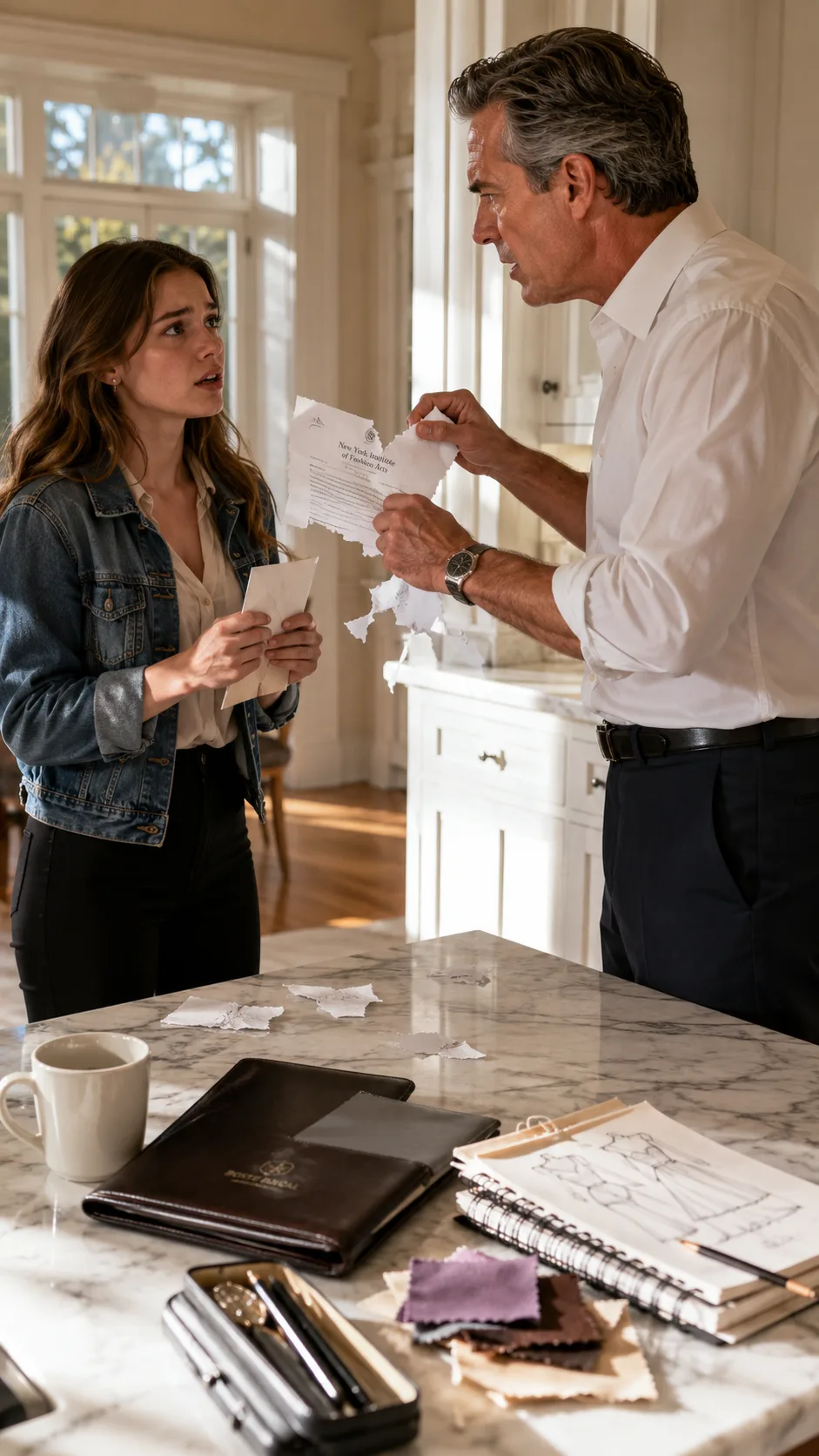
MY FATHER TORE UP MY DREAM LETTER, BUT MY MOTHER’S HIDDEN SKETCHES TAUGHT ME HOW TO LEAVE HIM
PART 3
New York did not welcome me gently.
Chapter 2
MY FATHER TORE UP MY DREAM LETTER, BUT MY MOTHER’S HIDDEN SKETCHES TAUGHT ME HOW TO LEAVE HIM
PART 3
New York did not welcome me gently.
It swallowed my savings in three weeks.
My dorm room was smaller than my father’s walk-in closet. The radiator hissed like an angry animal. My mattress dipped in the middle. I worked mornings at a coffee shop, afternoons in class, nights in the student studio where the lights buzzed overhead and everyone looked hungry for a future they couldn’t afford yet.
I called no one.
Not my father.
Not the neighbors who used to ask what hospital I would work at someday.
Not even Evelyn Moore at first.
Because some part of me was terrified that if I said my dream out loud, it would become easy for someone else to tear apart.
Then, one Thursday night, my sewing machine jammed at 2:13 a.m.
It was my mother’s machine—the one my father said didn’t work. It worked beautifully until it didn’t, and when the needle snapped, I sat there staring
at it like it had betrayed both of us.
A girl across the room looked up from her table.
“You okay?”
“No,” I said.
She walked over. She was tall, with short black hair, silver rings, and red thread stuck to her sleeve.
“I’m Maya,” she said. “Move.”
She fixed the machine in four minutes.
Then she looked at the sketch beside it.
“Whoa,” she said. “That yours?”
I hesitated.
“Mine and my mother’s.”
Maya studied it. “That’s either very beautiful or very haunted.”
I laughed for the first time in days.
“Both.”
That became the beginning.
Maya helped me find cheap fabric warehouses in Queens. Evelyn finally convinced me to visit her studio. She cried when she saw my mother’s handwriting, but she didn’t treat me like a fragile orphan. She treated me like a designer.
“Eleanor had a gift,” she told me. “But you are not her echo,
Grace.”
I looked at the gown sketch on her desk.
“Everyone keeps saying I have her eye.”
“You do,” Evelyn said. “But your mother designed like she was reaching for air. You design like you’ve already kicked open a window.”
That sentence saved me on the nights I almost quit.
And there were many.
I burned fabric. I missed meals. I fell asleep on the subway and woke up three stops past my apartment. My first critique was brutal. A professor told me my work was “emotionally interesting but technically uneven,” which was academic language for, “Your trauma has better structure than your seams.”
I cried in a bathroom stall for seven minutes.
Then I went back to the studio.
I named my first collection The Room He Locked.
It began with my mother’s unfinished sketches, but I refused to copy her. I used her lines as bones, then built
my own body around them. Her soft silhouettes became sharper. Her romantic sleeves became structured. Her delicate pencil marks became black silk, cream wool, silver thread, and one yellow ribbon sewn inside every garment where almost no one could see it.
Yellow had been my favorite color as a child.
She remembered.
My final piece was based on the drawing titled For Grace, someday.
I spent six weeks on it. A long ivory dress with a dark inner lining that only showed when the model moved. From the outside, it looked controlled. When she walked, it opened like a secret.
The school selected my collection for the Young Designers Showcase.
I did not invite my father.
Evelyn did.
She told me after.
“I sent him one ticket,” she said.
I froze. “Why?”
“Because truth does not need permission, but sometimes it deserves a witness.”
“I don’t want him there.”
“You don’t have to look for him.”
That was the best advice anyone gave me.
On the night of the showcase, I stood backstage with pins between my lips, my hands moving faster than my thoughts. Models changed around me. Steam rose from pressing irons. Someone cried over a broken zipper. Someone else prayed in Spanish. Maya squeezed my shoulder.
“You’re doing it,” she said.
“No,” I whispered. “We’re doing it.”
Then the lights went down.
The music started.
And my mother came back to life through fabric.
Not as a ghost.
Not as a wound.
As movement.
The first model stepped onto the runway in a gray coat inspired by one of Eleanor’s pencil sketches. The collar curved like protection around the throat, but the back opened in clean lines. The second wore black silk with pale stitching visible along the seams, every line intentional. The third carried the yellow ribbon at her wrist, loose and bright.
I stood behind the curtain, watching through the gap.
Then I saw him.
My father sat near the back.
He wore a dark suit and a blue tie. His hands were clasped between his knees. He looked like a man waiting for bad news in a hospital hallway.
For one second, I was seven again, desperate for him to smile.
Then the final model stepped out.
The ivory dress moved under the lights. The dark lining flashed with every step. The audience went silent in that rare way that feels louder than applause.
On the screen behind her, the title appeared:
The Room He Locked
Then the dedication:
Inspired by Eleanor Bennett, the first woman who taught me that beauty could survive silence.
A sound moved through the room.
A soft collective breath.
I looked at my father.
He was staring at the screen.
His mouth opened, then closed. His hand covered his eyes.
The applause began slowly, then rose until the floor seemed to vibrate under my shoes.
When they called my name, I walked out.
The lights blinded me. The applause hit my chest. For the first time in my life, I did not shrink from being seen.
I bowed.
I did not look for my father again.
Later, backstage, after photographs and congratulations and too many strangers saying my mother’s name like it had just been returned to the world, I found him standing near the exit.
He looked smaller without the house around him.
“Grace,” he said.
I stopped.
Maya stood a few feet behind me, ready to intervene if I needed her to. I didn’t.
My father held a folded program in both hands. The paper was creased where his fingers had gripped it too tightly.
“I thought I was saving you from becoming her,” he said.
I looked at him for a long moment.
“You weren’t saving me,” I said. “You were erasing her.”
He flinched.
“I know.”
Hearing him admit it did not heal me. It only made the wound real in a different way.
“I was afraid,” he said. “After she died, I told myself everything I did was because I loved her. Because I loved you. But tonight, I saw those dresses and…” His voice broke. “I saw what I took from her.”
I wanted to hate him cleanly.
It would have been easier.
But grief had made a prison guard out of him. Fear had made him cruel. Love had become an excuse, then a weapon, then a locked room.
That did not absolve him.
It only made the tragedy heavier.
“I can’t give back what I took,” he said.
“No,” I answered. “You can’t.”
His eyes filled. “Can I give you the rest?”
My breath caught.
“What rest?”
He reached into his coat and pulled out a small black notebook.
My mother’s initials were embossed on the cover.
“I found it after you left,” he said. “I almost kept it.”
I stared at him.
“But I’m tired of being the place beautiful things go to disappear.”
My hands trembled as I took the notebook.
Inside were more designs, but also journal entries. Notes about me. Notes about fear. Notes about wanting to try again. On the last page was a sentence written in blue ink.
Thomas thinks dreams take mothers away from daughters. He does not understand that buried dreams do the same thing.
I closed the notebook.
My father was crying now. Quietly. Without performance.
“I’m sorry,” he said.
I believed that he was.
But an apology is not a time machine.
“I need space,” I told him.
He nodded quickly, like any argument might make me vanish.
“I won’t ask you to come home.”
“Good,” I said.
His face tightened, but he accepted it.
“I will ask one thing,” he said.
I waited.
“When people ask about your mother, tell them the truth. All of it. Even the part where I was the villain.”
The word sounded strange from his mouth.
I looked down at the notebook.
“She was more than what you did to her,” I said.
“I know.”
“And I’m more than what you wanted me to be.”
His chin shook.
“I know that now, too.”
Three months later, my collection won the emerging designer prize.
The article came out on a Sunday morning.
Eleanor Bennett’s name was in the headline.
Not as Thomas Bennett’s late wife.
Not as Grace Bennett’s mother.
As a designer.
As an artist.
As the woman whose unfinished work had finally stepped into the light.
My father mailed me the original wedding photo frame with the key still taped behind it. Inside the package was a note.
No more locked rooms.
I placed the key on my desk beside my mother’s notebook.
I did not move back home.
I did not switch to medicine.
I did not become the daughter my father had planned.
I became the woman my mother had hoped I would have the courage to be.
And on the morning I opened my first tiny studio in Brooklyn, I hung one framed sketch by the door.
For Grace, someday.
Under it, I placed a small brass plaque.
Eleanor Bennett began this dream.
Grace Bennett refused to let it stay buried.
Then I unlocked the door, stepped inside, and turned on the lights.
THE END
Chapter complete
You have reached the end of this chapter.
Continue reading
A few more worlds to get lost in after this chapter.




