stories. She was beautiful. She was gentle. She made soup when it rained. She liked flowers. She loved me.
That was all my father allowed.
Any time I asked about her drawings, he said, “Just a hobby.”
Any time I asked about the old sewing machine in the storage room, he said, “It doesn’t work.”
Any time I asked why Grandma Louise once called Mom “brilliant,” he said, “People exaggerate after someone dies.”
So I learned not to ask.
But I never stopped wondering.
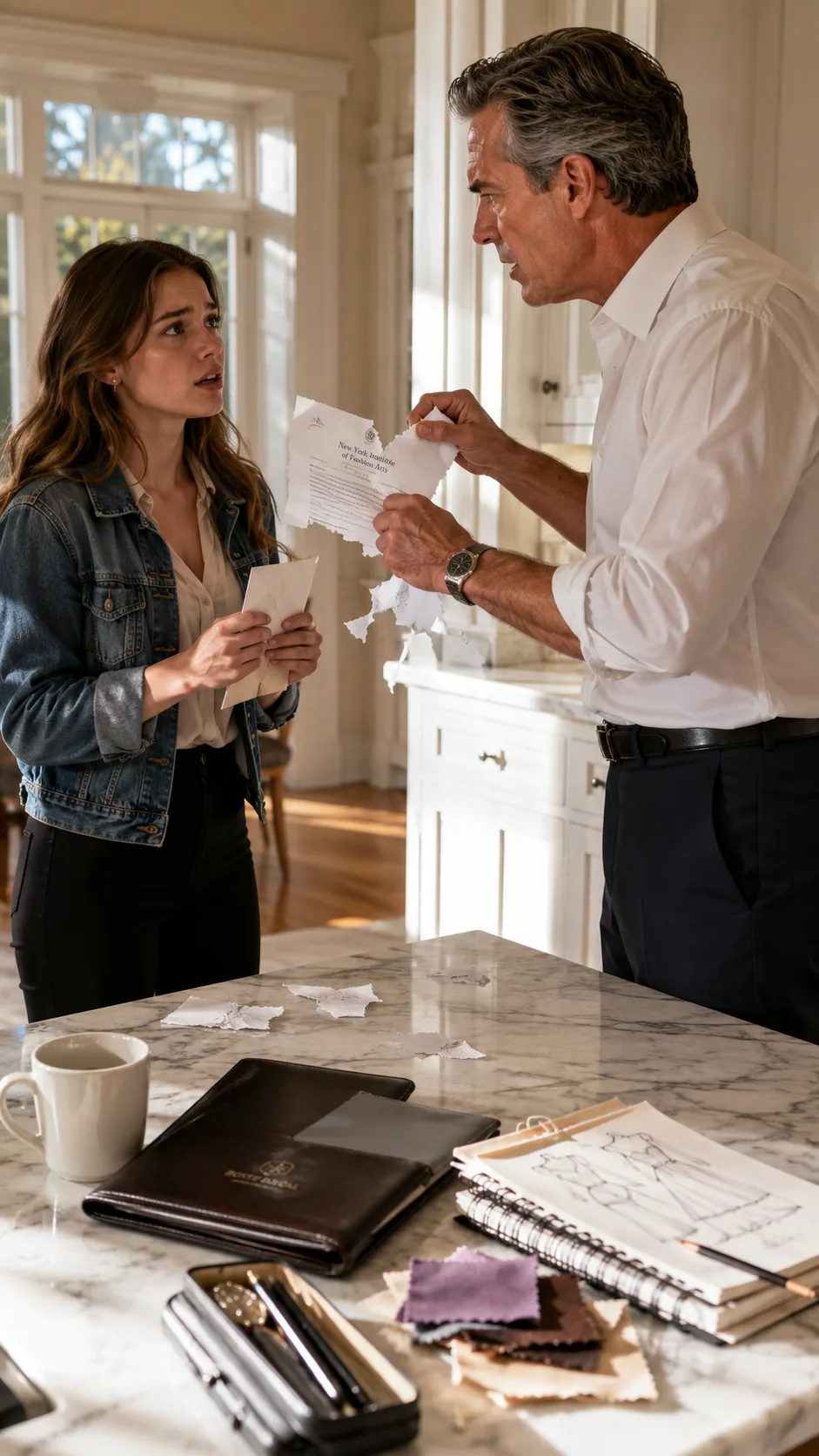
“What does Mom have to do with this?” I asked.
His face changed so quickly I knew I had touched something buried.
“She wasted years chasing applause from strangers,” he said. “I will not watch you do the same.”
“She was a designer.”
“She was a wife and mother.”
“She could have been both.”
His palm hit the kitchen island so hard the coffee mug beside him jumped. “You don’t know anything about what she could have been.”
I stared at him.
There it was.
Not grief.
Not protection.
Fear.
My father was afraid of a dead woman.
I took the envelope and the torn pieces of paper and walked out of the kitchen. He called after me twice, but I didn’t turn around. I went upstairs to my room, shut the door, and opened my laptop.
The email was still there.
No matter how many pieces of paper he tore, he couldn’t rip the truth out of my inbox.
I read the acceptance letter again.
Then I noticed the name under the scholarship recommendation.
Evelyn Moore.
I had never heard of her.
At first, I thought it was a mistake. Then I searched the name.
Evelyn Moore was the creative director of a small but respected fashion studio in Manhattan. She had taught guest workshops. She had been featured in Vogue. And in one old article from twenty-two years ago, I found a photograph that made my breath stop.
Evelyn Moore stood outside a New York runway show beside a young woman with dark waves, bright eyes, and a sketchbook pressed to her chest.
My mother.
The caption read: Emerging designers Evelyn Moore and Eleanor Bennett after their first collaborative presentation.
I sat frozen at my desk.
Collaborative presentation?
My mother had a presentation?
My father had told me she made dresses for fun. He said she had never pursued anything serious. He said she chose “real life” over fashion.
My phone buzzed.
A new email.
From Evelyn Moore.
Grace, I hope this reaches you before anyone makes you doubt yourself. Your portfolio stopped me because I saw Eleanor’s eye in your work—but I also saw your own voice. Your mother would have known the difference. Call me when you’re ready.
My throat closed.
I clicked the attached image.
It was a scanned drawing. A gown in charcoal pencil, unfinished, with sharp folds like wings. At the bottom, in handwriting I had seen only on birthday cards saved in a box, were the words:
For Grace, someday.
I stood so fast my chair hit the wall.
The storage room.
My father kept it locked.
He always said it was full of old medical books, holiday decorations, and things too painful to sort through. But suddenly I remembered something. When I was thirteen, I had seen him standing in the hallway outside that room with his hand against the door, crying without sound.
He wasn’t guarding old boxes.
He was guarding her.
I waited until midnight.
My father’s bedroom door stayed closed. The house went quiet. I moved down the hallway barefoot, holding my phone flashlight low against my chest.
The storage room key was not in the kitchen drawer. Not in his office. Not in the laundry room cabinet.
Then I remembered the one place he never let me touch.
The silver frame on the upstairs console table.
Their wedding photo.
I lifted it.
A small brass key was taped behind the frame.
My hand went cold.
I unlocked the storage room.
The smell hit me first: dust, cedar, and a faint trace of perfume that made my eyes sting before I understood why. Stacked boxes lined the walls. Old coats hung under plastic covers. A cracked dress form stood in the corner like someone waiting in the dark.
At the back of the room was a cedar trunk.
My mother’s initials were carved into the lid.
E.B.
I opened it.
Inside were hundreds of sketches.
Not ten. Not twenty.
Hundreds.
Dresses, coats, stage gowns, bridal pieces, children’s clothes, handwritten notes about fabric movement, color, structure. Some pages had coffee stains. Some had lipstick marks. Some had tiny scribbles in the corner.
Grace laughed today.
Grace likes yellow.
Grace pulled ribbon from my table and wrapped it around her wrist.
I pressed one page against my chest and sank to the floor.
My father had not hidden a hobby.
He had hidden a life.
At the bottom of the trunk was a blue folder, soft from age. Inside was a letter addressed to me.
My Grace,
If you are reading this, it means there is a part of me your father could not explain, or would not. I loved him. I loved you more. But love should never ask a woman to disappear quietly.
If you draw before you learn to write, let yourself keep drawing.
If someone calls beauty useless, remember that people only dismiss what they cannot control.
And if one day your hands make something that feels like freedom, follow it.
Even if you have to begin with nothing.
Mom
I covered my mouth with both hands.
A sound came out of me that I didn’t recognize.
Behind me, the floor creaked.
I turned.
My father stood in the doorway.
His face had gone pale.
“You had no right,” he said.
I rose slowly, holding the letter.
“No,” I said. “You had no right.”
His eyes dropped to the trunk, then to the sketches spread around my feet.
“You don’t understand.”
“Then explain it.”
He stepped into the room. “Your mother was sick.”
“That’s not an explanation.”
“She was exhausted.”
“Still not an explanation.”
“She was obsessed with that world.”
“She was talented.”
“She was leaving us behind.”
The words came out like they had been rotting inside him for fourteen years.
I stared at him. “What?”
He looked away.
“She had been invited to show a solo collection in New York,” he said. “A real one. Buyers. Press. Everything she thought she wanted.”
My pulse thudded in my ears.
“She never went.”
His silence answered before he did.
“What did you do?” I whispered.
He swallowed. “I thought I was saving our family.”
“What did you do?”
“I didn’t give her the letter.”
The room tilted.
“She waited for that letter,” he said. “She thought they had changed their minds. She cried for three days, Grace. Three days. And then she put everything away.”
I looked down at the trunk.
All those sketches.
All that silence.
All that stolen future.
“You watched her believe she wasn’t wanted,” I said.
His voice cracked. “I was afraid she would choose that life over us.”
“No,” I said, tears burning my eyes. “You were afraid she would choose herself.”
He reached for me.
I stepped back.
“Grace, I loved your mother.”
“You loved having her.”
His face broke then, just a little, but I couldn’t comfort him. Not anymore.
I took the letter, the folder, and as many sketches as I could carry. Then I went to my room and packed one suitcase.
At dawn, my father stood at the bottom of the stairs in his white dress shirt, looking older than he had the night before.
“If you walk out that door,” he said, “don’t expect me to fund this fantasy.”
I lifted my suitcase.
“I got a scholarship.”
“Don’t expect this house to wait.”
I looked past him at the home where I had spent my whole life trying to be easy to love.
“I’m not asking the house to wait,” I said. “I’m asking myself to stop waiting.”
Then I walked out with my mother’s sketches under one arm and my future in the other.
To be continued, Part 3 now