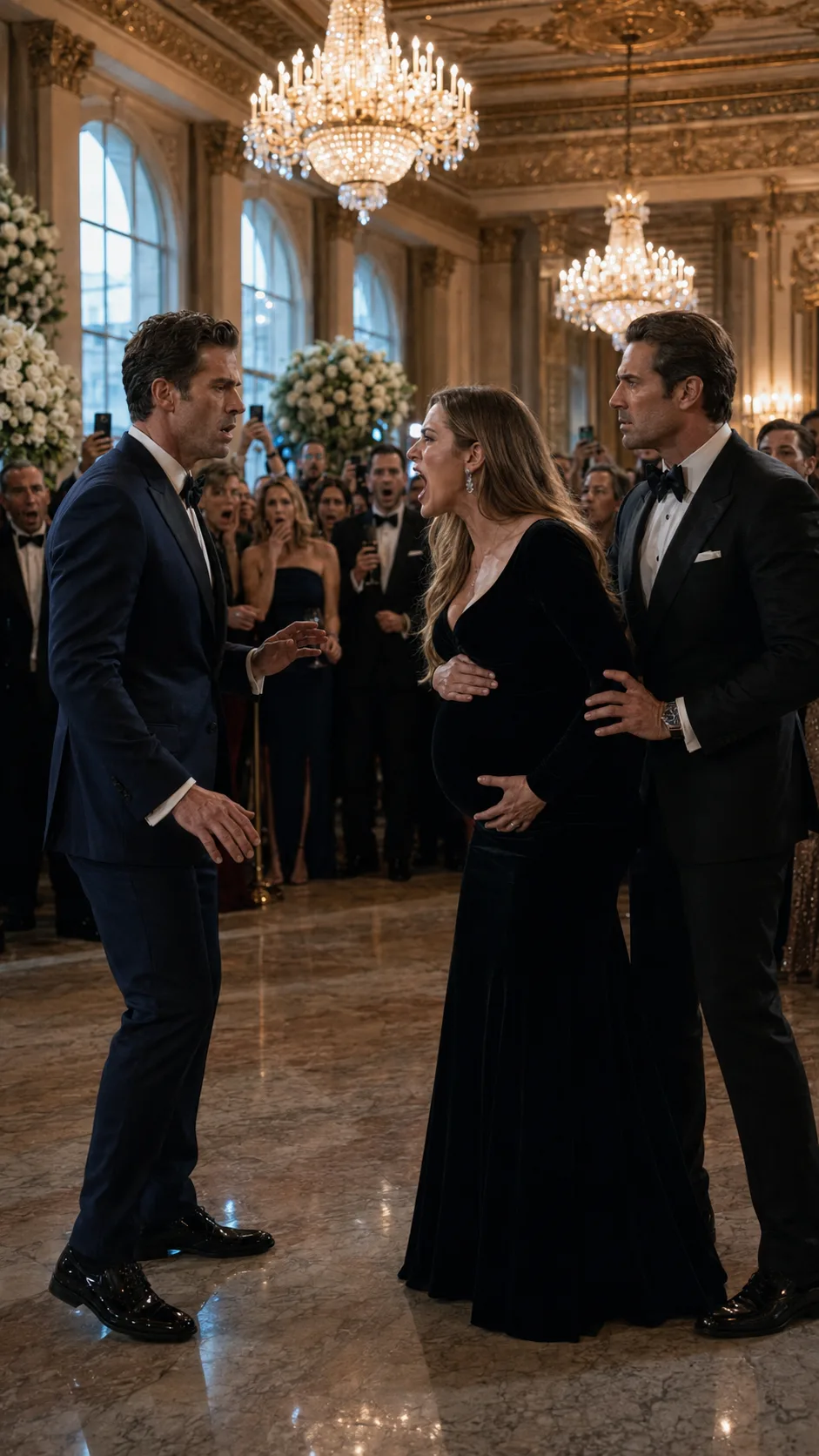
My Ex-Husband Flaunted His Beauty Queen Fiancée—Until I Walked In Pregnant With the Billionaire Who Sponsored Her Crown
The first thing Julian Duval saw when I walked into the Allesian Hearts Gala was not my face.
Chapter 1
My Ex-Husband Flaunted His Beauty Queen Fiancée—Until I Walked In Pregnant With the Billionaire Who Sponsored Her Crown
The first thing Julian Duval saw when I walked into the Allesian Hearts Gala was not my face.
It was my stomach.
Five months pregnant, wrapped in black velvet, one hand resting calmly over the life he never knew existed.
The second thing he saw was the man beside me.
Gabriel Lancaster.
Billionaire. Philanthropist. Founder of Ascend Capital. The private sponsor behind half the charity world in Manhattan, including the pageant that had made Julian’s twenty-six-year-old fiancée famous.
And in that frozen second, while three hundred of New York’s most powerful people stopped breathing under the chandeliers, my ex-husband finally understood something he should have learned two years earlier.
You can throw a woman away.
But you do not get to decide what she becomes after that.
The Armand Grand Hall had always been built for spectacle. Its marble staircase curved like a judgment. Its crystal chandeliers hung over the ballroom like frozen lightning. Every year, the Allesian Hearts Gala gathered the kind of people who smiled for
cameras while quietly measuring one another’s worth.
Tech billionaires. Fashion editors. Senators’ wives. Private equity kings. Influencers with diamond collars and empty eyes. Everyone was there to be seen, praised, envied, or feared.
Julian came to be worshiped.
He arrived at 8:00 p.m. in a white Rolls-Royce, wearing a midnight-blue tuxedo that made him look exactly like the man magazines had once claimed he was: brilliant, handsome, untouchable.
On his arm was Dalia Fontaine.
Beauty queen. Model. Internet darling. Twelve years younger than me. Her silver gown clung to her like poured moonlight, and the diamond on her finger was so large it looked less like a promise and more like a threat.
Reporters screamed their names.
“Julian! When’s the wedding?”
“Dalia, show us the ring!”
“Julian, is your ex-wife attending tonight?”
Julian paused for that one.
He smiled, the same polished smile he had practiced in mirrors before investor
meetings.
“I doubt Khloe would show her face,” he said smoothly.
The reporters laughed.
Dalia laughed too, leaning into him like she had won a prize.
And I stood less than fifty feet away in the private entrance, watching everything on a security monitor while Gabriel adjusted the clasp of my bracelet.
“You don’t have to do this,” he said quietly.
I looked down at the soft curve of my stomach.
“Yes,” I said. “I do.”
Two years earlier, I had disappeared from public life so completely that gossip blogs wrote theories about me like I was missing treasure.
Khloe Marin Duval spotted in Italy.
Khloe Duval in rehab?
Julian Duval’s ex-wife hiding after divorce scandal.
None of them knew the truth.
I was not hiding because Julian left me.
I was hiding because if I stayed in Los Angeles one more day, surrounded by cameras and pity and headlines
calling me barren, broken, replaced, I would have forgotten who I was before I became his wife.
Before Julian, I was Khloe Bennett from a small town outside Tulsa, Oklahoma. I grew up in a rental house with peeling yellow paint, a father who worked at a steel plant until an accident crushed his spine, and a mother who cleaned houses for women who never learned her name.
I learned early that survival had a sound.
It sounded like bills being opened at midnight.
Like my mother whispering, “We’ll figure it out.”
Like my father apologizing for pain that wasn’t his fault.
I left Oklahoma with a scholarship to Northwestern, sixty-two dollars, and a promise to myself that I would never again shrink just because life expected me to.
At Northwestern, I studied economics and strategic communications. I worked at the library before sunrise, poured coffee on weekends, edited papers at night, and slept so little I sometimes forgot what day it was.
That was where I met Julian.
He was already famous on campus, a computer science major with a startup, a smile like trouble, and the kind of confidence people mistook for destiny.
The first time he noticed me, I was sitting in the back row of a tech panel, listening to him describe his app as “democratizing human connection.”
When the moderator opened the floor, I raised my hand.
“You’re not democratizing connection,” I said. “You’re monetizing loneliness. Isn’t that just exploitation with better branding?”
The room went silent.
Julian blinked.
Then he smiled like I had just become interesting.
That night, he found me in a bookstore café and asked me out.
I said no.
The next day, he came back with caramel tea and a used copy of The Lean Startup covered in sticky notes. We talked for six hours. By spring, he called me his brain trust. By graduation, I had rewritten his investor pitch, rebuilt his messaging strategy, and helped him close the seed funding that would make him rich.
When he sold his first company at twenty-six for $22 million, he proposed over Chinese takeout in our tiny Chicago apartment.
“You’re the reason any of this works,” he whispered. “Build the rest with me.”
I said yes because I believed him.
That was my first mistake.
In the beginning, he loved my mind. Then he used it. Then he resented it.
Behind closed doors, he asked for my opinion. In public, he took credit for it.
I told myself that was marriage. Partnership. Sacrifice.
When he forgot to introduce me at events, I smiled. When he took meetings without me, I understood. When he hired publicists who treated me like outdated furniture, I remained gracious.
Then came the pregnancies.
The first loss gutted us.
The second made me quiet.
The third broke something in me that never healed right.
I still remember sitting on the bathroom floor in our glass penthouse, blood on a white towel, my whole body shaking as Julian stood in the doorway checking his phone.
“I can’t miss Davos,” he said.
I looked up at him.
“I just lost our baby.”
He sighed, tired and irritated, like grief was a scheduling conflict.
“You need to stop letting this define you, Khloe. We have a company to run.”
Three months later, his lawyer texted me before Julian did.
The press release came that afternoon.
Julian and Khloe Duval have decided to part ways amicably. They remain supportive of each other’s future endeavors.
Supportive.
He left me with an NDA, a settlement he thought was generous, and a world full of people who believed I had been discarded because I could not give him a child.
A week after our divorce was announced, he was photographed with a twenty-four-year-old model outside a hotel in Miami.
I left the country the next morning.
Tuscany did not save me all at once.
Healing never happens like it does in movies. There was no dramatic sunrise where I became a new woman. There were weeks when I did not get out of bed. Months when I could not look at baby clothes. Nights when I woke with my hand over my stomach, reaching for a heartbeat that was not there.
But slowly, life returned.
I planted lavender.
I walked through olive groves.
I wrote economic briefs under a different name.
I invested quietly in women-led startups, medical technology, education platforms, refugee-owned businesses. I had been investing since college, long before Julian understood valuation beyond ego. The money grew because I knew what he never learned.
Real power does not always announce itself.
Sometimes it waits.
Then, one spring morning, I woke up nauseated.
I bought three pregnancy tests from a tiny pharmacy where no one knew me.
All positive.
I cried so hard the pharmacist knocked on the bathroom door.
There had been no clinic. No treatment. No scheduled heartbreak. Just life, stubborn and miraculous, arriving when I had stopped begging for it.
When I returned to the United States, I did not call Julian.
I hired a doctor, found a home in New York, and quietly rebuilt my consulting practice.
That was how I met Gabriel Lancaster.
At a private equity dinner in London, Gabriel gave a speech about legacy capital. Everyone applauded. I did not.
During the Q&A, I challenged his entire model.
“You’re calling it sustainable investment,” I said. “But three of your international holdings are structurally dependent on wage suppression. That’s not legacy. That’s delayed extraction.”
Half the room looked horrified.
Gabriel looked fascinated.
Afterward, he asked for my card.
I gave him one with no logo, no title, just an email.
Three days later, he sent me a message.
I researched you. You’re either the most dangerous strategist I’ve ever encountered or the most under-credited one.
I replied, Why not both?
Gabriel’s first rule was simple.
“Never walk into a room unless you know who profits from your silence.”
I had laughed when he said it.
Now, standing beneath the chandeliers of the Armand Grand Hall with my ex-husband staring at my pregnant stomach as if it were a public accusation, I finally understood.
Julian Duval was not shocked because I was alive.
He was shocked because I had returned without asking permission.
Dalia’s smile cracked first.
Her hand tightened around Julian’s arm, diamond flashing under the lights. “Julian,” she whispered, but he did not answer.
His eyes moved from my stomach to Gabriel’s face.
Then to my left hand.
No ring.
That seemed to confuse him even more.
Gabriel placed a steady hand at the small of my back. Not possessive. Protective. The kind of touch that asked nothing and promised everything.
“Khloe,” Julian said at last.
The room heard him.
Of course they did.
A ballroom full of powerful people always pretended not to listen while listening for blood.
I smiled. “Julian.”
Dalia recovered quickly. Beauty queens are trained to bleed prettily.
She stepped forward, silver gown shimmering. “Khloe, what a surprise. I didn’t know you were attending.”
“No,” I said softly. “I imagine you didn’t.”
Her eyes dropped to my stomach, then lifted with calculated sweetness. “Congratulations. How far along?”
“Five months.”
Julian flinched.
A tiny movement. Almost nothing.
But I saw it.
So did Gabriel.
Dalia saw it too.
Her smile thinned. “How lovely.”
Gabriel extended his hand. “Ms. Fontaine. Congratulations on your crown.”
Dalia brightened instantly. “Thank you, Mr. Lancaster. Your sponsorship changed my life.”
“I’m aware,” Gabriel said.
Not warmly.
Not cruelly.
Just accurately.
Julian’s jaw tightened. “You two know each other?”
Gabriel’s expression remained calm. “Khloe consults on several of my philanthropic investment boards.”
That was a polite version.
The truth was, I had quietly redesigned half of Gabriel’s charitable empire in eight months. Cut corrupt vendors. Exposed padded budgets. Redirected millions into programs that actually worked.
Including the pageant foundation Dalia represented.
Dalia tilted her head. “How impressive.”
I looked at her.
She was beautiful, yes. But young in the way people are when they mistake proximity to power for ownership of it.
Julian leaned closer, lowering his voice. “Can we speak privately?”
“No.”
The word landed cleanly.
His smile froze. “Khloe, don’t make this dramatic.”
I almost laughed.
For two years, he had fed the world a story where I was the tragic ex-wife. The barren woman. The discarded partner. The silent footnote.
Now I had said one word in public, and suddenly I was dramatic.
Gabriel glanced toward the cameras. “Mr. Duval, the auction begins in ten minutes. I believe your fiancée is expected onstage.”
Dalia’s eyes sharpened. “Yes. I am.”
Julian did not move.
He was still staring at my stomach.
And then he asked the question no decent man would ask in that room.
“Is it mine?”
The ballroom died.
No clinking glasses.
No polite laughter.
No music.
Just silence, cold and glittering.
Dalia turned to him as if he had slapped her.
My hand stayed on my stomach.
Gabriel’s face did not change, but something dangerous entered the air around him.
I looked Julian directly in the eye.
“No.”
One word again.
This time, it did not land.
It cut.
Julian swallowed. “Then whose—”
Gabriel stepped forward.
Only half a step.
Enough.
“Choose your next sentence carefully.”
Julian’s pride fought his fear. For a second, I saw the man I had known in college—the boy who believed every locked door existed only to prove he deserved a key.
Then Dalia pulled his arm.
“Julian,” she hissed. “People are watching.”
That was what reached him.
Not shame.
Not decency.
Optics.
He straightened, adjusted his cufflinks, and smiled at the crowd as if nothing had happened.
“Of course,” he said smoothly. “Congratulations, Khloe.”
“Thank you.”
He guided Dalia away, but not before I saw the panic behind his eyes.
Gabriel leaned close. “You handled that well.”
“No,” I whispered. “I handled that late.”
His gaze softened.
Across the ballroom, Julian’s publicist was already moving like a battlefield medic. Dalia’s manager whispered into her ear. Cameras shifted. Rumors grew legs.
And I stood there, breathing through the ache in my ribs, realizing the night had only just begun.
The charity auction began with applause.
Dalia took the stage beneath a halo of white light, perfect posture, perfect smile, perfect lie.
She spoke about hope. About women’s empowerment. About rising above pain.
The audience adored her.
Julian stood near the front, clapping too loudly.
I sat at Gabriel’s table.
Not beside him.
At his right hand.
The seat of importance.
That detail did not go unnoticed.
When the auctioneer announced the final item—a private cultural scholarship fund in Dalia Fontaine’s name—she lifted her chin, glowing with triumph.
“The opening pledge,” the auctioneer declared, “is one million dollars, generously initiated by Mr. Gabriel Lancaster.”
Applause exploded.
Dalia pressed a hand to her chest.
Then Gabriel rose.
The applause faded.
He buttoned his jacket. “Before the pledge is finalized, Ascend Foundation has completed its standard audit.”
Dalia’s smile faltered.
Julian went still.
Gabriel continued, voice smooth as black ice. “Unfortunately, the foundation connected to Ms. Fontaine’s campaign has reported several irregular transfers.”
A murmur ran through the room.
Dalia laughed lightly. “There must be some mistake.”
Gabriel looked at her. “There is.”
He paused.
“The mistake was assuming no one would check.”
Julian stepped forward. “This is outrageous.”
I opened the folder in front of me.
Inside were copies of invoices, transfer records, shell company registrations, emails.
I had found the pattern three weeks earlier.
Funds meant for girls’ education had been diverted through a branding agency.
That agency belonged to Dalia’s mother.
And one of the consulting payments had gone to a company Julian secretly controlled.
Dalia was not just his fiancée.
She was his cover.
Gabriel nodded toward the large screen behind the stage.
The first document appeared.
Gasps spread like fire.
Dalia’s face drained of color.
Julian looked at me.
Not Gabriel.
Me.
Because he knew.
He knew whose mind had built the blade.
“You did this,” he said.
I stood slowly. “No, Julian. You did.”
For the first time all evening, his mask cracked completely.
“You don’t understand what you’re interfering with.”
There it was.
Not denial.
Not innocence.
A threat.
I walked toward the stage. Each step felt impossibly calm.
“You used a charity to launder money through your fiancée’s public platform,” I said. “You let donors believe they were funding scholarships while you moved cash into your own failing venture fund.”
The word failing struck harder than fraud.
Julian’s empire had always depended on illusion.
And I had just named the rot.
Dalia grabbed the microphone. “I didn’t know!”
Her voice broke.
Maybe she was lying.
Maybe she wasn’t.
The room did not care.
Powerful people forgive theft.
They do not forgive embarrassment.
Julian turned on her. “Be quiet.”
That was her mistake’s reward.
Public humiliation.
Dalia stared at him, and for one strange second, I saw myself in her.
Younger. Blinded. Useful.
Then she did something I had not expected.
She lifted the microphone again.
“I have emails,” she said.
Julian froze.
The room leaned forward.
Dalia’s lips trembled, but her voice grew stronger. “He told me the transfers were legal. He said everyone did it. He said Mr. Lancaster would never notice because men like him only sponsor beauty, not paperwork.”
Gabriel’s mouth curved almost invisibly.
Dalia turned toward me. “And he said Khloe was too broken to ever come back.”
The silence after that was different.
Not scandalized.
Hungry.
Julian lunged for the microphone, but security intercepted him before he reached her.
His face twisted. “Dalia, don’t be stupid.”
She looked at him with wet, furious eyes.
“I was stupid when I believed you loved me.”
Something passed through me then.
Not pity.
Recognition.
Julian’s destruction had a pattern. He did not ruin women by hating them. He ruined them by making them feel chosen first.
Gabriel’s legal team moved in.
Reporters surged.
The gala dissolved into elegant chaos.
And in the middle of it, Julian leaned toward me one last time as security held him back.
“You think you won?” he hissed.
I rested both hands over my stomach.
“No,” I said. “I think I’m finally done playing.”
His laugh was low and ugly.
“You should have stayed gone, Khloe.”
Then he smiled.
And that smile chilled me more than his anger.
Because Julian had lost the room.
But he had not lost hope.
At midnight, Gabriel took me home.
The city glittered beyond the car windows, indifferent and endless. My phone had not stopped vibrating. News alerts. Unknown numbers. Former friends. Journalists.
Gabriel sat beside me, silent.
Finally, I said, “You knew he would ask if the baby was his.”
“I suspected.”
“And you didn’t warn me?”
His eyes found mine. “Would you have stayed home?”
“No.”
“Then I trusted you.”
That answer ruined me a little.
Trust was such a small word until someone gave it without using it as a leash.
At my townhouse, Gabriel walked me to the door.
“Stay with security tonight,” he said.
“I’m not afraid of Julian.”
“You should be.”
I looked at him sharply.
Gabriel’s face was unreadable.
“There’s something else,” he said.
The baby moved then, a soft flutter beneath my palm.
For a moment, the world narrowed.
Gabriel noticed. His expression changed, gentled.
“Is she kicking?”
“She?”
He froze.
I stared at him.
He looked away too quickly.
A strange coldness slid through me.
“Gabriel,” I said. “How did you know?”
He did not answer.
The silence opened between us like a door.
My doctor knew.
I knew.
No one else.
Unless—
My phone rang.
Unknown number.
I answered slowly.
Julian’s voice came through, calm now.
Almost amused.
“Ask Lancaster why he really sponsored Dalia.”
My blood went still.
Gabriel closed his eyes.
Julian laughed softly.
“You thought you walked in with the man who saved you,” he said. “Khloe, darling… you walked in with the man who bought the story before you ever knew you were in it.”
The line went dead.
I looked at Gabriel.
For the first time since I had met him, he seemed afraid.
Not of Julian.
Of me.
And somewhere inside the house, behind the locked front door, my security alarm began to scream.
Gabriel Lancaster did not fall in love loudly.
He did not send roses to restaurants or leak photographs to the press. He did not orbit me like Julian once had, all heat and hunger and performance.
Gabriel entered my life like weather changing over water—quiet, inevitable, impossible to ignore once it had arrived.
For three months, we worked together before he ever touched my hand.
He hired me first as a private strategist to audit one of Ascend Capital’s humanitarian funds. I expected arrogance. I expected polished speeches and defensive executives. Instead, Gabriel sat across from me in a gray wool coat, listening as I dismantled an entire investment model with a pencil and a napkin.
When I finished, he said, “You’re right.”
I stared at him.
He almost smiled. “Was that not the expected response?”
“No,” I said. “Usually men worth eleven billion dollars prefer to argue.”
“Usually,” he replied, “they can’t afford the truth.”
That was Gabriel.
He did not flatter me. He studied me.
He noticed when I stopped drinking wine before anyone else did. He noticed when I pressed crackers into my palm during meetings because nausea had become my shadow. He noticed when my fingers lingered over my abdomen one second too long.
One evening, after a board dinner in Manhattan, he walked me to my car beneath a soft, silver rain.
“You’re pregnant,” he said.
I froze.
Not accused. Not questioned. Simply observed.
I turned toward him slowly. “Yes.”
His gaze dropped briefly, respectfully, to my stomach. Then back to my eyes.
“Does he know?”
The rain touched my face like cold needles.
“No.”
Gabriel nodded once. “Do you want him to?”
I laughed, but it came out broken. “Julian made it clear what he thought I was worth when he believed I couldn’t give him a child.”
Gabriel’s jaw tightened.
That was the first time I saw anger in him—not loud, not uncontrolled, but precise.
“Khloe,” he said gently, using my name like it deserved care, “your value was never measured by what your body endured.”
I looked away because tears came too fast.
For so long, people had treated my grief like gossip, my losses like failure, my silence like guilt. Gabriel did none of that. He did not ask invasive questions. He did not pity me.
He simply opened his umbrella over both of us and stood there until I could breathe again.
Two weeks later, he came to my doctor’s appointment.
Not because I asked.
Because I had fainted during a morning call, and my physician insisted someone accompany me.
“You don’t have to,” I told him.
“I know,” Gabriel said, helping me into the car.
At the clinic, when the ultrasound room went dark and the grainy black-and-white image fluttered across the screen, I gripped the edge of the bed so hard my knuckles whitened.
Then came the sound.
A heartbeat.
Fast. Strong. Defiant.
The room blurred.
Gabriel stood beside me, one hand folded behind his back, motionless except for the muscle working in his jaw.
The technician smiled. “There’s your baby.”
My baby.
Not Julian’s shame. Not society’s speculation. Not proof of anything.
A living, beating miracle.
I covered my mouth with both hands and sobbed.
Gabriel looked at the screen as if seeing the sun rise for the first time.
Afterward, in the car, he said nothing for ten blocks.
Then quietly, he asked, “Does the child need a father in public?”
I turned sharply. “What?”
“Not legally. Not biologically. Publicly.” His hands rested steady on the steering wheel. “Julian Duval controls a narrative. He will use yours if you let him. If you attend the gala alone, he will turn your pregnancy into scandal before dessert.”
I stared at him.
“And if I attend with you?”
Gabriel’s mouth curved faintly. “Then the room will wonder why I’m standing beside you, not why he left.”
That should have offended me.
It didn’t.
Because Gabriel was right.
The Allesian Hearts Gala was not just another charity event. It was Dalia Fontaine’s coronation lap. Her pageant title had been funded through a private sponsorship chain tied to Gabriel’s foundation. Julian thought he was bringing his new fiancée into a room where she would be adored.
He did not know the room’s brightest crown had been purchased with another man’s signature.
And he definitely did not know I was the anonymous donor behind the maternal health wing being announced that night.
So I agreed.
Not for revenge.
For reclamation.
At 8:42 p.m., Gabriel offered me his arm behind the private entrance of the Armand Grand Hall.
On the monitor, Julian was still smiling for reporters.
“Ready?” Gabriel asked.
I placed one hand over my stomach.
“No,” I said.
Then I lifted my chin.
“But I’m walking in anyway.”
Part 4 — The Moment the Ballroom Forgot How to Breathe
The double doors opened.
Music floated first—violins, soft piano, a woman’s laugh cut short by surprise.
Then silence spread across the ballroom like spilled ink.
I felt hundreds of eyes turn toward me.
The black velvet gown had been designed to hide nothing. Its neckline was elegant, its sleeves long, its waist cut to frame the unmistakable curve of my pregnancy. Diamonds glimmered at my ears, but the only jewel anyone noticed was the life beneath my palm.
Beside me, Gabriel Lancaster moved with calm authority, his hand resting lightly at the small of my back.
Not possessive.
Protective.
Julian saw us from the center of the ballroom.
His champagne glass stopped halfway to his mouth.
For one perfect second, the mask fell.
The man who had told reporters I would never show my face looked as if my face had become the one thing he feared.
Dalia noticed his stare and followed it.
Her smile stiffened.
“Khloe,” Julian said when we reached them.
Not Mrs. Duval. Not my ex-wife. Not a ghost.
Just Khloe.
I smiled. “Julian.”
His eyes dropped again to my stomach.
The question burned there, vulgar and desperate.
Before he could ask it, Gabriel extended his hand.
“Duval.”
Julian stared at him. “Lancaster.”
Their handshake lasted three seconds too long.
Dalia recovered first. She gave me a bright, practiced smile sharp enough to cut silk.
“Khloe, what a surprise. You look…” Her gaze flicked downward. “Different.”
“So do you,” I said, looking at the diamond on her finger.
Her mouth tightened.
Julian cleared his throat. “I didn’t realize you were in New York.”
NEXT PART->
Chapter complete
You have reached the end of this chapter.
Continue reading
A few more worlds to get lost in after this chapter.