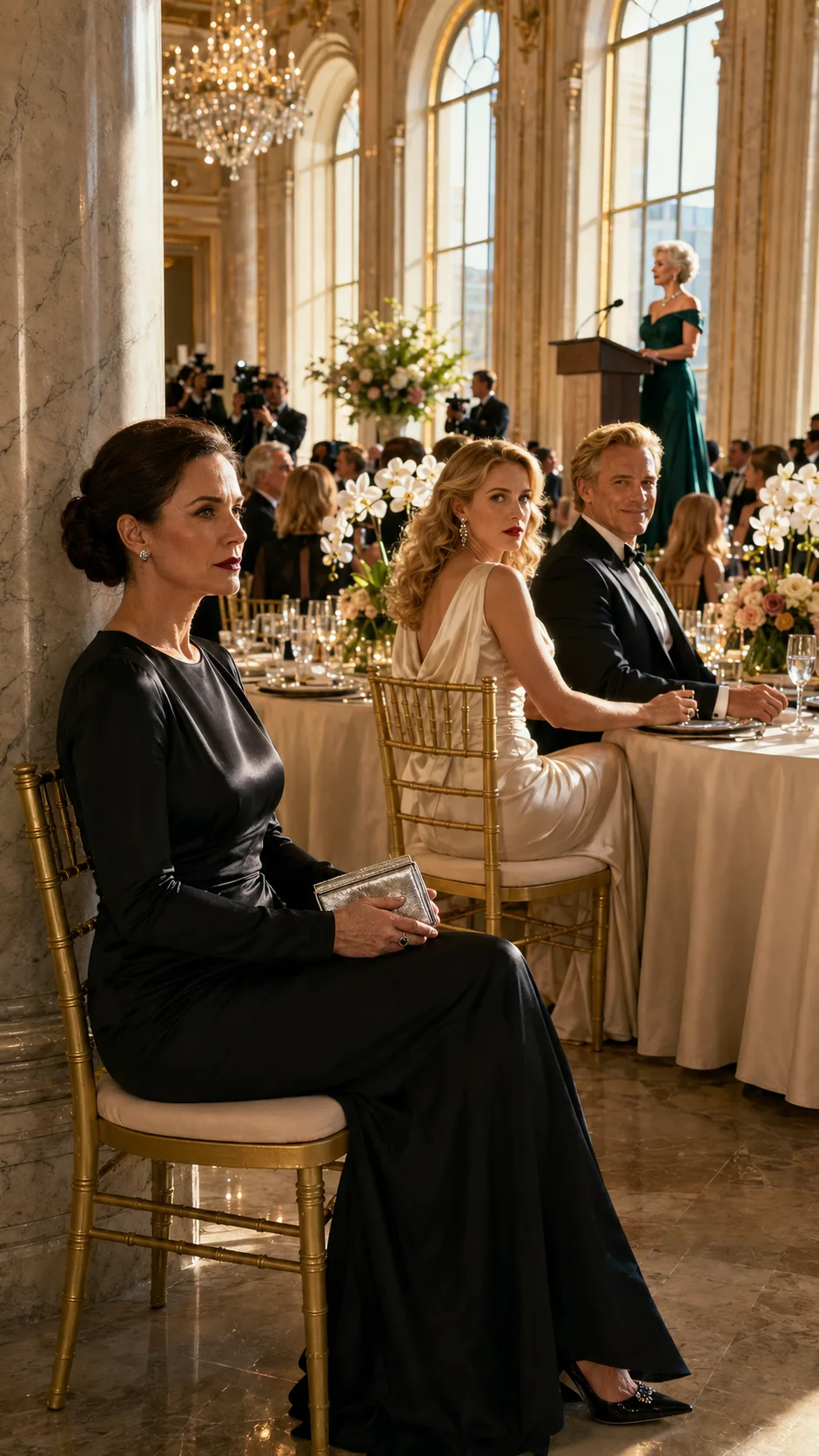
HE GAVE MY SEAT TO HIS MISTRESS.
Chapter 3
HE GAVE MY SEAT TO HIS MISTRESS.
I TOOK BACK THE ROOM
PART 3 — THE WOMAN WHO BUILT HER OWN ROOM
CHAPTER 4: WHEN THE CHANDELIER TURNED COLD
By midnight, the internet had already chosen its headline.
BILLIONAIRE WIFE MOVED TO WORST SEAT, ACCEPTS LIFETIME ACHIEVEMENT AWARD, REVEALS SHE OWNS EVERYTHING.
It wasn’t completely accurate.
Viral stories rarely are.
But it was close enough to sting.
Clips of my speech spread across Facebook, Instagram, TikTok, and every gossip account that fed on the downfall of polished men. Someone slowed down Preston’s face at the exact moment the Hart House logo appeared behind me. Someone else zoomed in on Celeste’s hand slipping from his sleeve. A meme appeared before dessert was cleared: a picture of the marble pillar with the caption, PUT ME HERE AND SEE WHAT HAPPENS.
I did not see any of it until later.
After the speech, I walked offstage into a storm of
hands, cameras, whispered congratulations, and faces I had known for years suddenly rearranged into admiration.
Vivian squeezed my arm. “That was cleaner than he deserved.”
“I wasn’t doing it for him.”
“I know,” she said. “That’s why it worked.”
Across the ballroom, Preston was trapped.
Not physically. The doors were open.
But socially, reputationally, he was pinned beneath every glittering eye in the room. Men who had laughed with him at cocktails now studied their phones. Women who had tolerated him because Lillian controlled three committees now smiled at me with the sweet ferocity of people seeing an old insult corrected.
Celeste stood behind him, no longer glowing. Ivory satin is unforgiving under judgment.
Lillian approached me first.
Of course she did.
Her posture remained perfect, but her mouth had thinned into a pale line.
“Evelyn,” she said, “surely this could have been handled privately.”
I looked at her diamonds.
For years, I had watched those diamonds flash as she corrected my table settings, my guest lists, my vowels, my ambition. I had once wanted her approval so badly it embarrassed me now.
“It was handled privately,” I said. “For fourteen years.”
Her eyes flickered.
“Think carefully,” she whispered. “Divorce is ugly at this level.”
“No, Lillian. Marriage was ugly at this level. Divorce is just paperwork.”
She stepped back as if I had slapped her.
Preston came next.
He did not storm. He glided, because men like Preston believe grace can disguise panic. Two attorneys followed at a distance, already speaking urgently into their phones.
“Evelyn,” he said softly. “You’re emotional.”
The word landed between us like a dead insect.
I almost laughed.
“Still?”
His mask cracked. “Do you have any idea what you’ve done?”
“Yes.”
“You humiliated me.”
“No, Preston. I described you accurately in public. You’re feeling
the difference.”
His eyes hardened.
For a moment I saw the man behind the charm. Not wounded. Not sorry. Offended. As if I had stolen something that belonged to him by refusing to remain stolen.
“You think they respect you now?” he asked. “They’re entertained. That’s all. By tomorrow, they’ll move on.”
“Maybe.”
“You’ll be alone.”
I looked past him.
Near the exit, a tall man in a black tuxedo stood beneath an archway of white orchids. Adrian Vale. Attorney. Investor. Former prosecutor. The sort of man who made silence feel expensive.
He had been my counsel for eight months.
He had also been the first person in years to ask me, over coffee in a windowless conference room, “What do you want your life to feel like when this is over?”
Not look like.
Feel like.
I had not known how to answer.
Now I did.
“Alone is not the threat you think it is,” I told Preston.
Celeste appeared at his side.
Her confidence had returned in fragments. “Evelyn, I never wanted to hurt you.”
That was the sentence mistresses say when they very much enjoyed the hurting until witnesses arrived.
I turned to her fully.
Celeste was beautiful. There was no point denying that. But beauty without depth becomes exhausting when panic removes the lighting.
“You sat in my chair,” I said.
Preston stepped in. “For God’s sake, it was a chair.”
“No,” I said. “It was a message.”
Celeste’s eyes glistened. “He told me you were separated.”
“We live in the same house.”
“He said it was for appearances.”
“It was.”
She flinched.
For the first time, I wondered if she had believed him because believing him was profitable. Perhaps that was not innocence, but it was something more ordinary than evil. Hunger. Vanity. Ambition. The small human sins that grow teeth when rich men feed them.
I reached into my clutch and removed a cream envelope.
Celeste stared at it.
“This is for you,” I said.
Preston stiffened. “Evelyn, don’t.”
I handed it to her.
Inside was a copy of the audit summary, with the sections involving Monroe Media highlighted. There was also a business card for an attorney unaffiliated with any of us.
Celeste opened it with trembling fingers.
“You should have independent counsel,” I said. “Not his. Not mine.”
Her lips parted.
That was the moment the second twist broke across her face.
She had thought she was the prize.
Now she understood she might be the shield.
Preston had placed her in my seat not only to humiliate me, but to bind her to him publicly before the audit landed. If she looked like his partner socially, perhaps she could be made to look like his partner legally. Men like Preston did not love women. They arranged them.
Celeste looked at him.
“What is this?” she whispered.
“Nothing,” he snapped.
But his voice was too sharp.
She stepped away.
The cameras caught that too.
By then, guests had begun pretending not to listen with the full commitment of people listening to every word.
Preston lowered his voice. “You won’t destroy me.”
I felt tired suddenly.
Not weak. Just tired in the marrow from years of carrying a man who mistook being carried for standing tall.
“I’m not destroying you,” I said. “I’m returning you to yourself.”
His expression twisted.
“And what about us?”
Us.
The smallest word. The largest lie.
I looked at his wedding ring. Platinum. Engraved inside with a line from a poem he had not understood: We are what we choose to keep.
“I kept enough,” I said. “Now I’m choosing differently.”
Then I walked away.
Adrian met me near the archway.
He did not touch me at first. I appreciated that. Men are often too quick to put a hand on a woman emerging from fire, as if survival requires claiming.
“You were magnificent,” he said.
“I was precise.”
“That too.”
Behind us, the ballroom had become a hive. Phones glowed. Voices buzzed. The chandelier still glittered overhead, but it looked colder now, less like celebration and more like evidence.
Adrian offered his arm.
“Your car is waiting.”
I looked back once.
Not at Preston.
At the pillar.
My seat beside it was empty now.
My name card remained on the table, small and white against the linen.
I nearly went back for it.
Then I didn’t.
Some things are only powerful until you leave them behind.
CHAPTER 5: THE WOMAN WHO OPENED THE DOOR
The divorce took eleven months.
Preston fought everything.
The townhouse. The foundation name. The narrative. The art. The guest lists. A set of silver candlesticks he had once mocked as “provincial” until he learned they had belonged to my mother.
He gave interviews through unnamed sources.
Friends of Preston Whitmore described him as devastated.
Friends of Evelyn Hart Whitmore described her as calculating.
A society columnist wrote that my speech at the gala had been “effective but perhaps unbecoming.”
I sent her a donation receipt from Hart House Arts Initiative funding twelve girls from the Bronx to attend a summer film program, with a note: May they all become unbecoming.
The screenshot went viral too.
By then, I had stopped pretending not to notice.
Viral fame is not warmth. It is weather. It comes fast, floods everything, and leaves debris. Strangers called me a queen, a legend, a warning, a gold digger, a genius, a bitter wife, a feminist icon, an ice sculpture, an inspiration, and several words I would not repeat in front of my mother’s portrait.
None of it healed me.
But the work did.
Hart House Arts Initiative moved into an old limestone building in Chelsea that had once been a piano factory. We restored the windows, kept the scuffed maple floors, and turned the freight elevator into a vertical gallery for student work. On the first morning we opened, a ten-year-old boy from Newark stood in the lobby staring at a wall of donated violins and whispered, “You mean we can touch them?”
That healed something.
Not everything.
Something.
Celeste cooperated with investigators.
Her company did not survive. Neither did her romance with Preston, which ended shortly after she realized the apartment he had promised her was leased through a business entity now controlled by Hart House Holdings.
Six months after the gala, she sent me a letter.
Not an email. A real letter on thick paper, written in blue ink.
She did not ask for forgiveness. That mattered. People who ask for forgiveness too quickly are often asking to skip the consequences.
She wrote: I thought taking your seat meant I had won. I understand now that he had trained both of us to compete for a place at a table he never built.
I kept the letter in a drawer.
Not as friendship.
As evidence that some women do wake up.
Preston’s fall was less cinematic than people expected.
There was no prison scene. No dramatic collapse on courthouse steps. Just resignations, settlements, legal fees, invitations that stopped arriving, and the slow social death of a man whose charm no longer produced profit.
His mother moved permanently to Palm Beach.
Preston moved into a glass apartment downtown with rented furniture and a view of buildings he did not own.
The last time I saw him was outside the Manhattan Supreme Court after the divorce was finalized.
He looked thinner. Still handsome, but in the way expensive flowers are handsome after three days without water.
“You got what you wanted,” he said.
I buttoned my camel coat against the wind.
“No,” I said. “I got what I earned.”
He looked at me for a long time.
Then, for the first and only time, he said, “I did love you.”
I believed that he believed it.
That was not the same as truth.
“You loved being near what I built,” I said. “That’s different.”
He had no answer.
I walked down the courthouse steps alone.
At the bottom, Adrian Vale stood beside a black town car, reading a folded newspaper like a man from another century. Snow moved lightly through the air, softening the hard edges of the city.
He looked up.
“Free woman,” he said.
“Expensive woman,” I corrected.
His smile was slow. “Accurate.”
Adrian and I did not fall into each other’s arms. Life is rarely that simple, and I had no interest in making another man a destination. But over the following months, he became part of the quiet architecture of my new life.
He came to gallery openings and stood in the back so students could take the front row. He sent books instead of flowers. He never called me brave when I was tired; he brought soup. He did not ask me to soften my edges. He seemed to understand that some edges are not damage. They are design.
One evening in late spring, Hart House hosted its first public gala under the new name.
Not at the Grand Meridian.
I refused.
We held it in the restored Chelsea piano factory, under exposed beams and strings of warm lights, with food from a Queens restaurant my mother had loved. Billionaires stood beside public school teachers. Broadway actors talked with teenagers from Detroit. A senator spilled sauce on his tuxedo and nobody died.
There was no Table One.
That was my rule.
The seating chart was circular. Artists sat with donors. Students sat with trustees. No wives placed behind pillars. No mistresses displayed like trophies. No one positioned as decoration for someone else’s importance.
At the entrance, we placed a small framed card.
A seat is not power. Access is.
People photographed it all night.
Near the end of the evening, a young composer named Maya Reynolds performed a piece she had written for strings and piano. She was seventeen, from Baltimore, and had once practiced on a keyboard missing three keys. Now she stood beneath the old factory windows while her music filled the room with something aching and bright.
I sat in the front row.
Not because it was the best seat.
Because Maya had saved it for me.
When the final note faded, the room stood.
Maya looked overwhelmed, then found me in the crowd. I touched my hand to my heart. She did the same.
That was legacy.
Not a logo. Not a marriage. Not a chandelier.
A door held open long enough for someone else to walk through.
After the applause, I stepped outside onto the terrace for air. The city glittered beyond the railings, restless and alive. Somewhere downtown, Preston was probably telling someone a version of the story in which he had been misunderstood. Somewhere in Palm Beach, Lillian was probably correcting a florist. Somewhere online, strangers were still arguing about whether I had gone too far.
The night smelled of rain and lilacs from the planters along the brick wall.
Adrian joined me with two glasses of sparkling water.
“No champagne?” I asked.
“You once told me champagne is for people trying to make bad decisions look festive.”
“I say many wise things.”
“You do.”
We stood in comfortable silence.
Below us, Manhattan moved like a river of light.
After a while, he said, “Are you happy?”
I considered the question.
Happiness had once seemed like a room I needed someone else to invite me into. Then it became a rumor. Then a luxury. Now, it felt quieter than I expected.
It felt like breathing without asking permission.
“I’m getting there,” I said.
Adrian nodded, as if that answer deserved respect.
Inside, laughter rose. Music began again. Someone opened the terrace door and warm light spilled across the floor, touching the hem of my dress.
This time, I wore blue.
Not black armor. Not widow’s silk. Blue like morning over water. Blue like a life beginning after the storm has done its worst.
Adrian offered his hand, not to lead me, but to ask.
I took it.
Together, we walked back into the room I had built.
CONCLUSION: A WARM LIGHT AFTER THE STORM
Years later, people would still ask me about that night at the Grand Meridian.
They wanted the glamorous version. The betrayed wife. The mistress in ivory. The cruel husband. The speech. The gasp. The line that traveled across the internet faster than truth usually does.
They wanted to know if I had planned every second.
I always told them the same thing.
I had planned the documents. The board vote. The legal protections. The new foundation name. The timing of the announcement. I had planned everything necessary to protect the work.
But I had not planned the chair.
That was Preston’s contribution.
A final, perfect symbol from a man who understood status but never understood value.
He thought placing me beside a pillar would make me smaller.
Instead, it gave the whole room a clear view of what he was.
And it gave me one last lesson before I left: never confuse proximity with power. Never mistake being chosen for being cherished. Never build your life around a seat at someone else’s table when you have the strength, the vision, and the right to build your own room.
The awards changed. The headlines faded. The viral clips became memories people rediscovered every few months with captions and flame emojis.
But Hart House remained.
The scholarships grew. The theaters reopened. The children touched violins. The murals climbed brick walls in cities that had been told beauty was not for them. Women who had been interrupted, erased, underestimated, and placed behind pillars wrote to me from all over the country.
I answered as many as I could.
Not with advice about revenge.
With reminders about worth.
Because the sweetest victory was never watching Preston lose his place.
It was no longer needing one beside him.
It was waking each morning in a home full of books and flowers I bought myself. It was hearing music from a rehearsal room down the hall. It was laughing without checking anyone’s mood first. It was learning that love, real love, does not move your name card to make room for another woman.
Real love saves you a seat where you can be fully seen.
And if it cannot find one, it stands beside you until you build a better table.
THE END
Chapter complete
You have reached the end of this chapter.
Continue reading
A few more worlds to get lost in after this chapter.




