HE GAVE MY SEAT TO HIS MISTRESS.
Chapter 2
HE GAVE MY SEAT TO HIS MISTRESS.
I TOOK BACK THE ROOM
PART 2 — THE WOMAN BEHIND THE PILLAR
CHAPTER 1: THE WOMAN BEHIND THE PILLAR
The Grand Meridian Hotel had been built for people who liked to pretend money was a form of morality.
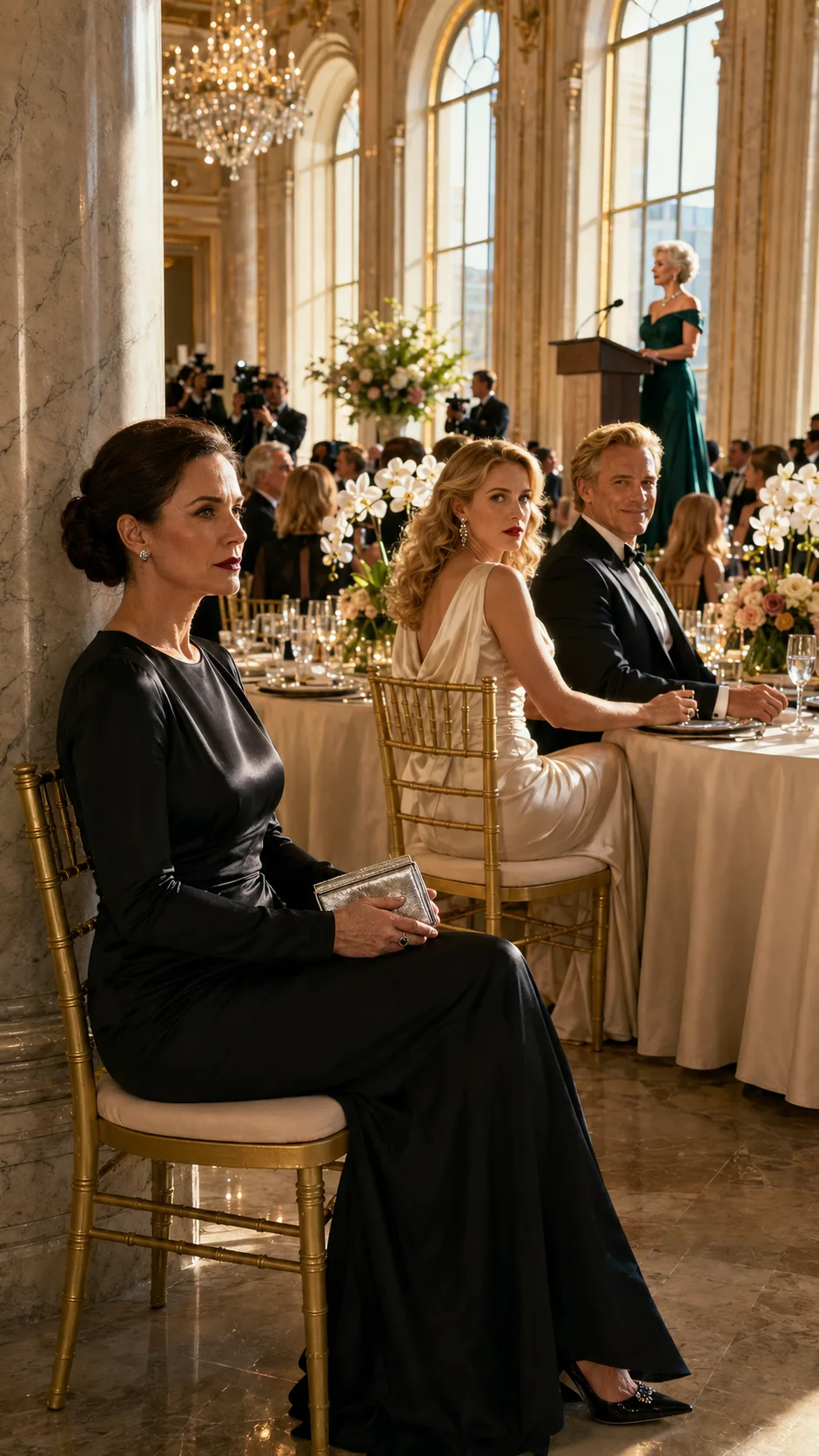
Gold-veined marble floors. Velvet ropes. White orchids arranged in vases taller than children. Waiters in black jackets moving silently between tables, pouring champagne that cost more per bottle than my first month’s rent in Brooklyn.
The ballroom glittered with old New York confidence. Men in tuxedos laughed too loudly at jokes that weren’t funny. Women in couture smiled like blades. Flashbulbs burst near the step-and-repeat where the city’s arts patrons posed beneath the silver logo of the Whitmore Cultural Foundation.
My husband’s foundation.
At least, that was what everyone thought.
“Mrs. Whitmore?”
A young hostess with a headset and terrified eyes stood beside me, clutching a seating chart like it might
explode.
“Yes?”
“I’m so sorry. There was a last-minute adjustment.”
Her voice trembled on the word adjustment.
I looked down at the place card in her hand.
EVELYN HART WHITMORE.
My name. My full married name. Printed in elegant navy script. The card had a slight crease across the top, as though someone had picked it up, moved it, and pressed it back into place with unnecessary force.
“Where am I sitting now?” I asked.
She swallowed and pointed toward the end of Table One.
The worst seat at the best table.
It was almost artistic.
From that angle, I would appear included in every official photograph, but only barely. My shoulder might show. A sliver of my profile. Enough for Preston to claim I had been honored. Not enough for anyone to see my face.
A public humiliation with plausible deniability.
Classic Preston.
“I see,” I said.
The hostess
blinked. “I can try to—”
“No.” I smiled gently, because none of this was her fault. “Leave it exactly as it is.”
She looked relieved and frightened at the same time.
I walked across the ballroom.
Every step made the hem of my gown whisper over the floor. The dress was black silk, long-sleeved, cut high at the throat and low at the back. It had belonged to my mother for one night in 1989, when she attended a benefit in Boston with borrowed pearls and a borrowed confidence she later told me changed her life.
I had worn it tonight for her.
Preston hated sentimental things.
He liked new things. Shiny things. Women who laughed at his jokes before he finished them. Women who made him feel young without requiring him to become good.
Celeste Monroe was twenty-nine, maybe thirty, with honey-blonde hair and the soft, expensive glow of
someone who had recently discovered dermatologists, Pilates, and men who paid for both. She wore ivory satin, a dangerous choice for a woman seated beside someone else’s husband. Her lips were painted the color of cherries in a crystal bowl.
She looked up as I approached.
For one second, the smile slipped.
Then she recovered beautifully.
“Evelyn,” she said, as if we were friends meeting at a garden party instead of enemies under a chandelier. “You look stunning.”
“Thank you,” I said. “So do you.”
Preston stood halfway from his chair, the coward’s version of manners.
“Evie,” he said.
He only called me Evie in public now. In private, he called me unreasonable.
“There was a mix-up,” he continued, smoothing his jacket. “Celeste is here representing Monroe Media. Important sponsor. You understand.”
I looked at the place setting in front of Celeste.
My menu. My gold-rimmed charger. My small handwritten note from the gala chair that read: With deepest gratitude for everything you have built.
Celeste’s fingers rested near it.
“I understand perfectly,” I said.
Preston’s eyes narrowed.
He had expected tears, perhaps. Or a sharp comment. Something he could use later. Evelyn embarrassed me tonight. Evelyn was unstable. Evelyn made everyone uncomfortable.
That was his favorite trick—wound me in public, then accuse me of bleeding too loudly.
Lillian Whitmore leaned forward, diamonds trembling at her throat.
“Darling,” she said, “you know these events are all about optics.”
I turned to her.
Lillian had once told me I was “surprisingly presentable” for a scholarship girl from Queens. That was three months before my trust quietly paid off the Whitmore family’s tax liens.
“Yes,” I said. “I do know that.”
A small silence followed.
Then I moved to the seat beside the pillar and sat down.
No one knew what to do with a woman who refused to perform her own devastation.
So they returned to their champagne.
For the next forty minutes, I watched the theater unfold.
Preston placed his hand on the back of Celeste’s chair as he spoke to a senator’s wife. Celeste laughed with her entire body, leaning close enough that her perfume reached me in little poisonous waves. Lillian introduced her to two museum trustees with a proud warmth she had never once extended to me.
And yet, beneath the humiliation, I felt something calm and cold settle inside me.
Not rage.
Rage is hot. Messy. Wasteful.
This was clarity.
I had given Preston fourteen years. Fourteen years of smiling at fundraisers while he took credit for my work. Fourteen years of editing his speeches, repairing his scandals, softening his cruelty before it reached the press. Fourteen years of being the elegant wife in the background, the woman who made the machine run while he stood in front of it pretending to be the engine.
And tonight, he had given away my seat.
That was his mistake.
Not the affair. Not the lies. Not even the way he had moved his mistress beneath the chandelier like a coronation.
His mistake was believing the seat had power.
It didn’t.
The woman did.
CHAPTER 2: CHAMPAGNE, LIES, AND OLD MONEY
I met Preston Whitmore at a charity auction in Palm Beach.
He was thirty-six then, golden-haired, charming, and already skilled in the art of appearing more generous than he was. I was thirty-two, newly appointed director of a small arts nonprofit in Brooklyn, still surprised when rich people remembered my name.
He bought a painting that night for fifty thousand dollars.
Later I learned he had charged it to a credit card that was already overdue.
But that evening, under the warm Florida lights, he looked like a prince. He asked me why I cared so much about abandoned theaters and underfunded art programs. I told him beauty saved people who didn’t know how to ask for help.
He looked at me as if I had said something holy.
“I want to learn how to see the world like you,” he said.
It took me years to realize he didn’t want to see the world like me.
He wanted the world to see him beside me.
We married eighteen months later at a stone chapel in Connecticut while rain tapped softly against stained glass windows. His family called it romantic. My mother, already sick by then, squeezed my hand and whispered, “Make sure he loves your light, not just the way it shines on him.”
She died the following spring.
Grief made me generous in dangerous ways.
Preston’s father had left behind a collapsing investment firm, three lawsuits, and a family name polished thin by debt. Preston confessed this to me one night in our townhouse on East 74th Street, standing by the window with a drink in his hand and shame arranged attractively on his face.
“I didn’t want you to know,” he said. “I wanted to be worthy of you.”
I believed him.
That is the embarrassing truth about betrayal. Before it becomes obvious, it often looks like vulnerability.
So I helped.
My mother had left me Hart House, a small but valuable portfolio of real estate and private investments built by my grandfather, who repaired elevators in Queens and bought buildings nobody wanted until the city grew around them.
I used part of that inheritance to stabilize Preston’s family business.
Quietly.
No headlines. No announcements. No Whitmore men forced to admit a woman had saved them.
In exchange, Preston promised to help build my dream: a national foundation that funded arts education, restoration projects, and grants for young creators from working-class communities.
The Whitmore Cultural Foundation was born one year later.
Preston became the face of it.
I became the hands.
For a while, I told myself that was enough.
I told myself good work did not need applause. I told myself marriage was partnership, and partnership meant sometimes one person stood in the light while the other held the ladder.
But Preston did not stand in the light.
He blocked it.
He began saying “my foundation” during interviews. He accepted awards for programs I designed. He called my caution negativity and my intelligence anxiety. When donors praised me, he interrupted with stories that made him look visionary. When journalists asked about my role, he smiled and said, “Evelyn prefers privacy.”
I did prefer privacy.
Until privacy became erasure.
The first time I smelled another woman’s perfume on his shirt, I said nothing.
The second time, I asked.
He kissed my forehead and told me I was tired.
By the third time, I knew her name.
Celeste Monroe.
Former lifestyle influencer. Founder of Monroe Media, a boutique branding firm that specialized in turning rich people into saints online. She had been hired to modernize the foundation’s image. Within six months, Preston’s Instagram looked like a presidential campaign and Celeste was attending private donor meetings in dresses that cost more than our first gala budget.
I watched. I listened. I collected.
Not because I wanted revenge at first.
Because I wanted proof that I was not losing my mind.
Receipts. Emails. Calendar invites. Hotel charges in Napa during a weekend Preston claimed to be in Boston. A bracelet from Cartier billed to a foundation account and labeled donor relations.
Then came the documents that changed everything.
Three months before the awards dinner, a forensic accountant named Maribel Santos called me from Chicago.
“Mrs. Whitmore,” she said, “you asked me to review administrative expenses. I found something larger.”
“How large?”
There was a pause.
“Large enough that your husband should not be chairing anything with the word charitable in it.”
I remember standing in my kitchen while rain slid down the windows, listening as Maribel explained the web of shell vendors, inflated consulting fees, and private travel disguised as outreach. Not all of it was criminal. Preston was too careful for that. But it was rotten. Soft corruption dressed in tailored suits.
And Celeste’s company sat at the center of it.
That night, Preston came home carrying white roses.
White roses meant he had done something expensive.
He kissed my cheek. “You’ve been distant.”
“I’ve been busy.”
“With what?”
“Seeing clearly.”
He laughed. “That sounds ominous.”
“It should.”
For the first time in years, he looked uncertain.
Then his phone lit up on the counter.
Celeste.
Not her number. Her name.
He saw me see it.
And still, he smiled.
That was when I understood the depth of his arrogance. He did not hide because he did not think I would leave. He thought my dignity was a cage. He thought I would never risk scandal because women like me are trained to protect the table, even when the table is built from our bones.
So I began to move quietly.
I hired attorneys in New York and Delaware. I activated clauses Preston had never read in agreements he had signed because he was too bored to respect paperwork. I met with board members one by one. I showed them facts, not tears. I secured votes. I transferred assets. I purchased, through Hart House Holdings, the distressed majority stake in Whitmore Capital before Preston knew the anonymous buyer existed.
And then, two weeks before the gala, the National Arts Alliance called.
“Mrs. Whitmore,” the chairwoman said, voice bright with ceremony, “we would be honored to present you with this year’s Marguerite Caldwell Lifetime Achievement Award.”
I laughed once, softly.
Not because it was funny.
Because timing, when it finally turns in your favor, has a dark sense of humor.
CHAPTER 3: THE BEST TABLE IN THE ROOM
At 8:47 p.m., Preston leaned toward Celeste and brushed a strand of hair from her cheek.
It was a small gesture.
Tender. Familiar. Fatal.
A photographer captured it.
I saw the flash.
Celeste saw it too. Her eyes darted toward me, then away.
For all her confidence, she did not yet understand old money rooms. They do not gasp. They record. They do not confront. They remember.
The first course had been cleared. The ballroom lights dimmed to a warm amber. Onstage, a jazz trio finished a slow version of “The Way You Look Tonight,” which felt so cruelly on theme I almost admired the universe for it.
The gala chair, Vivian Sterling, stepped to the podium.
Vivian was seventy, silver-haired, and terrifyingly calm. She had inherited shipping money, multiplied it in biotech, and spent the last twenty years funding artists who made politicians nervous. She was the only woman in the room richer than the men who tried to impress her.
She looked directly at me.
Not at Preston.
At me.
A ripple moved through my chest.
“Ladies and gentlemen,” Vivian began, “tonight we celebrate legacy. Not the kind printed on buildings. Not the kind polished by publicists. The real kind. The kind built quietly, consistently, and at great personal cost.”
Preston clapped politely.
He did not hear the blade entering the room.
Vivian continued. “Our next honoree has changed the landscape of arts education in this country. Because of her work, abandoned theaters have reopened in Detroit, youth orchestras have been funded in Atlanta, mural programs have transformed neighborhoods in Baltimore, and more than eight thousand students have received scholarships, instruments, studio space, or mentorship.”
Celeste tilted her head, bored but pretty.
Preston checked his cufflinks.
I placed both hands in my lap.
Vivian smiled.
“Many of you know the Whitmore Cultural Foundation. Tonight, it is my privilege to honor the woman who built its heart, its mission, and, quite frankly, its spine.”
Preston froze.
Lillian’s champagne flute stopped halfway to her mouth.
Vivian turned a page.
“The Marguerite Caldwell Lifetime Achievement Award goes to Evelyn Hart Whitmore.”
For one perfect second, nobody moved.
Then the ballroom erupted.
Not politely. Not reluctantly.
Fully.
Chairs shifted. People stood. Applause rose toward the ceiling like weather. The cameras swung away from Preston and Celeste so quickly that Celeste flinched.
My husband stared at me as if I had walked out of a portrait.
I rose from behind the pillar.
That detail mattered. The room saw it. They saw where I had been placed. They saw the distance between the woman being honored and the man who had given away her chair.
I walked toward the stage.
Every step felt like crossing a border.
Preston stood at last, clapping too hard, smiling too late. Celeste remained seated for three seconds longer than everyone else, then stood when she realized a camera was on her.
Vivian embraced me at the podium.
“You ready?” she whispered.
“I was ready the moment he moved the card,” I whispered back.
She laughed softly and handed me the award.
It was heavier than I expected, a glass sculpture shaped like an open door.
I looked out at the ballroom.
At the donors. The board. The journalists. The society wives pretending not to enjoy themselves. The young artists seated at the back tables with wide eyes and borrowed tuxedos. At Lillian, pale beneath her diamonds. At Celeste, gripping her napkin. At Preston, whose smile had become a wound.
The microphone waited.
I leaned in.
“Thank you,” I said. “This is an extraordinary honor. And I confess, when I arrived tonight, I was not sure I would have a clear view of the stage.”
A murmur moved through the room.
I let it breathe.
“But perhaps that was appropriate. Much of my life’s work has been done from obstructed views.”
The applause came again, sharper now.
Preston’s jaw tightened.
“I have spent many years believing that quiet work was enough. That if a child in Detroit held a violin for the first time, it did not matter whose name appeared on the program. That if a theater in Baltimore turned its lights back on, it did not matter who stood at the ribbon-cutting. That if a scholarship changed a young person’s life, it did not matter who took the photograph.”
I paused.
“I still believe the work matters most.”
Then I looked at Preston.
“But I no longer believe women must disappear in order for the work to survive.”
The room went still.
There are silences that feel empty.
This one felt armed.
“Tonight, I want to thank the artists, educators, students, architects, restoration teams, community organizers, and volunteers who built every miracle this award recognizes. I want to thank Vivian Sterling and the National Arts Alliance for honoring not a brand, but a body of work.”
I lifted the glass award slightly.
“And I want to correct the record.”
Preston’s face changed.
Not dramatically. He was too practiced for that.
But I saw the fear arrive.
It entered through his eyes.
“For fourteen years, the public has known the Whitmore Cultural Foundation as my husband’s vision. The truth is more complicated. It was funded originally through the Hart family trust, designed by my office, and sustained by a network of women and working artists who were often thanked last, if at all.”
A few heads turned toward Preston.
I did not raise my voice.
Luxury rooms do not require shouting. A whisper travels farther when everyone is desperate to hear it.
“As of five o’clock this evening, after a unanimous emergency vote by the board, the foundation has been formally restructured. Its assets, programs, and endowments will continue under a new name: Hart House Arts Initiative.”
The screen behind me changed.
The Whitmore logo dissolved.
In its place appeared a simple mark: a black door opening into gold light.
HART HOUSE ARTS INITIATIVE.
The room gasped.
Actually gasped.
It was beautiful.
Preston rose halfway from his seat. “Evelyn.”
The microphone caught his voice just enough.
I smiled at him.
“Please sit, Preston. You’ve always enjoyed a good performance.”
A stunned laugh broke from somewhere near the back. Then another. Then the whole room shifted, leaning toward the stage with the helpless hunger of people watching a dynasty crack in real time.
I continued.
“In addition, Hart House Holdings has acquired the controlling interest in Whitmore Capital’s outstanding debt. That acquisition prevents the liquidation of several community properties tied to our grant programs.”
I turned slightly, so the cameras caught my profile.
“It also means that, for the first time in its history, the Whitmore family business is majority-controlled by a woman named Hart.”
Lillian put down her glass.
Celeste whispered something to Preston.
He did not answer.
Now came the part I had debated removing.
Not because it was cruel.
Because it was final.
“An independent audit has also identified improper foundation expenditures, including luxury travel, personal gifts, and consulting fees billed through Monroe Media.”
Celeste’s face drained of color.
I did not look at her.
That would have been too small.
“Those findings have been referred to counsel. I will not discuss them further tonight. The work is bigger than the misconduct, and the people served by this foundation deserve protection from spectacle.”
That was the difference between revenge and power.
Revenge wants blood on the floor.
Power knows when to leave the knife clean.
I took a breath.
Then I looked at the table where my place card no longer sat.
“I came here tonight and found that my reserved seat had been given away. At first, I thought it was a humiliation. Then I realized it was a gift. It showed me, and perhaps many of you, the exact shape of the life I am leaving behind.”
Preston stared at me.
I held his gaze for the last time as his wife.
“Funny how the best seat in the room was never beside him.”
The applause hit like thunder.
TO BE CONTINUED, PART 3 NOW
Chapter complete
You have reached the end of this chapter.
Continue reading
A few more worlds to get lost in after this chapter.




