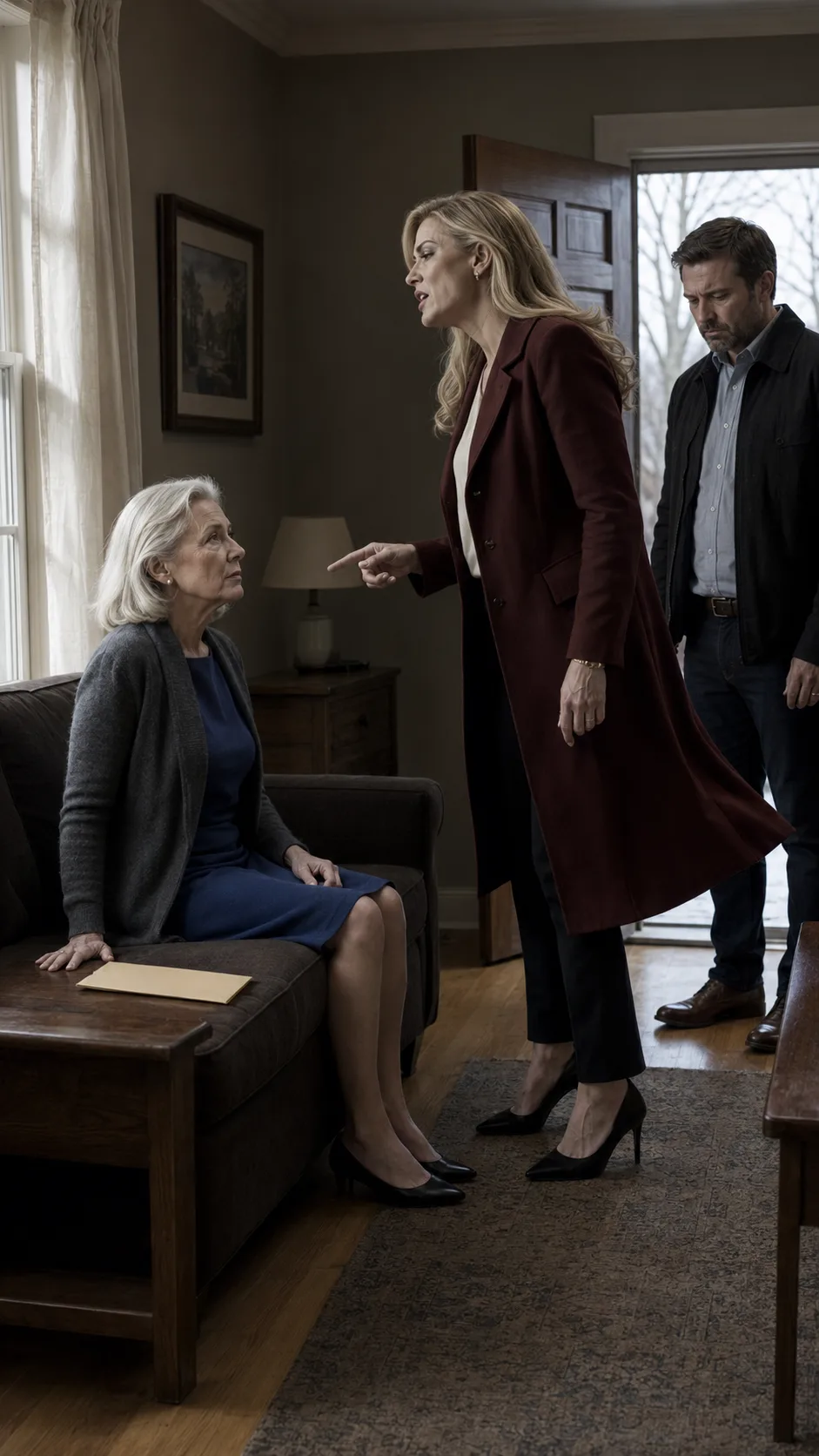
Michael placed the gift bag on my coffee table.
Chapter 3
Michael placed the gift bag on my coffee table.
Clare remained standing, her arms crossed beneath her burgundy coat.
I sat in my chair and waited.
For years, silence had made me uncomfortable. I had rushed to fill it with excuses, reassurances, and offers of help.
Not anymore.
Michael cleared his throat.
“We came to make peace.”
Clare said nothing.
Michael leaned forward.
“Things got out of control. Everyone said things they didn’t mean.”
“Everyone?” I asked.
He looked toward Clare.
“She was stressed.”
Clare removed her sunglasses.
“We were both stressed.”
I studied her face.
There was no remorse in it.
Only irritation that her usual methods had failed.
Michael pushed the gift bag toward me.
“We brought you something.”
I did not touch it.
“What is it?”
“A scarf,” he said. “Clare picked it out.”
Clare’s mouth tightened.
I imagined the old Jean opening the bag, pretending to be delighted, thanking them for spending fifty dollars after
taking more than one hundred thousand.
The old Jean would have hugged them.
The old Jean would have sent the money again before they left.
“I don’t need a scarf,” I said.
Michael’s expression fell.
“Mom, we’re trying.”
“No. You’re negotiating.”
“That’s not fair.”
“You keep saying that whenever the truth becomes uncomfortable.”
Clare stepped closer.
“You stopped paying us without warning. You closed an account Michael had access to. Then you let strangers attack us online.”
“I didn’t post your bracelet.”
Her face flushed.
“That video was private.”
“It was posted publicly.”
“I was emotional.”
“You were dishonest.”
Michael raised both hands.
“Can we stop fighting? We’re family.”
I looked at him.
“Where was my family on Thanksgiving?”
He looked down.
“Clare’s sister invited us.”
“Where was my family on Christmas?”
“The children wanted to be with their cousins.”
“And where was my family on my birthday?”
Neither answered.
I continued.
“I sat alone for ninety minutes while you drank at someone else’s party. When I called, your wife told me my age meant nothing.”
Clare rolled her eyes.
“I already said I didn’t mean it.”
“No. You said you were stressed. That is not the same as apologizing.”
“Fine,” she snapped. “I’m sorry.”
The words were sharp, impatient, and empty.
I nodded.
“That apology means exactly what my birthday meant to you.”
Her face hardened.
Michael stood.
“Mom, what do you want from us?”
For the first time, I realized the answer was nothing.
I no longer wanted their calls if the calls came from obligation.
I no longer wanted visits purchased with weekly transfers.
I no longer wanted apologies offered as down payments on future favors.
“I don’t want anything,” I said.
His voice cracked.
“We need you.”
I held his gaze.
“Do you need me, Michael?
Or do you need seven hundred dollars every Friday?”
“That money helps your grandchildren.”
“That money paid for Clare’s bracelet.”
Clare stepped forward.
“How dare you monitor what I buy?”
“I didn’t monitor you. You displayed it publicly while claiming you couldn’t pay your bills.”
Michael rubbed his forehead.
“We made mistakes. But cutting us off permanently is extreme.”
I reached toward the side table and picked up the manila folder containing the bank statements and legal documents.
Clare’s eyes followed it.
“What is that?”
“The record of what your family cost me.”
Michael stared at the folder.
“Mom…”
“More than one hundred thousand dollars in three years.”
His face paled.
“I didn’t realize it was that much.”
“You never asked.”
“We thought you could afford it.”
“That was never the question.”
I stood slowly.
My knees still hurt, but I no longer postponed treatment. I had seen a specialist the week before. I had started physical therapy. I was buying my medication on time.
For the first time in years, taking care of myself did not feel selfish.
I held the folder against my chest.
“You told me my age meant nothing. So I made sure my money would mean nothing to you too.”
Clare’s expression changed first.
“What did you do?”
“I closed the joint account.”
“We know that,” she said.
“I also changed my will.”
Michael froze.
Clare’s arms dropped to her sides.
“You can’t do that.”
A strange calm moved through me.
“I already did.”
Michael stepped closer.
“Mom, please. Don’t make a permanent decision because of one terrible night.”
“It wasn’t one night.”
I opened the folder and removed the first page of the new estate plan.
“It was Thanksgiving. Christmas. Every unanswered call. Every conversation that became a request. Every time I ignored my health so you could maintain a lifestyle you had not earned.”
Clare stared at the document.
“Who gets the money?”
“The Robert and Jean Carter Second Chances Scholarship.”
Michael blinked.
“What?”
“It will support women over fifty returning to school or beginning new careers.”
“You’re giving everything to strangers?” Clare demanded.
“No. I’m giving it to people who understand what a second chance is worth.”
“We’re your family.”
“Family shows up.”
Michael’s eyes filled with tears.
For one dangerous second, I saw the little boy who once brought me wilted daisies with his first paycheck.
I loved that boy.
Part of me would always love him.
But loving someone did not require financing their disrespect.
“Can we fix this?” he whispered.
“You can fix your life,” I said. “Find steady work. Spend less than you earn. Teach your children gratitude. Become the man your father raised you to be.”
“And us?” he asked.
“I am no longer buying a relationship with you.”
Clare grabbed her purse.
“This is pointless. She wants to punish us.”
“No,” I replied. “I want to stop punishing myself.”
I pointed toward the open door.
Clare walked out first.
Michael remained near the threshold.
“Goodbye, Mom.”
“Goodbye, Michael.”
He waited, perhaps expecting me to stop him.
I didn’t.
After they left, I closed the door and returned the document to its folder.
My hands were steady.
The house was silent.
But the silence no longer felt empty.
It felt like mine.
Every Friday after that, I continued transferring seven hundred dollars.
Not to Michael.
To the scholarship fund.
The first recipient was a fifty-three-year-old divorced mother named Linda who wanted to become a nurse.
The second was Patricia, a widow finishing a social-work degree after twenty years at home.
The third was Grace, who trained to become a teacher.
Months later, Patricia sent me a handwritten letter.
Dear Mrs. Carter, you don’t know me, but you changed my life.
She wrote that after her husband died, employers treated her as if decades of raising children and managing a household meant nothing.
She had felt invisible.
Then the scholarship arrived.
For the first time in years, she wrote, someone believed I was worth investing in.
I held the letter against my heart and cried.
Not because I missed the money.
Because I finally understood what generosity was supposed to feel like.
It was not fear.
It was not buying attention.
It was not sacrificing medicine, friendships, and dignity for people who saw love as a transaction.
Real generosity created possibility.
It helped someone stand.
It did not allow someone to keep you on your knees.
I placed Patricia’s letter in a wooden box and began collecting every note from the women the fund supported.
The box filled slowly.
So did my life.
I returned to the library as a volunteer.
I joined a painting class.
I planted tomatoes, peppers, and herbs in the backyard.
Betty came to dinner every Thursday, and we laughed loudly enough to fill every room.
I finally bought a new winter coat.
The first time I wore it to church, Dorothy smiled.
“You look lighter,” she said.
“I am.”
I still thought about Michael sometimes.
I wondered whether he found work.
I wondered whether Clare ever understood what she had destroyed.
I wondered whether my grandchildren would one day hear the real story.
But I no longer waited beside the phone.
I no longer measured my worth by whether my son needed something.
My seventy-fifth birthday had shown me the most painful truth of my life.
People who love you may need help.
But people who only love your help will disappear when it ends.
Michael and Clare believed they had abandoned an old woman at a restaurant.
What they actually abandoned was the person who had been holding their entire life together.
They taught me what my worth was by treating it as nothing.
And I reminded them by walking away with everything that was mine.
THE END
Chapter complete
You have reached the end of this chapter.
Continue reading
A few more worlds to get lost in after this chapter.




