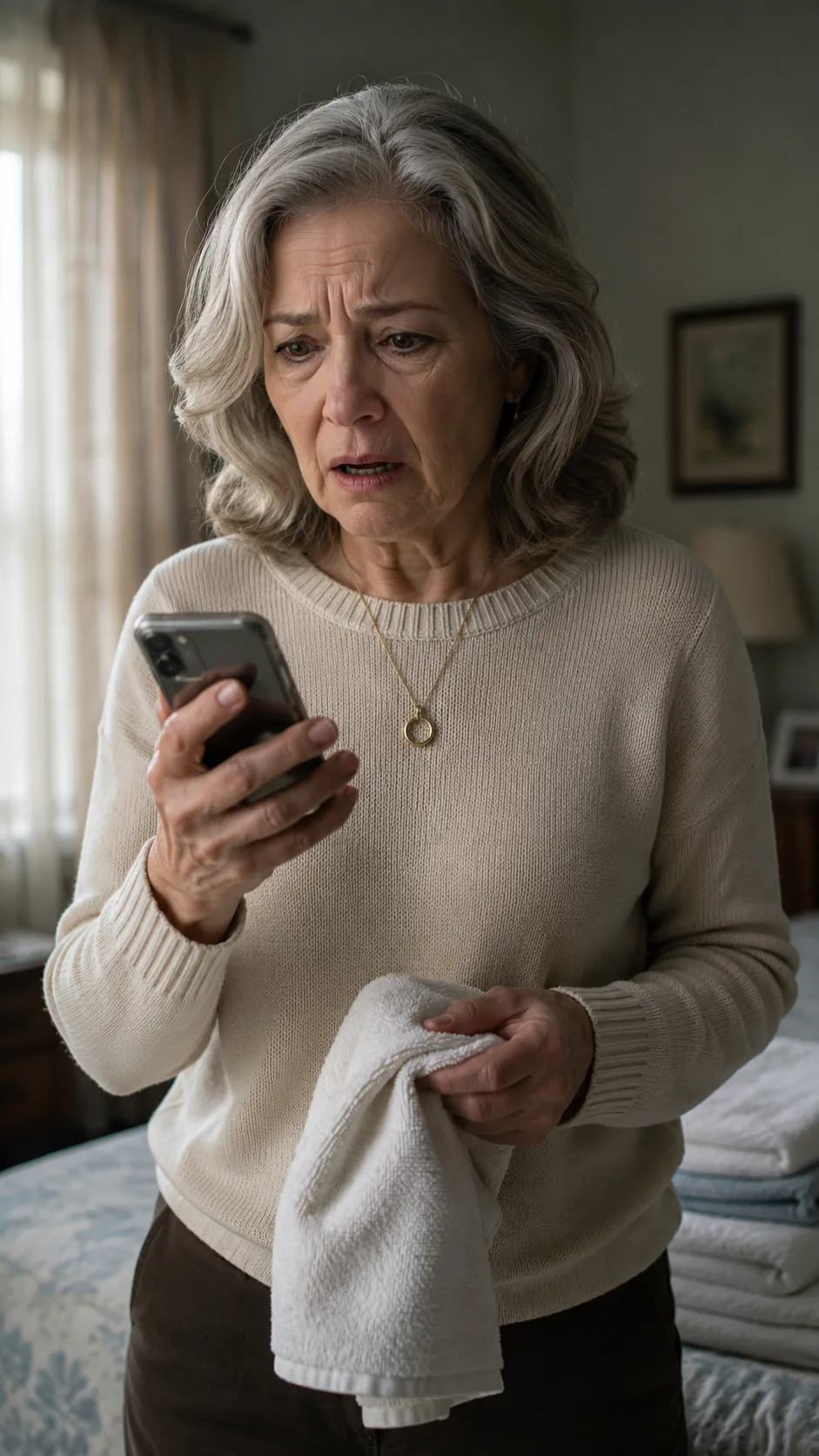
PART 3 — I SIMPLY LOCKED THE DOOR BEHIND YOU
I walked across the street slowly.
Chapter 3
PART 3 — I SIMPLY LOCKED THE DOOR BEHIND YOU
I walked across the street slowly.
Not because I was weak. Because I wanted every step to belong to me.
I wanted to feel the pavement under my shoes and the morning air on my skin and the full, deliberate weight of what I was about to do, which was not to make a speech or deliver a punishment, but simply to stand in front of my son and tell the truth without apology.
Officer Bennett turned.
“Mrs. Whitaker?”
“Hello, Paul.”
Daniel came down the porch steps so quickly he almost tripped over his own suitcase.
“Mom,” he said, forcing his voice into something gentle, something that sounded like the voice he used when he visited and wanted me to feel cared for. “Thank God. What is going on? We have been terrified.”
Terrified.
The word almost made me laugh.
Terrified was what I had felt sitting alone in this house for two years, wondering if
my son still loved me or if he was simply waiting. Terrified was hearing your child call you a burden in the same tone he might use to describe a traffic jam.
What Daniel felt was not terror.
It was the sudden, disorienting experience of a plan going wrong.
Melissa came up beside him and reached for my arm.
I stepped back before she could touch me. Her hand hung in the air between us, fingers still curled, and something flickered across her face.
Not hurt. Surprise.
She was not used to me refusing comfort.
Officer Bennett noticed.
“I am not missing,” I said. “I am not confused. I am not in danger. And I sold my house legally, with my lawyer present, in full possession of my faculties.”
Daniel’s mouth tightened.
“Mom, you cannot just sell the family home without talking to me.”
“The family home,” I repeated.
I
let the words sit between us for a moment, let him hear what they actually sounded like when spoken aloud by a man who had not paid the mortgage, had not replaced the roof, had not sat with his dying father in the kitchen and promised to keep the lights on.
His face flushed.
“You know what I mean.”
“Yes,” I said. “That is the problem. I finally know exactly what you mean.”
Melissa folded her arms.
“We were trying to help you. This place was too much for you.”
“No,” I said calmly. “You wanted it to be too much for me.”
Officer Bennett looked between us with the careful neutrality of a man who has learned that domestic situations are never as simple as the first person to speak makes them sound.
He asked me if I had somewhere safe to stay. I told him I did. He
asked if I was there voluntarily. I told him I was. He asked if I had completed the sale willingly, and I said yes, with my lawyer present, and I reached into my purse and took out the folder.
I had prepared it carefully.
Frank always said, “Hope for decency, prepare for paperwork.”
So I had.
Inside were copies of the closing documents, the letter from my physician confirming I was of sound mind and fully capable of managing my own affairs, a statement from Arthur Greer, and printed screenshots of Daniel’s emails.
The power of attorney research. The draft language referring to me as resistant and emotionally unstable. The highlighted article about contesting competency.
I handed the folder to Officer Bennett.
Daniel went pale.
It happened fast, the way color leaves a face when the body understands something the mind has not yet accepted. Melissa stopped breathing for half a second. I could see it in her chest, the way it simply paused, as though her lungs had decided to wait until the moment passed before committing to another breath.
Officer Bennett opened the folder. His eyes moved across the pages. He did not react much, but his jaw changed, and that was enough.
“Daniel,” he said after a moment, “this appears to be a civil matter. Your mother has the right to sell her property.”
“She is my mother,” Daniel snapped.
“And she is an adult,” Officer Bennett said.
The words settled between us like a gavel coming down on something that should never have been a case.
Melissa recovered first.
“So that is it?” she asked. “You sold everything and ran away because of one private conversation?”
“One?” I asked.
She looked away.
That was when Daniel understood.
I had found more than the voicemail. I had found the paper trail. The plans. The quiet machinery they had been building around me while I was folding their laundry and keeping their leftovers in my refrigerator and believing, foolishly, persistently, that my son still saw me as his mother and not as an obstacle between him and a house he had never earned.
I stepped closer to him, lowering my voice so the officer would not have to hear what a mother should never need to say in public.
“I heard you call me a burden,” I said. “But that was not what broke my heart.”
His eyes flickered.
“It was how normal you sounded,” I continued. “Like you had said it before. Like you had already practiced living without me before I was even gone.”
His mouth opened.
No words came out.
For years, I had imagined what it would feel like to make my son speechless. It did not feel good. It felt like standing beside a grave that had not yet been dug, looking down into the empty space and knowing that something you loved was going into it whether you were ready or not.
Melissa shook her head.
“You are being dramatic. Every family has difficult conversations.”
“You were not having a difficult conversation,” I said. “You were counting.”
“Counting what?”
“My years. My money. My rooms. My usefulness.”
The porch went quiet.
Across the street, Mrs. Alvarez had come outside with her garden gloves still on. Mr. Greene was pretending to check his mailbox for the third time that morning.
Cedar Grove had always been a quiet town, but quiet towns hear everything, and by evening every house on the block would know what had happened on my porch.
I found that I did not care.
Daniel noticed the neighbors and lowered his voice.
“Mom, please. Let us go somewhere and talk.”
“No.”
It was the easiest word I had ever said. It came out clean and whole, with no hesitation and no guilt trailing behind it. I had spent decades softening that word, wrapping it in qualifiers, burying it under maybe and we will see and let me think about it.
But not anymore.
He flinched.
“No?”
“No. There is nothing to discuss. I sold the house. I moved. My lawyer has already updated my will, my medical directive, and my financial accounts. You no longer have access to anything that belongs to me.”
Melissa’s eyes widened at the word will.
There it was.
The tiny crack in the mask.
She could absorb the loss of the house. She could weather the embarrassment on the porch. But the will was the real architecture of their plan, the final structure they had been building toward, and hearing that it had been changed was like hearing that the foundation had been poured somewhere else entirely.
Daniel saw it too.
For one second, shame passed across his face. Not because of what they had done, perhaps. But because I had seen it clearly and he could no longer pretend otherwise.
“Mom,” he whispered, “you changed the will?”
“Yes.”
His voice cracked slightly.
“You cut me out?”
I looked at him for a long moment.
There were so many answers I could have given. I could have reminded him of the nights I stayed awake pressing cool cloths to his forehead when he had fevers. The overtime Frank worked so Daniel could graduate without debt. The down payment we helped with when he and Melissa bought their first condo, twenty-two thousand dollars that Frank pulled from our retirement account without complaint because that was what fathers did.
The birthday cards Daniel stopped sending unless Melissa picked them out. The way grief had made me smaller and their greed had mistaken that smallness for weakness.
But none of that mattered anymore.
Those memories belonged to a version of our family that no longer existed, and I was not going to stand on this porch and auction them off, hoping one might buy me back my son’s affection.
So I said the truth.
“I did not cut you out, Daniel. You walked out. I simply locked the door behind you.”
His eyes filled then.
Whether from anger or fear or genuine pain, I could not tell. Maybe all three at once, swirled together the way they sometimes are in people who have done something terrible and are only beginning to understand the weight of it.
He looked toward the empty house.
“What about Dad’s things?”
“I have them.”
“The piano?”
“Sold.”
His face twisted.
“That was mine someday.”
“No,” I said. “It was mine today.”
The next morning, the new owners took possession.
I watched from the end of the street, not because I regretted selling, but because I needed to say goodbye. The little girl ran across the lawn first. She could not have been more than seven. She spun in the front yard with her arms out, laughing like the house had been waiting for her, like it had been holding its breath for weeks and could finally exhale.
Her brother chased the golden retriever through the side gate. Their mother stood on the porch crying quietly while their father held her shoulder, and through the front window I could see moving boxes stacked in the living room and a lamp being plugged in and the first warm light filling rooms that had been dark since I left.
Frank would have liked that.
I drove to the lake afterward and began unpacking slowly.
Frank’s photo went on the bookshelf. The blue vase from our anniversary went by the window where it caught the morning light. Daniel’s childhood drawings stayed in a box for three days before I finally took them out, and that was the hardest part, harder than the porch, harder than the letter, because love does not vanish just because trust does.
I could protect myself from my son and still miss the child he had been.
I could despise what he had done and still remember teaching him to ride a bicycle on the sidewalk in front of that house, running beside him with my hand on the seat, letting go without telling him, watching him pedal on alone and not realize for half a block that I was no longer holding on.
Two weeks passed before he came to see me.
I do not know how he found the address. Maybe through an old neighbor. Maybe through guilt, if guilt can carry a person that far.
I saw him from the balcony before he rang the bell. He looked smaller. No Melissa. No suitcase. No polished confidence. Just my son standing on the walkway with his hands in his coat pockets, staring at the building like he was trying to decide whether he still had the right to knock.
I let him wait a full minute.
Then I opened the door.
***Click the blue “PART 4” below to read the final part: 👉 PART 4 👈***
Chapter complete
You have reached the end of this chapter.
Continue reading
A few more worlds to get lost in after this chapter.




