MY FAMILY CALLED ME A SOCIAL BURDEN AT MY SON’S BIRTHDAY, SO I MOVED $4.347 MILLION BEYOND THEIR REACH
PART 3 — THE FAMILY THAT HAD TO LEARN WHAT LOVE COSTS
My house became quiet in a new way after that.
Chapter 3
MY FAMILY CALLED ME A SOCIAL BURDEN AT MY SON’S BIRTHDAY, SO I MOVED $4.347 MILLION BEYOND THEIR REACH
PART 3 — THE FAMILY THAT HAD TO LEARN WHAT LOVE COSTS
My house became quiet in a new way after that.
Not peaceful exactly.
Cleared.
As if a storm had ripped through and taken the dead branches with it.
The worst part was not John’s anger.
Anger has edges. You can see where it begins and step around it.
The worst part was the space that opened after I stopped answering.
For decades, my days had been organized around other people’s possible needs. Keep extra soup in the freezer in case someone got sick. Keep birthdays written on the calendar in red. Keep the guest room ready. Keep money liquid enough for emergencies, because there was always an emergency when someone else needed help.
Suddenly, no one needed me.
Or rather, they needed me and had lost the language to ask for anything but access.
On the sixth day, I almost called David.
I had my phone in my hand, his name open on the screen, when I remembered his voicemail.
Nobody wants your money.
Maybe we can fix this.
Not I’m sorry.
Not What did you hear?
Not How long have you felt this way?
Fix this meant restore the old arrangement and call it healing.
I set the phone down.
That afternoon, I drove to Costco because I needed paper towels and because ordinary errands are sometimes the only way to prove the world has not ended. I moved through the aisles beneath fluorescent lights, past families buying bulk snacks and retirees debating rotisserie chickens, feeling strangely unmoored.
At the checkout, the cashier looked at my membership card and said, “How are you today, Eleanor?”
It was nothing. A routine courtesy prompted by a screen.
Still, I almost cried.
I went home with paper towels, blueberries, and a giant bag of birdseed I did not need.
Dark night sounds dramatic. Mine smelled like warehouse coffee and sat in the
passenger seat beside bulk groceries.
That evening, I sat on the porch while the desert cooled and told Frank I was tired.
“I don’t know what to do with all this freedom,” I said.
The hummingbirds came and went, bright commas in the air.
Then my doorbell rang.
Not a hard ring. Not John’s impatient press.
A soft one.
Through the window, I saw Zoe.
She stood alone on my porch in jeans and a cream sweater, hair pulled back, face pale in the porch light. No Jessica behind her. No John’s SUV at the curb. Just my granddaughter, twisting her car keys in one hand.
I opened the door.
“Grandma,” she said.
Her eyes filled before she finished the word.
“Can we talk?”
I stepped aside.
She came in and looked around my living room as if seeing it for the first time. The crocheted throw over the chair.
Frank’s books on the shelf. The framed photo of her at eight years old missing two front teeth, holding a science fair ribbon while I knelt beside her and beamed like she had discovered penicillin.
We sat on the couch.
For a moment, she said nothing.
Then the words tumbled out.
“I heard them.”
I did not ask who.
“At the party,” she said. “I heard Dad. I heard Mom. I was standing near the sliding door. I looked like I was on my phone, but I heard everything.”
A small pain moved through me. Not sharp. Deep.
“I wondered if you had.”
“I should have said something.”
“You’re twenty-three.”
“That’s old enough to know when something is wrong.”
“Yes,” I said gently. “It is.”
She covered her face with both hands.
“I’m so sorry, Grandma.”
Those four words did what none of the calls had done.
They reached me.
I waited while she cried. Not prettily. Not theatrically. Like someone ashamed of waking up late to a fire that had been burning for years.
When she could speak again, she said, “They’re saying awful things.”
“I assumed.”
“Dad keeps saying you’re confused. Mom says you’re manipulative. She told me not to come here because it might upset you. She said you were trying to make everyone choose sides.”
“Are you choosing a side?”
Zoe lifted her head.
“I’m choosing the truth.”
There are sentences that sound simple until you realize the courage inside them.
She pulled out her phone and showed me a message from Jessica.
Your grandmother is being selfish and unstable. Do not let her guilt you. This is between adults.
Zoe’s hand shook.
“She’s trying to make it sound like you did this for attention.”
“I spent years trying not to need attention.”
“I know.” Zoe wiped her cheeks. “That’s what makes me so mad. You were always there. For me. For everyone. When I got mono sophomore year, Dad said he couldn’t fly out because of client meetings. You drove two hours with soup and those ridiculous electrolyte popsicles.”
“They worked.”
“They were disgusting.”
“They worked disgustingly.”
She laughed through tears, and for one second the room breathed.
Then she said, “You helped me practice my thesis presentation over FaceTime until midnight. You sent me gas money when I was too proud to ask. You came to every graduation, every recital, every stupid school thing. Dad doesn’t remember half of them. Mom remembers if there are pictures.”
I looked down at my hands.
“I didn’t do those things so you would owe me.”
“I know. That’s why they mattered.”
We talked for two hours.
Not about the trust at first. About her job. Her apartment. A boyfriend named Miles she had been afraid to mention because Jessica thought he lacked ambition, which meant he worked for a nonprofit and drove a Subaru with a cracked windshield. About how lonely she had felt in her parents’ house once she started noticing what counted as love there.
“It’s like everything is a transaction,” she said. “Even kindness. Especially kindness.”
“That is a hard thing to grow up inside.”
“I think I learned it too.”
“We all learn what feeds us until we taste something better.”
Near the end, she looked at the folder on my coffee table. Patricia’s folder. The one I had not put away.
“Are you really giving everything away?” she asked.
“Yes.”
“Like, everything everything?”
“Not my coffee mugs. The charities may fight over those.”
She smiled, then sobered.
“Dad says it’s over four million.”
“About $4.347 million.”
Her eyes widened, not with greed. With realization.
“Grandma.”
“That number seems to have helped everyone locate my importance.”
She flinched.
“I don’t want your money.”
“I know.”
“I mean it.”
“I know.”
Her shoulders dropped as if she had been waiting to be tested and found herself trusted instead.
“There are educational grant provisions in the trust,” I said. “For nontraditional students, graduate work, people trying to better their lives. If someday you decide to go back to school, you may apply through the same process anyone else would.”
“I don’t want special treatment.”
“Good. Then you’ll understand why I’m proud of you.”
She cried again when she hugged me at the door.
After she left, I stood in the entryway for a long time.
For the first time since the party, the word family did not feel like a locked room.
It felt like a door I could choose to open.
John discovered Zoe had visited by Saturday.
I knew because his blocked number left no calls, but David’s did.
When I answered, his voice was tight.
“Mom, did Zoe come to see you?”
“Hello to you too, David.”
He exhaled. “Sorry. Hello. Did she?”
“Yes.”
“John is losing his mind.”
“That sounds uncomfortable for John.”
“Mom.”
There was the tone. The one that tried to make me return to my assigned role.
“What do you want, David?”
“I want us to stop tearing each other apart.”
“Who is us?”
“What?”
“Who is tearing whom apart?”
Silence.
He tried again. “I think everybody has said things they regret.”
“What have you said that you regret?”
“I mean—this whole situation—”
“No. You called me. Say your part.”
Another silence. Longer.
Finally, quietly, “I should have called more.”
“Yes.”
“I should have visited.”
“Yes.”
“I should have noticed John was treating you like…” He stopped.
“Like what?”
“Like an account.”
There it was.
Not enough. But something.
My throat tightened, and I hated that my heart still knew how to rise for crumbs.
“Why are you calling?” I asked.
“Because I’m scared.”
“Of losing money?”
“At first, yes.”
Honesty has a sound. It is not always pretty, but it is clean.
“And now?”
“Now I’m scared I already lost my mother and didn’t notice because you kept answering the phone anyway.”
I closed my eyes.
David cried then. Not loudly. He was not a loud man. He cried like someone trying not to be heard in his own kitchen.
“I don’t know how to fix it,” he said.
“You don’t fix it. You start telling the truth and see what survives.”
“Can I come see you?”
“When?”
“Next weekend?”
“No spouses. No inheritance talk. No mediator.”
“Okay.”
“And David?”
“Yeah?”
“If you ask me to undo the trust, the visit ends.”
“I won’t.”
I believed him at forty percent.
Sometimes forty percent is where rebuilding begins.
John, on the other hand, chose war with the persistence of a man who had mistaken entitlement for strategy.
He sent letters. Then emails from new addresses. Then a message through a cousin in Tucson I had not spoken to since a wedding in 1998.
Are you really cutting your boys off over one sentence?
People love the phrase one sentence when they want to hide the years behind it.
Then Jessica made the mistake of posting online.
Not my name, of course. Women like Jessica understand plausible deniability the way desert plants understand thirst. She wrote something about “elderly relatives being manipulated by predatory legal professionals” and “families torn apart by greed disguised as charity.” There was a sunset photo attached. Naturally.
Dorothy sent me a screenshot with the message: Want me to bite?
I replied: Not yet.
Two days later, Zoe called me.
“Grandma,” she said, “Mom is telling people you cut us out because Dad wouldn’t let you control his business.”
I looked at the hummingbird feeder outside my kitchen window.
“I see.”
“She’s saying you gave money to everyone and then used it as leverage.”
“I never asked for a dollar back.”
“I know. But people are believing her because she says it nicely.”
That is another truth people learn late: a lie in good lighting travels faster than an ugly fact.
I called Patricia.
“Can I release a statement?” I asked.
“To whom?”
“My family. Maybe a few friends. Not social media. I don’t want a circus.”
“Keep it factual. No accusations you can’t support. No medical claims. No name-calling.”
“I was married to an engineer for fifty years. Factual I can do.”
With Patricia’s review, I wrote a letter.
Not long. Not dramatic. Three paragraphs.
I stated that I had independently chosen to place my assets, valued at approximately $4.347 million, into the Eleanor Morrison Charitable Trust. I stated that I was evaluated, advised, and represented by qualified legal professionals. I stated that this decision reflected years of personal reflection and my desire to support causes consistent with the life Frank and I built together: education, housing stability, legal aid for vulnerable seniors, and support for women rebuilding their lives.
Then I added one final paragraph without Patricia changing a word.
I have not cut off anyone who wants a relationship with me. I have only removed money as the price of admission. My door remains open to love, honesty, and respect. It is closed to entitlement.
I mailed copies to my sons, to Zoe, to two cousins, and to Dorothy mostly because she wanted a souvenir.
The response was not immediate.
That told me it had landed.
John came to my house three days later.
This time, he did not pound.
He rang once.
I opened the door because I wanted to see what silence had done to him.
He looked older. Not humbled exactly. Men like John often have to mistake humiliation for humility several times before they learn the difference. But his face was drawn, and the expensive confidence had thinned around the edges.
“Mom,” he said.
“John.”
“Can I come in?”
“Are you here to discuss the trust?”
His jaw worked.
“I’m here to discuss everything.”
“That includes the trust.”
“It’s part of everything.”
“Then no.”
He stared at me.
“You won’t even let me inside?”
“Not if you’re carrying the same old disrespect in new wrapping.”
Color rose in his face.
“I’m your son.”
“Yes.”
“Does that mean nothing?”
“It means more than you understood.”
He looked away toward the street, where a neighbor’s sprinkler clicked over a patch of winter grass.
“I said something stupid,” he muttered.
I waited.
“I shouldn’t have said it.”
“No.”
“It was a party. I was trying to—Tom doesn’t understand family dynamics, and Jessica—”
I began closing the door.
“Wait.” He put his hand out, not touching the door, just stopping himself from being shut out too quickly. “Okay. No excuses.”
I opened it again by an inch.
He swallowed.
“I was embarrassed.”
That surprised me.
“By me?”
He looked miserable.
“By where I came from.”
The desert could have stopped moving and I would not have noticed.
He continued, words rough now. “Scottsdale, the business, those people—it’s stupid, but I spent years trying to prove I belonged there. You show up and you’re just… you. Mesa. Pot roast. Stories about Dad starting out in the kitchen. You remind me that I didn’t build myself from nothing.”
“No one builds himself from nothing.”
“I know.”
“Do you?”
His eyes shone, but no tears fell. John had always distrusted visible weakness.
“When Tom asked about you, I felt exposed,” he said. “And I punished you for it.”
There. Not complete. Not enough for forgiveness. But real enough to make the air change.
“And Jessica?” I asked.
“She’s angry.”
“That was not my question.”
“She thinks you’re trying to humiliate us.”
“You did that without my help.”
He flinched.
For a second, I saw him at twelve years old, standing in our kitchen with a broken lamp, trying to decide whether the lie would be easier than the consequence.
“Mom,” he said. “I’m sorry.”
I had imagined those words for years. I thought they would heal more.
They did not heal.
They opened a wound clean enough to treat.
“Thank you,” I said.
His shoulders loosened.
“But the trust remains.”
His face tightened again.
“I figured.”
“No,” I said. “You hoped.”
He did not deny it.
“Here is what I can offer you,” I said. “You may come to dinner next Thursday. Alone. We will eat what I cook. We will talk about your father, your daughter, your life, and mine. We will not talk about money. If you can do that, you may come again.”
“And if I can’t?”
“Then you were not here for dinner.”
He gave a small, painful laugh.
“You got harder.”
“No,” I said. “I stopped being soft in places people kept stepping.”
He nodded once.
“I’ll come Thursday.”
“We’ll see.”
He walked back to his SUV without looking like a man who had won anything.
That, I admit, satisfied me.
David came first.
He flew in the next Saturday and rented a car at Sky Harbor. I knew because he texted me every unnecessary update like a man trying to prove presence through logistics.
Landed.
Getting car.
On 202.
Stopping for flowers. Is that okay?
I wrote back: Flowers are not an apology, but I like sunflowers.
He arrived with sunflowers, red eyes, and no wife.
For the first ten minutes, he stood in my kitchen looking like a tourist in his own childhood. He touched the back of a chair. He looked at the little mark on the doorframe where we had measured his height until he was fifteen and declared himself too old for pencil lines.
“I forgot about this,” he said.
“You forgot many things.”
He nodded.
We ate lunch on the back porch. Chicken salad, iced tea, sliced tomatoes with salt. Nothing impressive. Everything true.
David did not mention the trust.
Not once.
Instead, he asked about Frank. About the years before the firm succeeded. About whether I had been lonely after he and John left home. About why I never told him how hurt I was.
“I did,” I said.
“When?”
“In every pause you rushed through.”
He looked down.
“I hate that that’s fair.”
“Good. Hate can be useful if you don’t hand it to the wrong person.”
He stayed four hours. When he left, he hugged me hard and whispered, “I’m going to call next Sunday.”
“Don’t promise things because you’re emotional.”
“I’m promising because I was careless.”
The next Sunday, he called.
So did the one after that.
John came Thursday.
Alone.
He arrived at six with no flowers, which I appreciated. Flowers would have been strategy from him. He brought a carton of vanilla ice cream because he remembered, apparently, that I liked warm apple crisp with something melting over it.
I made pot roast.
Jessica would have called it heavy.
John ate two servings and did not say the word lifestyle.
At first, conversation limped. Weather. Traffic. Zoe’s job. The Diamondbacks. Then, over coffee, he looked toward the office where Frank used to keep a drafting table.
“Did Dad know?” he asked.
“Know what?”
“How much you did.”
“Yes.”
“He didn’t say much.”
“He was a man of his generation. Sometimes gratitude came out as fixing the squeaky hinge before I asked.”
John smiled faintly.
“He did that.”
“He also wrote the will the way he did because he knew exactly what I had done.”
John’s smile faded.
“I know.”
“No. You’re learning.”
He accepted the correction.
That was new.
Before he left, he stood by the door and said, “Jessica thinks I’m betraying her by coming here.”
“No,” I said. “You are disappointing her by being a son.”
His mouth twisted.
“She won’t come apologize.”
“I didn’t invite her.”
“She thinks you owe us a conversation.”
“She can think that from Scottsdale.”
He almost laughed.
Then he turned serious.
“Mom, I don’t know how to undo what I said.”
“You don’t. You become someone who would not say it again.”
He stood with that for a moment.
“Thursday again?” he asked.
“We’ll see.”
He came the next Thursday too.
And the one after that.
Not every week. Not perfectly. There were relapses. John once began a sentence with, “From a planning perspective, the trust—” and I picked up his plate and carried it to the sink before he finished. He stopped, apologized, and helped wash dishes.
Progress, I learned, is not the absence of old habits.
It is the interruption of them.
Jessica did not progress.
She sent one letter, handwritten on heavy cream stationery, which was exactly as warm as it sounds. She apologized if I had been hurt by a misunderstanding. She hoped we could all move forward in a way that preserved Frank’s legacy and family unity. She believed outside legal structures should not replace openhearted communication.
I mailed it to Patricia with a sticky note that said, For your museum of almost-apologies.
Patricia replied with three laughing emojis, which I had not expected from an estate attorney and enjoyed more than I should have.
Zoe became a regular presence in my life.
She came for coffee. She brought Miles, the nonprofit boyfriend with the cracked-windshield Subaru and kind eyes. He called me Mrs. Morrison until I told him only dentists and telemarketers did that. He fixed a loose cabinet hinge without announcing it as a favor.
I liked him immediately.
Three months after the party, Zoe applied to a graduate program in public policy.
“I want to work on elder financial protection,” she told me, sitting at my kitchen table with application drafts spread out between us.
I looked at her over my glasses.
“Because of me?”
“Because of you. Because of what almost happened. Because of what happens to people who don’t have Patricia Chen and color-coded folders.”
The Eleanor Morrison Charitable Trust awarded its first educational grant that fall.
Not to Zoe. She insisted on waiting until she had worked another year and could apply without feeling as if the timing made it about family drama. The first grant went to a forty-eight-year-old woman in Tucson finishing a nursing degree after raising three children and leaving a marriage that had emptied her savings.
Her thank-you letter came on lined paper.
I keep it in my desk.
The trust also funded a small legal aid clinic pilot in Phoenix for seniors pressured by relatives over property transfers, powers of attorney, and “family loans” that had more teeth than paperwork. Patricia introduced me to the director, a woman named Marisol Vega who spoke plainly and wasted no sympathy on people who confused age with weakness.
At the ribbon-cutting, someone handed me oversized scissors and asked me to say a few words.
I looked at the small crowd: attorneys, social workers, two local reporters, a city councilwoman, several older women wearing expressions I recognized.
I had not prepared a speech.
So I told the truth.
“Many people do not lose themselves all at once,” I said. “They are asked to be reasonable. Then flexible. Then generous. Then quiet. By the time they realize they have disappeared, everyone around them calls their absence normal.”
The room went still.
“My husband and I built what we had through work, sacrifice, and trust. I used to believe the highest purpose of that work was to leave money to my children. I was wrong. The highest purpose of a life’s work is to honor the life that built it.”
I saw Zoe standing in the back, crying openly.
John stood beside her.
Not hiding.
Not smiling for anyone.
Listening.
I continued.
“This clinic exists because no one should have to buy respect with inheritance. No parent, no widow, no grandfather, no aunt who kept the family running from a kitchen table should have to prove they matter by remaining useful to people who forgot how to love them.”
The applause was gentle at first, then stronger.
Afterward, John approached me while people were eating grocery-store cookies from a folding table.
“Dad would be proud,” he said.
I looked at him carefully.
For once, I heard no angle.
“Yes,” I said. “He would.”
John’s eyes filled.
“I am too.”
That was the closest he came to understanding the $4.347 million.
Not as money lost.
As a mother found.
A year after the birthday party, I hosted dinner at my Mesa house.
Not a holiday. Not an obligation. A Thursday, because Thursdays had become the day John learned to show up without an audience.
David flew in that weekend and came straight from the airport with a duffel bag and sunflowers, though he had learned by then not to treat them as currency. Zoe brought Miles. John came alone. Jessica was “not feeling well,” which may have been true in the broad spiritual sense.
I made pot roast, mashed potatoes, green beans with almonds, and apple crisp.
At the table, David told a story about getting lost in Phoenix traffic because his rental car GPS kept trying to send him through construction near the airport. John teased him. Zoe laughed. Miles asked Frank questions he could not answer and listened as we filled him in.
For a little while, the house sounded the way it used to when the boys were young and dinner stretched long because no one had somewhere better to be.
After dessert, John helped me carry plates to the sink.
He picked up the old champagne glass I had set out for water without thinking. It was one of a set Frank and I bought after the firm’s first profitable year. I had not used them in ages.
John turned it in his hand.
“You know,” he said quietly, “I keep thinking about that night.”
“So do I.”
“I wish you had confronted me right then.”
“No, you don’t.”
He gave a sad half-smile.
“No. I guess I don’t.”
“If I had confronted you, you would have performed regret and I might have believed you. Then nothing would have changed.”
He rinsed the glass carefully.
“And now?”
“Now we’ll see.”
He nodded. “That’s fair.”
Later, after everyone left and the house settled, I carried my tea to the back porch. The hummingbird feeder hung in the same place. The desert evening smelled faintly of dust and orange blossoms from a neighbor’s tree.
On the small table beside me lay three things.
Frank’s photograph.
Patricia Chen’s business card.
And a copy of the trust summary showing the number that had changed meaning so many times I no longer saw it as a number at all.
$4.347 million.
Once, it had been Frank’s success.
Then my sons’ expectation.
Then my shield.
Now it was a promise moving outward into lives I might never see.
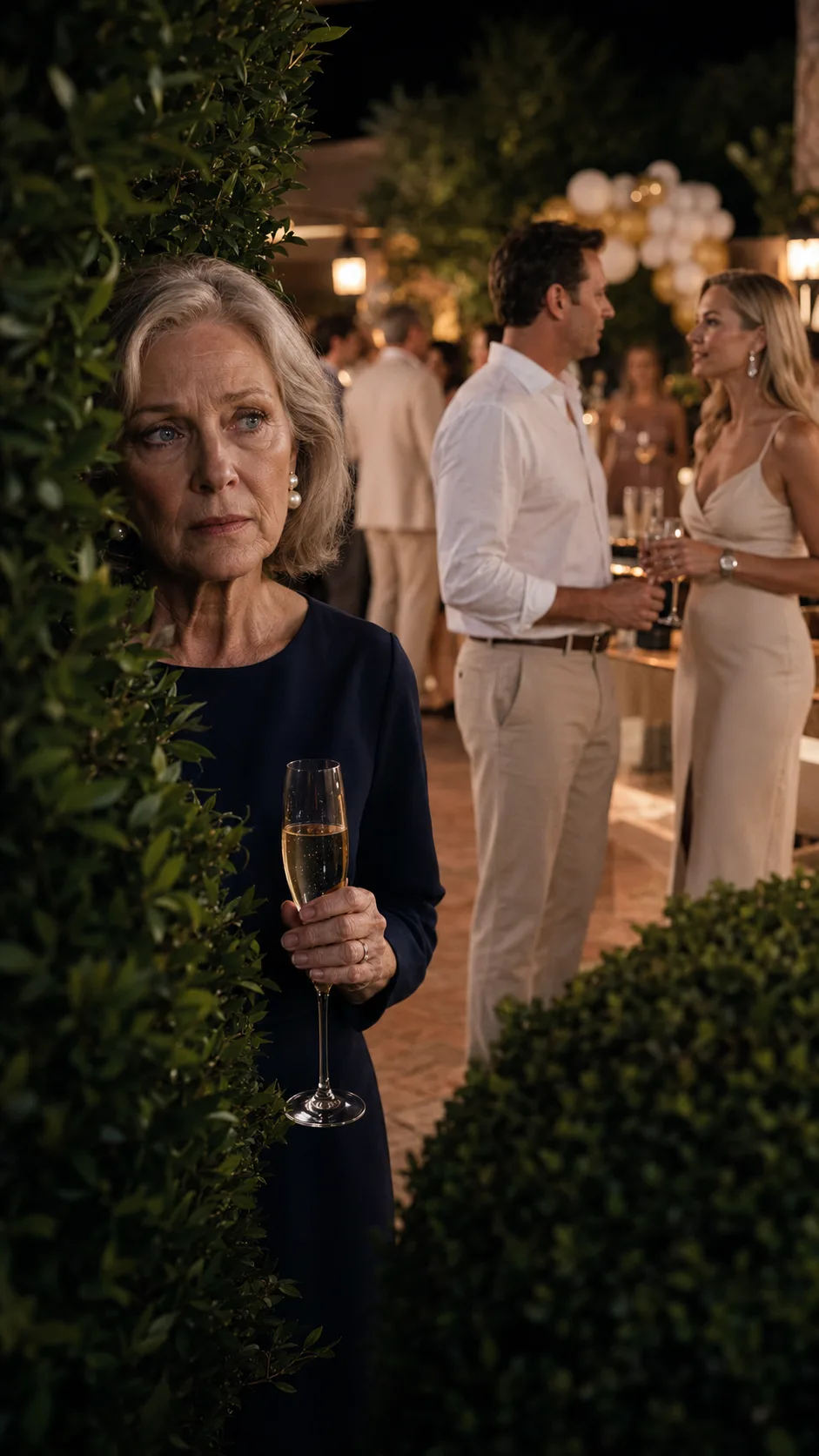
I thought about the woman I had been at John’s party, standing behind balloons with an untouched glass of champagne, hearing that she did not matter.
I wanted to reach back through time and take her hand.
Not to warn her.
To thank her for leaving quietly.
Sometimes the most powerful thing a woman can do is not raise her voice.
Sometimes she sets down the glass, walks out the door, and lets the paperwork speak in a language everyone suddenly understands.
If this story found you at the right time, maybe it is worth asking who has been calling your silence peace, who has been calling your generosity duty, and who only noticed your heart after you moved the money away from it.
Because love does not need an inheritance to prove itself.
Entitlement always does.
THE END.
Chapter complete
You have reached the end of this chapter.
Continue reading
A few more worlds to get lost in after this chapter.




