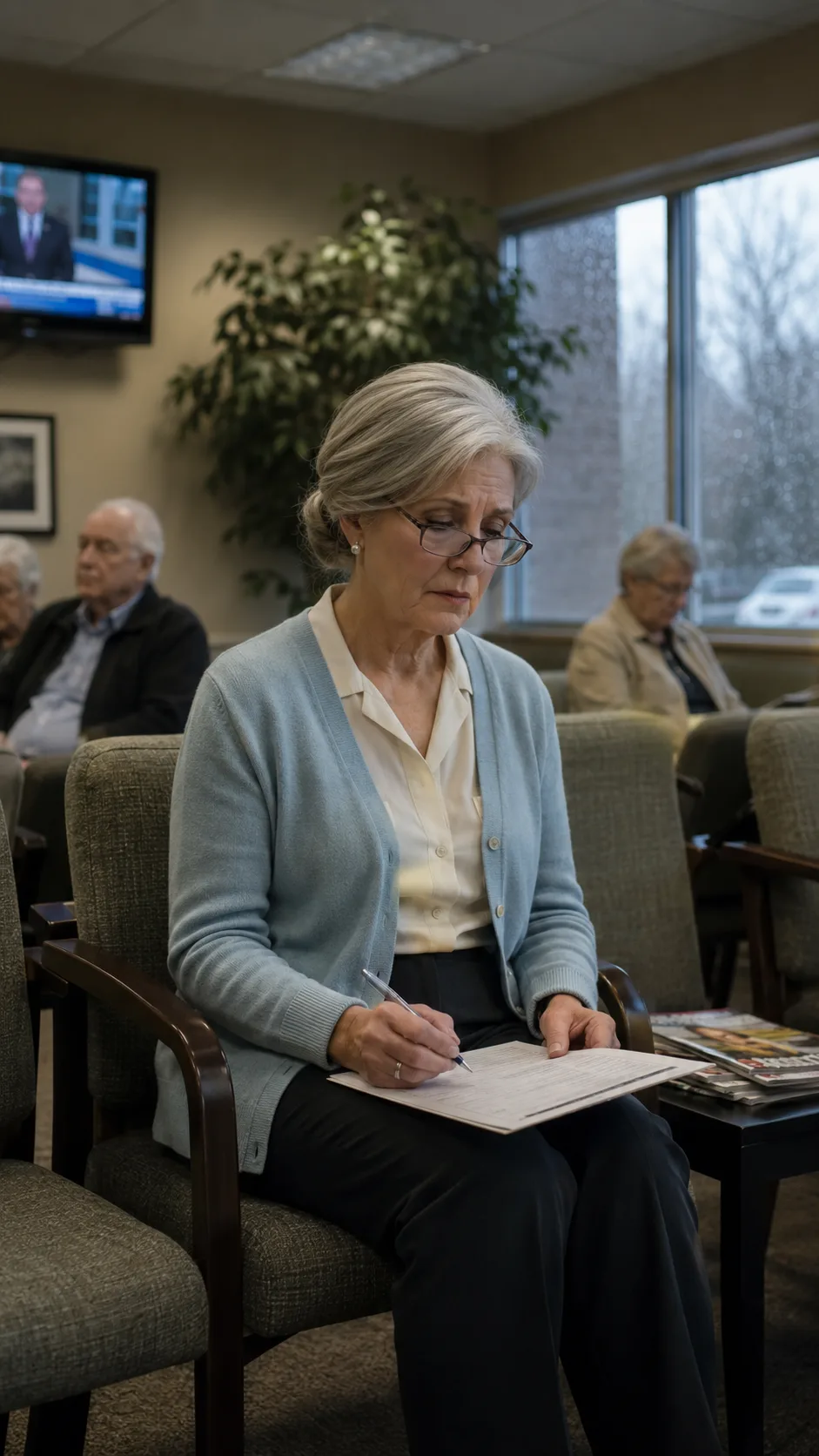
PART 2 — THE REALTOR TEXT AND THE SECRET PROTECTION
The house conversation did not end with that phone call.
Chapter 2
PART 2 — THE REALTOR TEXT AND THE SECRET PROTECTION
The house conversation did not end with that phone call.
It escalated the way these things do, with everyone pretending it had not escalated.
Three weeks later, Leonard came home for what he called “just a visit.”
Gwen did not come. She had a work thing, he said. A client retreat. Or a leadership summit. Something with a name that sounded expensive and vague.
Looking back, I wonder if she sent him ahead to test the water.
He arrived on a Friday afternoon in a rented SUV, wearing a wool coat I had never seen before and shoes too polished for the rain. I watched him through the front window as he stood in the driveway and looked at the house.
Not like a son coming home.
Like a person assessing property.
Maybe I imagined that.
Maybe I did not.
When I opened the door, he hugged me hard enough to prove something.
“Hey, Mom.”
“Hey, sweetheart.”
He smelled like
airport coffee and expensive laundry detergent.
For a few hours, everything was almost normal. He carried his bag upstairs to his old room, though I had turned it into a sewing room years ago. He laughed at the faded baseball trophies still boxed in the closet. He opened the refrigerator and said, “You still buy that orange marmalade?” as if marmalade were a family heirloom.
I made coffee.
He fixed the Wi-Fi on my printer.
We stood in the kitchen, and if I held the moment at the right angle, I could see the boy he had been.
At dinner, he took me to the Italian place on Clement Street, the one we used to go to when he was in high school after soccer games. It had red vinyl booths, framed black-and-white photos of Rome, and the same owner, though his hair had gone from black to silver. Raymond
used to say the garlic bread there could solve most ordinary sadness.
Leonard ordered the chicken marsala, which is what he always orders.
I found that comforting in a strange way. Some things about your children stay fixed even when everything else changes. They still avoid mushrooms unless hidden in sauce. They still tap their fingers when anxious. They still order the same thing from the same restaurant because some part of them wants the world to hold still.
I had the linguine.
We talked about regular things for most of the meal.
His job. Chicago winters. The train system. The price of parking. My library patrons. Curtis across the street. Marlene’s suspicious soup. The new gutters. The fact that the bakery downtown had changed owners and now put too much frosting on everything.
Then coffee came.
The waiter set down two white cups and a little metal pitcher of
cream. Leonard wrapped both hands around his cup, though he did not drink.
“Mom,” he said, “I want to talk about the future.”
I looked at him over the rim of my cup.
“All right.”
He had rehearsed it.
That was obvious from the structure.
There was a problem statement, a list of concerns, a proposed solution. Gwen had probably helped him. I could almost see her bullet points hovering over the table between us.
He talked about the square footage of the house versus my needs.
He talked about deferred maintenance costs.
He talked about “safety considerations” and “long-term planning.”
He mentioned the stairs twice.
He mentioned the roof three times.
He used the phrase “sitting on equity” twice, which I do not believe had ever come naturally out of his mouth before Gwen entered his life.
“The market is strong right now,” he said. “Really strong. And you have to think about liquidity.”
I took a slow sip of coffee.
It was bitter.
“Liquidity,” I repeated.
He looked embarrassed for half a second, then recovered.
“I just mean the house is an asset.”
“It is also my home.”
“Of course.”
He said it quickly. Too quickly.
“No one is saying it isn’t.”
“No one?”
He looked down.
There was a family at the next table celebrating a birthday. A little girl with braids was trying to blow out one candle while her grandfather filmed on his phone. The whole restaurant smelled like garlic, tomato sauce, and rain-damp wool.
Leonard leaned forward.
“I don’t want you to feel attacked.”
“Then you may want to stop approaching me as if I’m a problem to solve.”
His jaw tightened.
That was the first real reaction I had seen from him all night.
“I’m trying to help.”
“Are you?”
“Mom.”
“Leonard,” I said, “who gets the money if the house sells?”
He shifted in the booth.
“It would go into an account for you.”
“Managed by whom?”
“We’d help you.”
“Managed by whom, sweetheart?”
He did not answer directly.
He said something about simplifying my life.
He said something about not wanting me overwhelmed.
He said Gwen had experience with financial planning, which I doubted in the way one doubts a bridge made of cardboard.
I looked at him across the table.
This person I had pushed into the world. This child I had nursed through pneumonia twice. This boy I had driven to every soccer practice for six years, even the ones across town in rain so heavy the wipers could barely keep up. This man whose father had died too young, leaving us both in a kitchen full of casseroles and condolence cards, trying to remember how to breathe.
And I felt something I had not expected to feel.
Not anger.
Not hurt.
Clarity.
It arrived quietly, without drama, and it did not leave.
I folded my napkin.
“Let’s get the check.”
He looked startled.
“We don’t have to stop talking.”
“Yes,” I said. “We do.”
“Mom—”
“Tonight, we do.”
The waiter came by, and Leonard asked for the check with a strained smile. He paid, because he had invited me, and because some rituals survive even when the relationship underneath them is shifting.
On the drive home, he talked too much.
About traffic.
About a podcast.
About a colleague who had bought a townhouse.
I watched the wet streets shine under the headlights and said very little.
When we reached the house, he parked in the driveway but did not turn off the engine immediately.
“Gwen really does care,” he said.
I looked at him.
“About what?”
He opened his mouth.
Closed it.
Turned off the car.
What Leonard did not know, what neither of them knew, was that eighteen months before any of this, I had a conversation with my friend Bertrice.
Bertrice and I have been friends since our children were in the same kindergarten class, which was a very long time ago, though both of us refuse to say exactly how long unless wine is involved.
Her full name is Bertrice Langford, and yes, she spells it that way. She says her mother wanted her to be memorable and succeeded before Bertrice had even learned to walk.
She is practical in a way I admire enormously.
After her husband left her for a younger colleague in the mid-nineties, Bertrice became the kind of woman who reads legal documents before signing them, knows exactly what is in every account, and can identify nonsense within three seconds of hearing it. She calls that period of her life her “never again education.”
She had earned every credit.
About a year and a half before Leonard came home for that dinner, Bertrice and I were sitting in my kitchen having coffee. It was October. The apple tree had dropped its last tired fruit, and the maple leaves along the curb had gone yellow at the edges. I had made cinnamon toast because Bertrice believes any conversation worth having should include butter.
I told her about a story I had read in the newspaper.
An elderly woman in Ohio had given her son power of attorney while recovering from surgery. She thought it was temporary. She thought it was protective. She thought love and paperwork were pointing in the same direction.
They were not.
By the time she understood what was happening, her accounts had been emptied slowly enough that no one had noticed in time. The article had stayed with me. Not because Leonard had ever given me a reason to imagine such a thing, but because the woman in the story had not expected it either. That was the part that unsettled me.
Bertrice set her mug down.
“Have you set yours up?” she asked.
“Set what up?”
“Your protection.”
I laughed a little because the word sounded dramatic.
“My what?”
“Your structures,” she said. “Who has access to what. Who can sign what. Who makes decisions if you can’t. What happens to the house. What happens to your accounts. Who knows where the papers are.”
I looked at her.
“I have a will.”
“When was it updated?”
I stirred my coffee though there was nothing in it.
“Two thousand nine.”
Bertrice closed her eyes briefly, as if asking the Lord for patience.
“Loretta.”
“What?”
“Raymond was alive in two thousand nine.”
“Yes.”
“And has anything significant happened since then?”
I looked toward the back window, where Raymond’s apple tree stood in the gray light.
“That is a rude way to make a point.”
“It is an effective way to make a point.”
Raymond and I had made those wills in 2009 after a neighbor had a stroke at fifty-eight. We were responsible people. We signed where the attorney told us to sign, put the copies in a folder, and placed the folder in the filing cabinet under “Important.” Then life moved on. Raymond got sick. Raymond died. Grief took up all the space practical thinking should have occupied.
I had a vague sense that things would sort themselves out.
Bertrice identified that immediately as the kind of thinking that ends badly.
“Things do not sort themselves out,” she said. “People sort them. And sometimes the wrong people get there first.”
“I don’t want to think that way about Leonard.”
“I’m not asking you to think badly about Leonard. I’m asking you to think clearly about yourself.”
That sentence annoyed me.
Then it stayed with me.
Two days later, Bertrice drove me to her estate attorney herself.
His name was Edmund Voss, and his office was on the second floor of a brick building downtown, above a boutique that sold candles for prices I considered emotionally irresponsible. Edmund had silver glasses, careful hands, and the calm expression of a man who had spent decades watching families become very honest when money entered the room.
Bertrice sat in the waiting room while I met with him.
She brought a paperback and a travel mug because Bertrice comes prepared for other people’s life decisions.
The meeting was not dramatic.
That surprised me.
I think part of me expected estate planning to feel like a thunderstorm, like I would be forced to imagine terrible things in great detail. Instead, Edmund asked questions in a practical, orderly voice.
What property did I own?
Whose name was on the deed?
What accounts did I maintain?
Who did I trust?
Who did I trust under pressure?
Did I want Leonard to inherit eventually?
Did I want him making financial decisions for me now?
Did I understand the difference?
That last question mattered.
It made me sit back.
Because of course I loved my son.
Of course I wanted him to be provided for someday. He was my only child. Raymond and I had always assumed the house, or the value of it, would eventually pass to him in some form. That was not the same thing as handing him control while I was alive, capable, and still very much living in the rooms my life had built.
Love and access are not the same thing.
Edmund did not say it that way.
I did.
In my own head.
By the time I left his office, we had a plan.
Not because I was afraid.
Because I was awake.
On the way home, Bertrice glanced at me from the driver’s seat.
“You feel better?”
“I feel like I’ve been to the dentist,” I said, “but in a good way.”
She laughed so hard she nearly missed the turn.
Over the next several weeks, I gathered documents. Deed. Account statements. Insurance papers. Raymond’s death certificate. Old wills. New forms. Beneficiary designations. Names. Dates. Copies. Signatures.
It was tedious.
It was also strangely comforting.
There is a dignity in knowing where things are.
By the time Gwen made that first phone call from Chicago, the house was in a revocable living trust.
My name on it.
My terms.
My trustee.
Bertrice, who had agreed with considerable enthusiasm and said she had been waiting her whole life for someone to give her a legally appropriate reason to be formidable.
The house could not be sold without my explicit written consent and the approval of my trustee.
Any realtor Gwen had spoken to would discover that the moment a proper title search began.
There was also a durable power of attorney, properly structured so that no one could simply step in and manage my finances without my agreement. It had safeguards. It had limits. It had language Edmund had explained twice because I asked him to, and because he respected the fact that I wanted to understand every sentence.
And there was a letter.
Not a legal document.
Just a letter.
I had written it at my kitchen table on a rainy Sunday afternoon, with Raymond’s old fountain pen because it made me feel steadier. I addressed it to Leonard. Edmund held a copy. Bertrice knew about it. The letter explained what I had arranged and why. It named what I feared could happen, not because I expected it, but because pretending possibilities do not exist is not the same as preventing them.
I had not expected to need any of it.
I had not expected not to need it either.
That is the strange middle ground of protection.
You build the fence before you know whether anyone will lean on it.
About a month after the dinner at the Italian restaurant, I got a text from a number I did not recognize.
A local number, which was odd.
I was in the laundry room folding towels warm from the dryer. Rain tapped lightly against the little window above the washing machine. The house smelled like lemon detergent and old wood.
The message read:
Hi, Loretta. This is Steven Farr. I’m a realtor with Pacific Coast Properties. I understand you may be considering listing your home. Happy to chat anytime.
I read it once.
Then again.
I understand you may be considering.
May be.
Considering.
I sat on the edge of the laundry basket.
There are moments when anger arrives like fire. This was not one of them. This was colder. Cleaner. Like opening a door and realizing the temperature has dropped.
I took a screenshot.
Then I called Bertrice.
She answered on the second ring.
“What happened?”
That is how you know someone knows you well. They do not say hello. They hear your silence and prepare for weather.
“They gave a realtor my number.”
“What?”
I read her the text.
“Without asking you?”
“Yes.”
She was quiet for a moment.
Then she said, “Do you want me to call Edmund?”
“Not yet.”
“Loretta.”
“I know.”
“Do you?”
“Yes.”
Another pause.
“I want to talk to Leonard first,” I said.
“Loretta.”
“He’s my son.”
Bertrice did not push.
She is good that way. She will push a person toward a lawyer, a bank, or a hard truth with the force of a snowplow, but once you say you need one conversation for your own heart, she knows enough to step back.
“All right,” she said. “But call me afterward.”
“I will.”
“And do not let them make this sound like a misunderstanding.”
I looked at the text again.
“No,” I said. “I won’t.”
That evening, I waited until seven-thirty to call.
I did that on purpose. Not during work hours. Not during dinner, assuming Chicago dinner had not become something scheduled through an app. I wanted Leonard to have no excuse not to answer.
Gwen answered.
Which she had started doing.
Which I noted.
“Hi, Loretta,” she said.
There was surprise in her voice, but not enough.
“I’d like to speak to Leonard.”
“Oh. Sure. One second.”
Not “of course.”
Not “let me get him.”
Just “sure,” clipped and careful.
There was movement, muffled talking, a sound like a cabinet closing.
Then Leonard came on.
“Hey, Mom.”
He immediately started talking about something else. A trip they were thinking about taking in June. A restaurant they had tried with small plates and apparently large prices. Something funny a colleague had said.
I let him go for a minute or two.
It is useful sometimes to let a person show you how hard they are trying not to stand in the room they built.
Then I said, “Leonard, did you give a realtor my phone number?”
Silence.
His name came out of my mouth before he could gather an excuse.
“Steven Farr. He texted me this morning.”
“Mom, we just—”
“Did you give him my number?”
“Gwen thought it might be easier if—”
“Leonard.”
I said his name the way I had said it when he was small and about to touch a hot stove.
Not loud.
Final.
I stood in the living room beside Raymond’s old leather chair. The one in the corner near the window. I had never recovered it, never replaced it, never even moved it, though one arm was cracked and the cushion leaned slightly to the left. Raymond had read there every Sunday afternoon. He had watched football there. He had fallen asleep there with Leonard as a baby on his chest.
Outside, the rose bush was just beginning to show new growth along the fence.
“I need you to listen to me very carefully,” I said, “because I’m going to say this once, and I want you to understand it.”
He did not speak.
“The house is in a trust. It has been for over a year. It cannot be sold without my consent and my trustee’s approval. I don’t know exactly what you and Gwen have been planning, but whatever it is, it isn’t possible. Not legally. Not in any way.”
The silence that followed was different from the others.
Earlier silences had been evasive. This one was empty.
Shocked empty.
“What do you mean it’s in a trust?” he asked.
“It means I planned ahead. It means I saw a good attorney. It means the house is mine, secured, and has been this entire time.”
I could hear him breathing.
I could hear Gwen in the background asking something. Her voice had that quick, efficient clip she used when events were not proceeding according to schedule.
Leonard covered the phone badly.
I heard my name.
Then his.
Then Gwen saying something sharp.
He came back.
“Why didn’t you tell me?”
There it was.
To be continued, Part 3 now.
Chapter complete
You have reached the end of this chapter.
Continue reading
A few more worlds to get lost in after this chapter.




