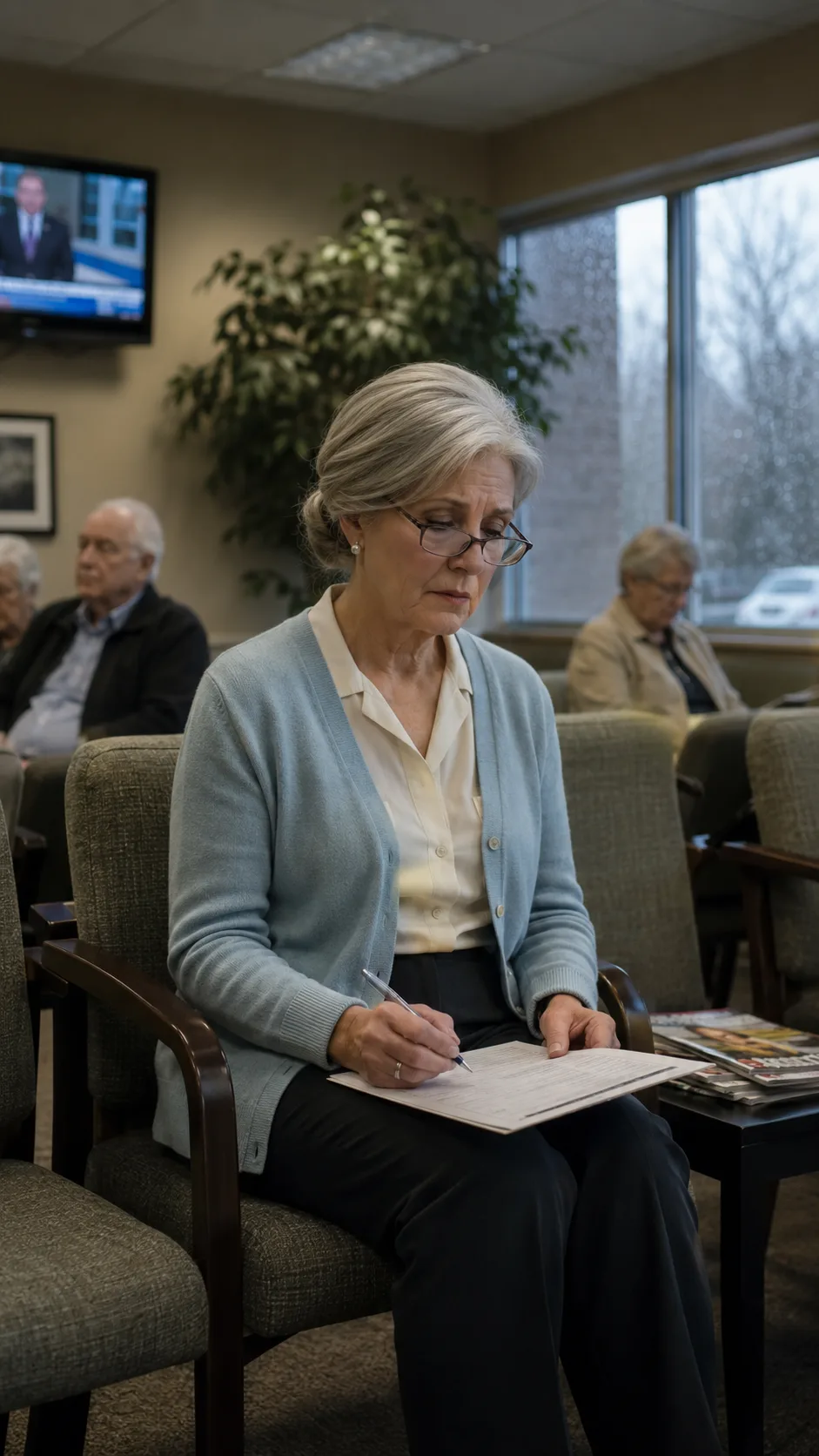
handled politely.
“Hi, Gwen,” I said.
Her voice came through bright and smooth, with that clean corporate cheer she used when she wanted to make unpleasant things sound like well-organized opportunities.
“I wanted to let you know that Leonard and I have been talking,” she said, “and we’ve made some decisions about your situation.”
My situation.
I remember that phrase with unusual clarity because I had to set the pen down on the plastic chair beside me. I placed it carefully, as if the movement mattered, as if a pen falling to the floor might embarrass me more than the call already had.
Across from me, an elderly man in a navy windbreaker was doing a word search puzzle. He had a stainless-steel thermos of coffee balanced beside his shoe. He seemed very content, circling words with slow confidence.
I breathed in the way my doctor had told me to breathe. Slowly through the nose. Hold. Slowly out.
“What decisions?” I asked.
“Well,” Gwen said, “you’re alone down there.”
Down there.
As if I were not in my own home, my own town, my own life, but some inconvenient location on a map.
“The house is too big for one person, honestly. And Leonard feels, we both feel, that it makes more sense financially for you to be somewhere smaller. An apartment maybe, or one of those senior communities.”
I looked at the intake form on my lap.
Have you experienced dizziness?
I thought that was an interesting question.
“There’s a lovely one near us, actually,” Gwen continued, “in Schaumburg. We already looked at it online.”
We.
Already.
Online.
The word “lovely” did not help.
“And the house?” I asked.
The pause that followed was very small, but it contained a whole room full of things nobody had asked my permission to move.
“We spoke to a realtor just to get a number,” she said. “You’d be surprised what it would sell for in this market.”
I looked at the elderly man with the word search. He had found something diagonal and was smiling to himself. I remember envying him, which sounds silly now, but it is true. He had a puzzle with answers hidden inside it. I had a phone pressed to my ear and a daughter-in-law calmly telling me that she and my son had begun planning the sale of my home.
“I see,” I said.
Gwen heard those two words and mistook them for softness.
“Leonard thinks it would give you some financial security,” she said. “The proceeds could go into an account, and we could help manage—”
“Is my son there?”
This time the pause was longer.
There was a rustling sound, a muffled word, the faint scrape of the phone changing hands.
Then Leonard’s voice came through, distant and reluctant.
“Hey, Mom.”
Hey.
Casual. Thin. Like we were discussing whether he should pick up milk.
“Leonard,” I said carefully, “did you ask a realtor to look at my house?”
“We just wanted to know the value,” he said. “It’s not a big deal.”
“It’s my house, sweetheart.”
“I know, Mom. I know. But you’re sixty-three. You live alone. You’ve had two cardiac events in four years. The house has stairs. It needs a new roof. And Gwen and I just think—”
“One was a false alarm,” I said, “and the other was a minor arrhythmia.”
“I’m not saying you can’t take care of yourself.”
“Then what are you saying?”
He exhaled.
I could picture him exactly. Leonard had a way of rubbing the bridge of his nose when conversations became difficult. He had done it as a teenager when Raymond caught him sneaking in after curfew. He had done it at twenty-three when he called to say he had dented the side of his father’s truck. He was probably doing it now, in whatever clean Chicago kitchen Gwen had decorated in whites and grays.
“I’m saying we need to be realistic.”
There it was.
Realistic.
A word people use when they want their desire to sound like math.
“Leonard,” I said.
I kept my voice very even.
I had learned to do that a long time ago. His father taught me, actually, back when Leonard was sixteen and could turn any minor household rule into a courtroom argument. Raymond used to stand in the kitchen doorway with his arms folded and say, “The calmer you sound, the more frightened they get.”
He was joking.
Mostly.
“We’ll talk about this,” I said, “when I’m not sitting in a waiting room.”
“All right,” Leonard said.
He sounded relieved, which told me he had expected worse.
“Okay.”
Gwen came back on the line and said something cheerful about Schaumburg having excellent restaurants.
I hung up.
I did not say goodbye. I did not throw the phone. I did not make a scene. I simply pressed the red button, placed the phone face down on the chair beside me, and looked at the blank line on the medical form asking for my emergency contact.
For the first time in my life, I did not immediately write Leonard’s name.
The nurse called me twenty minutes later.
“Loretta Whitman?”
I stood too quickly and had to gather myself before walking through the door. The nurse wore blue scrubs with tiny white flowers on them and had the brisk kindness of someone who had seen hundreds of people try to pretend they were calmer than they were.
She took my blood pressure.
She looked at the number.
Then she took it again.
“Rough morning?” she asked.
“You could say that.”
When the doctor came in, he was carrying my chart and half a cup of coffee. Dr. Patel had been my cardiologist for four years. He was younger than I wanted him to be when I first met him, but he had steady hands and a habit of listening all the way to the end of a sentence. That matters in a doctor.
“How are we doing today?” he asked.
I looked at him.
“My daughter-in-law just told me she looked into selling my house without asking me.”
He blinked.
“What did you say?”
“I said we’d talk later,” I told him. “But I needed to tell someone or I was going to explode, and you seem like a reasonable person.”
He stared at me for one more second, then laughed.
Not at me.
With me.
It was the first easy sound I had heard all morning, and I needed it more than I would have admitted.
“I’m honored to be considered reasonable,” he said.
“You should put it on your business cards.”
“I’ll think about it.”
He checked my heart, adjusted one medication, told me the tightness sounded stress-related but that we would not be careless with it. He gave me the same practical advice he always gave me. Hydrate. Walk. Sleep. Call if symptoms changed.
No doctor ever says, “Your daughter-in-law may be trying to reorganize your life for her convenience, so please avoid sudden betrayals.”
Medical science has limits.
By the time I drove home, the rain had stopped.
The streets shone under a thin, silver light. I passed the grocery store where I still bought peaches every summer even though they were never as good as the ones from the farmers’ market. I passed the elementary school where Leonard had once stood in a paper pilgrim hat for a Thanksgiving program, singing loudly and off-key while Raymond recorded the whole thing with a camcorder the size of a toaster.
The world outside my windshield looked exactly the same, which felt rude.
I turned onto Maple Ridge Lane and slowed, the way I always did, just before my driveway.
The house sat there under the wet branches of the sycamore tree, two stories of pale blue siding with white trim, the porch rail freshly painted last spring, the gutters new and still a little too shiny. There were black-eyed Susans asleep under the mulch, a rose bush along the fence that had never understood moderation, and a small apple tree in the side yard that gave exactly enough apples each fall for two pies.
The house was not grand.
It was not the kind of house that made strangers slow down.
But Raymond and I had bought it in 1987, and in the private language of a marriage, it meant almost everything.
It was not beautiful when we got it.
The previous owners had painted every room a different color, and not in a charming way. The kitchen was yellow. The hallway was peach. One bedroom was a shade of blue so cold it made you feel like you had been scolded. And the downstairs bathroom was entirely forest green.
Entirely.
Ceiling, floor, cabinet doors, trim, towel rack. Even the toilet seat had been covered with something fuzzy and green that I still refuse to describe in detail.
Raymond stood in that bathroom on the day of the walkthrough, hands on his hips, and said, “Well, at least they committed.”
That was Raymond.
He could find humor in anything, including bad plumbing, tax forms, airport delays, and once, memorably, a Thanksgiving turkey that refused to thaw.
We spent the next thirty years making that house ours.
We painted the rooms one by one, always arguing about colors and always ending up with something neither of us had chosen at first. We redid the kitchen in 1999 after saving for two years. Raymond insisted he could install the backsplash himself. He could not. The tiles leaned subtly to the right, and for years he claimed it was an artistic choice.
The back porch was his greatest defeat.
He built it himself one summer with great confidence and many trips to Home Depot. By September, the railing wobbled, one step dipped in the middle, and the whole thing made a suspicious groaning sound whenever more than two people stood on it. We hired someone to fix it the following year.
Raymond never fully recovered from that.
Emotionally, I mean.
He would sit out there with his coffee and say, “A lesser woman would have let her husband keep his dignity.”
I would say, “A wiser husband would have built a porch people could stand on.”
He would grin and kiss the top of my head.
That was marriage, at least our version of it. Repairs and jokes. Bills and burnt dinners. Arguments over thermostat settings. A child’s sneakers in the hallway. A mortgage payment mailed on time. A garden planted because you wanted something to look better next year than it did this year.
Raymond died six years ago.
Pancreatic cancer.
Fast, hard, and final in the way that illness so often is. He was sixty-one. We had been married thirty-four years, which sounds like a long time until it is over, and then it feels impossibly brief, like a song cut off before the last chorus.
Leonard was twenty-nine when his father died.
He flew home immediately.
He stayed three weeks.
I do not want to forget that part, and I do not want anyone else to forget it either. Leonard was wonderful then. He helped me clean out Raymond’s closet, though both of us cried over a pair of old work boots as if they were a person. He handled calls from the insurance company when I could not bear one more menu of recorded options. He brought me tea I did not drink. He sat on the kitchen floor with me at two in the morning because grief had made chairs seem too formal.
He was my son.
He was wonderful.
Then he went back to his life, and I went back to mine.
That is how it should be.
I do not say that bitterly.
Children grow up. They leave. They build rooms you do not enter unless invited. If you have done your job well, they do not need you the way they used to. There is pride in that, even when it aches.
I had my neighbors.
I had my book club.
I had my part-time work at the library two days a week, mostly helping people find books, fix printer settings, and understand why their password could not be “password.” I had Curtis across the street, a retired postal worker who knew everyone’s trash day and said very little unless it was worth saying. I had Marlene next door, who watered my plants when I visited Leonard and once brought me soup in a container labeled “not spicy,” which turned out to be a lie.
I was not a woman who sat by the window waiting for her child to call.
But I will say this.
Somewhere between Raymond dying and Leonard meeting Gwen at a work conference in Atlanta, something shifted quietly.
Not all at once.
Not dramatically.
More like water changing direction underground. You do not know it has happened until one day you look up and the creek is not where it used to be.
Gwen was not a bad person.
I want to be fair about that, because unfairness makes a story easier and less true.
She was efficient. Ambitious. Beautiful in a sharp, well-lit way. She had glossy brown-blonde hair, excellent posture, and the kind of wardrobe that made it look as if she had never once left clean laundry in a basket for three days. She worked in corporate consulting, which Leonard explained to me twice and which I understood only in the broadest sense. She helped companies make decisions faster, he said.
That sounded right.
Gwen was very good at decisions.
She organized trips, dinners, conversations, holiday menus, flight times, seating charts, restaurant reservations, and eventually Leonard.
His diet.
His wardrobe.
His sleep schedule.
His career trajectory.
His holiday availability.
He seemed happy. He told me he was happy. I believed him, mostly.
Still, I noticed things.
A mother notices changes in the weather long before anyone else sees the storm.
When Leonard and I talked on the phone, there was often a slight pause before he answered certain questions. Not all questions. If I asked about work, he answered quickly. If I asked whether he was tired, quickly. If I asked when he might come home for a visit, there was a pause.
Not hesitation exactly.
More like he was checking something.
Or waiting for a signal.
If Gwen was in the room, I could always tell. The air around his voice changed.
I did not say anything.
You do not say anything at first. You wait. You tell yourself marriage is private, because it is. You tell yourself every couple has a rhythm, because they do. You tell yourself your son is a grown man, because he is.
And then your daughter-in-law calls you at the cardiologist’s office to say she has spoken to a realtor about your house.
To be continued, Part 2 now.