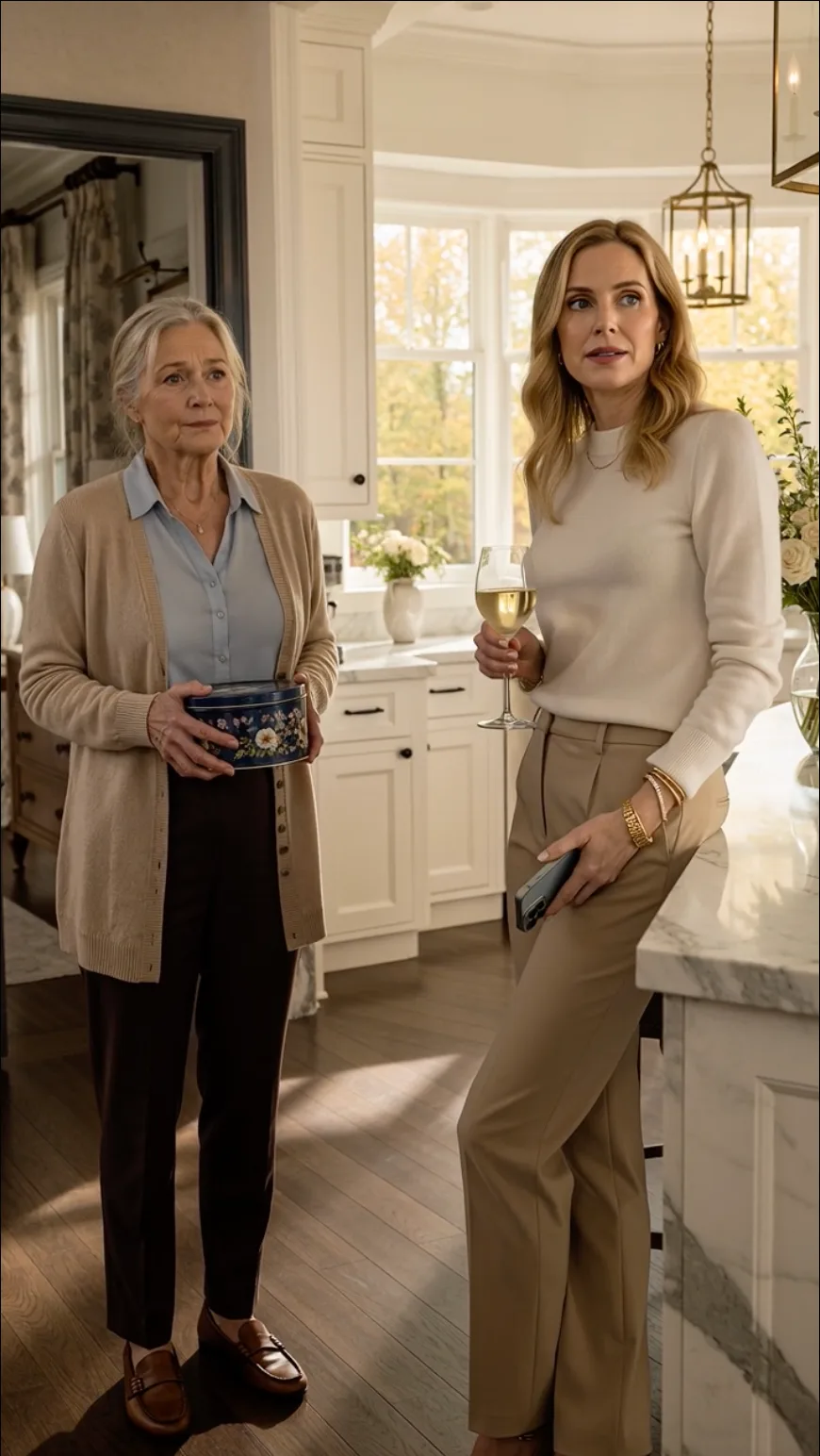
PART 3: THE TRUTH ABOUT THE HOUSE CHANGED OUR FAMILY FOREVER
“No, sweetheart.
Chapter 3
PART 3: THE TRUTH ABOUT THE HOUSE CHANGED OUR FAMILY FOREVER
“No, sweetheart.
It isn’t a joke.”
“I don’t understand.”
“I know.”
“What does that mean, you own the house?”
“It means exactly what the letter says.”
Another pause.
Then, in a voice I had not heard since he was very young, he said, “Why?”
So I told him.
I told him about the trust, about the purchase, about the paperwork he had signed, about the account in his name. I told him every payment he had made had been saved and invested for him. I told him that $312,000 and change had been released to him that morning and was his to use as he pleased.
He said nothing.
I told him about the Westport house, the one I had never sold. I told him about my salary, which had been about $48,000 a month at the height of my work and was now closer to $31,000 because I had stepped back
into part-time advisory work. I told him about the investments, the trusts, the careful planning Charles and I had done while Tobias was busy building his own life and thinking his mother was getting by on savings and Social Security.
I told him about the trust I had set up for his future children, years before there were any children, before he and Felicity had spent two hard years trying and failing and not saying much about it at dinner.
The silence after that was different.
Not confused.
Hurt.
“Why didn’t you tell me?” he asked.
“Because I wanted to know that you loved me without it.”
The answer came out more plainly than I intended.
Tobias inhaled sharply.
“I love you without it, Mom.”
“I know you do.”
“Do you?”
“Yes,” I said. “I do.”
“Then why are you taking the house?”
There it was.
The question underneath every
other question.
I looked out at the maple trees. A man in a dark jacket walked a small white dog along the sidewalk below. Ordinary life continued, rude and merciful.
“Tobias,” I said, “ten days ago, I came home from coffee and walked in through the side door. Felicity was on the phone with her sister. She did not know I was there.”
He said nothing.
“I want to tell you exactly what she said. I want you to hear it from me. Will you let me?”
His voice was strained.
“Yes.”
So I told him.
Word for word, as best as I could remember.
The barnacle.
The facility.
The old folks’ home.
The old beggar.
The nursery.
The throw her out.
I spoke calmly because I had practiced it in the mirror that morning. I had stood in the hotel bathroom with both hands gripping the sink and made
myself say the words without breaking. Not because I was proud. Because I did not want my son’s first response to be to comfort me.
I wanted him to hear what had been said.
Not the wound.
The fact.
When I finished, Tobias was crying.
Not loudly.
I could hear him trying not to.
“Mom,” he said. “Mom, I’m so sorry. I’m so sorry I didn’t—”
“I know you didn’t.”
“I should have seen it.”
“Yes,” I said softly. “You should have.”
That silence hurt him. I let it.
“I’m going to talk to her,” he said. “I’m going to fix this. Mom, please don’t do this. Don’t take the house. Give me a chance to make it right.”
“Sweetheart,” I said, “I love you. But this is not a thing where I take the house because I’m angry.”
“Then what is it?”
“It is a thing where I take the house because I have watched for three years while your wife treated me like I was something she had stepped in. And I have watched you not see it. And I have decided I am not going to spend the last good years of my life paying indignity for the comfort of a woman who resents me.”
He was breathing hard.
“The house is mine,” I said. “It has always been mine. I am going to live in it, or sell it, or do whatever I decide to do with it. You have thirty days. The money in the account is yours. You can use it as a down payment on a place that belongs to you and your wife, free and clear, in whatever neighborhood you want.”
“Mom.”
“I am not leaving you with nothing, Tobias. I would never do that. But I am also not leaving myself with nothing just so Felicity can continue believing she is generous.”
He cried then.
Fully.
My son, forty-three years old, crying into the phone while I sat in a hotel room and watched leaves move against glass.
“Will you talk to me?” he asked at last. “Will you let me come see you?”
“Of course,” I said. “I’m your mother.”
He came that night.
Alone.
He walked into the hotel restaurant wearing the same gray coat he had worn for years, his hair damp from rain, his face pale in that overhead light restaurants insist is flattering to no one.
When he saw me, he stopped for half a second.
Then he came to the table and bent down and wrapped his arms around me.
I felt him shake.
I put one hand on the back of his head.
For a moment, he was seven again, sobbing because he had dropped his model airplane down the basement stairs. For a moment, I was young enough to fix everything with glue.
But I was not young.
And this was not a toy.
He sat across from me and held my hands over the white tablecloth. The waiter came, saw his face, and very kindly pretended not to notice.
Tobias asked questions. Many of them. Some practical. Some wounded.
“How could I not know?”
“Because you weren’t looking.”
“How could she say that?”
“Because she believed it.”
“Do you hate her?”
“No.”
That answer surprised him.
I think it surprised me too.
“I don’t hate her,” I said. “But I will not be at her mercy.”
He looked down.
“I’m going to leave her.”
“No.”
His head snapped up.
“Mom—”
“Not tonight,” I said. “Not because of this. Not in a hot moment.”
“She called you—”
“I know what she called me. I was there.”
His eyes filled again.
I squeezed his hands.
“Go home,” I told him. “Talk to your wife. Listen to what she says when she cannot pretend. Listen carefully. Then make a real decision. The kind you make when your blood is cool.”
He stared at me for a long time.
“Whatever I decide?”
“Whatever you decide,” I said, “I will support you. But I will not move back into that guest room.”
He nodded.
He understood that much.
He went home.
I do not know exactly what was said in that house that night.
I know only what came afterward.
At 1:14 in the morning, my phone rang.
Felicity.
I had been awake. Of course I had. The hotel room was too quiet, the pillow too high, the air conditioner too loud. I had been lying there with my hands folded on my stomach, listening to Hartford traffic pass in soft waves below the window.
I answered.
She did not say hello.
She was upset, and her voice came through sharp and shaking. She called me manipulative. She called me a liar. She called me several other things I will not repeat because they added nothing to the argument except volume.
She said I had ruined her marriage.
She said I had ruined her life.
She said I had always hated her, that I had been waiting for a chance to humiliate her, that all my quietness had been an act.
I let her talk.
Sometimes the most powerful thing you can do with someone determined to accuse you is give them enough room to hear themselves.
When she finally ran out of breath, I said, “Felicity, I have one question for you.”
She made a sound somewhere between a laugh and a sob.
“What?”
“If you had known three years ago that I was wealthy, would you have called me an old beggar on the phone with your sister?”
Silence.
Not a dropped call.
Not confusion.
Silence.
“I’ll take that as a no,” I said. “Good night, dear.”
Then I hung up.
She did not call again.
A week later, Tobias met me at the Westport house.
The tenants had moved out two days earlier. I had paid their moving stipend myself and sent a handwritten note thanking them for caring for the place. The house was cold when I opened the door. Not unfriendly, just sleeping.
It smelled faintly of dust, lemon oil, and the closed-up sweetness of rooms waiting for their people to come home.
The dish towels Charles had bought from a market in Vermont were still folded in the third drawer down, exactly where I had left them three years before. When I opened that drawer, I had to grip the handle until the wave passed.
Tobias arrived with red eyes and a canvas duffel bag slung over one shoulder.
He looked around the kitchen.
“I forgot how much this place feels like Dad,” he said.
“So did I,” I answered.
I made tea because there are conversations that cannot begin until water has boiled.
We sat at the kitchen table, the same table where Tobias had done algebra homework, where Charles had carved the Thanksgiving turkey, where I had signed documents that changed other people’s companies while wearing slippers.
Tobias wrapped both hands around his mug.
“I asked Felicity for a separation,” he said.
I did not speak.
He needed room.
“It’s been coming for a while,” he continued. “I didn’t want to admit it. I kept thinking we were stressed, or grieving, or disappointed about the baby stuff, or just… tired. But last night, when I asked her what she said about you, she didn’t deny it.”
That hurt him more than denial would have.
“She said you were using money to control us. She said you had tricked me. She said you wanted me to choose you.”
He looked up.
“I told her you never asked me to choose.”
“No,” I said. “I didn’t.”
“She said terrible things.”
“I’m sorry.”
“About you. About me. About what kind of man I am.”
His mouth tightened.
“Some things you can’t unhear.”
“No,” I said. “You can’t.”
He stayed at the Westport house with me for two weeks while he figured out what to do. Not in his childhood room, because I had turned that into a sewing room years before and refused to feel guilty about it, but in the den on a pullout sofa Charles had once claimed was designed by people who hated spines.
Tobias did not complain.
He worked during the day. In the evenings, we ate simple dinners at the kitchen table. Soup. Roast chicken. Grilled cheese when neither of us had the energy to pretend we were above it. Sometimes we talked. Sometimes we sat together with the television on low, not watching.
One night, while rinsing plates, he said, “Did Dad know?”
“Yes.”
“What did he say?”
I smiled despite myself.
“He said I was building you a bridge without telling you there was water.”
Tobias leaned against the counter.
“That sounds like him.”
“It does.”
“Was he mad?”
“No. Worried, maybe. But not mad.”
“Why worried?”
“Because secrets protect people until they don’t.”
He nodded slowly.
By the third week, the house began feeling less like a memorial and more like a place where people lived. I bought groceries that were not chosen for anyone’s approval. I opened windows. I called Hazel and told her I was back in Westport. She cried so loudly I had to hold the phone away from my ear.
Then something happened I did not expect.
Felicity came to the door.
It was late afternoon, and rain had made the porch steps shine. I saw her through the front window before she rang. She stood very still, holding her purse in front of her with both hands like a shield.
For a moment, I considered not answering.
That is the truth.
Forgiveness sounds lovely in stories told from a distance. Up close, it often begins with a tired woman deciding whether she has enough strength to open a door.
I opened it.
Felicity looked terrible.
Not untidy in a fashionable way. Not deliberately bare-faced. Terrible in the human way, the way people look when sleep has stopped visiting them. Her hair was pulled into a ponytail, which I had never seen, and she wore sweatpants under a raincoat, which I had not known she owned.
“Coraline,” she said.
She had almost always called me Mom in public and nothing in private.
Hearing my name in her mouth felt strangely respectful.
“Felicity.”
“May I come in?”
I studied her face.
Then I stepped back.
She sat on the couch in the living room and did not take off her coat. Tobias was out, picking up groceries. I did not tell her when he would return, and she did not ask.
For a while, she only looked at her hands.
Then she said, “I want to apologize.”
I waited.
She swallowed.
“I don’t expect you to forgive me. I don’t expect anything. I just… I wanted to say that what I said about you was monstrous.”
Her voice cracked on the last word.
“It was.”
“I know.” She nodded quickly, almost gratefully, as if she deserved the bluntness. “I know it was. And I want you to know that I know. I wasn’t raised to be kind, exactly, but I wasn’t raised to be that either. I don’t know when I became that.”
I said nothing.
“I think I have been very unhappy for a long time,” she said. “And I have been taking it out on the wrong person. Not just that day. Before that. For years.”
Her eyes lifted to mine, then dropped again.
“I am ashamed.”
I let her sit with that.
Shame can be useful if no one rushes to cover it.
Finally, I said, “Why are you here, Felicity?”
She looked up.
Her eyes were red, but she was not performing tears now. I had seen Felicity perform. This was messier. Smaller.
“Because I love your son,” she said. “And I do not want to lose him. And I know I might already have. But I had to come and say this to you because if I didn’t, I would never forgive myself.”
That sentence was the first one I had heard from her in years that did not seem polished before delivery.
So I made her a cup of tea.
Not because tea fixes things.
It does not.
But because my mother raised me to offer something warm to a person who comes into your house shaking, even if that person has hurt you.
I set the cup in front of her and sat across from her.
“Tell me about your father,” I said.
She blinked.
“What?”
“Your father. He died two years ago. You never talked about him.”
Her hand tightened around the cup.
For a moment, I thought she would leave.
Then she cried.
Not beautifully. Not like women cry in movies with one tear sliding down a cheek. She bent forward and pressed a hand over her mouth, and her shoulders shook with the kind of grief that has been sitting too long in a locked room.
She told me things I had not known.
She told me her father had been distant, that his love came in the form of checks and criticism. She told me her mother had been cruel in a quiet, precise way, a woman who measured worth by appearance and social position and taught both daughters that being pitied was worse than being disliked.
She told me that when her sister bought the house in Greenwich, something inside her had snapped tight. She had looked around Birwood Lane and seen not a home but a scoreboard.
She told me she and Tobias had been trying for a child for two years, and every failed month made the empty guest room feel like an accusation.
Then she looked at me.
“I looked at you,” she said, “sixty-eight years old, widowed, in a clearance cardigan, and I saw my own future. I saw being unwanted. Being dependent. Being tolerated.”
Her mouth trembled.
“And I hated you for it.”
That was an ugly truth.
But it was truth.
I respected it more than excuses.
I thought of all the times I had watched her glance at my sweater, my shoes, my old car. I had believed she saw less than I was. In some way, she had seen more than she could bear.
I reached across the space between us and held her hand.
It surprised both of us.
Her fingers were cold.
I did not tell her that night that I forgave her.
I did not.
Not yet.
Forgiveness is not a switch. It is a road, and sometimes the first honest step is simply not turning away.
But I told her something I think was harder.
“I understand you,” I said.
She cried again, but quietly this time.
When Tobias returned with groceries and found Felicity in the living room, he stopped in the doorway. Rain shone on his coat. A paper bag sat in his arms with celery leaves sticking out of the top.
No one spoke for several seconds.
Then Felicity stood.
“I came to apologize to your mother,” she said.
Tobias looked at me.
I nodded once.
That was all.
He set the groceries down.
They went outside to talk on the porch because my house had held enough of their marriage for one day. Through the front window, I watched them stand beneath the overhang, not touching, while rain blurred the street behind them.
I did not try to hear.
Some doors, once opened, do not need an audience.
Felicity and Tobias began therapy the next week.
Real therapy. Twice a week at first, then once. Not the kind where one person wants a referee and the other wants a pardon. The kind where two people sit in a room and tell the truth badly until they learn to tell it better.
Tobias stayed with me for a while longer, then moved into a short-term apartment near his office. Felicity remained at Birwood Lane during the notice period, though she no longer acted as if the house had been born from her own virtue.
When the thirty days ended, I did not evict her.
That surprises people when I tell the story.
They expect a more dramatic ending to that chapter. Boxes on the lawn. A locksmith. Felicity weeping beside a moving truck.
But real consequences do not always need theater.
After three months, Tobias moved back into the house at Birwood Lane.
I allowed it.
I did not transfer the deed to him, because I am not a fool. Love should be generous, not blind. I drew up a lease. I charged them fair rent. I made every term clear. I told them both, sitting at Wendell’s office beneath a framed watercolor of a courthouse, that this was a chance, not a guarantee.
Felicity nodded.
Tobias looked older than he had a year before, but steadier too.
“I understand,” he said.
“I hope you do,” I answered.
Then I moved fully back into Westport.
The first night, I slept in the bedroom I had shared with Charles for forty-one years. I expected grief to rise like floodwater. Instead, I woke once at three in the morning, listened to the house settle, and felt something I had not felt in a long time.
Not happiness exactly.
Room.
I started cooking again. Not the useful cooking I had done in Felicity’s kitchen, where every pan seemed to need permission, but the kind of cooking that fills a house with memory. Beef stew in the blue Dutch oven. Apple cake from my mother’s recipe. Tomato sauce that simmered for six hours while I listened to old records and opened mail at the counter.
I invited the Tuesday women over.
Hazel cried the first time she walked in because she had been to Charles’s funeral there and had not been back since. She stood in the foyer holding almond cookies and pressing a tissue under both eyes.
“Oh, Coraline,” she said. “He’s everywhere.”
“Yes,” I said. “But so am I.”
That made her laugh through the crying.
Soon the kitchen was full of women again. Coffee cups. Crumbs. Cardigans. Arthritis complaints. Grandchildren stories. Widow jokes so dark we only told them to one another. The kind of laughter that makes you feel stitched back into the world.
Meanwhile, Tobias and Felicity worked.
Not perfectly.
There were hard months. There were phone calls when Tobias sounded exhausted. There were evenings when Felicity sent me a text so carefully worded I could feel the therapy homework behind it.
Coraline, I realize I was short with you yesterday. I’m sorry. You didn’t deserve that.
The first time she sent one, I stared at it for ten minutes.
Then I wrote back, Thank you for saying so.
Progress is not always warm. Sometimes it is awkward, formal, and still worth keeping.
Felicity got a part-time position coordinating events for a small nonprofit in town. I do not know whether she needed the money. I suspect she needed to become useful to herself. She stopped speaking quite so much about her sister’s house. She wore her hair in a ponytail more often. She learned, slowly, to sit in silence without filling it with judgment.
I learned too.
That may be the part people prefer not to hear.
It is easier to tell a story where one person is wrong and one person is wise. Real families are not so tidy.
I learned that my secrecy had protected Tobias, but it had also kept him a child in certain rooms of his own life. I had given him a cushion without telling him there was one, then wondered why he never learned to look under the floorboards. I had mistaken quiet control for humility.
Those are not the same thing.
One evening, Tobias came over to Westport for dinner alone. After we ate, he helped me dry the dishes.
“Mom,” he said, “I need you to promise me something.”
“That depends entirely on what it is.”
He smiled a little.
“No more major secrets.”
I handed him a plate.
“Define major.”
“The kind involving houses.”
“Fair.”
“And trusts.”
I sighed.
“Also fair.”
“And salaries that sound like phone numbers.”
That made me laugh.
“All right,” I said. “No more major secrets.”
He looked relieved in a way that made me ache.
So over the next year, I told him more.
Not everything at once. That would have been cruel in its own way. But gradually, over coffee and legal documents and long conversations at the kitchen table, I showed him the full shape of what Charles and I had built. The investments. The accounts. The charitable funds. The trust for future grandchildren.
Tobias did not become greedy.
That mattered to me.
He became quieter at first, almost reverent, as if he had discovered a hidden room in a house he thought he knew. Then he became practical. He asked questions. He took notes. He admitted what he did not understand. I watched him become not just my son, but the man who would someday carry forward what I left behind.
I did not tell Felicity everything.
She did not need to know.
More importantly, she never asked.
And that, in its own quiet way, was one of the first signs that she was changing.
A year and four months after that terrible Tuesday in October, Tobias called me.
I knew before he spoke that something had happened.
His voice had light in it.
Not happiness exactly. More like disbelief trying not to frighten itself.
“Mom,” he said.
I sat down.
“What is it?”
“It’s a girl.”
For a moment, the whole kitchen disappeared.
The sink. The window. The coffee cup in my hand. The maple outside.
All I could see was Tobias at five years old, running across our backyard with untied shoes, shouting, “Mom, watch this,” before doing something that was not worth watching except that he was mine.
“A girl,” I said.
“Yes.”
“How is Felicity?”
“She’s…” His voice broke. He cleared it. “Mom, she’s holding her. She wants to know if you’ll come to the hospital.”
I put my hand over my mouth.
I did not cry because Coraline Voss does not cry on the phone.
But it was a near thing.
“I’m leaving now,” I said.
I drove the Subaru with the dent still in the rear bumper because some things you do not change, not even for a hospital parking garage full of cleaner cars.
On the way, I thought of Charles.
I thought of how he would have gripped the dashboard and told me I was driving too fast, though he drove faster than I ever did. I thought of his hands holding Tobias for the first time, large and terrified. I thought of the trust I had set up for a child who had not existed yet, and how hope sometimes has to sign paperwork long before it sees a face.
Felicity was in the hospital bed, exhausted, pale, her hair stuck to her forehead. For once, she looked entirely unpolished and entirely real.
The baby was in her arms.
When Felicity saw me, her face crumpled.
“Hi,” she whispered.
“Hi, dear.”
I walked closer.
The baby made a small sound, no bigger than a question.
Felicity looked down at her, then back at me.
“Her name is Coraline,” she said.
I did cry then.
I am not too proud to admit it.
Tobias stood beside the bed with one hand over his mouth, crying too. We must have looked ridiculous, three adults undone by one sleeping child who had no idea what she had repaired simply by arriving.
Felicity held the baby out.
“Would you like to hold her?”
My hands trembled when I took her.
She was the size of a loaf of bread, warm and impossibly light. She had Tobias’s nose, which was Charles’s nose, and the unfocused ancient eyes all newborns seem to have, as if they have just come from someplace wiser and are disappointed by the lighting here.
“Hello, little Coraline,” I whispered.
Her fingers opened against my cardigan.
The cardigan was beige, from the clearance rack.
For the first time in years, I did not wonder what anyone thought of it.
I thought about the worst day of the last decade of my life. The mudroom. The tin of almond cookies. The word beggar. The squirrel climbing the maple tree while I stood outside my own door trying to decide who I would be.
And I thought about how strange it is that life can take the ugliest sentence someone has ever said about you and, by some long crooked road, lead you to a child named in your honor.
I am sixty-nine now.
I still wear the cardigans.
I still drive the Subaru.
I still trim my own hair most months, though Hazel has threatened more than once to drag me to her stylist by force.
The house at Birwood Lane is theirs now.
I signed it over six months ago on Coraline’s first birthday.
Not before. Not because anyone begged. Not because I forgot what happened.
I signed it over because Tobias had become the kind of man who could receive it with clear eyes, and Felicity had become the kind of woman who understood that a gift is not proof of superiority. It is proof of trust.
We gathered in the backyard under white string lights Tobias had hung himself. Little Coraline sat in a high chair with frosting on both hands and one eyebrow, looking deeply offended that cake had structural limits.
Wendell brought the papers in a leather folder because Wendell believes life’s important moments should be documented and slightly overprepared.
Tobias cried when he signed.
Of course he did.
He is my son.
Felicity stood very still. Afterward, she came to me near the hydrangeas, where the evening light had turned everything soft.
For a second, she looked like the woman who used to stand in doorways judging my shoes. Then the expression passed, and something humbler took its place.
She hugged me.
Not the careful, social kind of hug where only shoulders touch. A real one.
Her cheek pressed against my hair.
“Thank you,” she whispered.
I let my arms close around her.
“You’re welcome,” I said.
And I meant it.
That is the part that still surprises me.
Not that she apologized. Not that Tobias changed. Not even that I forgave her, eventually.
What surprises me is that forgiveness, when it finally came, did not feel like opening a door for Felicity.
It felt like opening a door for myself.
I want to tell you something.
If you have stayed with me this long, understand this clearly: I did not take back the house to punish anyone.
I took it back because I had spent my whole life being quiet about my worth, and I had reached an age where I was no longer willing to let that worth be measured by people who could not see it.
The house was just the lever.
The lesson was larger.
And it was not only for Felicity.
It was for me.
I had let myself be small for a long time. In cardigans. In old cars. In rooms where I owned the table but sat like a guest. I had called it humility because humility sounded noble.
But not all of it was humility.
Some of it was fear.
Fear that if I took up space, I would be resented.
Fear that if I allowed people to see what I had built, they would love the building and not the woman.
Fear that if I stood tall, I would stand alone.
I was wrong.
I am not alone.
I am surrounded.
I have a son who calls me three times a week now, not because he worries I am fragile, but because he likes telling me ordinary things. A furnace problem at work. Something Coraline said. A soup he ruined by “following the recipe creatively,” which I told him is not a legal defense.
I have a daughter-in-law who has slowly and painfully become someone I actually like. Not in a perfect way. In a real way. She still cares too much what certain people think. She still gets tense around her sister. She still has to catch herself before old habits sharpen her tongue.
But she catches herself now.
That matters.
And I have a granddaughter named after me, who learned to say Gigi before she learned to say Mama, a fact Felicity reports to me about once a week with a laugh that is half pride and half resignation.
“Don’t look so pleased,” she told me once.
“I will look exactly as pleased as I am,” I said.
She laughed.
A real laugh.
The Tuesday women still come over. Hazel still bakes almond cookies. The kitchen in Westport is noisy again. Sometimes, when everyone has gone and I am alone at the sink washing coffee cups, I look out into the dark yard and think about that afternoon in October.
The squirrel in the maple tree.
The tin of cookies.
The doorbell.
I rang my own front door because I needed ten minutes to decide who I was going to be next.
I am glad I took them.
I am glad I did not walk into that kitchen with my face open and my heart bleeding where Felicity could see it. I am glad I gave myself the dignity of a pause.
A woman who has been quiet her whole life is not a small woman.
She is a woman who has been saving up.
And when she finally speaks, the whole house listens.
In the quiet hours of morning, before the sun clears the trees and while the kettle is just beginning to whistle, I sometimes think about why all of it happened the way it did. Not just the conflict. The repair. The strange mercy of it.
I keep coming back to the same answer.
Nothing in that story was an accident.
Every door that opened had been approached long before anyone touched the knob.
When Felicity called me an old beggar in my own kitchen, she was not having a sudden moment of cruelty. She was harvesting a crop she had been planting in small ways for years. Every eye roll. Every sigh at my Subaru. Every joke she did not quite make but allowed to live in her face. Every time she taught herself to look at an older woman and see only dependence instead of history.
And when I sat in that hotel room in Hartford and called my attorney, I was not making a sudden decision either.
I was harvesting my own crop.
Thirty-one years of paying attention.
Thirty-one years of saving carefully, investing wisely, reading every document, keeping my name on what mattered, and protecting my son even when he did not understand protection was happening.
The seeds I had planted in love long before I knew I would need them became the very seeds that gave me the power to stand up and walk out with dignity instead of rage.
That is what I want my granddaughter to understand someday.
Character is not built in the loud moments.
It is built in the boring ones.
In the quiet decision to be honest with yourself about money.
In the quiet decision to read what you sign.
In the quiet decision not to let cruelty rent space in your mouth, even when nobody important is listening.
In the quiet decision to keep showing up for coffee with your friends on Tuesdays for fifteen years because women who know your whole face are the only mirrors honest enough to show you who you are becoming.
I made mistakes too.
I let myself shrink for too long.
I believed, without admitting it, that being easy to accommodate was the same as being loved. But a woman who believes she must shrink to be loved will eventually be loved by people who only love her shrunken.
I learned that the hard way.
At sixty-eight years old.
In a mudroom.
Holding a tin of almond cookies.
What saved my family in the end was not that I had money.
Money gave me options, yes. I will never pretend otherwise. Poverty traps people in rooms where they are mistreated, and anyone who says money does not matter has usually had enough of it to leave.
But money was not the thing that saved us.
What saved us was that when the moment came, I had the clarity to act, the patience to act slowly instead of furiously, and the strength to follow through even when my son cried on the other end of the phone.
Doing the right thing is rarely the same as doing the easy thing.
It is usually the slow thing.
The careful thing.
The painful thing.
The thing that requires you to sit in a hotel room for ten days while legal papers are prepared, when every wounded part of you wants to storm into the kitchen and shout.
The thing that requires you to hold your ground without turning cruel.
The thing that requires you to leave a door open just wide enough for repentance, but not so wide that someone can walk back in carrying the same disrespect.
If you are quiet today, do not mistake it for weakness.
Quiet is where strength is stored.
And one day, when you finally speak, the people who never bothered to listen will hear you for the first time.
Last week, Coraline came to visit me at Westport.
She is old enough now to run badly but enthusiastically, which is the best way children run. She came through the back door holding one of Hazel’s almond cookies in each hand, her cheeks dusted with sugar, her little shoes blinking red lights against my kitchen floor.
Felicity followed behind her, laughing and telling her not to touch anything with sticky fingers.
Too late, of course.
Children touch everything. That is how they bless a house.
Coraline climbed into my lap while I sat at the kitchen table and pressed one damp cookie into my palm.
“For you, Gigi,” she said.
I looked at her face, at Tobias’s nose and Charles’s chin and the wild, bright certainty of a child who has never had to wonder whether she is welcome.
Across the room, Felicity caught my eye.
There was apology there still, though softer now. There was gratitude too. But more than either, there was understanding.
Not perfect.
Enough.
I took the cookie from my granddaughter and bit into it.
Almond. Butter. Sugar.
The same taste as that terrible Tuesday.
The same taste, and yet not the same at all.
Because sometimes life gives back the very thing that once broke your heart and lets you hold it differently.
Coraline leaned against me, warm and solid, and outside the kitchen window, the maple leaves moved in the afternoon light.
I sat there with my granddaughter in my lap, cookie crumbs on my cardigan, my old Subaru in the driveway, my house full of voices again.
And for once, I did not feel like a woman who had been quiet too long.
I felt like a woman who had finally been heard.
THE END.
Chapter complete
You have reached the end of this chapter.
Continue reading
A few more worlds to get lost in after this chapter.




