PART 2: THE DAY MY DAUGHTER-IN-LAW CALLED ME AN OLD BEGGAR CHANGED EVERYTHING
What neither Tobias nor Felicity knew was that I had not sold my old house.
Chapter 2
PART 2: THE DAY MY DAUGHTER-IN-LAW CALLED ME AN OLD BEGGAR CHANGED EVERYTHING
What neither Tobias nor Felicity knew was that I had not sold my old house.
I had kept it.
Quietly.
Through a property management company, I rented it out to a kind couple from Stamford who were between moves and paid on time. I stored a few boxes at the back of the garage. I left the dish towels exactly where they were. I told myself I was being practical, but the truth was, I could not bear to let go of the kitchen where Charles had danced me across the floor the night Tobias got into college.
They also did not know that the house Tobias and Felicity lived in was mine.
Technically.
Legally.
Quietly.
Let me explain that, because I know how it sounds.
When Tobias got engaged to Felicity, they were renting a shoebox apartment in Hartford with thin walls and a bathroom door that did not close all the way. Tobias was content. He had always been able to live anywhere
as long as he had a desk, a decent chair, and enough light to read.
Felicity was not content.
She wanted a house.
Not just any house. A specific kind of house, in a specific neighborhood, with a specific school district, near a specific country club she claimed not to care about but mentioned often enough that I knew she did.
The house was a four-bedroom colonial on Birwood Lane, with white shutters, a slate walkway, and hydrangeas that turned blue in June. The price tag was $390,000 in 2014 money, which my son could not afford on an engineer’s salary, especially not with a wife who, at that time, did not work and had very clear ideas about how life should look from the outside.
Tobias came to me one evening with a folder of mortgage estimates and a face full of defeat.
“I don’t want to disappoint her,”
he said.
That sentence told me more about their marriage than he meant it to.
I bought the house.
Not for Felicity.
For him.
I put it in a trust. Marigold Trust Holdings, named after my mother’s favorite flowers, though no one knew that but me and Wendell. Wendell was my attorney then, as he had been for decades, and he understood that I preferred legal arrangements clean, quiet, and airtight.
I had Tobias sign paperwork he did not fully read because I told him it was a co-borrower arrangement to help with the mortgage rate. That was not entirely false. It just was not the whole truth.
Because he trusted me, he signed.
The deed was mine.
The arrangement was simple on the surface. Tobias paid a monthly amount that looked, to him, like a mortgage payment to a lender he had never met. In reality, every dollar he
paid went into an investment account in his name, an account he would not see until I either gave it to him or died.
I know that sounds controlling.
Perhaps it was.
But I did it because I loved him.
I did it because I had spent enough years sitting across conference tables from people who smiled while draining companies dry to recognize hunger when I saw it. Felicity’s spending was never only about money. It was about the feeling money gave her. The proof of it. The shine. The story one could tell by walking into brunch with the right handbag or posting a picture from the right vineyard.
The shopping bags. The brunches. The trips to wine country. The kitchen remodel she insisted was necessary because “the old cabinets made the whole house feel tired,” though the cabinets had been perfectly fine.
I wanted my son to have a home that would eventually belong to him free and clear, no matter what happened.
I never told him.
I never told anyone.
My attorney knew, of course. My accountant knew. Charles had known before he passed, and though he raised one eyebrow the first time I explained the arrangement, he did not argue.
“You’re building him a bridge without telling him there’s water,” he said.
“I’m hoping he never has to look down,” I answered.
So when Charles died and Tobias asked me to come live with them, I said yes. I rented out my Westport house quietly. I kept driving the Subaru. I kept wearing the cardigans. I moved into the guest room of a house I legally owned and allowed my son and his wife to believe they were doing me a kindness.
For the first year, it was fine.
Not warm, exactly, but fine.
Felicity was cool but polite. She showed me which shelves in the pantry I could use, as if I were a college roommate and not the woman whose name sat behind the deed. She asked me to keep my dishes off the counter. She reminded me that the laundry room was off limits between two and four because that was when she liked to do her own clothes and she did not want things “mixed.”
Small things.
A tone here.
A closed cabinet there.
The way she would pause before entering a room if she heard my voice inside it.
I told myself I was a guest.
I told myself to be a good guest.
So I learned the rhythms of the house. I woke early and made coffee before anyone came downstairs. I kept my room spotless. I bought my own shampoo and labeled nothing. I cooked dinner three nights a week because Tobias worked long hours and because I still enjoyed the ordinary holiness of chopping onions while the evening light moved across the counter.
Tobias was grateful.
Felicity said thank you in the same tone she used with delivery drivers.
Then something changed in the second year.
At first, I thought I imagined it.
Felicity had lost her father around that time, a man she had rarely mentioned except with tightness around her mouth. Her sister in Greenwich had bought a larger house with a pool and a kitchen island the size of a small boat. Tobias had been given a promotion that brought more responsibility but not the kind of raise Felicity had clearly expected.
I do not know which of these things turned the lock inside her.
Maybe all of them.
But the polite distance hardened.
She stopped pretending when Tobias was not nearby.
She began speaking about me as if I were not in the room, even when I was sitting right there at the kitchen island with my coffee cooling between my hands.
One afternoon, her friend Margot came for lunch. Margot was the kind of woman who wore perfume to yoga and laughed at things before deciding whether they were funny. I was in the den, three feet from the dining room. The doorway was open.
“She’s just always here,” Felicity said.
I froze with my hand on the book I had been pretending to read.
Margot murmured something I could not hear.
“It’s like having a piece of furniture you can’t move,” Felicity said.
Then they laughed.
Not loudly.
That made it worse.
A loud laugh can be dismissed as foolishness. A small laugh has already judged you.
I sat very still until they went out to the garden with their salads and their cold glasses of wine. Then I walked upstairs, closed my bedroom door, and cried.
I almost never cry.
Not because I am hard, but because crying alone feels like dropping a glass in an empty house. There is no one to help sweep it up.
Afterward, I washed my face, looked at myself in the bathroom mirror, pinched some color back into my cheeks, and went downstairs to make dinner for my son.
I did not tell him.
What was the point?
She was his wife.
A mother can criticize almost anyone in her son’s life except the woman he has chosen to sleep beside. There is no safe way to say, “Your wife is cruel to me,” without sounding as if you are asking to be chosen.
I refused to ask my son to choose.
So I adjusted.
That is what women like me are often praised for.
We adjust.
The thing that finally broke it was a Tuesday in October.
I remember the exact color of the day. Pale gold. Windy. Leaves gathered along the curbs in damp little heaps. The sky had that hard, bright Connecticut blue that makes every white house look newly painted.
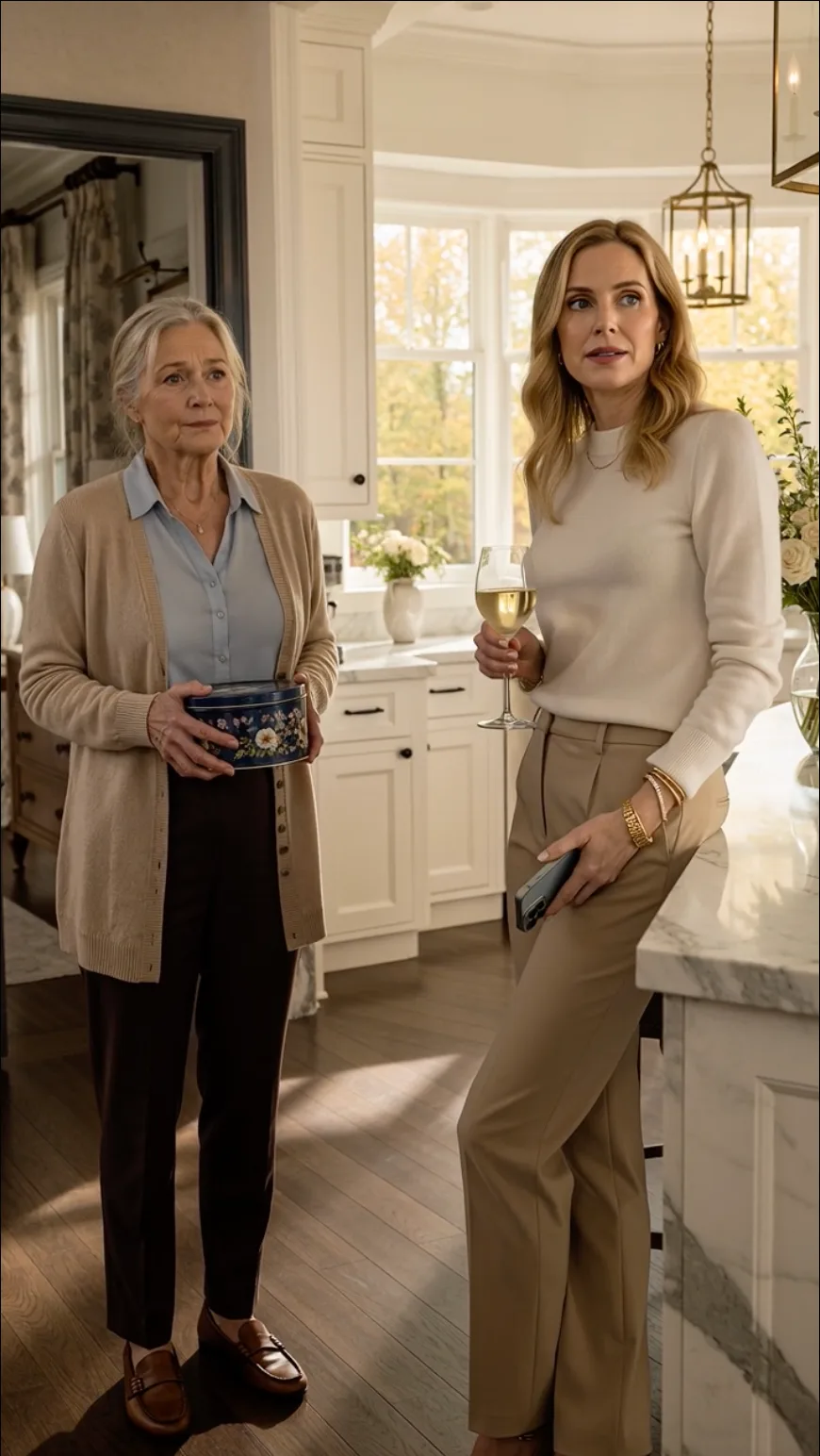
I had just come back from coffee with the Tuesday women. Hazel had baked her almond cookies, the ones Tobias loved, and packed some into a round tin with blue flowers on the lid.
“Take these to your boy,” she said.
Hazel still called Tobias my boy, though he had gray at his temples.
I came in through the side door that opened into the mudroom. The house smelled faintly of lemon cleaner and Chardonnay. I could hear Felicity in the kitchen, speaking on the phone.
Her voice was loud, the way it became when she had been drinking in the afternoon, which she had begun doing more often.
I did not mean to listen.
That is important.
I was taking off my coat, setting down my purse, thinking about whether we had enough chicken for dinner.
Then I heard my name without hearing my name.
“I am at my limit,” Felicity said. “I am at my absolute limit. She’s like a barnacle.”
I stopped.
One sleeve of my coat was still caught at my wrist.
“She just attaches herself,” Felicity went on. “No, he won’t talk to her about it. He’s a mama’s boy, you know that. I’ve told him a hundred times she needs to be in some kind of facility. There are nice ones. We could afford it between what she gets from Social Security and whatever she has saved, which can’t be much, because look at how she dresses. My God.”
I held the tin of cookies so tightly the metal rim pressed into my palm.
“The worst part is she eats,” Felicity said.
Such a small sentence.
Such an ordinary cruelty.
“She eats like a teenage boy. Have you seen her at dinner? And she just sits there. She doesn’t contribute. She doesn’t pay rent. She’s just this old beggar in our house, eating our food, watching our television, taking up a whole bedroom that I wanted for a nursery.”
I looked down at my shoes.
Old brown loafers. Polished that morning.
There was a pause. Her sister in Greenwich must have said something.
“I know,” Felicity said. “I know. I told him last week. I said, Tobias, this is not what I signed up for. I did not marry you so I could spend my forties running an old folks’ home for free. We don’t need this old beggar. We need to throw her out. I mean it. I’m going to put my foot down.”
The house was very quiet after that.
Not truly quiet, of course. The refrigerator hummed. Somewhere upstairs, the heating clicked on. A branch scratched lightly against a window.
But inside me, everything went still.
I did not feel angry at first.
That came later, in pieces.
What I felt in that moment was a clean, cold awareness, like a window opening in winter.
I set the tin of cookies down on the mudroom bench very gently, the way you put down a sleeping baby.
I slid my coat back onto my shoulders.
I walked out the side door.
Then I walked around to the front of the house and stood on the porch.
For ten minutes, I watched a squirrel climb the maple tree across the street. It moved with such confidence, such tiny certainty, as if the world had been built for its feet.
I remember thinking, absurdly, that Charles would have liked that squirrel.
Then I rang my own doorbell.
Felicity answered.
Her face went through three different expressions in about two seconds.
Surprise.
Irritation.
Performance.
“Oh,” she said. “I didn’t know you were out.”
“I went to coffee, dear,” I said. “Tuesday.”
“Right. Right, of course.”
She stepped back to let me in.
“Did you have a nice time?”
“Lovely,” I said. “Hazel sent cookies.”
“How nice.”
Her eyes flicked toward the mudroom, where the tin sat exactly where I had placed it.
If she noticed my hands shaking, she said nothing.
I went upstairs to my room and sat on the edge of the bed.
The bedspread was beige, Felicity’s choice, with decorative pillows I removed every night and replaced every morning though I never understood why pillows needed costumes. On the dresser sat a framed photo of Charles and me from our thirtieth anniversary. He was wearing a navy suit and looking at me instead of the camera.
I stared at that picture for a long time.
My hands were still shaking, but my mind was not.
My mind had gone quiet.
It was the same quiet that came over me before a major meeting, when the lights in the conference room would dim, the projector would hum, and a dozen executives who thought they knew more than I did would look up as I stood to speak.
Everything inside me became orderly.
I picked up the phone and called Wendell.
Wendell Avery was seventy-six and had been my attorney for thirty-four years. He had a voice like old paper and the rare gift of not filling silence just because it existed. He answered on the second ring, as he always did, even on weekends, even at night, even when he was probably somewhere with soup in front of him.
“Coraline,” he said. “Is everything all right?”
“No,” I said. “But it will be.”
I told him what had happened.
I told him every sentence I could remember. I did not embellish. I did not need to. Cruelty, when quoted accurately, is usually sufficient.
Then I told him I wanted to begin the process of taking back the house.
There was a long pause.
“Are you sure,” he said finally, “that you know what this will do?”
“I know.”
“Tobias loves that house.”
“Tobias has a wife who calls his mother an old beggar in his own kitchen.”
Wendell exhaled.
“All right, my dear,” he said. “Tell me what you want to do.”
So I told him.
He took notes. He asked questions. He reminded me of the notice requirements. He confirmed the trust documents, the occupancy terms, the way the payments had been recorded, the account in Tobias’s name, every careful piece of paper we had put in place over the years.
We talked for forty minutes.
By the time I hung up, the shaking had stopped.
For the next ten days, I lived in that house as if nothing had changed.
I smiled.
I made dinner.
I folded towels.
I kept my dishes off the counter.
I asked Felicity whether she wanted more coffee and watched her accept it from my hand.
She was almost pleasant that week. Whatever poison she had needed to release into her sister’s ear had left her lighter. She moved through the kitchen with lifted shoulders. She played music while arranging flowers. She spoke to Tobias in a voice bright enough to make him relax.
She thought she had won something.
I could see it in the way she looked past me.
On a Thursday morning, while Tobias was at work and Felicity was at her Pilates class, I packed two suitcases.
I did not take much.
Clothes. Medication. My mother’s pearls. The framed photo of Charles. A stack of financial files Felicity would not have recognized as important if she had held them in her hands. A navy wool coat I had not worn since Charles’s funeral.
Before I left, I stood in the doorway of the guest room and looked back.
It had never really been mine.
Not because the house wasn’t mine. Because I had never allowed myself to take up space in it.
I called a car service.
Then I left a note on the kitchen island.
“Tobias, I’ve gone to stay with a friend for a while. I’ll be in touch. I love you, Mom.”
I did not mention Felicity.
That omission was its own sentence.
The car took me to a hotel in Hartford. Wendell met me in the lobby wearing his camel overcoat and carrying a leather folder that had probably been older than some judges.
He had reserved a conference room because Wendell believed private grief deserved proper lighting and a door that closed.
We began.
The first thing I did was give the property management company instructions to terminate the lease on my Westport house at the end of the current term, with the renters’ permission and a generous moving stipend because I would be moving back in. They had been good tenants. None of this was their fault.
The second thing I did was instruct Wendell to send a formal notice to my son and his wife on letterhead, informing them that the deed to the property at 14 Birwood Lane was held in trust by Marigold Trust Holdings, that I, Coraline Voss, was the sole trustee and beneficial owner, and that the occupants were being given thirty days to vacate the premises.
The third thing I did was instruct him to release into an account in my son’s name the full balance of every payment Tobias had made over the past eleven years.
Three hundred twelve thousand dollars and change.
It was his money.
It had always been his money.
I had only been keeping it safe.
The fourth thing I did was eat a tuna sandwich because I had skipped breakfast, and even women who have just changed the direction of their families still need lunch.
The notice went out the next morning.
I received the call at 11:47.
I was sitting in my hotel room near the window, watching maple leaves lift and fall along the street below. My tea had gone cold. The television was on with the sound muted, showing a woman in a red blazer pointing at a weather map no one in the room was listening to.
My phone rang.
Tobias.
I let it ring twice.
Then I answered.
“Mom?”
His voice sounded thin, almost boyish.
“Yes, sweetheart?”
“Mom, what is this?”
“What is what?”
“There’s a man at our door with an envelope from a law firm about the house. About Birwood Lane. Mom, what is going on?”
I closed my eyes.
“I think you should sit down, honey.”
“No. Just tell me what’s happening.”
“Tobias.”
There was a pause.
Then I heard movement, a door closing, and the faint squeak of the leather armchair in the living room.
I knew that sound.
I had bought that chair.
“Mom,” he said, quieter now, “this letter says you own the house. It says you’ve owned it the whole time. Is this a joke?”
To be continued… Click “PART 3” to read the final part : 👉 PART 3 👈
Chapter complete
You have reached the end of this chapter.
Continue reading
A few more worlds to get lost in after this chapter.




