Now she stood before me and said, “I think I owe you a story.”
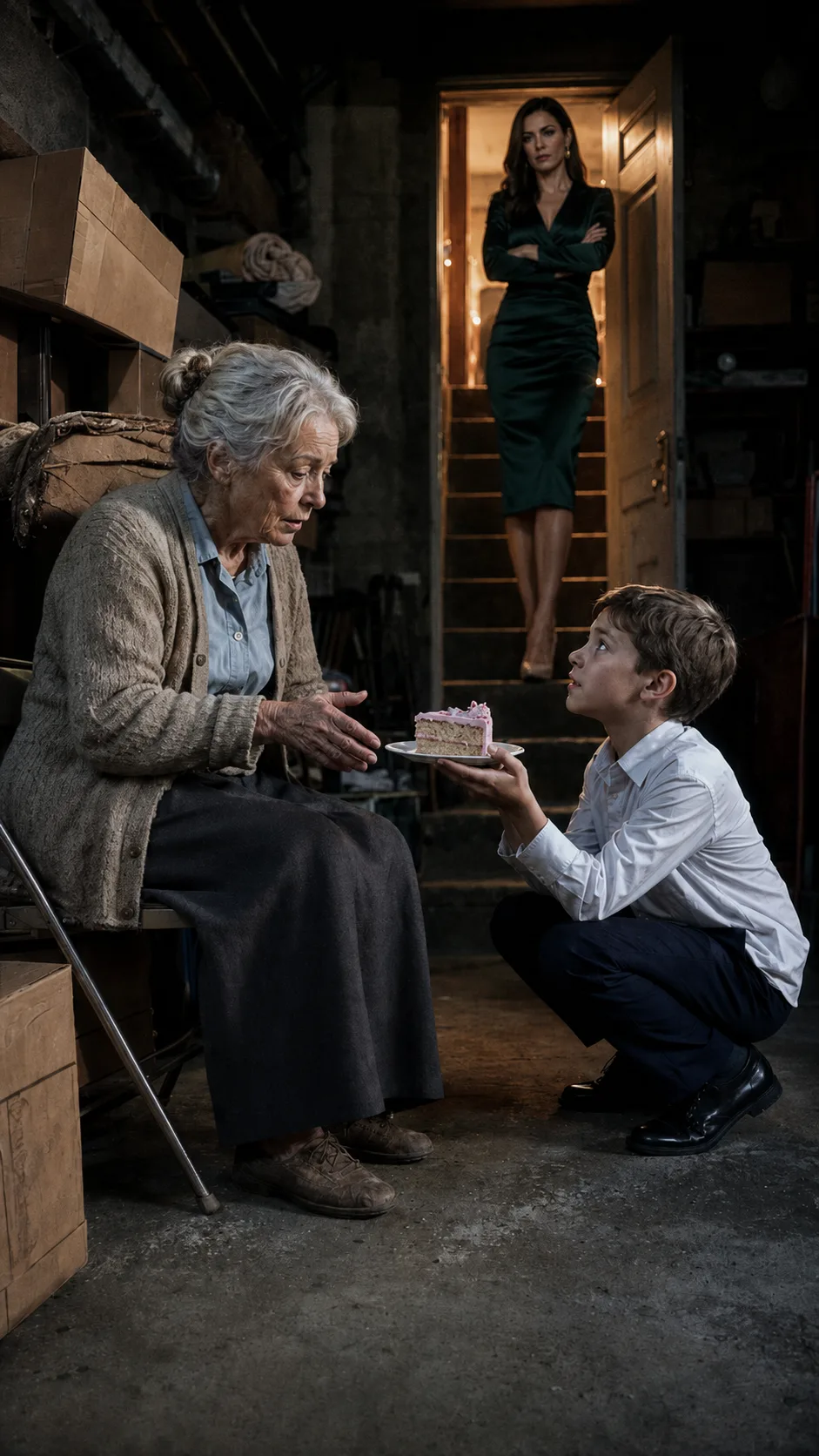
She pulled out her phone and showed me a grainy video. Me, sitting in the garage with a paper plate next to boxes in silence while music floated down from the party above.
The image was brief, almost an accident, caught by a neighbor’s daughter who had been vlogging that day.
“I saw it online,” she said. “Someone asked in the comments, ‘Who lets an old woman sit alone in the garage during a party?’”
I did not answer.
She continued, “I started digging. Property records, insurance filings, tax forms. Then I saw your name, and I remembered you. I remembered my mother crying into your lap.”
She asked if I would speak on record.
I said no.
Then I said yes. Not for revenge, but because silence, when swallowed too long, begins to rot the soul.
She came back two days later with a small crew. Just her, a cameraman, and a microphone that trembled slightly in her hands.
We filmed in the garage. I sat in the same chair beside the same boxes. This time, I faced the camera.
I told them about the party, the locks, the altered insurance forms. I showed them the receipts, the letters, the folder of evidence I had copied and mailed.
I spoke slowly, not with anger, but with weight, like every word had been waiting in line for decades to be spoken.
She named the segment The Mother in the Garage.
It aired two nights later on the local station, Boston Prime Time. At first, it was just a few hundred views. Then thousands. Then national outlets started calling.
People shared it not because it was dramatic, but because it was real.
One woman wrote, “I put my mother in assisted living because I thought I had no choice. Now I wonder if I ever asked what she wanted.”
Another said, “I watched this with my daughter. We cried together.”
It became more than a story. It became a mirror.
Within forty-eight hours, the office of the attorney general for the state contacted me directly. The lawyer I had been working with had already submitted the fraud complaint. Now, they were adding elder mistreatment, financial exploitation, and psychological coercion to the list.
The investigation began quietly, but quickly. They subpoenaed records from the clinic where I had supposedly signed those forms, compared timestamps, and analyzed signatures. My lawyer sent over every item we had cataloged.
And through it all, I said nothing upstairs.
I cooked my meals. I swept my corner. I smiled when she walked past, never letting on that every moment she breathed easy was a gift from my patience.
But things began to change.
People at the school where she volunteered stopped speaking to her. Invitations dried up. Neighbors who once waved began to cross the street instead.
She did not know why. She thought it was gossip. She thought it would pass.
Then she saw the broadcast.
I heard the scream before the door even opened. She rushed down into the garage with her phone in hand, her face pale, her voice shaking.
“You set me up.”
I looked up from my knitting.
“I told my story. That is all.”
She cursed. She cried. She begged. And when none of it moved me, she threatened.
“You think people care because you’re old and pathetic? You think that makes you believable?”
I said nothing.
Because the thing about truth is that it does not need to shout. It only needs to survive long enough to be heard.
The camera caught me in the worst moment of my life. Alone. Diminished. But it also captured something they never expected.
That quiet does not mean defeated.
That sitting still is not the same as surrendering.
And most of all, that sometimes justice begins with a knock on a garage door and the memory of a bowl of warm porridge.
The courtroom smelled like paper and stale coffee. I sat in the second row, my back straight, my hands folded on my lap, not because I wanted to appear dignified, but because my husband used to say, “Don’t let them see you fold, even when they try to break you.”
The judge wore glasses too large for his face. He looked like a man used to listening to liars and paperwork more than people. But he looked at me differently, with something that felt like recognition, like maybe he had seen his own mother in someone’s garage once and never forgiven himself.
They sat two rows ahead: my son and the woman he had built a life with from borrowed charm and staged perfection.
He wore a suit he never could have afforded without the down payment I gave to help buy that house. She refused to take off her sunglasses, even in court.
When the judge called the case, my name sounded strange coming from his mouth, as if it no longer belonged to someone who folded laundry in silence, as if it now carried weight.
The opening arguments were clinical. My lawyer outlined the financial transfers, the falsified insurance records, and the history of psychological coercion.
He did not need drama. He had facts, timelines, signatures, digital footprints, emails, and copies of the policies I had stored for twenty years.
The file was over two inches thick.
Their lawyer tried to object.
“This is a family matter,” he argued. “A misunderstanding.”
The judge raised one eyebrow.
“Fraud is not a misunderstanding.”
The video clip was played, the one from the garage, with me sitting with my paper plate as laughter echoed above.
I did not watch it. I watched them.
Her face tightened. His shoulders sank.
And then came the moment of truth.
They introduced the handwriting expert. She pointed to two versions of my signature. The one on the policy change form had been traced with ninety-six percent confidence.
My son looked at the floor.
She looked at him.
And just like that, the beautiful illusion cracked.
When it came time for them to speak, she refused.
“This is slander,” she whispered. “None of this is real.”
He stood barely.
His voice broke before his second sentence.
“I thought… I thought she wouldn’t notice. We were just trying to secure the future.”
The judge leaned forward.
“By erasing hers?”
The verdict came quickly.
First, a protective order. They were forbidden from contacting me for five years. No calls, no visits, no letters, not even through my grandson.
Second, financial restitution. The court acknowledged my majority contribution to the house. I was awarded primary ownership. They had thirty days to vacate or purchase my share outright at full market value.
Third, an ethics referral. She was removed from her board position at the local school district pending further investigation into her conduct.
That night, I watched the lights upstairs stay on late into the night. I did not need to listen to know what was being said. Accusations. Panic. Blame passed like hot stones between people who used to toast to unity.
By morning, her mother was gone. She took the guest room sheets, the wine glasses, and her silence with her. No note. Just absence.
Two days later, my son knocked on the garage door.
He did not come inside.
“Mom,” he said, “I know I don’t deserve anything, but I need to say I’m sorry.”
I opened the door and stood in the threshold.
He looked older, not in his face, but in his eyes, like someone who had just realized the cost of comfort.
“I should have stopped it,” he said. “I should have protected you.”
I waited.
He wiped his face with the back of his hand.
“You were right about everything.”
“About her?” I asked. “Or about you?”
Then he asked, “Can you forgive me?”
I looked at the boy I once rocked to sleep. The man who had let my dignity be boxed up next to lawn tools. The son who had watched it happen and said nothing.
“You once told me I was a burden,” I said. “Maybe not in words, but in actions.”
He nodded.
“Then from now on,” I said, “learn to carry the weight of your choices. That is what grown men do.”
I did not slam the door. I just closed it slowly, not with rage, but with finality.
He stood there for a few minutes more, then left.
I watched him walk away, and for the first time in years, I did not feel smaller. I felt steady. Rooted. Like the kind of woman who remembers everything, even when no one else does.
The news ran the story again that night, this time with an update.
The mother who was once locked in a garage now holds the title to the home. And the silence she once kept has become a voice for thousands.
Comments poured in from strangers.
One said, “My mom cried watching this. So did I. We’re calling her tomorrow.”
Another wrote, “She’s the grandma I never had but always needed.”
They called me brave, but I was not. I was just a woman who had been underestimated one time too many.
They called me outdated. But they did not know I remembered everything. Names. Papers. Signatures. And I used every piece of it.
The apartment is small. Two rooms, one bathroom, and a tiny kitchen that smells like lemons and sea salt. The windows face east, and if I rise early enough, I can watch the sun climb out of the Atlantic like it still believes in second chances.
I do.
It is not the kind of place people write postcards about, but it is mine. The lease is in my name. The furniture is secondhand, but I picked every piece myself.
No one rolls their eyes when I hang up old photos. No one complains about the smell of menthol or nostalgia.
My grandson lives with me now. His mother said no. Said it would confuse him, make things complicated.
The judge said otherwise. He said stability lives where love is, not where power pretends to be.
He sleeps in the room beside mine, and every night before bed, he knocks twice on the wall. Just a habit we made.
Two knocks.
I’m okay.
I knock back once.
So am I.
We started a blog together. He helps me with the typing, the formatting, and the text stuff, as he calls it. I tell the stories, the ones I never thought anyone would care to read.
We called it From Garage to Justice.
Each post begins the same way: This is for the quiet ones. The ones who remember everything and still choose kindness until they cannot.
It started slow. A few clicks, a few comments. Then it spread.
Older women from Arkansas, single fathers in Ohio, teachers in Oregon—they wrote in and shared their own stories. Some had been forgotten by children. Some were caregivers themselves. Some just needed to hear that being invisible did not mean being worthless.
One woman wrote, “I haven’t spoken to my son in twelve years. After your story, I called him. He didn’t answer, but I left a message. Thank you for reminding me that I still have a voice.”
Another said, “You’re not just telling your truth. You’re teaching the rest of us how to carry ours.”
I do not answer every message, but I read them all. With tea in one hand and my grandson snoring softly in the next room, I let those words fill spaces that silence had once rotted.
The logo of the blog is a simple drawing my grandson made on a tablet with his finger. It is the old knitted blanket they threw away the day I was moved to the garage. The one with frayed corners and mismatched colors. The one that covered his father when he had fevers as a boy. The one I had made with scraps during years when we had more winter than warmth.
He remembered it. Recreated it. Said it should be our symbol because they thought it was ugly, but it kept people warm.
He is right.
We keep the original folded in a glass box near the desk. Not to honor the blanket, but to honor the fact that things built with love outlast those built with money.
People still ask if I have spoken to my son.
The answer is no.
Not because I am angry, but because I have nothing left to explain. He chose silence when I needed a voice. Now he must live in the quiet he helped create.
And Zara? She lost more than reputation. She lost legacy.
People remember not the expensive dresses or the speeches, but the day she locked an old woman in a garage and called it aesthetic.
She moved out of state and changed jobs. Some say she volunteers now. I hope she does. Redemption is possible, even for her.
But it will not come from me. Not in the form of forgiveness. Not in the form of forgetfulness.
I did not write this for vengeance. I wrote it so that other women, mothers, grandmothers, wives who kept the lights on with coupons and prayer, know that we are not the scraps of the household.
We are the thread.
And no one notices the thread until it snaps.
If you had told me two years ago that I would go viral on the internet for simply surviving, I would have laughed and said something modest.
But now, I understand.
The world is hungry for quiet truth, for soft power, for proof that endurance is not the absence of pain, but the presence of purpose.
And mine is simple now.
I walk by the sea. I write. I teach my grandson how to listen. Not just to me, but to the silences between words. That is where truth hides.
I do not need apologies. I need peace.
And I have it.
Some nights, I sit by the open window wrapped in that same old blanket and think of all the times I almost disappeared from my own story.
But I did not.
I stayed. I remembered. I spoke.
And in the end, I was not the leftover piece of their home.
I was the part they tried to throw away.
But some things do not burn. Some things do not bend. Some things return stronger than ever.
Because anyone can discard a memory. But those who do soon find themselves living in a house without a soul.
THE END.