PART 2 — THE SECRET MY HUSBAND TOLD ME TO KEEP
Before my husband passed, he came home from work one day with a little girl clinging to his hand.
Chapter 2
PART 2 — THE SECRET MY HUSBAND TOLD ME TO KEEP
Before my husband passed, he came home from work one day with a little girl clinging to his hand.
She was six, thin and quiet, with eyes like she had never been allowed to cry.
He looked at me and said, “Her name is Marie. She’s mine.”
I said nothing that night. I cooked dinner as usual, set the table, fed the child, and put her to bed in the room that used to store Christmas decorations. Then, after everyone slept, I sat in the kitchen until dawn.
I could have left. I could have screamed. But I thought of the child, innocent, unaware, and already abandoned once. So I stayed for three years. I raised her as my own.
No one in the neighborhood knew. I told people she was my niece from out of state. She called me Aunt in public and Mama in private.
When her birth mother showed up with a new boyfriend and a court order, I gave her back, and I cried for
days. Not because I lost a child, but because I had given my heart to a memory I was never allowed to keep.
Years later, when Zara found out about Marie, she smirked at me over dinner and said, “Only weak women raise their husband’s shame and call it loyalty. You’re not kind. You’re pathetic.”
My son said nothing again.
She would mock my stories.
“Here we go again,” she would say, rolling her eyes. “Another tale from the trenches. Another old speech. You really think anyone cares about letters written in ink that has already faded?”
She hated that I had a past that did not include her. She hated that I had been loved before she ever entered our lives. She hated that my wrinkles were not just time, but testimony.
Once, when I brought out the box of letters my husband had sent from overseas, she glanced
inside, saw the faded stamps, and said, “You kept this? Why? He betrayed you and brought home a souvenir with a heartbeat.”
That night, I sat in the garage long before I had been forced there officially and read those letters one by one. My husband never asked me to forgive him. He just kept writing about the weather, the food, the silence between distant blasts, about how he missed my cornbread, and how he still slept with his hand curled like he was holding mine.
I kept those letters because they reminded me of a man who, in his worst moment, still came home with the truth in his eyes. I stayed, not because I was weak, but because I knew how strong forgiveness could be.
But Zara only saw shame. She saw my past as a stain that refused to wash out.
She once said, “You’re the kind
of woman who lets the world walk all over you and then calls it character. Me? I bulldoze.”
And so she did.
She bulldozed into my life, into my family, into the room where my son once slept beside me when he was sick, and tore out every corner of softness like it was mold to be scrubbed away.
But the thing about women like me is that when we bend, it is not because we are broken. It is because we are remembering how to stand.
The invitation list was printed on glossy paper and taped to the refrigerator weeks before the event. My name was not on it.
House anniversary, it said in elegant silver letters. A year since they bought this house. My house, if one were to count the money. But I was to be invisible for the celebration.
That morning, I woke early to bake cornbread, the kind my husband used to love, thinking maybe it could be part of the meal. I set it on the counter to cool. When I came back from folding laundry, the dish was gone.
The trash bin smelled faintly of butter and cornmeal.
I did not ask. I already knew.
Around noon, I heard them moving furniture upstairs, laughing, dragging chairs, clinking glasses. The scent of expensive candles drifted through the air vents, something citrusy and sharp, not at all like home.
I went to the door that led upstairs. It was locked from the other side. I turned the handle again slowly, just to be sure.
Nothing.
The click was deliberate, not an accident.
Through the door, I could hear her voice.
“Make sure no one goes down there. The garage smells like damp wood and sadness. It’ll ruin the aesthetic.”
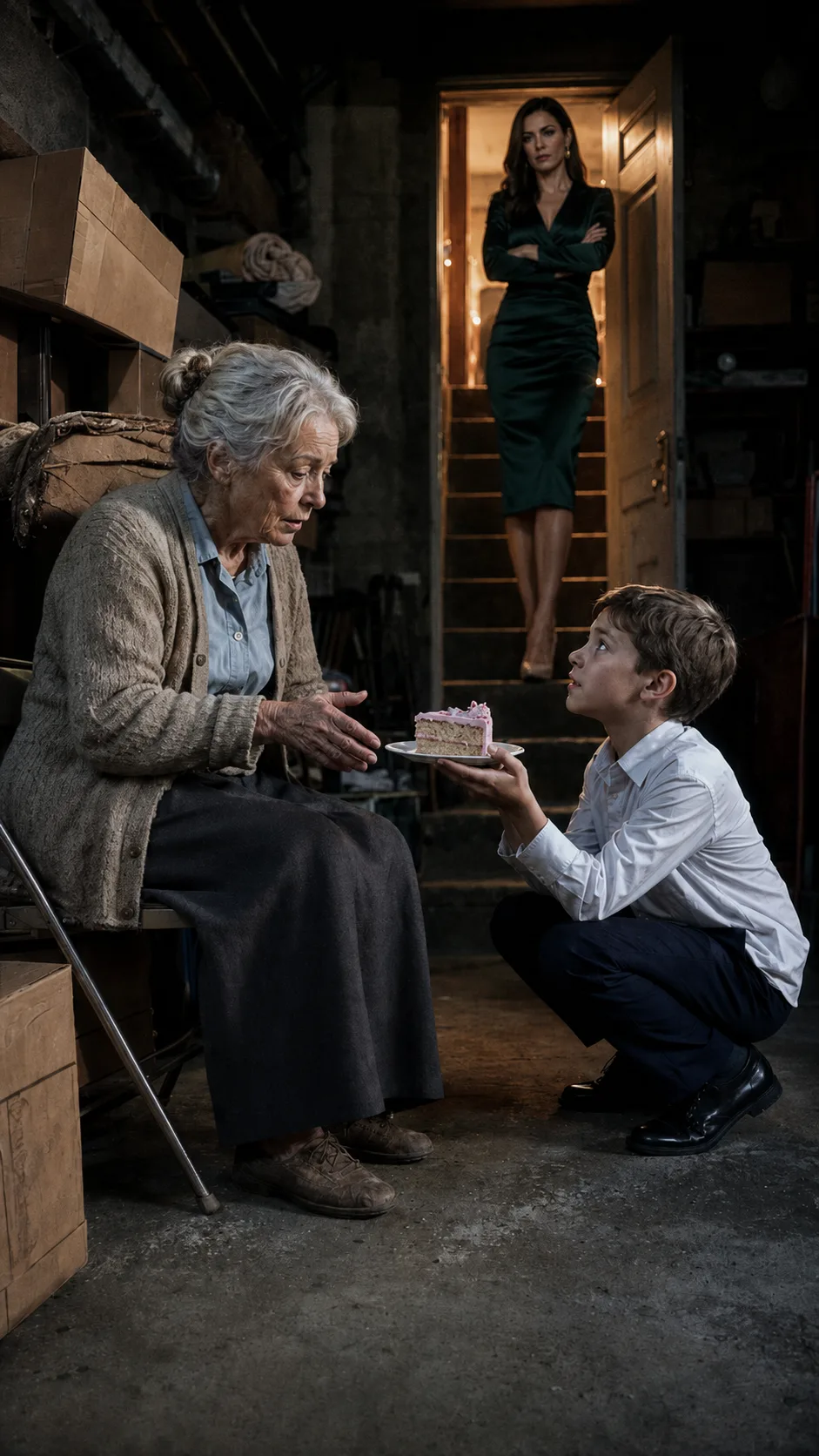
So I sat back on my folding chair next to the boxes that still carried my handwriting: Christmas, old photos, his uniform. The light through the small window made everything look smaller, older.
After a while, I heard footsteps. Soft, hesitant footsteps. Then a knock.
“Grandma?”
It was my grandson. He could not have been more than ten. His voice trembled like he knew he was doing something wrong.
He slipped through the narrow crack of the door, holding a small plate of cake with plastic frosting.
“I saved this for you,” he whispered. “Mom said you already ate, but I know you didn’t.”
I smiled, though I felt the sting behind my eyes.
“Thank you, sweetheart. You should go back before—”
The door burst open.
His mother’s voice was like cold metal scraping.
“What did I say about coming down here?”
She grabbed his wrist and yanked the plate from his hands. The cake splattered on the floor.
“She’s my grandma!” he cried.
“She’s the past,” Zara said. “And we’re not living in it.”
She turned to me, smoothing her dress like nothing had happened.
“We don’t want guests to see the oldest part of the house. It ruins the mood. You understand, don’t you? You always understand.”
Then she smiled and left, dragging him upstairs.
The door slammed. The lock clicked again.
I picked up the crushed cake with a napkin. The frosting left pink streaks on my fingers.
It was supposed to be a celebration. And yet there I was, sitting alone in a space that smelled of dust, paint, and betrayal.
If I had known someone was watching from across the street, maybe I would have wiped my tears. Maybe I would have straightened my back and hidden the loneliness. But I did not.
Later, I learned that the neighbor’s daughter had been filming a family vlog that day. The camera caught a glimpse through their open garage door: an old woman sitting beside a pile of boxes, a paper plate on her lap, the muffled sound of music above her.
Upstairs, laughter echoed, followed by applause. Zara must have made some toast about perseverance or family or love. Words that fall easy from lips that have never tasted loss.
I poured myself a glass of water and listened to their voices drift through the vents. My son’s laugh, once full and genuine, now sounded like a man clapping out of obligation.
Through the thin ceiling, I heard her say to a guest, “I had to redesign everything when we moved in. The old woman’s taste was rustic. You know, that country kind of sad. I wanted something sleek, something that said we made it.”
Another voice replied, “And the garage? What’s in there?”
She laughed.
“Oh, that’s just storage. We keep the outdated things down there.”
The room erupted in polite laughter. The music played louder after that, maybe to cover the sound of their words reaching me.
But they reached.
Every syllable found its way down through the vents, soft and heavy like dust.
I thought about going upstairs, standing in the doorway, and reminding them that I once scrubbed those very floors with my own hands. That the walls they bragged about painting white had been blue once, because blue made my husband feel calm after the war.
But I did not.
I sat there and let the sound wash over me until I could almost believe it was not real.
The garage light flickered, buzzing in rhythm with the laughter above. I looked around at the boxes, the shadows, the old photographs that smelled faintly of smoke, and told myself, “This is just one night. One more insult in a lifetime of them.”
The thing about silence is that it starts small. But once it grows roots, it becomes impossible to kill.
That night, I felt those roots dig deeper.
When the party ended, I heard doors closing, heels clicking, cars starting outside. No one came down to say good night. Not even my son.
The next morning, I swept the crumbs from the floor, folded the napkin, and tucked it into my box labeled Things Worth Remembering.
Because someday, when they looked for the weakest link in the family chain, I wanted them to realize the part they tried hardest to erase was the one still holding everything together.
My husband was not a loud man. He never raised his voice, even when the roof leaked or the car gave out in the middle of winter. But when he did speak, really speak, it felt like a lesson being carved into stone.
He had a way of making silence feel like a full conversation. Especially after the war, there were days he would sit in his chair by the window and just stare, his eyes fixed on something no one else could see.
I used to ask what he was thinking.
He would say, “I’m just remembering what it cost me to come home.”
His brother stole his land. One hundred and fifty acres of timber and dreams signed away while he was still overseas. The papers were legal. The betrayal was not. By the time he returned, it was too late to reverse anything.
The lesson he told me one night while tightening a bolt under the sink was that trust without proof is a luxury you cannot afford more than once.
He taught me how to mend a pipe and read a contract. Not because he doubted me, but because he believed a woman needed to know the world’s sharp edges, not just the soft ones.
After he passed, I found myself reaching for his voice in small things. The way I folded bedsheets. The order I kept in the pantry. But the most important thing he left me was not a habit. It was a sentence.
“Keep something they don’t know you have.”
I never forgot that.
When we sold the house, I did not just sign the check and trust the system. I kept copies. When I transferred my savings to help buy the Boston house, I did not wire the money blindly. I made sure the trail stayed in my name, that my part was recorded quietly, discreetly, but permanently.
I printed every transfer, saved every receipt, and placed them all, along with a notarized agreement we had drafted, into a small wooden box carved with an eagle.
It was the same box that once held my husband’s medals.
After he died, I folded his flag triangle tight and laid it inside. But over the years, the medals were put into storage, and the box became something else entirely.
It sat beneath my bed inside a canvas bag, under a layer of old clothes no one ever touched. Not because I was hiding something, but because I was preparing for something.
I just did not know what yet.
When I moved in with them, I brought only four boxes. That wooden one was the smallest, but the heaviest. No one asked what was inside. No one cared to.
After they gave my room to her mother, I returned to that box like a woman revisiting a locked door in a dream. I pulled it from beneath the folded quilts and opened it slowly, like it might speak.
Inside, everything was still there. The letter my husband wrote me before his last deployment. The copy of the deed from our first home. The bank statements. The signed transfer of one hundred thirty-eight thousand dollars into Beckham’s name, marked for joint home ownership, with his signature and mine.
And then there was the certificate of deposit. Twenty years, untouched, interest intact. It had matured last spring.
I ran my fingers over the edges of the paper, wondering what would have happened if I had been the kind of woman who threw things away once they became outdated.
Maybe that was what she thought I was. Disposable. An old drawer to be emptied once the paint dried.
But I had been listening, storing, documenting long before she ever learned how to spell mortgage.
Later that night, I waited until they were asleep and moved the box to the garage. I tucked it behind the old dresser, under the loose floorboard. I replaced it with a decoy, another box similar in size, filled with knitting yarn and torn family calendars, just in case.
Because something told me she would start snooping. The way she had eyed my photo albums. The way she asked casually if I had ever drafted a will. The way she had laughed when I told her I never signed anything I did not read.
“Oh, please,” she had said. “Old people are always so paranoid.”
No, dear. We are just prepared.
I spent the next few days writing a list: names, dates, account numbers. Not because I expected a fight, but because my husband had been right.
Proof is a language no one can argue with. It does not shout. It just waits, and then it speaks when called.
In the garage, while they played music upstairs and poured cocktails into matching crystal, I sat with that box on my lap and whispered, “Thank you,” to the man who had warned me decades ago.
He had known what betrayal tasted like, but he had also taught me that quiet women are not weak. We are just careful.
And now, I was ready.
It started with a phone call I was not meant to answer.
The landline rang while they were out. One of those spammy insurance numbers most people hang up on. I almost did, too, until I heard my name and then her name followed by the word beneficiary.
I stood still, holding the receiver so tightly my knuckles cracked.
“Can you repeat that?” I asked.
The woman on the other end hesitated.
“Ma’am, this is just a courtesy confirmation. The change was submitted last quarter. Your new listed beneficiaries are—”
I hung up.
For a moment, I thought I had misunderstood. But I knew I had not.
There was a buzzing in my ears, like when you realize you have been robbed and the door had been unlocked the whole time.
I walked straight to the folder in my sewing kit where I kept copies of my policies, printed, signed, untouched.
The original document listed my grandson as the sole recipient. It had been that way since the day he was born. My gift to him, silent, steady, and future-bound.
But now it had changed.
I remembered the fall.
Two months earlier, I had slipped while taking out the trash. Nothing serious, but enough to rattle my knee. Zara offered to drive me to the clinic.
“Urgent care is faster,” she said. “They’ll make you sign a few things to process the visit. Just standard forms.”
She handed me a clipboard with six pages clipped together.
“Sign here, here, and here. I’ll handle the rest.”
At the time, I was too tired to argue. My glasses were foggy from the cold. I trusted her.
I was foolish.
That night, I pulled out old forms I had signed before: the ones from my bank, my previous doctor, my will drafts. I laid them out side by side.
The signature on the new beneficiary form looked like mine, but not quite. It was neater, smoother, like someone had practiced copying it, and not for the first time.
I held both pages to the window, matching loops and pressure marks.
There was no doubt.
Someone had traced my name from an old document, the kind of mimicry a stranger would miss but a mother would not.
I did not cry.
I sat very still for a long time.
The next morning, I called the only person I still trusted in the legal world: my husband’s old war friend, now a financial adviser for the state. He had helped us refinance once decades ago and had always sent a Christmas card, even after my husband passed.
He answered on the second ring.
“I was wondering when you’d call.”
I told him everything. My voice did not shake. He listened without interruption, then said simply, “They underestimated you.”
He told me what to do.
“Gather evidence. Keep everything. Do not confront them. Not yet.”
So I began.
To be continued… Click “PART 3” to read the final part: 👉 PART 3 👈
Chapter complete
You have reached the end of this chapter.
Continue reading
A few more worlds to get lost in after this chapter.




