PART 3 — THE EVIDENCE HE NEVER EXPECTED THE JUDGE TO SEE
I want to describe what it feels like when the balance of power shifts in a room.
Chapter 3
PART 3 — THE EVIDENCE HE NEVER EXPECTED THE JUDGE TO SEE
I want to describe what it feels like when the balance of power shifts in a room.
It doesn’t feel like victory.
Not at first.
It feels like the air pressure changing the way it does before a thunderstorm, when the atmosphere is doing something enormous and invisible and you can feel it in your bones.
Harrison’s smirk flickered just once.
His lead attorney, a man named Gerald something, leaned toward him and whispered.
The judge spoke my full name.
“Sarah Jane Miller Prescott.”
Harrison went completely still.
That middle name.
He had been erasing it for six years.
Miller was my mother’s family name.
My grandfather’s name.
The name on the building my grandmother used to drive me past when I was small and tell me with enormous pride, “That’s ours, baby.”
Harrison called it old history.
He said it was unnecessary weight.
He had introduced me at every Prescott event as Sarah Prescott.
Just that.
Nothing before or attached.
I had let him.
I understood
now why he’d needed me to.
“Mr. Prescott,” Judge Thompson said, “are you familiar with the emergency filing submitted to this court at 7:15 this morning?”
Harrison’s attorney stood.
“Your Honor, my client’s wife has demonstrated a pattern of emotional instab—”
“I did not ask for your opinion,” the judge said. “Sit down.”
Silence crashed down like a wall falling.
In nineteen years of marriage court, I don’t know if Gerald something had ever been told to sit down with that particular intonation.
He sat.
“Mr. Prescott, the filing.”
“Your Honor,” Harrison said carefully.
He had recovered some composure.
He was very good at recovering composure.
It was one of the things I had admired about him once.
“I’m not aware of any emergency filing. My team prepared for a standard—”
The judge picked up a document from a folder that had not been on his bench when we entered.
He read aloud.
He read for eleven minutes.
I know it was eleven minutes because I counted.
I counted because counting was the only thing keeping me from shaking apart.
He read from medical records.
My prenatal records specifically, including notes from my OB, Dr. Brianna Vasquez, who had flagged elevated stress markers at four of my last six appointments and had documented in her clinical notes that I had arrived at a thirty-week appointment with bruising on my left arm consistent with grip pressure.
I had told her I’d bumped a door frame.
She had written: Patient’s account inconsistent with injury pattern. Possible domestic stress. Will monitor.
He read from bank statements.
Forensic analysis by Patricia Haynes, CPA, nineteen years in forensic accounting, showing the systematic transfer of assets from jointly held accounts into corporate accounts controlled by Apex Miller Holdings LLC, beginning the day of my mother’s funeral.
He read from corporate transfer documents with a highlighted annotation from Dr. Yolanda Marsh, handwriting analyst.
Signature on document dated November 14th is inconsistent with known exemplars from the subject. Probability of forgery, 96.3%.
He read from an affidavit.
Simon’s affidavit.
He hadn’t abandoned me.
He had been building something Harrison couldn’t touch.
He had filed the emergency motion at 7:15 a.m., before the courtroom opened.
Before Harrison’s team could respond.
Before the scrambled docket gave them a procedural foothold.
Asset freeze requested.
Protective order requested.
Fraud investigation referral to the Riverside County DA’s economic crimes unit requested.
Then the judge set down the document, removed his glasses, and said two words that stopped the blood moving in my veins.
“Miller Manor Group.”
My grandfather’s name.
My mother’s company.
The thing Harrison had told me was worthless, unsalvageable, not worth keeping.
Right before he forged my signature and put it in his pocket.
“Did you present fraudulent transfer documents to this plaintiff?” the judge said, looking directly at Harrison. “Moving her inheritance into a shell corporation under your sole control?”
Gerald something grabbed Harrison’s arm.
Too late.
Harrison’s face was a complicated thing to watch.
He was a man who had spent his whole life controlling the narrative, and the narrative was leaving the room without him.
Tiffany’s face had gone gray.
She was looking at the sealed doors like she was calculating the distance to them.
The judge continued reading.
Text messages retrieved from a backed-up device.
My old phone, which Simon’s forensic tech, a contractor named Marcus Webb, who had twelve years in digital forensics, had recovered from a cloud archive Harrison didn’t know still existed.
Messages from Harrison to Tiffany, dated while I was at prenatal appointments.
She’s at the doctor until noon. Go to the house and remove the accordion files from the office closet before she gets back.
Messages outlining attempts to access my private medical records through a contact at my OB’s billing office.
A message three weeks old, sent from Harrison’s personal phone.
If she doesn’t sign by the 14th, have the locks changed while she’s at her next appointment. I’ll handle the scene.
He had planned to lock me out of my own home, eight months pregnant, while I was at a prenatal appointment.
“The evidence supports her statement in full,” the judge said.
His voice hadn’t changed temperature once.
“And it supports several additional statements she hadn’t even made yet.”
Then the courtroom doors opened.
Simon Fletcher walked in looking like he had survived a war in the last three hours, which I would learn later he essentially had.
His tie was crooked.
There was a bruise forming along his left jaw.
His phone was gone.
Someone had taken it from his pocket in the parking garage.
It wasn’t random.
Harrison’s people had known exactly which garage Simon used.
They’d had someone watching.
Simon walked to my table, set down a new folder, and sat down beside me.
He looked at my face.
At my cheek.
At the split corner of my lip.
And something in his expression went very quiet.
“I’m sorry I’m late,” he said.
“You’re exactly on time,” I said.
The judge had watched all of this without comment.
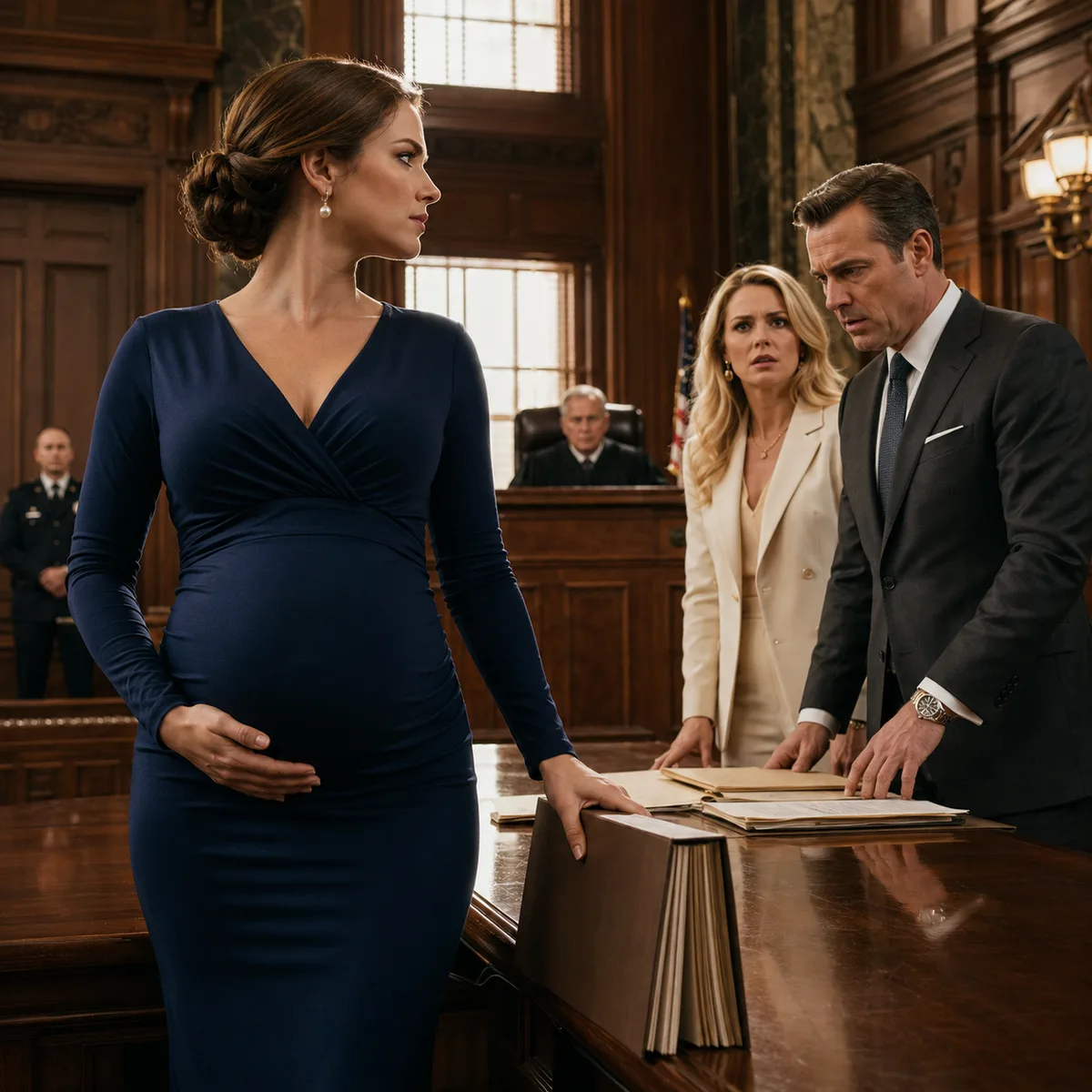
Now he looked at Tiffany Graves, who was still sitting at the plaintiff’s table, her cream blazer suddenly looking like a costume from the wrong play.
“Ms. Graves,” he said, “you are not a party to these proceedings. You struck a protected individual in my courtroom. You will be held pending a determination of contempt and separately will be referred to the district attorney’s office regarding the assault of a pregnant woman.”
Tiffany opened her mouth.
“You may remain silent,” the judge said. “I strongly recommend it.”
She remained silent.
Click the blue “PART 4” below to read the final part: 👉 PART 4 👈
Chapter complete
You have reached the end of this chapter.
Continue reading
A few more worlds to get lost in after this chapter.




