PART 2 — THE SLAP THAT SEALED THE COURTROOM
I laughed.
Chapter 2
PART 2 — THE SLAP THAT SEALED THE COURTROOM
I laughed.
I assumed it was a clerical error.
I told myself that for three weeks.
Then I found the hotel receipts in his laptop bag.
Not even hidden.
Just sitting there.
A folded printout.
Two nights at a Santa Barbara resort.
Dates that aligned with a conference Harrison had taken alone.
The room was booked under his name and hers.
I sat on the bathroom floor for a long time after that.
My daughter kicked twice, then was still.
I didn’t confront him immediately.
I know people always wonder why victims don’t just say something.
But I was eight months pregnant, financially dependent on a man whose name was on every account I thought we shared, and I had just discovered that the woman listed as an authorized contact on my own financial documents had been sleeping with my husband.
I called my college roommate, Drea, who worked as a paralegal
in Sacramento.
Drea said three things.
Document everything.
Don’t move money.
Get a divorce attorney immediately.
I called Simon Fletcher the next morning.
Simon Fletcher had been practicing family law for nineteen years.
His office in Riverside was unglamorous, a converted Victorian with mismatched furniture and a receptionist named Brenda, who had the energy of a woman who had seen everything and was unimpressed by all of it.
He shook my hand, looked at me over his reading glasses, and said, “Before you tell me anything, I want you to understand that your husband has already contacted my firm.”
I went very still.
“He called last week,” Simon said. “Said he was considering divorce proceedings and asked about our availability. He was, I believe, shopping for attorneys who might represent him or who he might be able to block from representing you.”
“Can he do that?”
Simon smiled thinly.
“He
tried. We had a conflict check done this morning before your appointment. You contacted us first. On the record, you’re my client.”
That was the first moment I understood the scale of what I was dealing with.
Harrison hadn’t just been cheating.
He’d been planning.
He had started building the architecture of this divorce before I even knew the marriage was ending.
Simon began pulling records.
It took him two months, a forensic accountant named Patricia Haynes, and three subpoenas.
What they found made my hands shake for days.
Miller Manor Group, my mother’s company, my inheritance, the thing my grandfather had built with forty years of his life, had been transferred via a fraudulent document bearing my signature into a shell corporation called Apex Miller Holdings LLC, registered in Delaware.
Sole managing member: Harrison James Prescott.
The signature on the transfer document was dated eleven days after my mother’s
funeral.
“That’s not my signature,” I told Simon.
He nodded.
He already knew.
He had a handwriting analyst, Dr. Yolanda Marsh, who had been comparing signatures for twenty-two years.
And Dr. Marsh had already submitted a twelve-page report, concluding that the signature was a traced forgery.
“He stole my mother’s company,” I said.
“Yes,” Simon said.
He didn’t soften it.
“And we’re going to get it back.”
The hearing was scheduled for a Thursday in October.
I was thirty-four weeks pregnant.
My ankles were the size of melons, and I had developed the specific exhaustion that comes not from physical effort, but from sustained, grinding fear.
The night before, Simon called me at 9:47 p.m.
“I need you to listen carefully,” he said. “Harrison’s legal team filed a motion at midnight. They’re claiming a scheduling conflict with their lead counsel. The clerk’s office accepted it. They’ve scrambled the docket.”
“What does that mean?”
“It means your hearing is still on, but I may not be able to appear in time. They’ll argue procedural confusion. It’s a stall tactic.”
“Can I postpone?”
Simon was quiet for a moment.
“Sarah, if you postpone, Harrison will use it. He’s already filed a motion suggesting you’re emotionally unstable and unfit. He has three witnesses prepared to testify to that.”
“If I don’t appear?”
“He wins the narrative.”
I lay awake until 3:12 a.m. with my hand on my stomach.
My daughter rolled and shifted, doing whatever babies do in the dark hours before everything changes.
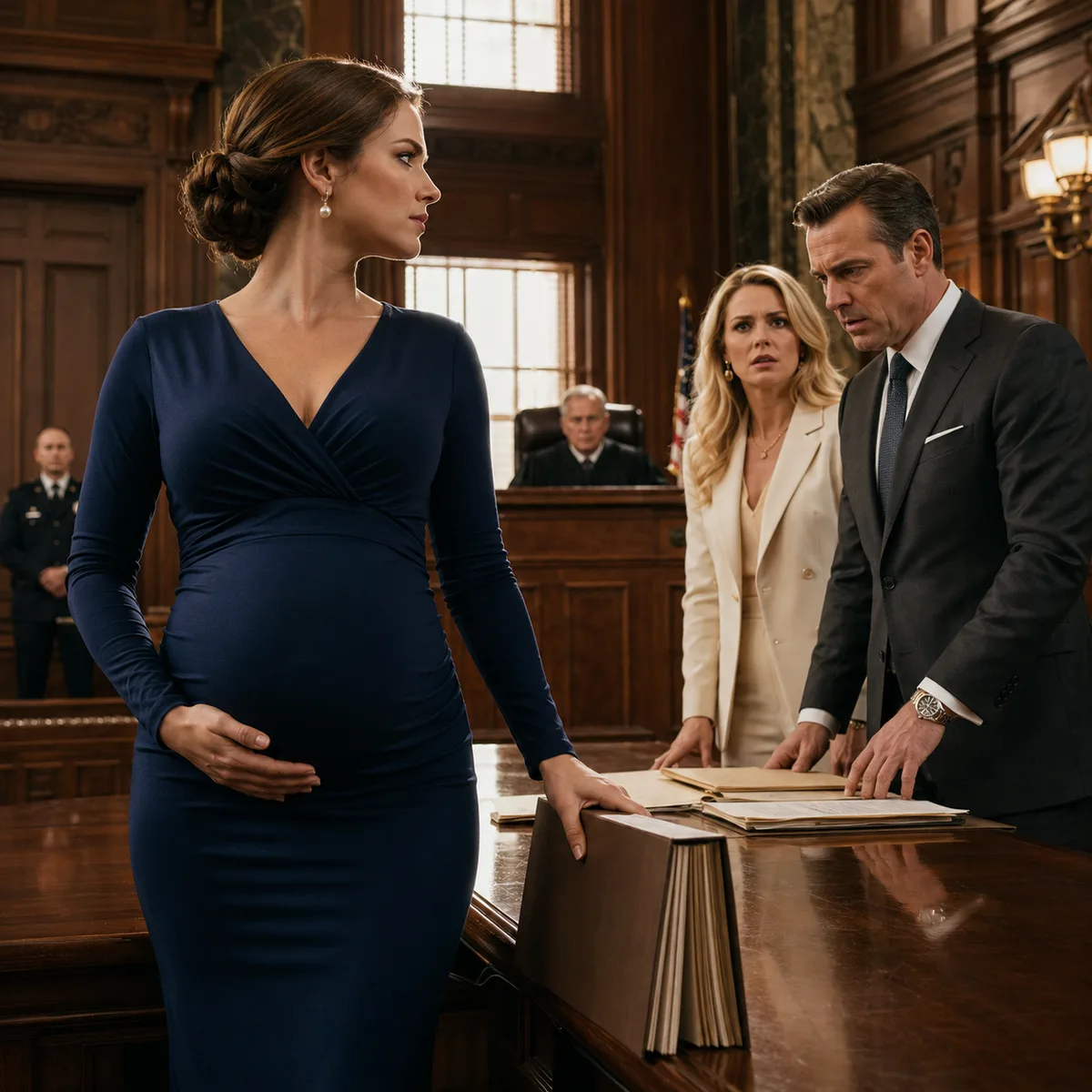
I wore my navy dress to court, the one that still fit.
I wore my grandmother’s pearl earrings because I needed to feel like someone formidable had my back, even symbolically.
I drove myself to the Riverside County Courthouse and sat down in courtroom seven at 8:45 a.m.
Simon’s chair was empty.
Harrison arrived at 9:02 with a team of three attorneys and Tiffany Graves on his arm.
She was wearing a cream blazer and the specific smile of a woman who believes she has already won.
Neither of them acknowledged me when they walked past.
They sat at the plaintiff’s table, and I sat at the defense table alone with my legal folder and my grandmother’s earrings and my thirty-four-weeks-pregnant body.
And I waited.
Harrison came to me before the judge entered.
His lawyer stayed at their table.
He crouched slightly, which was a performance of casualness because Harrison was not a casual man, and put his hand on the back of my chair.
“Sign the settlement,” he said quietly.
Charcoal suit.
Cold eyes.
The same cologne he’d worn on our wedding day.
“Walk away with whatever dignity you have left.”
“I’m not asking for anything unreasonable,” I said.
My voice was steady.
I was proud of that.
“Basic child support, my share of the marital assets, medical coverage through delivery. That’s it.”
From behind him, Tiffany made a sound.
“Fairness,” she said, loud enough that two clerks looked up. “You trapped a successful man with a pregnancy, and now you want fairness.”
I turned and looked at her directly.
“Don’t speak about my child.”
Her smile vanished so fast it was almost clinical, like a light switched off.
And then her hand moved.
I saw it in the half second before it landed.
I saw the intent in her shoulder, in the rotation of her wrist.
And I couldn’t move fast enough.
The slap connected with my left cheek at full force.
The sound bounced off every wall.
The stenographer made a sharp noise.
The bailiff stood up.
I tasted blood.
My hand went to my stomach, not my face.
Harrison said, “This is exactly the instability I’ve been warning everyone about.”
My instability.
I was the pregnant woman sitting alone at a table with a bleeding lip, and he was describing my instability.
I looked down at my shaking hands.
Then I looked up and saw Judge Randall Thompson.
He had not moved.
He had not reached for his gavel or his notes or anything procedural.
He was completely still in his chair, his document forgotten, staring directly at me with an expression I had never seen on a judge’s face before.
It wasn’t neutrality.
It wasn’t the practiced bureaucratic blankness that judges cultivate like a professional tool.
It was something older and harder and much more dangerous.
He looked, for a moment, like a man who had seen something he could not unsee and had made a decision about it.
“Bailiff,” he said.
His voice was the same temperature as a sealed room in winter.
“Seal the courtroom.”
The heavy doors swung shut with a sound like the end of something.
Click the blue “PART 3” below to read the next part: 👉 PART 3 👈
Chapter complete
You have reached the end of this chapter.
Continue reading
A few more worlds to get lost in after this chapter.




